niuniu-869/dsh-plugin-cas-kb
DeepSeek 工具集:文章级中国会计准则(CAS / ASSE)与税法查询,附带一项技能,确保引用始终锚定来源条款。
Project Overview项目介绍
A DSH plugin backed by the Quaesto open accounting knowledge base, exposing 265 Chinese accounting, auditing, and tax documents (53 article-style, 212 unit-style) plus 50 AI-generated decision procedures, with a skill that enforces citation discipline. Use it when an agent must quote specific CAS, ASSE, CSA, or tax-law articles, determine entity applicability, or resolve book-versus-tax differences. Auditing application guidance is sourced from CICPA PDF attachments unavailable to general web search. Article text is official transcript; decision procedures are unreviewed research drafts, and the L3 tax announcement layer is not yet ingested.
DSH 插件,基于 Quaesto 开放会计知识库,为智能体提供 265 份中国会计、审计与税法文件(53 份条款类、212 份单元类)的原文检索与 50 套 AI 生成的决策步骤,附 china-accounting-standards 技能约束引用规范。适用于需引用具体条款、判定企业适用准则或税会差异的场景。审计应用指引仅来自 CICPA 附件 PDF,公网难达。条款层为官方原文转录,决策层未经 CPA 审核;L3 公告层未收录,相关条目需另行核对。
请帮我了解并安装插件:【dsh-plugin-cas-kb】【https://github.com/niuniu-869/dsh-plugin-cas-kb】Send this message to DSH in your current session. CLI install commands may not be accurate across systems — DSH will figure it out for you.把上面这条消息直接发给当前会话里的 DSH,让它帮你了解并安装。安装命令不一定准确,发给 DSH 更稳。
Or use CLI install (for developers)或使用命令行安装(适合开发者)
CLI Install命令行安装
dsh plugin --profile web add github:niuniu-869/dsh-plugin-cas-kb把 niuniu-869/dsh-plugin-cas-kb 加入你的 DSH 配置(web profile)即可启用。
READMEREADME
dsh-plugin-cas-kb
English | 中文
A DeepSeek Harness bundle for Chinese accounting, auditing and tax questions. It gives an agent article-level access to Chinese Accounting Standards (CAS), the Accounting Standards for Small Enterprises (ASSE), the Chinese Standards on Auditing (CSA) and Chinese tax law — plus a skill that keeps the model from citing articles it never read.
Backed by the Quaesto open accounting knowledge base: 265 addressable documents across two layers —
- Article layer, 53 documents / 1,832 articles: 43 CAS standards (59 source texts once superseded versions are counted), ASSE with the enterprise size-classification rules, and 8 tax laws and implementing regulations. 50 of them also carry step-by-step decision procedures (1,681 steps) anchored to those articles.
- Unit layer, 212 documents / 10,013 citable units: 103 documents of auditing standards, their application guidance and the code of ethics (7,672 units), plus standard interpretations, application cases, official readings, CSRC guidance and annual-report circulars.
No account, no API key, read-only.
The auditing layer is where this bundle earns its keep. The application guidance for Chinese auditing standards lives in PDF attachments scattered across the CICPA website, with no full-text index — general web search cannot reach the body text. Measured on CPA auditing questions, this bundle scores 4.9 points higher than the same model's built-in web search (79 questions × 6 runs, 95% CI [+1.0, +9.2], Holm-corrected p = 0.013). On accounting questions there is no gain — the accounting standards are all over the open web, so what this adds there is verifiability, not accuracy. Full four-arm data, confidence intervals and an explicit "what this does not prove" list: benchmark page.
What you get
Ten tools (via @deepseek-ai/dsh-mcp-client, named mcp__quaesto_kb__*).
Seven for the article layer:
| Tool | Answers |
|---|---|
list_standards |
What article-style documents exist, per framework (CAS / ASSE / TAX / CSA) |
search_kb |
Full-text search over articles, decision steps and units |
get_article |
Verbatim article text, by standard reference and article number |
get_decision_procedure |
How to judge, step by step, each step anchored to articles |
check_applicability |
Which framework this entity must apply — size is computed, not declared |
get_tax_treatment |
Deduction limits, VAT rates, non-creditable input tax, small-business relief |
get_tax_accounting_diff |
Where book and tax diverge, and whether the difference is permanent or temporary |
Three for the unit layer — application guidance, interpretations, cases and regulatory
guidance have no "Article N" structure, so they are addressed by stable_id:
| Tool | Answers |
|---|---|
list_documents |
What unit-style documents exist, per framework (CAS / CSA) |
search_units |
Search only unit-style documents; returns stable_ids ready for get_unit |
get_unit |
Verbatim text of one unit, with its source, document number, fetch time and checksum |
One skill — china-accounting-standards. Tools alone are not enough: a model holding
real source text can still produce a confident conclusion with no anchor, which spends the
knowledge base's credibility on a hallucination. The skill carries the five rules that
matter:
- No verbatim source, no citation. Practice consensus is not standard text.
- Never invent article numbers for unit-style documents. Application guidance has no article structure; "Article 5 of the X Application Guidance" is a fabricated citation.
- The judgment layer is an AI-generated research draft, not CPA-reviewed. Source text is an official transcript; decision procedures are reasoning aids.
- Entity size is computed from
(industry, revenue, employees, assets), never declared — thresholds differ by industry. - The tax announcement layer (L3) is not yet ingested. Entries flagged
l3_dependencymust be re-checked against current circulars.
Plus one behavioural rule, the main change in this revision: verification is for checking your answer, not for changing it. Form a judgement first, then look it up; only revise when the retrieved text contradicts that judgement, and say which sentence does the contradicting. "I found a related article" is not "that article refutes me." Measured on CPA accounting questions, this rule is worth +1.7 points over tools alone (CI [+0.1, +3.4]) — on the same questions, adding the expanded knowledge base by itself was worth +0.0pp.
Install
dsh plugin --profile <name> add github:niuniu-869/dsh-plugin-cas-kb#<sha>
The package ships plain ESM with no build scripts, so a git install runs nothing on your
machine and needs no allowBuilds authorization. Pinning the commit keeps later pushes from
silently changing what you run.
Not on npm yet.
Verified run
dsh --profile headless "业务招待费在企业所得税前能扣多少?给出条款依据。"
("How much business entertainment expense is deductible for CIT? Give the article.")
— the actual tool sequence from that session log:
1. skill                              {"name": "china-accounting-standards"}
2. mcp__quaesto_kb__list_standards    {"framework": "TAX"}
3. mcp__quaesto_kb__search_kb         {"q": "业务招待费 税前扣除"}
4. mcp__quaesto_kb__get_tax_treatment {"category": "税前扣除"}
5. mcp__quaesto_kb__get_tax_treatment {"id": "cit-deduct-entertainment"}
6. mcp__quaesto_kb__get_article       {"ref": "中华人民共和国企业所得税法实施条例", "article_no": 43}
The answer quoted Article 43 verbatim, marked the no-carry-forward point as inference rather than statute, classified the gap as a permanent difference, and flagged that the definition of qualifying revenue lives in the announcement layer this base does not yet cover.
Coverage and known gaps
- Article layer — transcripts of official releases (casc.org.cn, gov.cn, fgk.chinatax.gov.cn) with source URL, fetch time and content hash. Historical versions are kept separately; superseded documents are labelled.
- Judgment layer — 50 decision procedures / 1,681 steps, all AI-generated and not
reviewed by a CPA; every one is served flagged
requires_human_confirmation. They pass automated gates (article numbers must exist, every figure must appear verbatim in the article it cites, cross-references must resolve), which catches fabricated citations but does not make them professional advice. - Unit layer — transcripts of official releases, with body text mostly extracted from
the PDF/DOC attachments on the issuing sites (cicpa.org.cn, kjs.mof.gov.cn and others),
carrying source URL, fetch time, body SHA-256 and attachment checksums. No article
structure — addressed by
stable_id. Units marked as derived ID have no official numbering in the source; their ID comes from layout position and may shift between revisions. - Auditing standards have no judgment layer — CSA ships source text only, no decision procedures.
- Not included: the tax announcement layer (circulars and administrative notices — this is where most current preferential rates live) and any copyrighted publication.
Configuration
Both rows can be overridden by id in your own profile patch — for example to point at a
mirror. A patch replaces the whole config, so restate every key you need:
- id: quaesto-kb-mcp
  config:
    serverName: quaesto_kb
    transport: streamable-http
    url: https://your-mirror.example.com/mcp
    toolCallTimeoutMs: 30000
    failOnStartupError: false
serverName appears in both rows and in the skill body. Keep them equal, or the skill will
name tools that do not exist.
Data and privacy
Tool calls go to api.accountingllm.site — the query text leaves your machine. The service
requires no account and stores no user identity; it does log the tool name, its arguments
and a daily-salted hash of the caller IP for usage statistics and abuse control, and rate
limits at 120 requests/minute per IP. The plugin itself adds no telemetry of its own.
Disclaimer
Article text is a transcript; the official releases by the Ministry of Finance and the State Taxation Administration govern. The judgment layer is a research draft, not reviewed by a certified public accountant, and is not accounting or tax advice.
MIT licensed. Part of Quaesto — accounting infrastructure for AI agents.
Related相关推荐
- lutrodev/dsh-roleplay Roleplay plugin suite for DeepSeek Harness: character cards, lorebooks, personas, presets, state, and conversation tools…
- zjl1989-li/dsh-harness-zh-cn DeepSeek Harness 中文汉化插件:运行时把所有系统提示词、工具描述与运行时上下文翻译成中文(system-prompt/assemble 瀑布钩子,零源码修改)
-
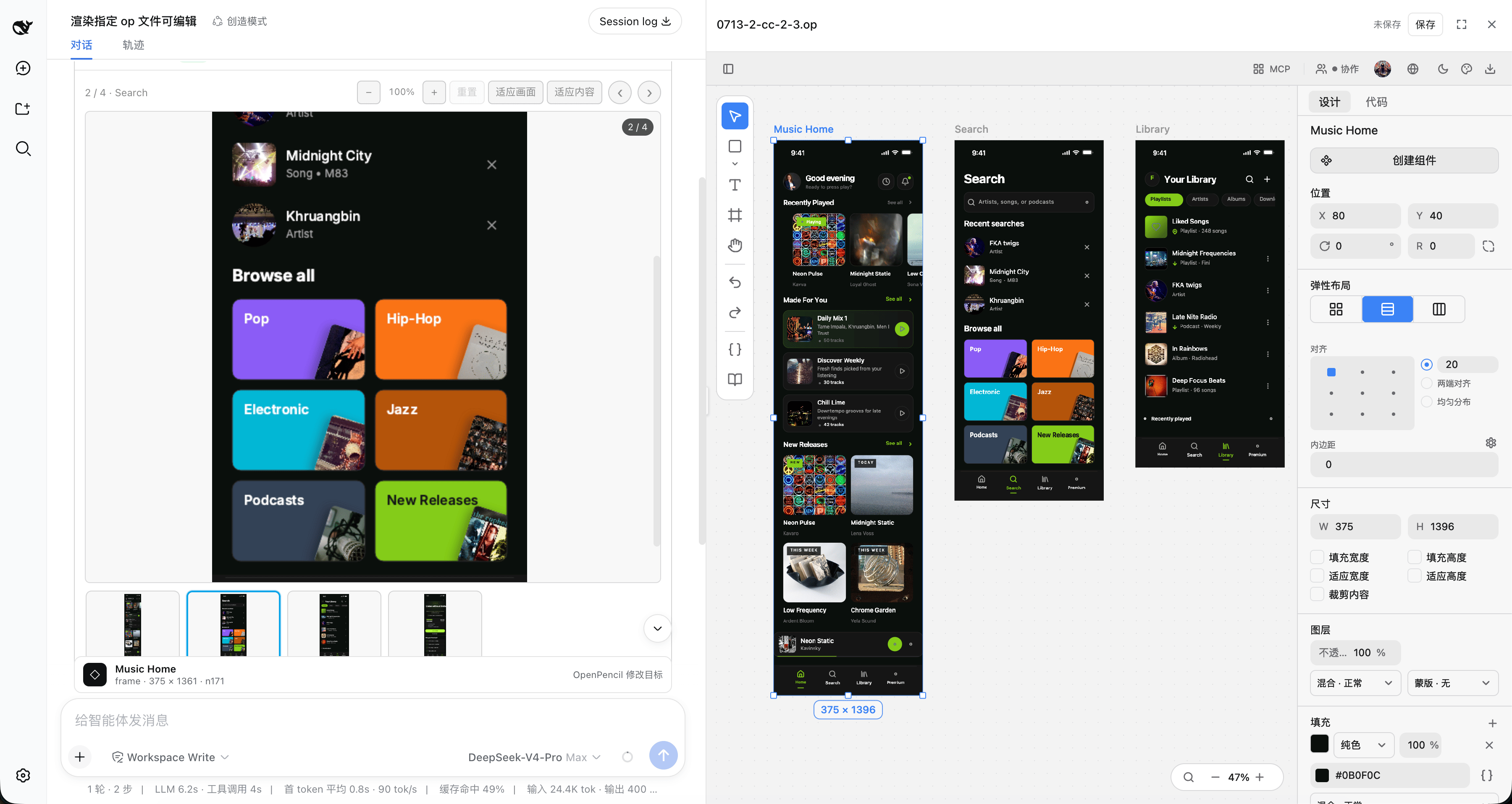 ZSeven-W/dsh-openpencil
The DeepSeek Harness plugin for OpenPencil — preview, inspect, and edit real .op documents inside a conversation.
ZSeven-W/dsh-openpencil
The DeepSeek Harness plugin for OpenPencil — preview, inspect, and edit real .op documents inside a conversation.
- Andiii208/dsh-ultramath UltraMath 数学建模竞赛多 Agent 求解 DSH 插件: 5 角色预设 + 33 篇模型库 + 论文模板/审稿脚本随包 + 进度可视化
-
 dingyi222666/dsh-focus-chat
为 Deepseek Harness 提供新的「聚焦会话」精简会话视图,更轻松易于阅读,只关注最终产出结果。
dingyi222666/dsh-focus-chat
为 Deepseek Harness 提供新的「聚焦会话」精简会话视图,更轻松易于阅读,只关注最终产出结果。
- gongyijie85/mattpocock-skills-dsh Matt Pocock's skills for DeepSeek Harness (DSH): grilling, writing-for-agents, wait-what, TDD and more — 25 skills adapt…
- omdsh-dev/dsh-plugin-dev DSH 插件开发踩坑与做法档案(skill + 文档):cordis 双副本、tsconfig 三件套、Windows junction、多帧 zstd 等实测记录
-
 penguin-oo/dsh-bookmarks
Bookmark assistant replies in DeepSeek Harness: per-message bookmarks with notes/tags, a cross-session center, and one-c…
penguin-oo/dsh-bookmarks
Bookmark assistant replies in DeepSeek Harness: per-message bookmarks with notes/tags, a cross-session center, and one-c…