robiteame/dsh-session-tree-extension
dsh-session-tree-extension Append-only, multi-branch conversation trees for DeepSeek-Harness — a PI-Agent-style SessionTree. The agent's history becomes a tree of immutable nodes, forkable at any historical node, with standard LLM message reconstruction, versioned JSON snapshots, and a WebUI tree panel embedded in the existing chat composer (no sta
Project Overview项目介绍
This is a plugin for DeepSeek Harness that provides append-only, multi-branch immutable conversation trees for agent sessions. It supports forking at any historical node, reconstructs standard LLM context, exports versioned JSON snapshots, and includes a WebUI panel. Use it when managing multi-branch AI conversation history. Requires DeepSeek-Harness v0.1.2-alpha.3+ and Cordis ^4.0.2.
这是DeepSeek Harness的会话树插件,为AI对话提供只追加、多分支的不可变会话树结构,支持从任意历史节点分支对话,重构LLM上下文,输出版本化JSON快照,自带网页端操作面板。适合需要管理多分支AI对话历史的场景,需依赖DeepSeek-Harness 0.1.2-alpha.3以上版本和Cordis ^4.0.2环境。
请帮我了解并安装插件:【dsh-session-tree-extension】【https://github.com/robiteame/dsh-session-tree-extension】Send this message to DSH in your current session. CLI install commands may not be accurate across systems — DSH will figure it out for you.把上面这条消息直接发给当前会话里的 DSH,让它帮你了解并安装。安装命令不一定准确,发给 DSH 更稳。
Or use CLI install (for developers)或使用命令行安装(适合开发者)
CLI Install命令行安装
dsh plugin --profile web add @robiteame/dsh-session-tree把 robiteame/dsh-session-tree-extension 加入你的 DSH 配置(web profile)即可启用。
READMEREADME
dsh-session-tree



Append-only, multi-branch conversation trees for DeepSeek-Harness — fork any historical node, clone a branch into a new session, and browse the whole lineage as one merged WebUI graph. Old history is never edited or deleted.
Three commands:
| Command | What it does |
|---|---|
/tree |
Open the merged lineage graph: every non-subagent session and node, clickable and bindable |
/fork |
Branch from any historical node — the fork appears in the graph and as an inline menu under its source session |
/clone |
Duplicate the current conversation into an independent new session under the same project |
Screenshots
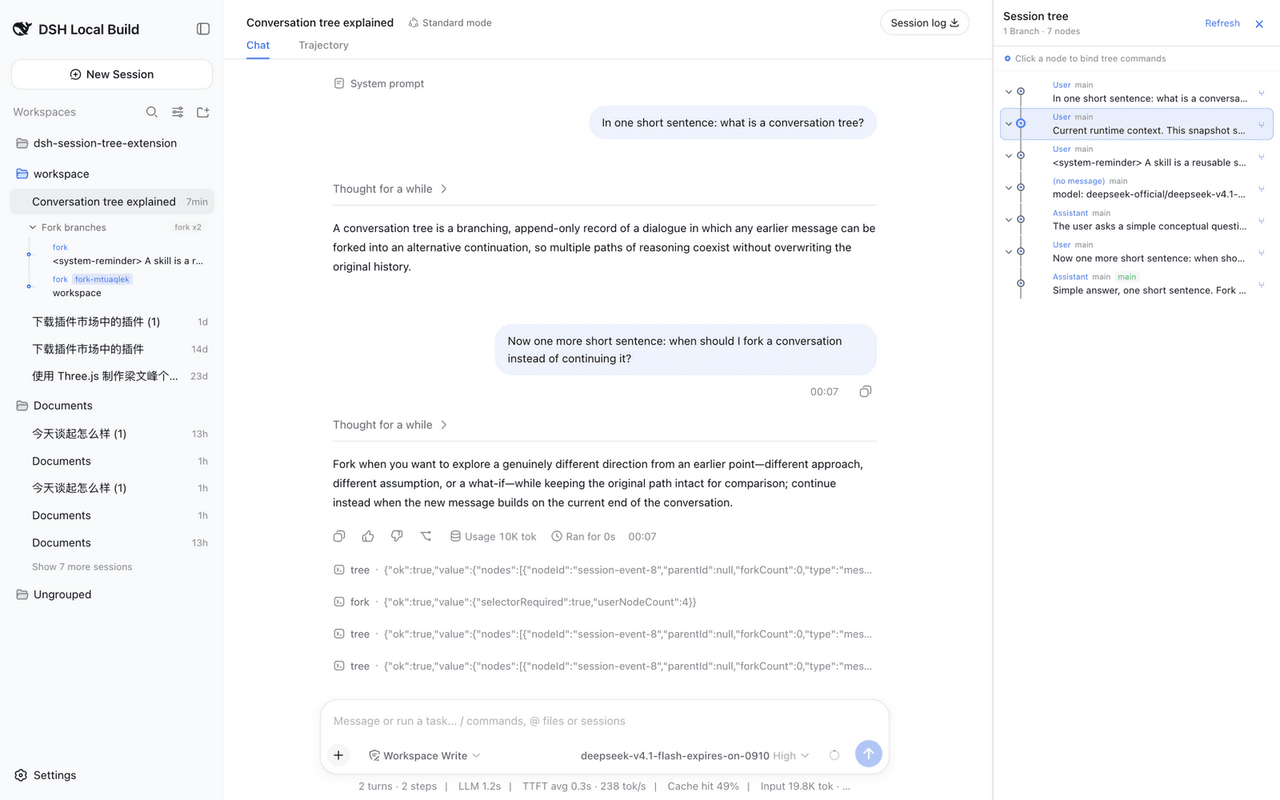
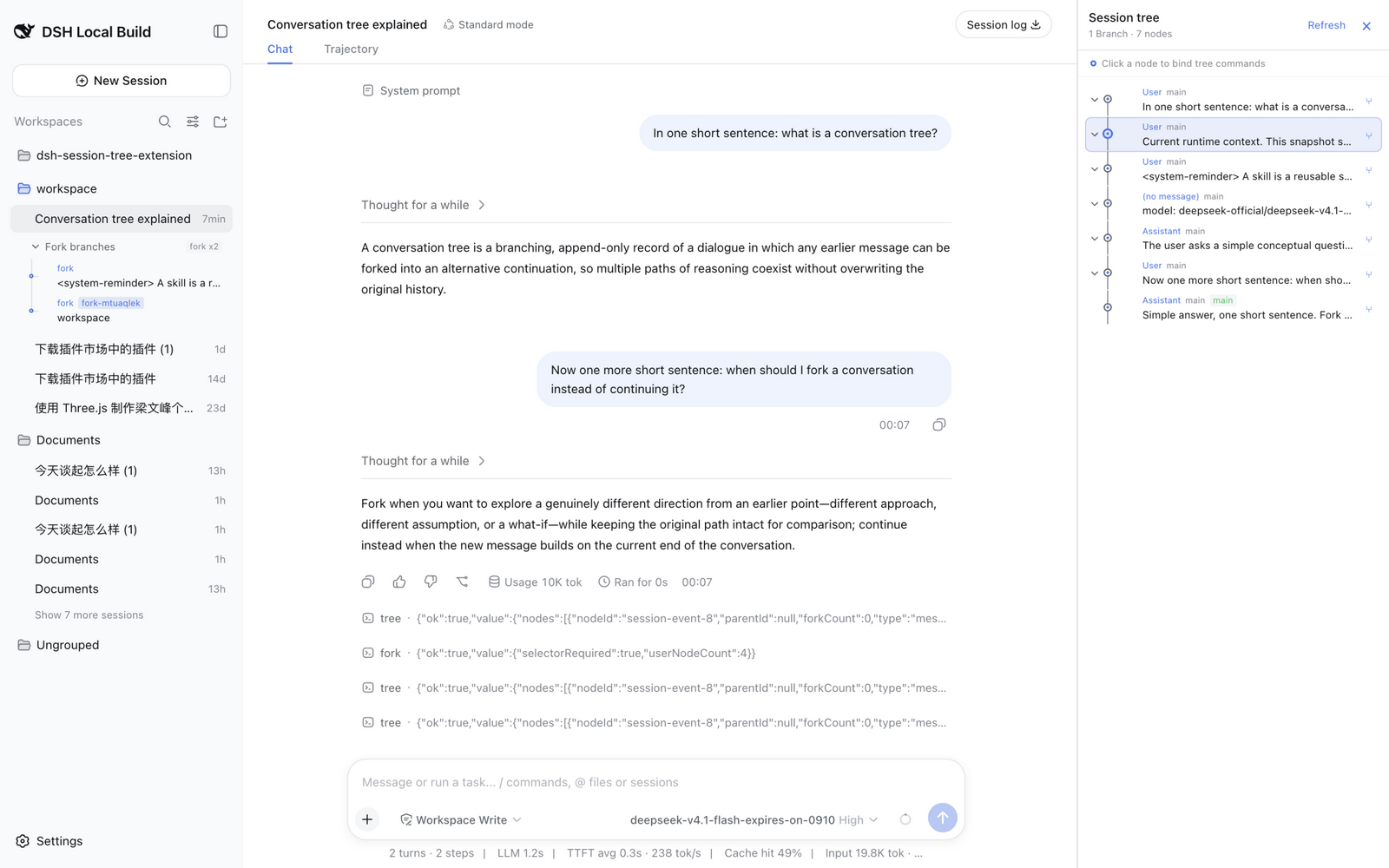
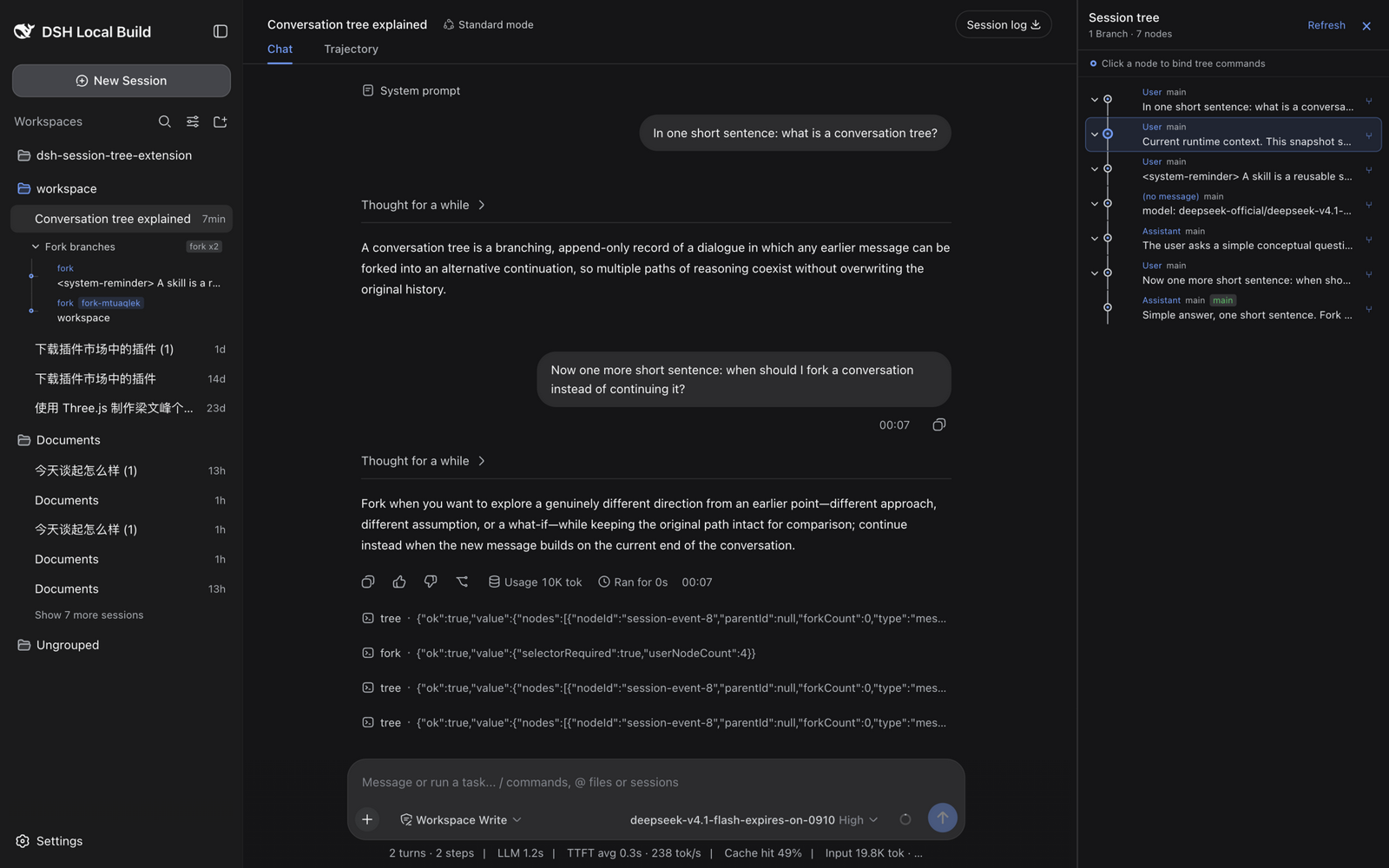
Tree panel (light and dark) with the sidebar's inline fork-branch menu:
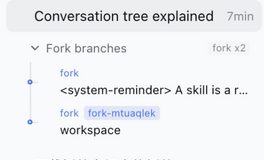
The inline /fork branch menu beneath its source session:
Published as four npm packages under the @robiteame scope:
| Package | Role |
|---|---|
@robiteame/dsh-session-tree |
Carrier Bundle: one install mounts everything below through its composition layer |
@robiteame/dsh-pi-agent-session-tree |
Host domain service: the SessionTree/SessionTreeStore domain model and the sessionTree Remote |
@robiteame/dsh-tool-session-tree |
Command surface: the /tree /fork /clone commands |
@robiteame/dsh-client-ui-session-tree |
WebUI tree panel: additive right-side overlay on official builds, native details dock on patched builds |
Install (users)
One command — from the plugin market UI, or from a Harness checkout's CLI:
dsh plugin --profile <profile> add @robiteame/dsh-session-tree
Prebuilt tarballs install the same way and need no build scripts:
dsh plugin --profile <profile> add robiteame-dsh-session-tree-0.3.0.tgz
After installing, restart the profile. The composition gains three rows
(pi-agent-session-tree, tool-session-tree, ui-session-tree) that load the
Host service, the commands, and the browser panel. Verify the composed layer:
dsh --profile <profile> --dump-config # should list the three session-tree rows
Requires DeepSeek-Harness 0.1.5-rc.2 (or a compatible 0.1.5 build) and
Cordis ^4.0.2; the target installation provides those peers. No install
scripts run — the tarballs ship prebuilt lib/ artifacts.
The three commands
/tree — open the tree panel
/tree opens the right-side panel as one merged graph for the current
session's lineage: ancestors, forks, and clones appear in a single git-style
view, with user messages, assistant replies, tool calls, and model switches
shown as connected nodes. Shared copied prefixes are deduplicated, fork points
carry session badges, and the current session's path stays highlighted. Click
a node to bind it; clicking a node owned by another session opens that session
first. Collapse individual subtrees or whole session branches to focus the
graph.
/fork — branch from any historical node
/fork picks an earlier user prompt and grows a new branch from there: the
conversation continues along the new path while the original one stays intact.
The fork is created through the official native fork API, so it appears in the
session list with real parent linkage. The plugin adds the new branch to the
merged graph and also renders it as an inline collapsible menu directly beneath
its source session's row. Both views follow the official reactive session list,
so new branches appear without a refresh.
/clone — duplicate into a new session
/clone copies the current conversation — through its root path — into an
independent Session under the same project. The source history stays
read-only; the clone is yours to continue separately.
Branch switching and graceful degradation
The plugin never modifies Harness core files. It capability-detects the optional branch-selection engine API at runtime:
- Native mode — on a checkout carrying
dev/session-branch-surface.patch(Session.selectMessageSurface()), jump/fork switch the model-visible history directly: the next turn genuinely starts from the new branch. - Stock mode — on an unmodified official Harness, the plugin emulates the
switch through official append APIs (an empty
replacesurface event) plus a plugin-owned sidecar under$DSH_HOME/storages/session-tree/for durable branch state. The log stays resume-valid. - Projection mode — if even the emulation is unavailable, navigation moves the tree projection and panel only, and the next turn keeps the canonical history.
Every mode is honest about itself: the Host log prints a one-time notice when
a session runs in a non-native mode. Move the raw session.jsonl.zstd between
machines together with the matching sidecar file.
How it works
- Append-only — every node is immutable; branching and jumping only move the cursor. Old branches are never edited or deleted.
- Every entry is a node — messages, tool calls, model switches, compaction
records, and branch summaries all become typed nodes; each has a unique
nodeIdand aparentId(root isnull). A node may have multiple children — that is the fork. - Cursor navigation — jumping moves the active leaf to a historical node; the next append grows a new branch from there. Sibling branches stay intact.
- LLM context — the model always receives the standard
messagesarray for the root→cursor path only.
Development (contributors)
The repository is a pnpm workspace building the three implementation packages standalone (no Harness checkout needed):
pnpm install
pnpm verify      # build + typecheck (host & client) + pack dry-run + vitest
pnpm pack:all    # produce the four tarballs
Tests run against the published Harness packages (0.1.5-rc.2) — the
stock-mode paths — with vitest from the repository root. The browser spec in
packages/client/ui-session-tree needs the Harness client test runtime and
runs inside a source-integrated checkout.
Source integration against a Harness checkout
For debugging against Harness source (native mode, native details dock):
dev/install.sh /path/to/deepseek-harness     # applies both dev patches + copies packages
cd /path/to/deepseek-harness && pnpm install && pnpm run build
See dev/README.md for what each patch does. This flow is
for contributors only — user installs never touch a Harness checkout.
License
MIT.
Related相关推荐
-
 chiro2001/dsh-oc
DeepSeek Harness × OpenCode TUI 前端:把 dsh 的 Agent、会话、工具接入官方 opencode 终端。OpenCode TUI frontend for the DeepSeek Harness (d…
chiro2001/dsh-oc
DeepSeek Harness × OpenCode TUI 前端:把 dsh 的 Agent、会话、工具接入官方 opencode 终端。OpenCode TUI frontend for the DeepSeek Harness (d…
-
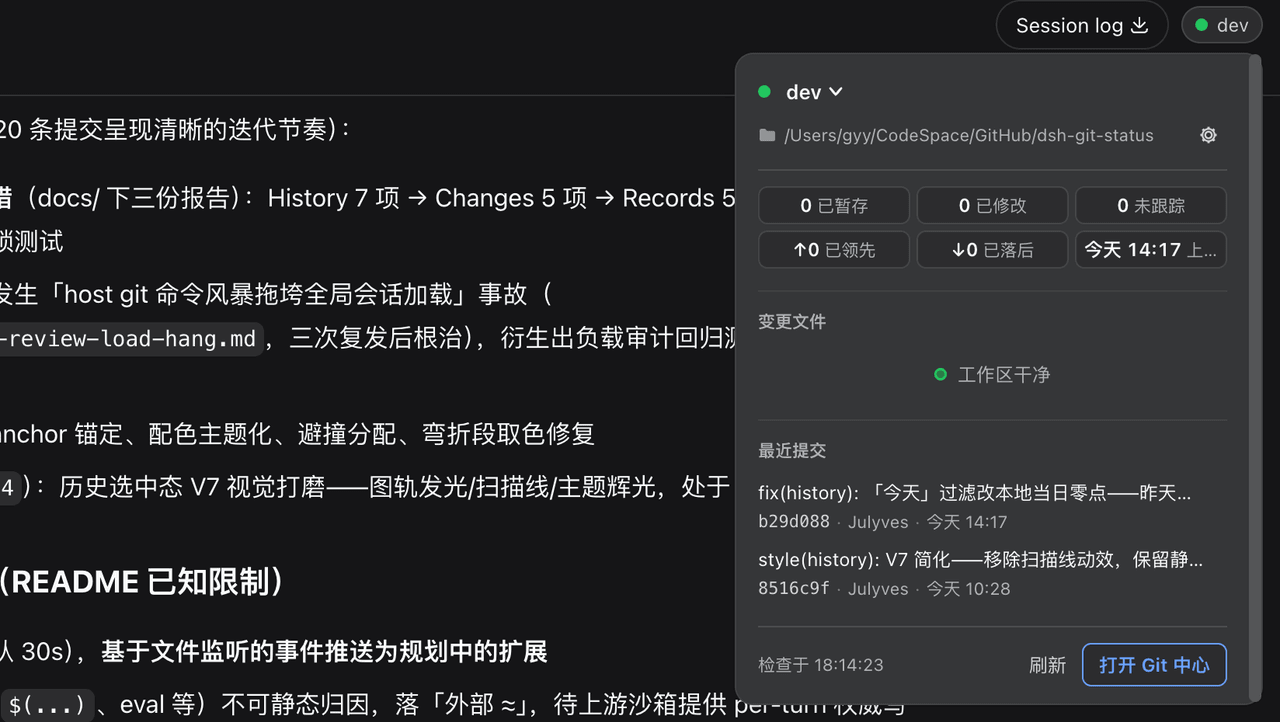 Julyves/dsh-git-ui
DeepSeek Harness (dsh) plugin: Git status pill in the session header — branch, dirty counts, ahead/behind, recent commit…
Julyves/dsh-git-ui
DeepSeek Harness (dsh) plugin: Git status pill in the session header — branch, dirty counts, ahead/behind, recent commit…
-
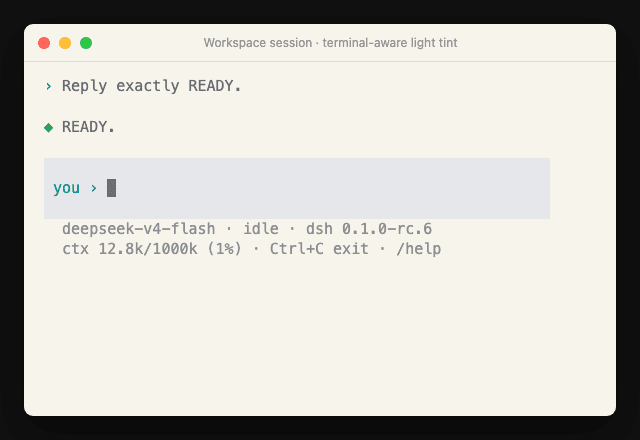 orriduck/dsh-tui
A small, session-aware terminal UI for DeepSeek Harness
orriduck/dsh-tui
A small, session-aware terminal UI for DeepSeek Harness
- awa-123-cw/dsh-webui-perf DeepSeek Harness WebUI 性能优化开关插件:长代码流式渲染/历史加载/高亮缓存优化,设置面板一键开关(with official-package patches)
- RoyougiShiki/dsh-restart-systemd DSH WebUI 重启按钮(systemd 版):侧栏一键重启 dsh-web,WSL/Linux systemd 通道 + Windows 分支,/restart 命令,会话自动续接
-
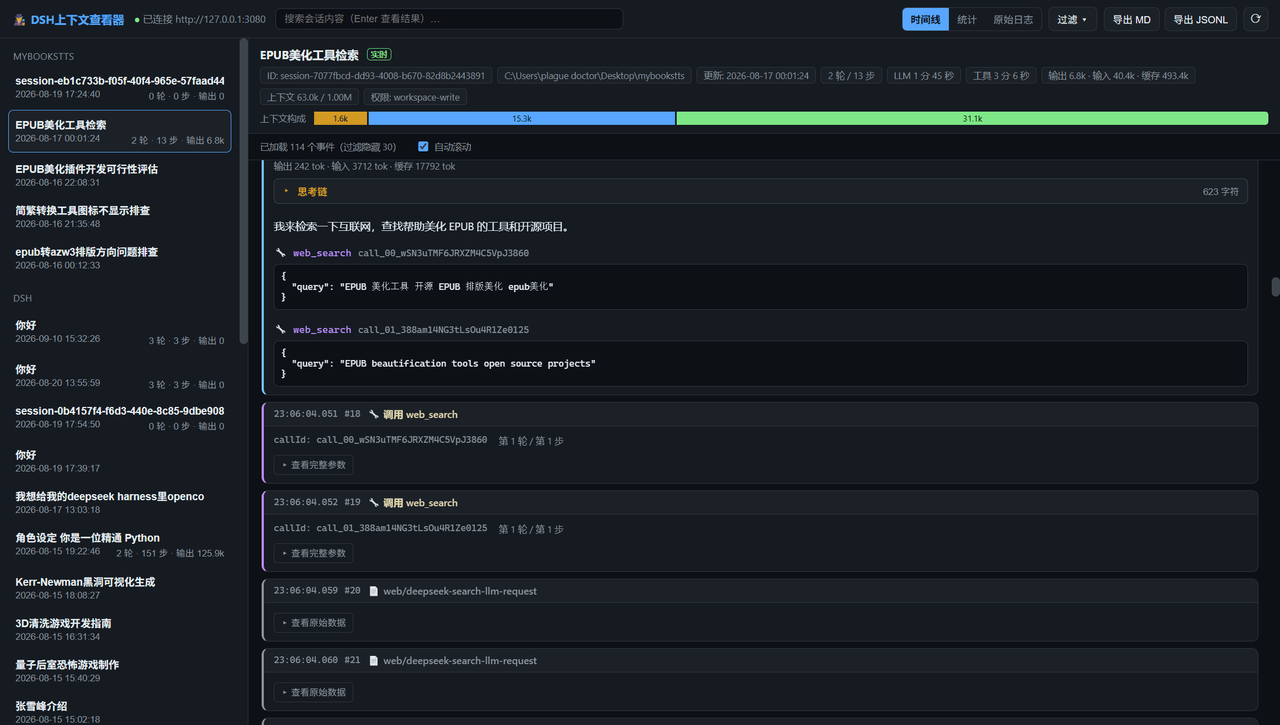 shiningsprk-arch/dsh-context-viewer
DeepSeek Harness (DSH) 上下文查看器 — 浏览思考链、shell 命令、工具调用与原始事件日志(Electron + React)
shiningsprk-arch/dsh-context-viewer
DeepSeek Harness (DSH) 上下文查看器 — 浏览思考链、shell 命令、工具调用与原始事件日志(Electron + React)
-
 kevenxz/dsh-desktop
Windows desktop client for DeepSeek Harness — native window, tray, shared DSH profiles and sessions.
kevenxz/dsh-desktop
Windows desktop client for DeepSeek Harness — native window, tray, shared DSH profiles and sessions.
-
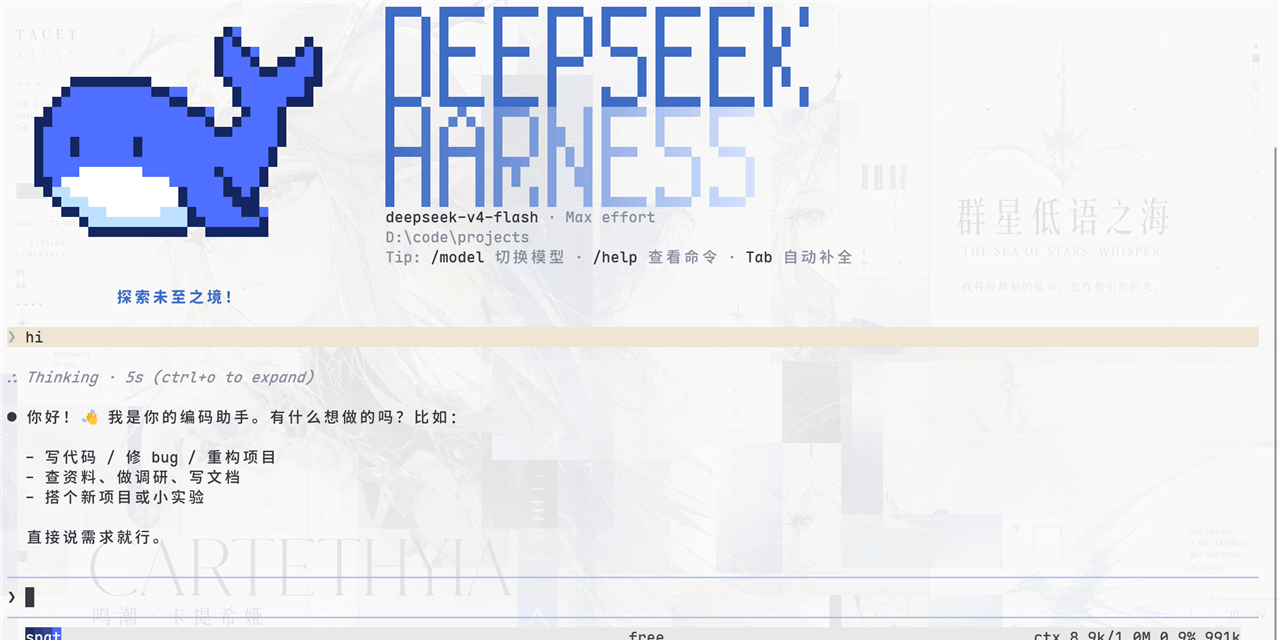 ccch1mneyyy/dsh-TUI
DSH 官方公众号收录的 TUI 补位插件:Claude Code 风,鲸鱼顶栏/实时状态/流式思考/双击 Esc 回滚/上下文进度+TPS。npm 一键装。 DSH official WeChat featured TUI plugin…
ccch1mneyyy/dsh-TUI
DSH 官方公众号收录的 TUI 补位插件:Claude Code 风,鲸鱼顶栏/实时状态/流式思考/双击 Esc 回滚/上下文进度+TPS。npm 一键装。 DSH official WeChat featured TUI plugin…