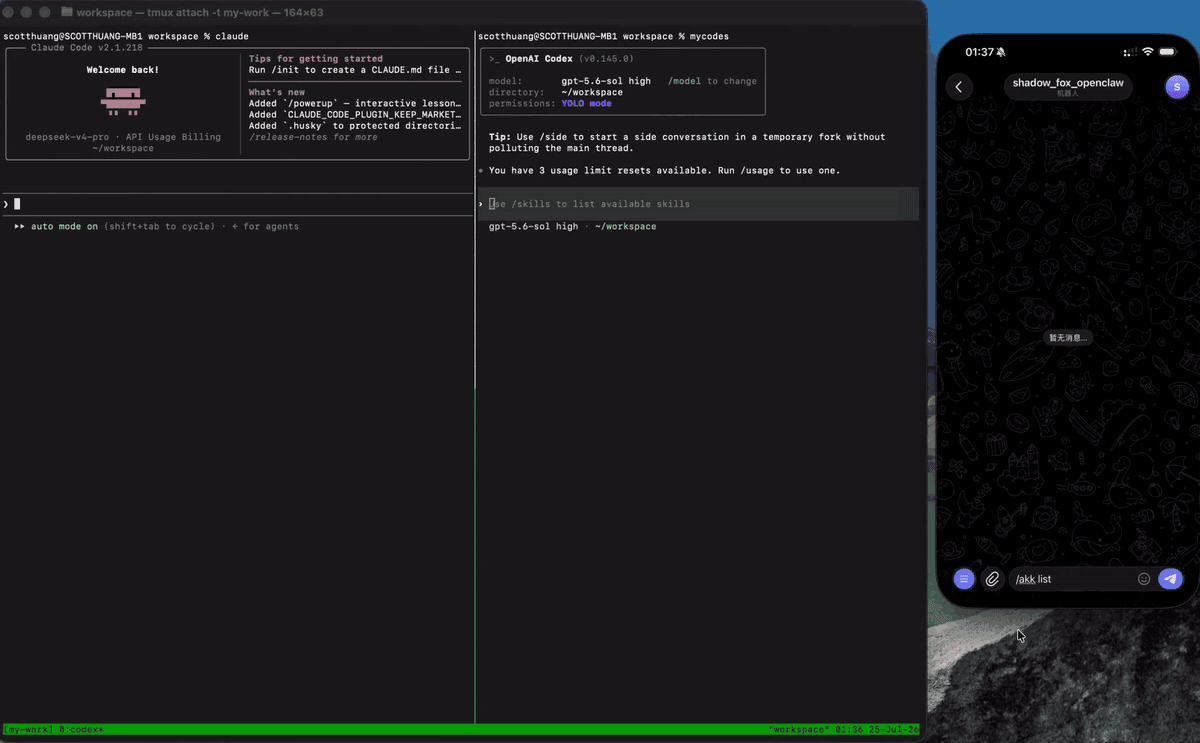
scotthuang/agent-knock-knock
Agent Knock Knock lets OpenClaw, Pi, or DeepSeek Harness control Codex and Claude Code already running in tmux or Herdr. Watch work without staring at a remote terminal, send the next instruction from chat, and get callbacks when the coding agent finishes or needs attention.
catalog descriptioncatalog 简介 / catalog description:Control local Codex and Claude Code from OpenClaw through shared tmux terminals, with seamless human-agent handoff.
Project Overview项目介绍
Agent Knock Knock, often shortened to AKK, is an agent orchestration tool that lets OpenClaw, Pi, or DeepSeek Harness control existing Codex and Claude Code coding agent sessions running inside tmux or Herdr. Unlike many orchestration tools, AKK never launches hidden replacement agents, so all work happens on the same visible terminal and native coding agent session that the human user already has access to. Users send instructions from their controller’s chat interface and get automatic callbacks when the coding agent finishes work or needs human attention. To install for DeepSeek Harness, users run the dsh plugin --profile web add command before starting the DSH web interface.
AKK is built for developers who need to manage multiple ongoing coding agent tasks without switching between multiple terminal windows or babysitting remote sessions. The typical workflow starts with installing the correct connector for your chosen controller (OpenClaw, Pi, or DSH), then starting a shared coding agent terminal in tmux or Herdr. On first run, users execute the /akk doctor command to confirm AKK is ready, then can use any /akk prefixed command to watch task progress, send new instructions, switch models, or resolve ambiguous session identification. Users retain full control at all times and never need to directly interact with the remote coding agent terminal.
AKK requires Node.js version 22.19.0 or newer, and only supports macOS and Linux operating systems. Each connector has specific minimum version requirements for its target controller, and older versions of OpenClaw, Pi, and DSH are intentionally unsupported. Herdr support has strict version locking because Herdr’s local control protocol is not yet a stable public API. AKK is released under the permissive MIT open source license, and users should treat it as privileged local automation because it controls terminal sessions, following the repository’s security guidance to avoid unintended permission issues and privacy exposures.
Agent Knock Knock(简称AKK)是一个代理编排工具,支持OpenClaw、Pi和DeepSeek Harness作为控制端,管理已经在tmux或Herdr中运行的Codex和Claude Code编码代理。它不会启动隐藏的替代代理,所有操作都基于同一个可见终端和原生编码代理会话,用户可从控制端聊天发送指令,接收编码代理完成工作或需要人工介入的回调。
AKK适用于需要同时管理多个运行中的编码代理任务的开发者,典型工作流是先安装对应控制端的连接器,启动共享编码代理终端,首次运行执行/akk doctor检查就绪状态,之后就可以用/akk指令观测已有任务进度、发送新指令、切换模型或识别歧义会话。用户全程不需要切换到远程终端操作,也始终保持对所有任务的控制权。
AKK要求Node.js 22.19.0及以上版本,仅支持macOS和Linux系统,各连接器有对应控制端的版本要求,低于指定版本的控制端都不受支持,Herdr支持因API不稳定也有严格的版本限制。它采用MIT开源许可证,使用时需要注意安全,因为它控制终端,属于特权本地自动化工具。
请帮我安装这个 DSH 插件。安装前先完成【兼容性检查 + 安全性检查】,检查通过再动手。

插件:agent-knock-knock(scotthuang/agent-knock-knock)
仓库:https://github.com/scotthuang/agent-knock-knock
本站详情页:https://www.yhbd.top/plugins/scotthuang-agent-knock-knock/
本站登记:类型 plugin · 归类 多平台兼容工具(非 DSH 原生) · 许可证 MIT · ⭐ 7 · 最近提交 2026-10-03 · 主语言 TypeScript · 未检测到 DSH 插件清单

按下面顺序执行,每步先把结论告诉我,再进入下一步:

【1 兼容性检查】
① 我这边:DSH 版本、Node 版本、操作系统、当前 profile(web / desktop)。
② 读它的 README、package.json、插件 manifest,列出它要求的 DSH 版本 / Node 版本 / 操作系统 / 外部依赖 / 需要另外先装的运行时。
③ 逐条比对,结论只写「满足 / 不满足 / 未知」三种;不满足的给出可行替代方案。
④ 检查是否和我已装的插件冲突:命令名重复、skill / tool 重名、端口占用、重复注册的 MCP server。

【2 安全性检查】
① 仓库可信度:和上面「本站登记」是否一致;star / fork 数、创建时间、最近提交,是否归档或长期停更。
② 安装脚本:逐行看 package.json 的 preinstall / install / postinstall,以及 install.sh、setup.ps1 之类脚本。出现 curl|bash、下载后直接执行、混淆代码、访问与插件功能无关的域名,立刻停下来告诉我,不要继续装。
③ 依赖:列出新增依赖,标出无人维护、或与知名包拼写近似的可疑包(typosquatting)。
④ 权限与副作用:它会读写哪些目录、访问哪些域名、需要哪些 DSH 权限(filesystem / network / shell / clipboard 等),以及怎么卸载和回滚。
⑤ 如果它要求 sudo / 管理员权限,或权限明显超出功能所需,先停下来问我。

【3 安装】
上面两步没有「不满足」和「高危项」时才执行;用官方推荐方式安装,不要自行提权。

【4 汇报】
用表格输出:检查项 / 结论 / 依据 / 是否需要我决策。拿不准的一律写「未知」并说明要我怎么确认——不要猜,也不要替我决定。
Send this message to DSH in your current session: it verifies compatibility and security first (answering met / not met / unknown item by item) and only installs once everything checks out — it will stop and ask you if it finds a high-risk item. The box scrolls; the copy is the full prompt. CLI install commands may not be accurate across systems, so DSH is the safer route.把上面这条消息直接发给当前会话里的 DSH:它会先核对兼容性与安全性(逐条给「满足 / 不满足 / 未知」),确认没问题再安装,有高危项会停下来问你。框内可滚动,复制到的是完整提示词;安装命令不一定准确,发给 DSH 更稳。
- Only 7 stars - very few users, little community feedback星标只有 7,几乎没人在用,遇到问题缺少社区反馈
- No DSH plugin manifest detected - it may only carry the dsh-plugin topic, so the install method must be confirmed on the spot未检测到 DSH 插件清单:可能只是打了 dsh-plugin 话题,安装方式要现场确认
- Not DSH-native: a multi-platform tool that may require Node / Electron or another runtime first非 DSH 原生,是多平台兼容工具:可能要先装 Node / Electron 等运行时
DSH walks through these 9 checksDSH 会逐条核对这 9 项
Compatibility兼容性
- DSH, Node, OS and profile requirementsDSH 版本 / Node 版本 / 操作系统 / profile 是否满足要求
- External dependencies and runtimes (Electron / Python / Docker, ...)外部依赖与运行时(Electron / Python / Docker 等)是否齐备
- Conflicts with installed plugins: command names, skill / tool names, ports, duplicate MCP registration与已装插件是否冲突:命令名、skill / tool 重名、端口占用、重复 MCP 注册
Security安全性
- Repo matches the facts registered here; archived or abandoned?仓库是否与页面登记一致,是否归档或长期停更
- Safety of preinstall / install / postinstall and install.sh / setup.ps1preinstall / install / postinstall 与 install.sh、setup.ps1 是否安全
- curl|bash, download-then-execute, obfuscation, unrelated domains → stop immediatelycurl|bash、下载即执行、混淆代码、无关域名 → 立刻停止
- Typosquatting or unmaintained packages among the new dependencies新增依赖里有没有 typosquatting 或无人维护的包
- Requested permissions vs. what the feature actually needs申请了哪些权限、是否超出功能所需(filesystem / network / shell / clipboard)
- Any sudo / admin requirement, plus uninstall and rollback是否要求 sudo / 管理员权限,以及卸载与回滚方式
Anything uncertain must be marked unknown with a note on how to confirm it. This site's signal screen is a static snapshot, not a security audit.拿不准的必须标「未知」并说明要我怎么确认。本站的信号筛查是静态快照,不能替代安全审计。
Or use CLI install (for developers)或使用命令行安装(适合开发者)
CLI Install命令行安装
dsh plugin --profile web add @scotthuang/agent-knock-knock-deepseek-harness@next把 scotthuang/agent-knock-knock 加入你的 DSH 配置(web profile)即可启用。
READMEREADME
Agent Knock Knock (AKK)



Agent Knock Knock lets OpenClaw, Pi, or DeepSeek Harness control Codex and Claude Code already running in tmux or Herdr. Watch work without staring at a remote terminal, send the next instruction from chat, and get callbacks when the coding agent finishes or needs attention.
AKK never launches a hidden replacement agent. The controller Host, the human, and AKK all use the same visible terminal and native coding-agent session.
Stay in the terminal. Stay in control. No hooks. No agent-side plugins. No YOLO.
Install for OpenClaw
You need OpenClaw 2026.6.5+, Node.js 22.19.0+, and an authenticated codex or claude CLI running as the same OS user.
openclaw plugins install clawhub:@scotthuang/agent-knock-knock
openclaw gateway restart
Start a shared coding-agent terminal in your project:
cd /absolute/path/to/project
tmux new-session -s akk-work -c "$(pwd -P)" codex
Use claude instead of codex if preferred. Herdr users can follow the Herdr quick start.
In OpenClaw, first send:
/akk doctor
After AKK doctor: ready, send a separate message:
/akk inspect this repository and summarize it
That is the complete first-task flow. For terminal setup and multiple panes, see the tmux quick start. Direct /akk ... commands need no OpenClaw tool-policy changes.
Install for Pi
Pi can be the controller Host without OpenClaw. The current connector targets Pi 0.84.4:
npm install -g @earendil-works/pi-coding-agent@0.84.4
pi install npm:@scotthuang/agent-knock-knock-pi@next
pi
Pi should show AKK ready. With Codex or Claude Code already running in tmux or Herdr, enter /akk list. The connector provides /akk, the complete capability-handshake-verified semantic tool catalog, the bundled agent-knock-knock skill, callbacks to the initiating Pi session, and native approval dialogs. See the Pi connector guide.
Showing the opening section of the README — the full document lives in the repository以上为 README 开头摘要,完整文档在仓库内 · View the full README on GitHub →在 GitHub 查看完整 README →
Related相关推荐
-
 omdsh-dev/DSH-better-sidebar
开放的侧边栏底座,支持三方拓展注册新侧边栏页面。内置文件渲染编辑/终端/侧边对话/Git/子代理页面 | Open sidebar foundation, supports third-party extensions to registe…
omdsh-dev/DSH-better-sidebar
开放的侧边栏底座,支持三方拓展注册新侧边栏页面。内置文件渲染编辑/终端/侧边对话/Git/子代理页面 | Open sidebar foundation, supports third-party extensions to registe…
-
 LiPu-jpg/Openwrite
dsh-Openwrite:OpenWrite 的 DeepSeek Harness 小说创作插件,含统一创作 Agent、90 个小说工具、原生工作台与标准审稿 DAG
LiPu-jpg/Openwrite
dsh-Openwrite:OpenWrite 的 DeepSeek Harness 小说创作插件,含统一创作 Agent、90 个小说工具、原生工作台与标准审稿 DAG
-
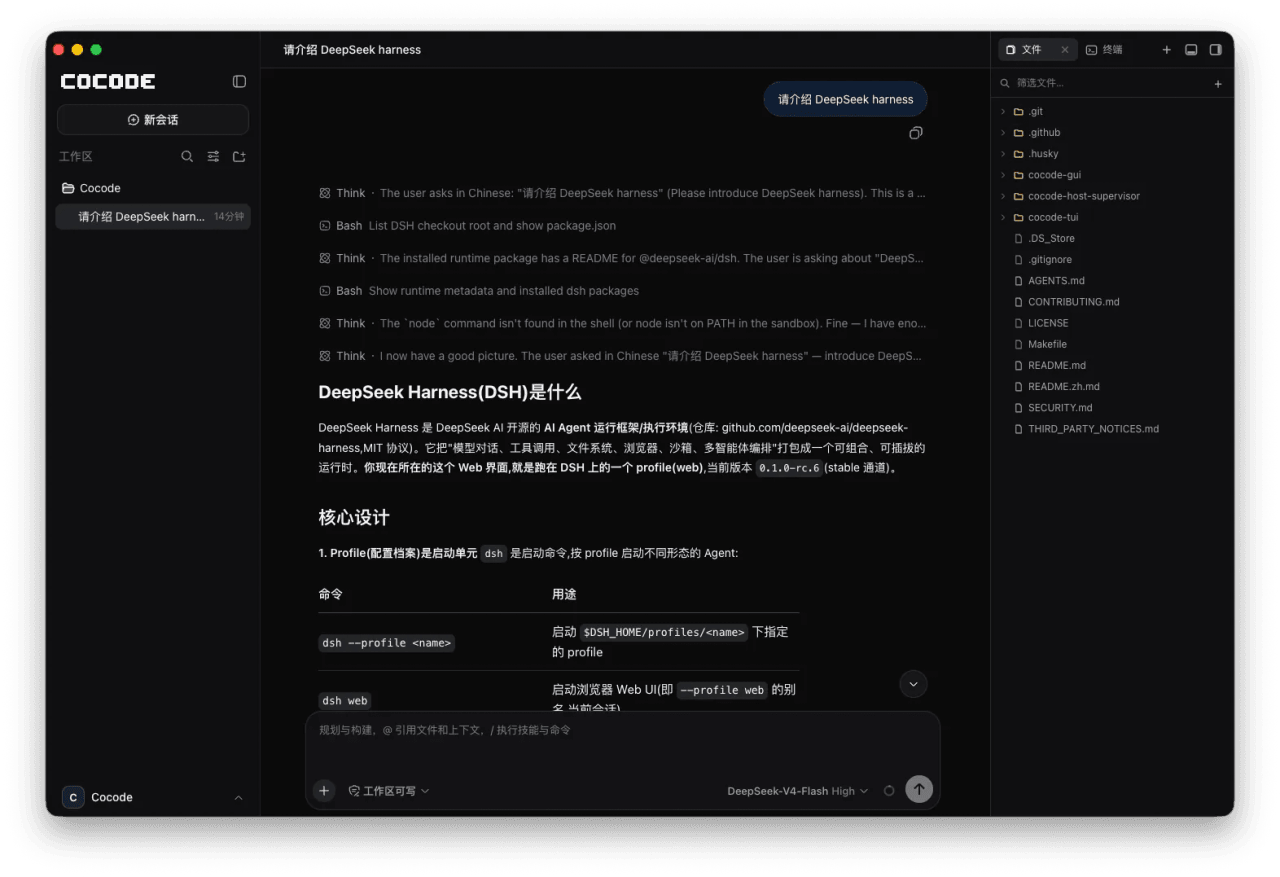 cocode-agency/cocode
Best ready-to-run DeepSeek Harness distribution: DSH desktop GUI, DSH terminal TUI, and harness integration.
cocode-agency/cocode
Best ready-to-run DeepSeek Harness distribution: DSH desktop GUI, DSH terminal TUI, and harness integration.
-
 drewnekota/cetus
One macOS app for Claude Code, Codex, and every agent runtime you use — scheduled runs, global hotkey launcher, per-run …
drewnekota/cetus
One macOS app for Claude Code, Codex, and every agent runtime you use — scheduled runs, global hotkey launcher, per-run …
-
 cosyncing/cosyncing
Synchronize and Orchestrate agents from CLI to GUI, across desktop to phone.
cosyncing/cosyncing
Synchronize and Orchestrate agents from CLI to GUI, across desktop to phone.
-
 UNLINEARITY/dsh-code
A terminal coding interface that brings the DeepSeek Harness kernel's full capability set — special modes, plugins, mode…
UNLINEARITY/dsh-code
A terminal coding interface that brings the DeepSeek Harness kernel's full capability set — special modes, plugins, mode…
-
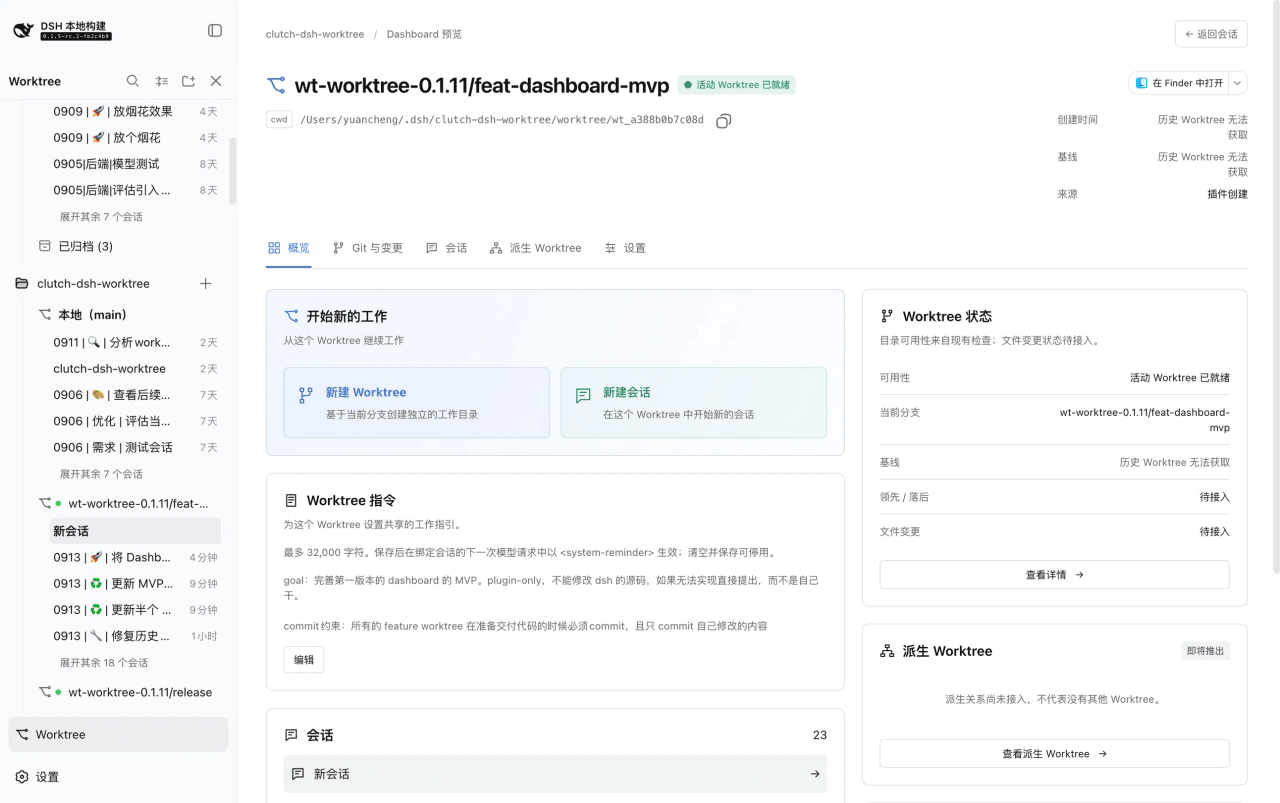 Cerbur/clutch-dsh
Open-source DSH plugins for DeepSeek Harness:Git Worktree session management(会话管理)、Session Title(会话标题)与 Fireworks(庆祝特效),…
Cerbur/clutch-dsh
Open-source DSH plugins for DeepSeek Harness:Git Worktree session management(会话管理)、Session Title(会话标题)与 Fireworks(庆祝特效),…
-
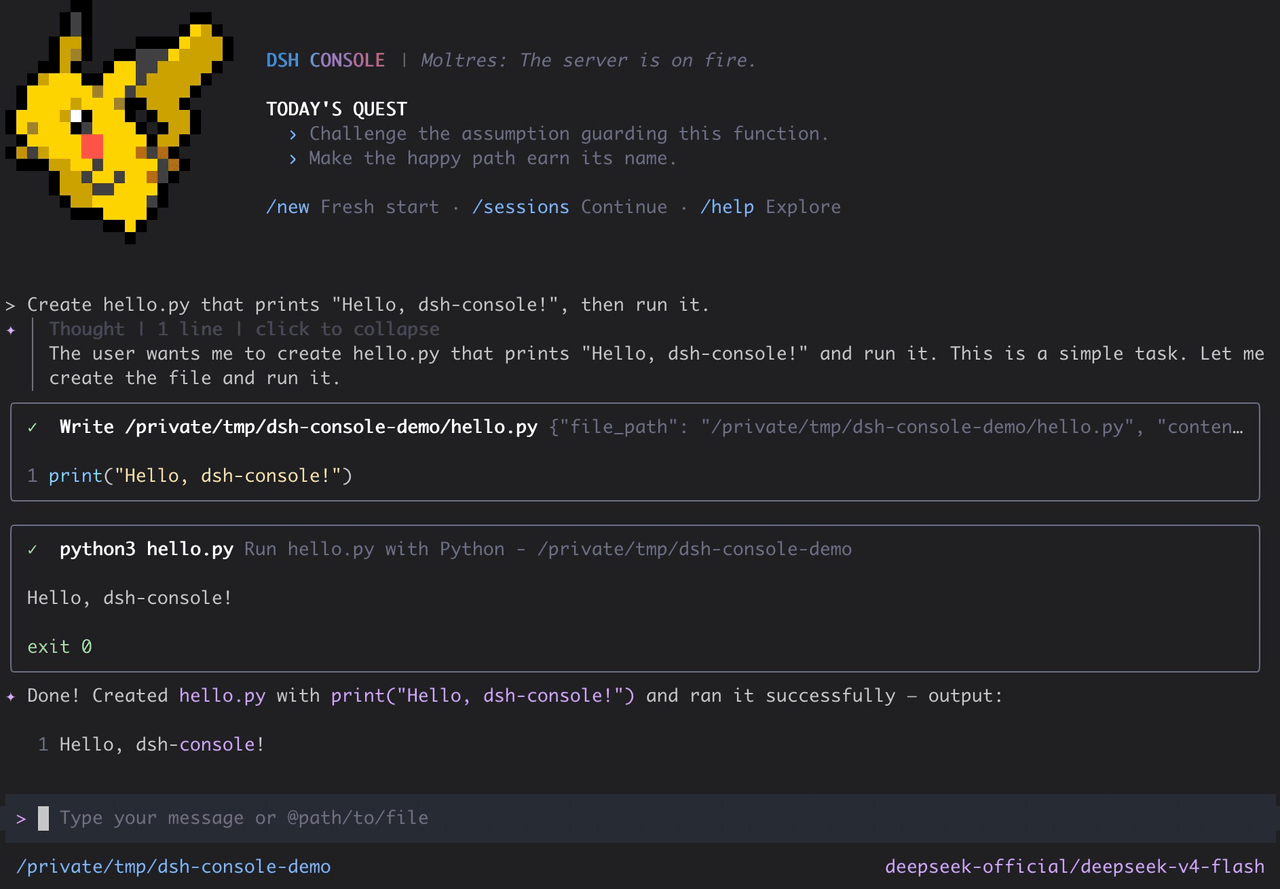 cofy-x/dsh-console
DSH-native terminal workbench (TUI) for DeepSeek Harness with durable sessions, structured tools, plans, subagents, and …
cofy-x/dsh-console
DSH-native terminal workbench (TUI) for DeepSeek Harness with durable sessions, structured tools, plans, subagents, and …