sliverp/DeepSeek-harness-lark
用于DeepSeek Harness的飞书和Lark文本与图像通道插件
Project Overview项目介绍
DeepSeek Harness Lark is an official WebSocket channel plugin that connects DeepSeek Harness to Feishu and international Lark without a public callback server, using @larksuiteoapi/node-sdk. It supports direct and group access policies, text, rich-text, image, and ordinary-file input, generated-image and workspace-file delivery, per-chat isolated sessions, built-in slash commands, and one-shot /approve /reject tool approvals. Use it to deploy a multimodal Lark bot backed by Harness. Caveat: requires Node.js 22.19+, pnpm 10.33.4+, Harness 0.1.0-rc.7+, and the Feishu app must be granted specific IM scopes with long-connection event delivery enabled.
DeepSeek Harness Lark 插件基于官方 @larksuiteoapi/node-sdk,通过 WebSocket 长连接接入飞书与国际版 Lark,无需公网回调。功能涵盖私聊与群聊访问策略、文本与富文本及图片和普通文件收发、生成的图片与工作区文件回传、每会话独立 Harness 上下文、内建斜杠命令及 /approve /reject 一次性工具审批。配置需 Node.js 22.19+、pnpm 10.33.4+ 与 Harness 0.1.0-rc.7+,需在飞书后台启用机器人并授予指定 IM 权限,将 App ID 写入环境变量、App Secret 通过凭证服务保存。
请帮我了解并安装插件:【DeepSeek-harness-lark】【https://github.com/sliverp/DeepSeek-harness-lark】Send this message to DSH in your current session. CLI install commands may not be accurate across systems — DSH will figure it out for you.把上面这条消息直接发给当前会话里的 DSH,让它帮你了解并安装。安装命令不一定准确,发给 DSH 更稳。
Or use CLI install (for developers)或使用命令行安装(适合开发者)
CLI Install命令行安装
dsh plugin --profile web add github:sliverp/DeepSeek-harness-lark把 sliverp/DeepSeek-harness-lark 加入你的 DSH 配置(web profile)即可启用。
READMEREADME
DeepSeek Harness Lark / Feishu plugin
A DeepSeek Harness channel powered by the official @larksuiteoapi/node-sdk. It uses the official WebSocket transport, so no public callback server is required, and supports both Feishu and international Lark.
Features
- Official WebSocket connection and automatic reconnection
- Direct and group access policies; groups require a bot mention by default
- Text, rich-text, image, and ordinary-file input
- Durable Harness attachments with model-aware multimodal input
- Ordinary files are downloaded into
.dsh-lark/inbox/under the Agent workspace so filesystem tools can inspect them - Model text replies, generated-image upload, and workspace-file delivery
- Persistent, isolated Harness sessions per chat;
/newretains old history and switches to a blank session - Agent presets are mounted and recorded for both creation and resume; the default is
standard - Registered Harness slash commands execute directly instead of being sent to the model
- Same-conversation
/approve <code>and/reject <code>decisions for one-shot tool approvals /bot-ping,/bot-help,/bot-image-test,/bot-file-test,/bot-status,/bot-cancel- App Secret resolution through the Harness credential service
- Dormant startup when App ID or App Secret is not configured, so installation alone never blocks Harness Web
Requirements
- Node.js 22.19 or later
- pnpm 10.33.4
- DeepSeek Harness 0.1.0-rc.7 or later
Install
pnpm dsh plugin --profile web add github:sliverp/DeepSeek-harness-lark
For a local checkout:
pnpm dsh plugin --profile web add /absolute/path/to/DeepSeek-harness-lark
Configure the Lark application
- Create a custom application in the Feishu developer console and enable its bot capability.
- Grant
im:message.p2p_msg:readonly,im:message.group_at_msg:readonly,im:message:readonly,im:message:send_as_bot, andim:resource. Theim:message:readonlyscope is required by Feishu's message-resource download endpoint for user-sent images and files. - Select long-connection event delivery and subscribe to
im.message.receive_v1. - Publish an application version and add the bot to the required chats.
- Put the App ID in
LARK_APP_IDand store the App Secret under the Harness credential referenceLARK_APP_SECRET.
Environment injection is supported for development:
export LARK_APP_ID='cli_your-app-id'
export LARK_APP_SECRET='your-app-secret'
pnpm dsh --profile web
For durable use, put the App ID in ~/.dsh/.env and store the App Secret through the Harness credential settings surface. Never commit credentials.
Bundle configuration
- id: lark-channel
  name: deepseek-harness-lark
  config:
    appId: !!js process.env.LARK_APP_ID
    appSecretRef: LARK_APP_SECRET
    cwd: !!js process.env.DSH_LARK_CWD ?? process.cwd()
International Lark and restrictive policy example:
    domain: lark
    singlePolicy: allowlist
    singleAllowFrom: [ou_xxx]
    groupPolicy: allowlist
    groupAllowChats: [oc_xxx]
    groupRequireMention: true
    imageInputMode: auto
    maxInboundFiles: 10
    maxInboundFileBytes: 52428800
    maxInboundMessageFileBytes: 104857600
    maxReplyFiles: 5
    maxOutboundFileBytes: 31457280
    approvalTimeoutMs: 240000
    agentPreset: standard
Access policies accept open, allowlist, or disabled. Use allowlists and least-privilege Harness permissions in production.
Connection and authentication run in the background. Missing or invalid Lark credentials leave this channel offline and are logged without blocking Harness startup.
Inbound images and ordinary files are downloaded through the message-scoped resource endpoint using their matching message_id and resource key; this requires im:message:readonly (or the broader im:message). The separate im:resource scope remains necessary for bot-side image/file upload. Filenames are reduced to safe leaf names, files are created without overwriting existing paths, and each message gets a private directory below <cwd>/.dsh-lark/inbox/. The defaults allow 10 files, 50 MiB per file, and 100 MiB total per message. The model receives the saved path and must use its normal filesystem tools to read the file; file contents are not executed or silently injected into the prompt.
When the model intentionally returns a regular workspace file, it places an explicit Markdown link to that file in the final visible answer. The plugin resolves the canonical path, rejects missing files, directories, symlink escapes, and every target outside the session cwd, then uploads the bounded bytes with Lark's file API. Only the final assistant message is inspected; intermediate tool output cannot trigger a file send. By default, one reply may send up to 5 non-empty files of at most 30 MiB each.
When Harness requests tool approval, the plugin sends a requester-bound six-digit code to the originating chat. Reply /approve <code> to allow that operation once or /reject <code> to deny it. Codes are one-shot, cannot cross chats, bypass ordinary message capacity while the original turn waits, and fail closed on timeout, cancellation, send failure, or shutdown. approvalTimeoutMs must remain below responseTimeoutMs.
agentPreset is the explicit fallback for new sessions and persisted records without a preset. The tool-loop fix advances the plugin session namespace from lark-v1-* to lark-v2-*: existing files are neither deleted nor rewritten, but the plugin no longer appends to potentially DSML-contaminated lark-v1-* records. They remain available for inspection in the Web UI.
Verify
Send /bot-ping, /bot-image-test, /bot-file-test, and /new. The bot should return pong, a blue diagnostic image, a downloadable text file, and confirmation that it switched to a blank session. Send ordinary text, an image, and a CSV file; ask the bot to inspect the CSV and verify that it uses the downloaded workspace path. Then ask it to create and send a CSV; the final reply should contain the file attachment. Request an operation that needs approval and reply with the exact /approve <code> or /reject <code> shown; the same turn should continue or stop without using the Web approval panel.
Develop
pnpm install
pnpm run check
pnpm pack
The repository uses PNPM 10.33.4. Plugin runtime requires Node.js >=22.19 and does not require PNPM 11.
Protocol and configuration behavior were cross-checked against larksuite/openclaw-lark. Transport and media operations use the official Lark Node SDK. MIT licensed.
Related相关推荐
-
 liustack/modlens
The first vision plugin for DeepSeek Harness, and the vision bridge for every text-only coding agent. Paste an image, ge…
liustack/modlens
The first vision plugin for DeepSeek Harness, and the vision bridge for every text-only coding agent. Paste an image, ge…
-
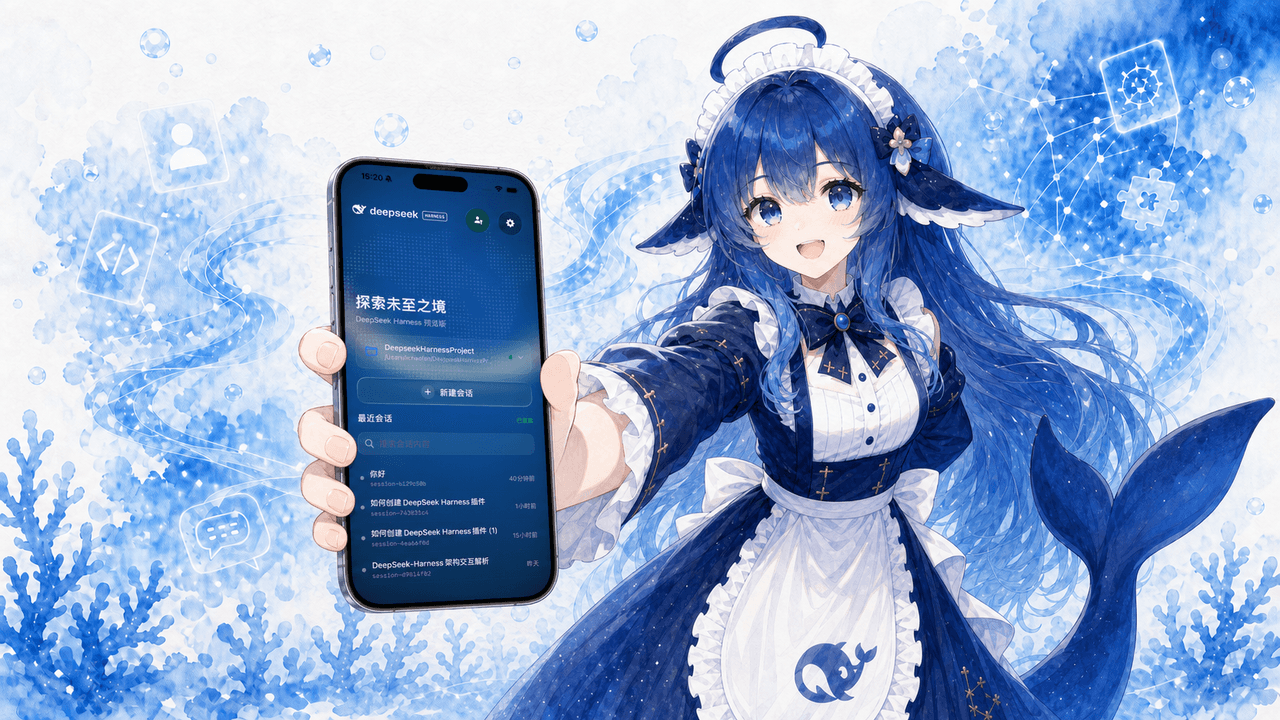 Clarklevis1995/dsh-mobile
DeepSeek Harness Mobile 是一个面向 DeepSeek Harness 的原生 iOS 客户端。它通过 dsh-plugin-mobile-gateway 与 Harness 建立 WebSocket 连接,将工作区、…
Clarklevis1995/dsh-mobile
DeepSeek Harness Mobile 是一个面向 DeepSeek Harness 的原生 iOS 客户端。它通过 dsh-plugin-mobile-gateway 与 Harness 建立 WebSocket 连接,将工作区、…
-
 ZSeven-W/dsh-crew
DeepSeek Harness (DSH) plugin: dispatch work to DSH agents from Claude Code / Codex — native subagent progress, in-host …
ZSeven-W/dsh-crew
DeepSeek Harness (DSH) plugin: dispatch work to DSH agents from Claude Code / Codex — native subagent progress, in-host …
-
 xiaoksio/dsh-solution-explorer
DSH Web GUI right sidebar: VS Code-style file explorer plus source control (git status, stage/unstage/discard, commit, d…
xiaoksio/dsh-solution-explorer
DSH Web GUI right sidebar: VS Code-style file explorer plus source control (git status, stage/unstage/discard, commit, d…
-
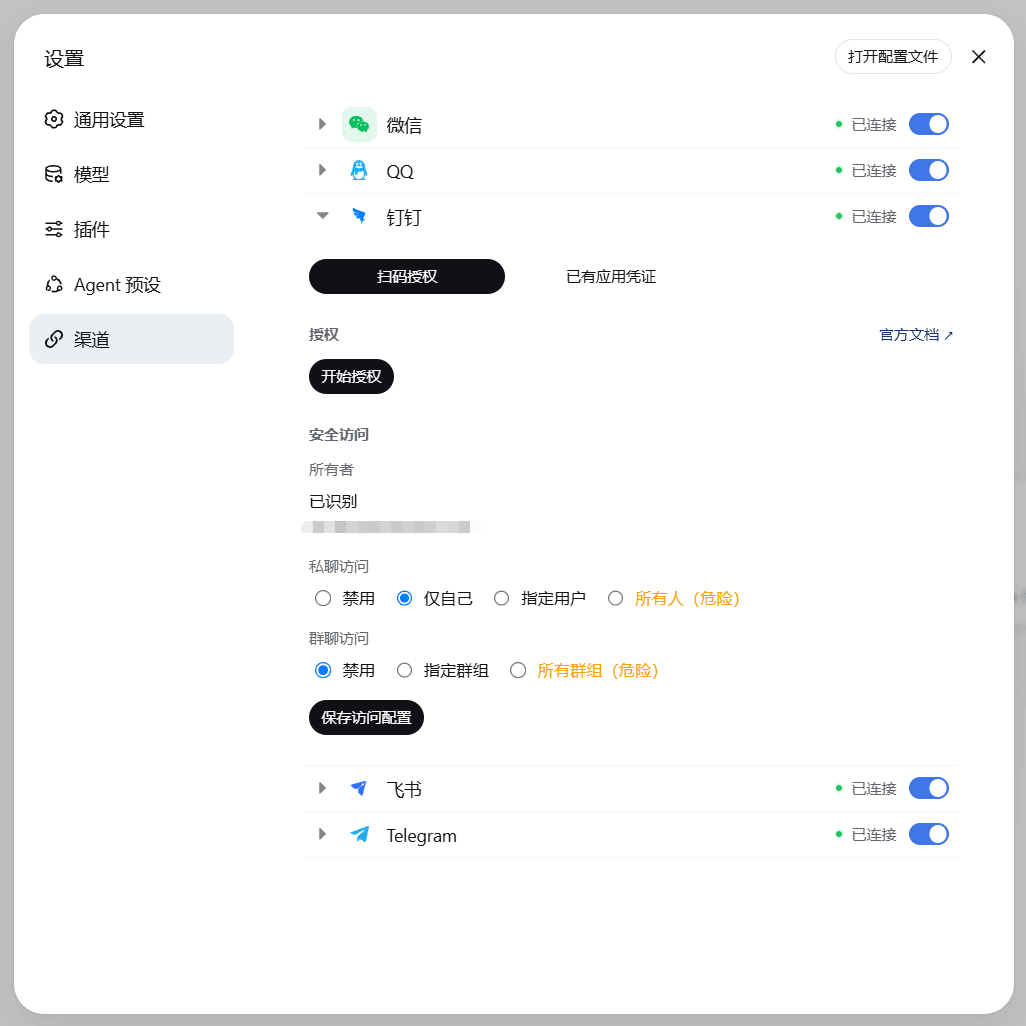 wsz987/dsh-channels
把微信 / QQ / 钉钉 / 飞书 / Telegram 接入 DeepSeek Harness:统一配置、扫码授权,直接在各 IM 与 Agent 对话;支持图片与文件收发,Agent 可读取 PDF、DOCX、XLSX 和文本内容。
wsz987/dsh-channels
把微信 / QQ / 钉钉 / 飞书 / Telegram 接入 DeepSeek Harness:统一配置、扫码授权,直接在各 IM 与 Agent 对话;支持图片与文件收发,Agent 可读取 PDF、DOCX、XLSX 和文本内容。
-
 siegfly/dsh-deepseek-vision
Vision-language gateway plugin for DeepSeek Harness - paste an image, DeepSeek sees text
siegfly/dsh-deepseek-vision
Vision-language gateway plugin for DeepSeek Harness - paste an image, DeepSeek sees text
-
 pan17/dsh-wechat
DSH插件,将微信私聊消息桥接到DSH,支持文本、图片、文件、音视频的双向传输。目标是在微信端还原DSH的原生体验
pan17/dsh-wechat
DSH插件,将微信私聊消息桥接到DSH,支持文本、图片、文件、音视频的双向传输。目标是在微信端还原DSH的原生体验
-
 sliverp/DeepSeek-harness-qqbot
QQ Bot text and image channel plugin for DeepSeek Harness
sliverp/DeepSeek-harness-qqbot
QQ Bot text and image channel plugin for DeepSeek Harness