songyang0603/dsh-codex
Rebuilding OpenAI Codex as exact, independently installable DeepSeek Harness plugins without invoking the Codex binary.
项目介绍Project Overview
dsh-codex 是把 OpenAI Codex 拆成可独立安装 DSH 插件的项目,不调用 codex 可执行文件。已验证执行策略、审批协议、补丁应用三个组件,提供策略发现、命令分类、审批缓存与补丁解析变更。适合逐能力安装、测试并组合成原生编码代理。注意:项目仍在开发,当前仅 macOS arm64 源码级一致性验证,安装这些组件尚不能得到完整 Codex 代理。
dsh-codex rebuilds OpenAI Codex as independently installable DeepSeek Harness plugins, without invoking the codex executable. Its verified components cover execution policy, approval protocol, and apply-patch semantics, exposing typed Cordis services for policy discovery, approval correlation, and patch mutation. Use it to install, test, and compose Codex capabilities toward a native DSH coding agent. Caveat: development is ongoing; only three foundations are parity-verified on macOS arm64, not a complete agent.
请帮我了解并安装插件:【dsh-codex】【https://github.com/songyang0603/dsh-codex】把上面这条消息直接发给当前会话里的 DSH,让它帮你了解并安装。安装命令不一定准确,发给 DSH 更稳。Send this message to DSH in your current session. CLI install commands may not be accurate across systems — DSH will figure it out for you.
或使用命令行安装(适合开发者)Or use CLI install (for developers)
命令行安装CLI Install
dsh plugin --profile web add github:songyang0603/dsh-codex把 songyang0603/dsh-codex 加入你的 DSH 配置(web profile)即可启用。
READMEREADME
dsh-codex
English | 简体中文
Rebuilding OpenAI Codex as exact, independently installable DeepSeek Harness components.
dsh-codex decomposes Codex into focused DSH plugins, then composes those plugins into a coding agent. DSH owns the runtime: the components do not invoke the codex executable and do not delegate work to Codex as a subagent.
Each completed component reproduces a precisely defined boundary from OpenAI Codex commit 086396f. The rule is simple: a component may be small, but behavior inside its declared boundary must be exact.
This repository is under active development. Three foundational components are verified today; installing them does not yet produce the complete Codex agent.
💡 Why dsh-codex?
DeepSeek Harness is built around composable plugins. dsh-codex uses that architecture to turn Codex subsystems into reusable DSH services with explicit ownership, lifecycle, packaging, and conformance boundaries.
This makes it possible to:
- install and test one Codex capability at a time;
- reuse a component in a different DSH coding-agent profile;
- replace or compose components without hiding behavior in a monolithic wrapper;
- compare every completed boundary against the pinned upstream implementation;
- build toward a native DSH coding agent rather than a bridge to the Codex binary.
🧩 Components
| Component | What it provides | Status |
|---|---|---|
@songyang0603/dsh-codex-execpolicy |
Codex policy/config discovery, command classification, approval-requirement derivation, migration, and rule persistence | 0.1.0 · macOS arm64 source parity_verified |
@songyang0603/dsh-codex-approval |
Lossless rich approval protocol, pending-request correlation, cancellation, and live-session approval cache | 0.1.0 · macOS arm64 source parity_verified |
@songyang0603/dsh-codex-apply-patch-engine |
Apply-patch parsing, invocation recognition, verification, local mutation, and ordered committed delta | 0.1.0 · macOS arm64 source parity_verified |
See the component map for the full Codex decomposition and the parity standard for what parity_verified means.
🚀 Quick start
Requirements: Node.js 22.19+, pnpm 10.19, Rust 1.95.0, and DeepSeek Harness 0.1.0-rc.6.
git clone https://github.com/songyang0603/dsh-codex.git
cd dsh-codex
pnpm install
pnpm native:stage
pnpm build
Install the completed components into one local DSH profile:
dsh plugin --profile codex-dev add ./packages/execpolicy
dsh plugin --profile codex-dev add ./packages/approval
dsh plugin --profile codex-dev add ./packages/apply-patch-engine
dsh --profile codex-dev --dump-config
The bundles mount three Cordis services:
ctx.codexExecPolicy
ctx.codexApproval
ctx.codexApplyPatch
native:stage builds the current-platform Rust sidecars, verifies their protocols and pinned source identities, and writes package-local binaries plus SHA-256 files. Generated binaries are intentionally excluded from Git.
These releases are currently source-only. No npm release or GitHub native-binary release is claimed yet.
⚙️ How it works
Pinned Codex source
        │
        ├── native semantic engines (Rust)
        │       └── exact upstream types and behavior
        │
        ├── DSH component packages (TypeScript + Cordis)
        │       └── lifecycle, IPC, validation, and service ownership
        │
        ├── canonical composition profile (in progress)
        │       └── shell, sandbox, network, provider, session, and UI
        │
        └── independent conformance suites
                └── pinned upstream oracle ↔ production component
Native sidecars are used where a TypeScript rewrite would risk semantic drift. The DSH packages own process lifecycle and expose typed Cordis services; consumers remain separate components so approval, sandboxing, networking, and execution order can be composed without double prompts or hidden bypasses.
Every installable package has its own dsh.bundle.patch, profile row, compiled entry points, instructions, license notices, and exact peers. The repository root is a component workspace, not an installable all-in-one bundle.
✅ What is verified today
| Boundary | Independent comparison | Package/runtime checks |
|---|---|---|
| Execpolicy | runtime 68/68; config stack 6/6; host discovery 11/11; migration and persistence 16/16 |
18 TypeScript/native/real-Loader tests and a clean DSH rc.6 archive smoke test |
| Approval | upstream/source-pinned 43/43; DSH adapter contracts 10/10 |
49 package tests and a clean DSH rc.6 add/activate/remove profile test |
| Apply-patch semantic engine | all 96 pinned upstream tests; differential oracle 23/23 |
10 native tests, 6 TypeScript/native/real-Loader tests, and a clean archive mutation test |
The oracles are built from the pinned upstream source; candidate output never serves as its own oracle. Exact commands, identities, hashes, failures, and exclusions live under conformance/*/STATUS.md and in upstreams.lock.json.
🌍 Platform scope
| Platform | Current treatment |
|---|---|
| macOS arm64 | parity_verified; current source and packaging target |
| macOS x64 | planned / unverified; compatibility CI retained, but no parity claim |
| Linux x64/arm64 | planned / unverified; upstream code, corpus, and non-blocking CI retained; no binary release |
| Windows x64 | planned / unverified; upstream cfg(windows) behavior, PowerShell corpus, and non-blocking CI retained; no binary release |
A Windows- or Linux-shaped case executed on macOS does not count as evidence for that operating system. A platform claim requires the pinned upstream oracle and candidate to run on the same real platform. We retain upstream platform branches and conformance entry points to avoid future reimplementation, but do not ship guessed compatibility code or unverified native binaries.
See platform support and evidence for the exact policy.
📁 Repository contents
crates/                 native semantic engines
packages/<component>/   independently installable DSH plugins
conformance/<boundary>/ independent upstream oracles and compact corpora
docs/                   architecture, package contracts, and parity scope
research/               pinned DSH ecosystem plugin implementation study
scripts/                pin verification, packaging, and native staging
upstreams.lock.json     machine-readable Git and npm identities
Generated JSONL outputs, Cargo targets, package builds, and native binaries are not committed. Compact corpora and test-only upstream instrumentation remain in the repository so contributors can reproduce a parity claim.
🛠️ Development
pnpm check
Heavyweight conformance workflows are separate because they compile pinned upstream Codex crates. Package-specific commands and APIs are documented in each component README:
🤝 Contributing
Issues and pull requests are welcome. A new component should own one clear subsystem, install independently, preserve DSH lifecycle semantics, pin its upstream identity, and include reproducible conformance evidence before claiming parity.
Start with the component package contract, the component map, and the DSH ecosystem compatibility study.
🔗 Upstream and independence
This is an independent community project. It is not affiliated with, endorsed by, or sponsored by OpenAI or DeepSeek.
OpenAI Codex and DeepSeek Harness remain separate upstream projects. Their names identify the systems being studied and integrated; they do not imply official status.
📄 License
Apache-2.0. See LICENSE, NOTICE, THIRD_PARTY_NOTICES.md, and UPSTREAMS.md.
相关推荐Related
-
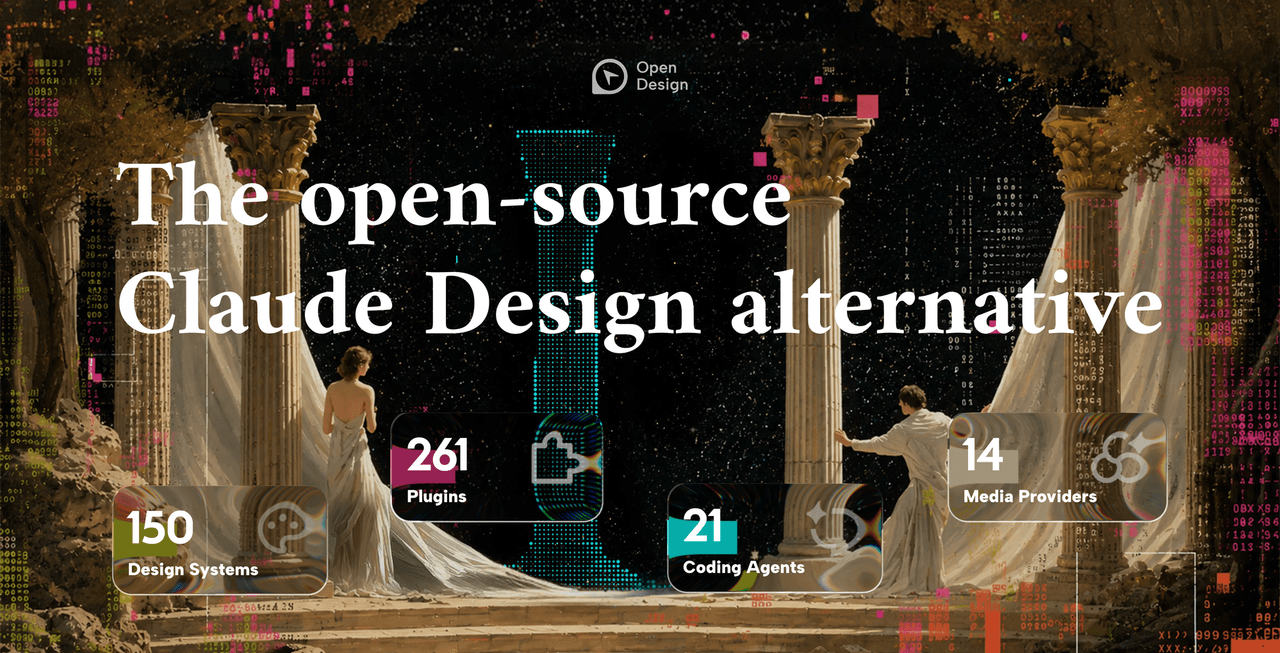 nexu-io/open-design
🎨 Best DeepSeek Harness Design Plugin. The open-source Claude Design alternative. 🖥️ Local-first desktop app. 🖼️ Your…
nexu-io/open-design
🎨 Best DeepSeek Harness Design Plugin. The open-source Claude Design alternative. 🖥️ Local-first desktop app. 🖼️ Your…
-
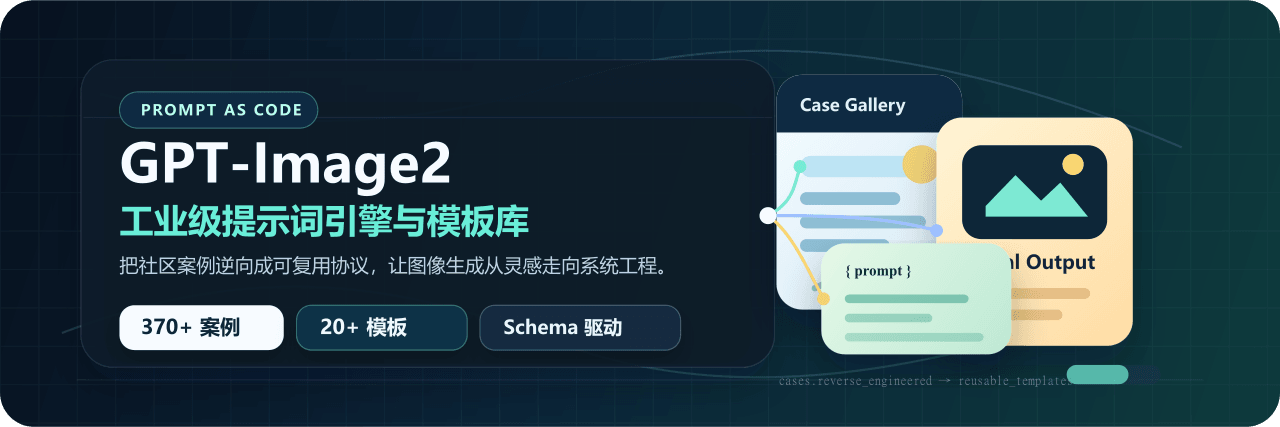 freestylefly/awesome-gpt-image-2
Prompt as Code | GPT-Image2 工业级提示词引擎与模板库,530+ 个案例逆向工程,20+ 套工业级模板,并提炼出Skills,持续更新中
freestylefly/awesome-gpt-image-2
Prompt as Code | GPT-Image2 工业级提示词引擎与模板库,530+ 个案例逆向工程,20+ 套工业级模板,并提炼出Skills,持续更新中
-
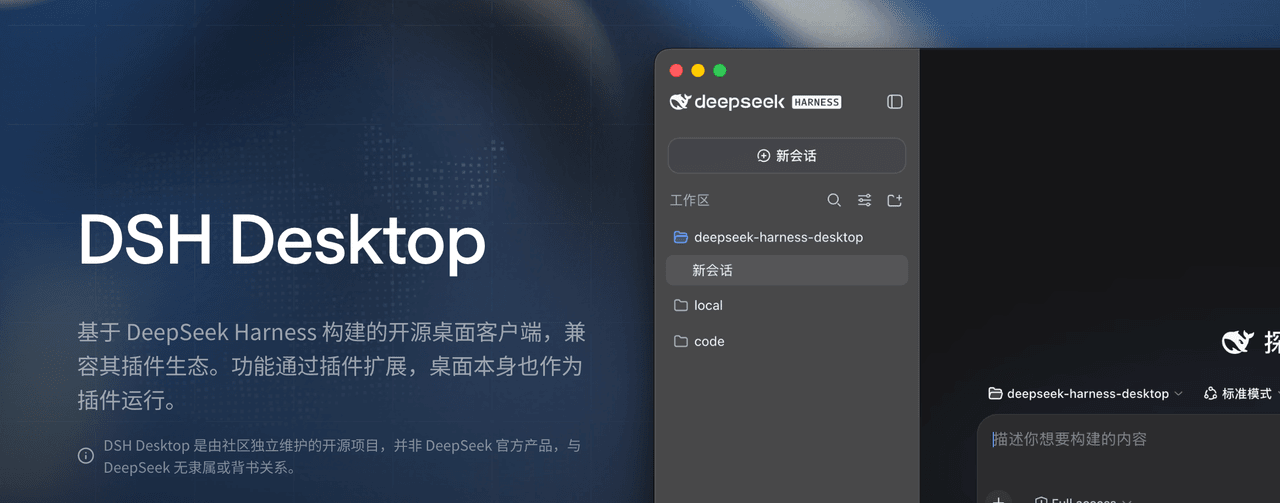 anywhere-labs/dsh-desktop
为 DeepSeek Harness (DSH) 插件生态打造的现代化桌面端解决方案。万物皆「插件」,桌面本身也是「插件」。
anywhere-labs/dsh-desktop
为 DeepSeek Harness (DSH) 插件生态打造的现代化桌面端解决方案。万物皆「插件」,桌面本身也是「插件」。
- Nagi-ovo/voyager Enhancement suite for Gemini, AI Studio, Claude & ChatGPT — plus a prompt manager for any web UI, DeepSeek Harness inclu…
-
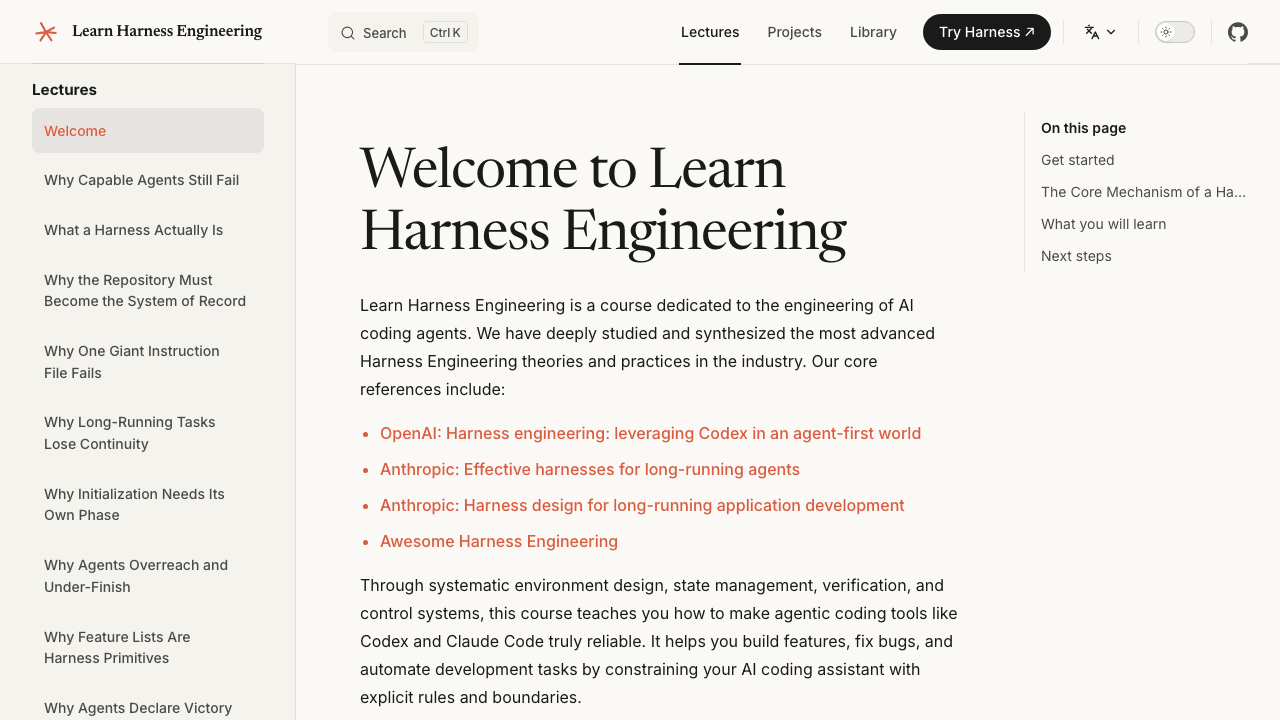 walkinglabs/learn-harness-engineering
Harness engineering beginner tutorial, from 0 to 1
walkinglabs/learn-harness-engineering
Harness engineering beginner tutorial, from 0 to 1
-
 awesome-dsh-plugin/awesome-dsh-plugin
A curated list of plugins for DeepSeek Harness (dsh) · DeepSeek Harness 插件精选列表
awesome-dsh-plugin/awesome-dsh-plugin
A curated list of plugins for DeepSeek Harness (dsh) · DeepSeek Harness 插件精选列表
-
 MemTensor/MemOS
Self-evolving memory OS for LLM & AI Agents: ultra-persistent memory, hybrid-retrieval, and cross-task skill reuse, with…
MemTensor/MemOS
Self-evolving memory OS for LLM & AI Agents: ultra-persistent memory, hybrid-retrieval, and cross-task skill reuse, with…
- yjh051108/dsh-routing-suite dsh-routing-suite — injector + router-standard kit: install the runtime injector first, then the task-aware reasoning-mo…