tancheng33/dsh-ontology
DeepSeek Harness的类型化推理本体论(TBox + ABox)插件——代理声明、断言并依据模式约束查询的持久领域知识。
Project Overview项目介绍
dsh-ontology is an ontology plugin for DeepSeek Harness. It provides structured domain knowledge storage with type constraints and inference, supporting vocabulary definition, fact validation, querying and safe retraction. Use it when agents need consistent domain knowledge. It enforces capacity guards, writes fail when exceeding the limit.
dsh-ontology是DeepSeek Harness的本体插件,提供带类型约束、支持推理的结构化领域知识存储,支持词汇定义、事实校验、推理查询和安全撤回,适合需要维护一致性领域知识的智能体使用,需注意它有容量限制,超出上限写入会失败。
请帮我了解并安装插件:【dsh-ontology】【https://github.com/tancheng33/dsh-ontology】Send this message to DSH in your current session. CLI install commands may not be accurate across systems — DSH will figure it out for you.把上面这条消息直接发给当前会话里的 DSH,让它帮你了解并安装。安装命令不一定准确,发给 DSH 更稳。
Or use CLI install (for developers)或使用命令行安装(适合开发者)
CLI Install命令行安装
dsh plugin --profile web add dsh-ontology把 tancheng33/dsh-ontology 加入你的 DSH 配置(web profile)即可启用。
READMEREADME
dsh-ontology
English | 中文
A typed, inference-capable ontology for DeepSeek Harness — durable domain knowledge the agent declares, asserts against, and queries under schema constraints.
Most agent memory is a bag of strings: the agent writes prose, later reads prose, and nothing ever tells it that what it just recorded contradicts what it recorded last week. This plugin gives the agent a vocabulary it must respect. You declare what kinds of things exist and how they may relate; every claim is then checked against that model before it is stored, and claims that follow from other claims are derived rather than repeated.
ontology_define   declare classes and typed relations   (the TBox)
ontology_assert   record entities and facts             (the ABox, validated)
ontology_query    look things up, traverse, infer
ontology_retract  remove, with dependency protection
Why a TBox, not a notes file
| notes-style memory | dsh-ontology | |
|---|---|---|
| Structure | free text | classes, typed relations, entities, triples |
| Bad input | silently stored | rejected, naming the constraint it broke |
| Implied facts | restated by hand, drift apart | derived on read from transitive / symmetric / inverseOf |
| Retraction | orphaned prose lingers | facts cascade with their entity; derived facts vanish with their premise |
| Reading it back | grep and hope | query by class (subclass-aware), triple pattern, neighbourhood, or shortest path |
The constraint is the point. When the agent asserts ada depends_on api and depends_on is declared Component -> Component, it gets back:
REJECTED ada depends_on api: ada is not in the domain of depends_on
  (requires one of: Component; has: Person)
That is a real signal — either the claim is wrong, or the model of the domain is incomplete. Free-text memory can produce neither.
Install
dsh plugin --profile <name> add dsh-ontology
dsh --profile <name>
Or from a checkout / git host:
dsh plugin --profile <name> add ./dsh-ontology
dsh plugin --profile <name> add github:tancheng33/dsh-ontology
A
github:install builds from source, so pnpm ≥10 needs the build allowlisted. AddallowBuilds: { dsh-ontology: true }to the profile'spnpm-workspace.yamland re-run, and pin a commit (#<sha>) so a later push cannot silently change what runs. Installing from npm needs no allowance.
The bundle brings its own storage stack (dsh-storage + dsh-storage-json + dsh-storage-domain) under the same row ids dsh-web-app uses, so it works in a bare profile and composes cleanly with one that already has storage. Data lands in $DSH_HOME/storages/<domain>.json.
Configuration
Override any of these in your profile's cordis.patch.yml:
| Key | Default | Meaning |
|---|---|---|
domain |
ontology |
Storage domain name; one name is one isolated graph. Must match /^[a-z][a-z0-9_]*$/. |
strict |
true |
Reject facts that violate the vocabulary. false stores them with the violations recorded, for exploratory modelling. |
inference |
true |
Allow queries to return entailed facts. |
promptSection |
true |
Contribute the vocabulary summary to the system prompt. |
promptMaxTerms |
60 |
Upper bound on terms in that summary. |
promptOrder |
150 |
Where the section lands in the assembled prompt. |
defaultLimit / maxLimit |
50 / 500 |
Query result sizes. |
maxEntities / maxFacts |
20000 / 100000 |
Capacity guards; a write past the bound fails loudly. |
Running two isolated graphs is just two rows:
- insert:
    - id: ontology-team
      name: dsh-ontology
      config: { domain: team_ontology, strict: true, inference: true, promptSection: true,
                promptMaxTerms: 60, promptOrder: 150, defaultLimit: 50, maxLimit: 500,
                maxEntities: 20000, maxFacts: 100000 }
(A patch replaces a row's whole config, so restate every key.)
A worked example
Declare the vocabulary. Order does not matter — entries are resolved by repeated passes, so a subclass may precede its parent and a relation may precede its inverse.
// ontology_define
{
  "classes": [
    { "id": "Service", "subClassOf": ["Component"] },
    { "id": "Component", "comment": "A deployable unit of the system" },
    { "id": "Person" }
  ],
  "relations": [
    { "id": "depends_on", "domain": ["Component"], "range": ["Component"],
      "characteristics": ["transitive"] },
    { "id": "owns", "domain": ["Person"], "range": ["Component"], "inverseOf": "owned_by" },
    { "id": "owned_by", "domain": ["Component"], "range": ["Person"] },
    { "id": "version", "domain": ["Component"], "rangeKind": "literal" }
  ]
}
Assert instances. Entities are created before the facts of the same call, so one call introduces an individual and its relationships together.
// ontology_assert
{
  "entities": [
    { "id": "api", "classes": ["Service"] },
    { "id": "auth", "classes": ["Service"] },
    { "id": "pg", "classes": ["Component"] },
    { "id": "ada", "classes": ["Person"] }
  ],
  "facts": [
    { "subject": "api", "predicate": "depends_on", "object": "auth" },
    { "subject": "auth", "predicate": "depends_on", "object": "pg" },
    { "subject": "ada", "predicate": "owns", "object": "api", "source": "CODEOWNERS" },
    { "subject": "api", "predicate": "version", "object": "2.1.0" }
  ]
}
Query, including what was never asserted.
// ontology_query
{ "mode": "facts", "subject": "api", "predicate": "depends_on", "includeInferred": true }
api depends_on auth
api depends_on pg (inferred: transitive)
// ontology_query
{ "mode": "path", "from": "ada", "to": "pg", "depth": 4 }
connected in 3 step(s):
  ada owns api
  api depends_on auth
  auth depends_on pg
Query modes
| Mode | Answers |
|---|---|
schema |
What vocabulary exists? (Start here.) |
stats |
How big is the graph, and how much is inferable? |
entities |
Which individuals are in class X (including its subclasses), or match text Y? |
facts |
Which triples match this pattern? Each omitted position is a wildcard. |
neighbors |
What surrounds this entity, out to depth N? |
path |
How are these two entities connected? |
The rules it enforces
Subsumption. subClassOf is transitive: an entity declared Service is also a Component, so it satisfies a Component domain and is returned by a Component query. Cycles are refused at definition time — a cycle would make "is an X" unfalsifiable for every class on it.
Domain and range. A relation's domain constrains subjects, its range constrains objects, both closed under subsumption. An empty list means unconstrained, which is the honest encoding of "not yet decided" rather than a silent allow-all.
Entity vs literal. rangeKind: "literal" makes a relation attribute-valued (a version string, a date). A literal-valued relation can be neither symmetric, transitive, nor inverted — the derived triple would have a literal in subject position — and that incoherence is refused at definition time rather than producing nonsense later.
Functional cardinality. A functional relation admits at most one object per subject. A second, different object is a functional-conflict, not a silent overwrite. Re-asserting the same object stays idempotent.
Entailment. transitive, symmetric, and inverseOf are applied to a fixpoint, so the rules compose (the inverse of a transitive relation is itself closed transitively). Entailed facts are derived on read and never stored — retract a premise and everything resting on it disappears, with no stale derivation left behind. Each carries via naming the rule that produced it.
Retraction safety. Retracting an entity cascades to every fact mentioning it. Retracting a term is refused while anything still depends on it — a class that still classifies an entity or appears in a relation signature, a relation still asserted — and the refusal names the dependent.
Code Mode
Every tool is reachable as a typed call, with the canonical JSON value (not the rendered prose) as the result:
const { facts } = await tools.ontology_query({
  mode: 'facts', predicate: 'depends_on', includeInferred: true,
})
const upstream = facts.filter(fact => fact.via === 'transitive').map(fact => fact.object)
Using the reasoning core on its own
The rule engine is pure — no IO, no storage, no Cordis — and ships as its own entry point, so it can be used outside a harness:
import { entail, findPath, validateFactInput } from 'dsh-ontology/ontology'
Development
pnpm install
pnpm test        # 47 unit tests: rules, tools, prompt section
pnpm typecheck
pnpm build
tests/memory-domain.ts is an in-memory stand-in for one open storage domain, so the store and the tools are tested end to end — real validation, real entailment, real tool results — without a backend.
Requirements
- DeepSeek Harness
>= 0.1.0-rc.6 - Node
^22.19 || >=24
License
MIT
Related相关推荐
-
 MemTensor/MemOS
Self-evolving memory OS for LLM & AI Agents: ultra-persistent memory, hybrid-retrieval, and cross-task skill reuse, with…
MemTensor/MemOS
Self-evolving memory OS for LLM & AI Agents: ultra-persistent memory, hybrid-retrieval, and cross-task skill reuse, with…
-
 zilliztech/memsearch
A persistent, unified memory layer for all your AI agents (e.g. Claude Code, Codex, DSH), backed by Markdown and Milvus.
zilliztech/memsearch
A persistent, unified memory layer for all your AI agents (e.g. Claude Code, Codex, DSH), backed by Markdown and Milvus.
-
 vshulcz/deja-vu
One memory shared by Claude Code, Codex, Cursor, Copilot CLI, OpenClaw and 20 more coding agents, built from the session…
vshulcz/deja-vu
One memory shared by Claude Code, Codex, Cursor, Copilot CLI, OpenClaw and 20 more coding agents, built from the session…
-
 sandbaseai/sandbase-harness
Local-first, self-hosted AI agent runtime and MCP bridge with sandboxed sessions, memory, credentials, audit/replay, and…
sandbaseai/sandbase-harness
Local-first, self-hosted AI agent runtime and MCP bridge with sandboxed sessions, memory, credentials, audit/replay, and…
-
 adoresever/graph-memory
Deepseek Harness、Openclaw知识图谱记忆插件。2026年4月受邀发布在清华大学讨论会。Knowledge Graph + Memory;Knowledge Graph Context Engine for OpenCl…
adoresever/graph-memory
Deepseek Harness、Openclaw知识图谱记忆插件。2026年4月受邀发布在清华大学讨论会。Knowledge Graph + Memory;Knowledge Graph Context Engine for OpenCl…
-
 mnemon-dev/mnemon
LLM-supervised persistent memory for AI agents — graph-based recall, cross-session knowledge, single binary. Works with …
mnemon-dev/mnemon
LLM-supervised persistent memory for AI agents — graph-based recall, cross-session knowledge, single binary. Works with …
-
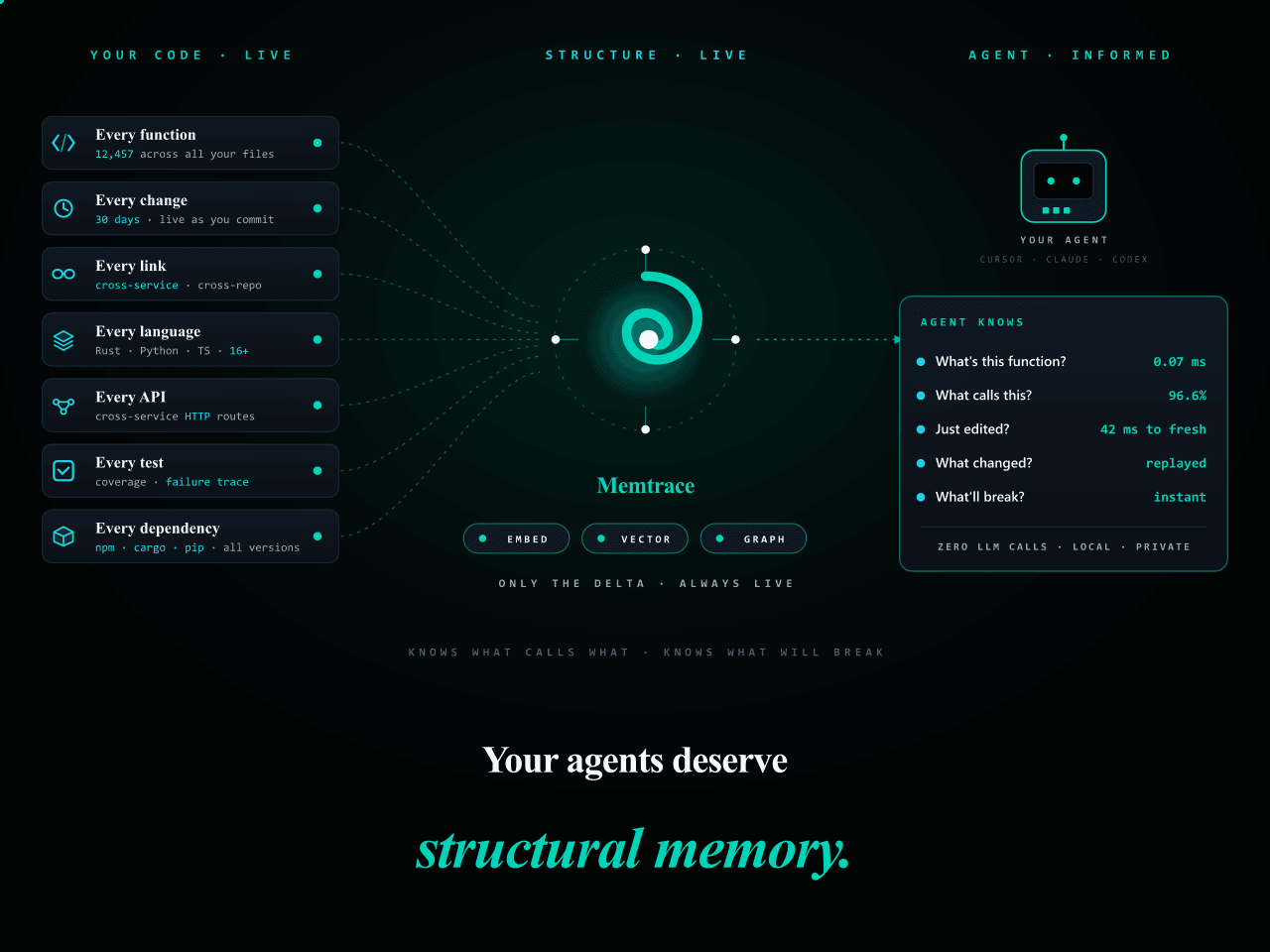 syncable-dev/memtrace-public
Structural memory for AI coding agents. Bi-temporal graph, MCP-native, zero LLM calls. Cursor · Claude Code · Codex · De…
syncable-dev/memtrace-public
Structural memory for AI coding agents. Bi-temporal graph, MCP-native, zero LLM calls. Cursor · Claude Code · Codex · De…
-
 text2future/flowix
Notes for you, Memory for your agents. / 内置 Deepseek harness Agent / 适用 办公 & 写作 & Coding
text2future/flowix
Notes for you, Memory for your agents. / 内置 Deepseek harness Agent / 适用 办公 & 写作 & Coding