adoresever/graph-memory
Deepseek Harness、Openclaw知识图谱记忆插件。2026年4月受邀发布在清华大学讨论会。知识图谱+记忆;OpenClaw的知识图谱上下文引擎——从对话中提取结构化三元组,压缩上下文75%,支持跨会话经验复用。
Project Overview项目介绍
Graph Memory is a native memory plugin built specifically for DeepSeek Harness, with added compatibility for OpenClaw. To install it on DSH, you first need to confirm you have Node.js 22.13 or higher installed, then run the official command: npx @deepseek-ai/dsh plugin --profile web add github:adoresever/graph-memory#v1.6.0-beta.16. It manages model-visible conversation context by keeping the 5 most recent user turns, archiving older history, and building a local knowledge graph to recall relevant source-backed knowledge when needed, without deleting DSH’s original event log. It reduces total token usage for long conversations by up to 80% compared to the default DSH baseline, according to project benchmarks.
This plugin is targeted at users who handle long-term development and complex tasks on the DeepSeek Harness platform. Its standard automatic workflow runs one auxiliary LLM call after each completed conversation turn to extract a turn summary, SPO triples, and add new structured nodes to the local knowledge graph. It automatically matches relevant historical knowledge to new conversation prompts, injects the sourced recalled content into the current context, and keeps the total token count low enough for extended work sessions.
Graph Memory is released under the open-source MIT license, so it is free to use, modify, and distribute. The current beta version 1.6.0-beta.16 has passed all 138 automated tests, and any failed structured extractions are quarantined so they will never block foreground conversations. To enable embedding-based recall, users need to set environment variables for an OpenAI-compatible embedding endpoint before starting their DSH session.
这是一款原生适配 DeepSeek Harness 的记忆插件,同时也兼容 OpenClaw。它的核心能力是管理对话上下文,默认保留最近 5 个完成的用户轮次,将更早的历史归档,同时构建知识图,在需要时自动召回带原始来源的知识。它不会删除 DSH 原有的事件日志,通过控制模型可见的上下文范围,大幅减少长对话的令牌占用。
面向使用 DSH 进行长周期开发和复杂任务处理的用户,它的典型工作流是每完成一个对话轮次,自动调用辅助大模型提取轮次摘要、SPO 三元组,构建本地知识图节点,归档旧上下文。开启新对话后,它会自动匹配相关历史知识,将召回内容加入当前上下文,既压缩了整体上下文规模,又完整保留了关键历史信息。
该项目依赖 Node.js 22.13 以上版本,采用 MIT 许可证开源免费使用。目前是 1.6.0-beta.16 测试版,已通过全部 138 项自动化测试,结构化提取失败的内容会被隔离,不会阻塞前台对话。首次安装可通过 DSH 官方命令从 GitHub 拉取,需要配置环境变量接入嵌入模型端点。
请帮我安装这个 DSH 插件。安装前先完成【兼容性检查 + 安全性检查】,检查通过再动手。

插件:graph-memory(adoresever/graph-memory)
仓库:https://github.com/adoresever/graph-memory
本站详情页:https://www.yhbd.top/plugins/adoresever-graph-memory/
本站登记:类型 plugin · 归类 原生 DSH 插件 · 许可证 MIT · ⭐ 636 · 最近提交 2026-10-01 · 主语言 TypeScript

按下面顺序执行,每步先把结论告诉我,再进入下一步:

【1 兼容性检查】
① 我这边:DSH 版本、Node 版本、操作系统、当前 profile(web / desktop)。
② 读它的 README、package.json、插件 manifest,列出它要求的 DSH 版本 / Node 版本 / 操作系统 / 外部依赖 / 需要另外先装的运行时。
③ 逐条比对,结论只写「满足 / 不满足 / 未知」三种;不满足的给出可行替代方案。
④ 检查是否和我已装的插件冲突:命令名重复、skill / tool 重名、端口占用、重复注册的 MCP server。

【2 安全性检查】
① 仓库可信度:和上面「本站登记」是否一致;star / fork 数、创建时间、最近提交,是否归档或长期停更。
② 安装脚本:逐行看 package.json 的 preinstall / install / postinstall,以及 install.sh、setup.ps1 之类脚本。出现 curl|bash、下载后直接执行、混淆代码、访问与插件功能无关的域名,立刻停下来告诉我,不要继续装。
③ 依赖:列出新增依赖,标出无人维护、或与知名包拼写近似的可疑包(typosquatting)。
④ 权限与副作用:它会读写哪些目录、访问哪些域名、需要哪些 DSH 权限(filesystem / network / shell / clipboard 等),以及怎么卸载和回滚。
⑤ 如果它要求 sudo / 管理员权限,或权限明显超出功能所需,先停下来问我。

【3 安装】
上面两步没有「不满足」和「高危项」时才执行;用官方推荐方式安装,不要自行提权。

【4 汇报】
用表格输出:检查项 / 结论 / 依据 / 是否需要我决策。拿不准的一律写「未知」并说明要我怎么确认——不要猜,也不要替我决定。
Send this message to DSH in your current session: it verifies compatibility and security first (answering met / not met / unknown item by item) and only installs once everything checks out — it will stop and ask you if it finds a high-risk item. The box scrolls; the copy is the full prompt. CLI install commands may not be accurate across systems, so DSH is the safer route.把上面这条消息直接发给当前会话里的 DSH:它会先核对兼容性与安全性(逐条给「满足 / 不满足 / 未知」),确认没问题再安装,有高危项会停下来问你。框内可滚动,复制到的是完整提示词;安装命令不一定准确,发给 DSH 更稳。
- This site's static screen found no obvious risk signal (stars, license, activity, manifest)本站静态筛查没发现明显风险信号(星标、许可证、更新活跃度、清单完整度)
DSH walks through these 9 checksDSH 会逐条核对这 9 项
Compatibility兼容性
- DSH, Node, OS and profile requirementsDSH 版本 / Node 版本 / 操作系统 / profile 是否满足要求
- External dependencies and runtimes (Electron / Python / Docker, ...)外部依赖与运行时(Electron / Python / Docker 等)是否齐备
- Conflicts with installed plugins: command names, skill / tool names, ports, duplicate MCP registration与已装插件是否冲突:命令名、skill / tool 重名、端口占用、重复 MCP 注册
Security安全性
- Repo matches the facts registered here; archived or abandoned?仓库是否与页面登记一致,是否归档或长期停更
- Safety of preinstall / install / postinstall and install.sh / setup.ps1preinstall / install / postinstall 与 install.sh、setup.ps1 是否安全
- curl|bash, download-then-execute, obfuscation, unrelated domains → stop immediatelycurl|bash、下载即执行、混淆代码、无关域名 → 立刻停止
- Typosquatting or unmaintained packages among the new dependencies新增依赖里有没有 typosquatting 或无人维护的包
- Requested permissions vs. what the feature actually needs申请了哪些权限、是否超出功能所需(filesystem / network / shell / clipboard)
- Any sudo / admin requirement, plus uninstall and rollback是否要求 sudo / 管理员权限,以及卸载与回滚方式
Anything uncertain must be marked unknown with a note on how to confirm it. This site's signal screen is a static snapshot, not a security audit.拿不准的必须标「未知」并说明要我怎么确认。本站的信号筛查是静态快照,不能替代安全审计。
Or use CLI install (for developers)或使用命令行安装(适合开发者)
CLI Install命令行安装
npx @deepseek-ai/dsh plugin --profile web add github:adoresever/graph-memory#v1.6.0-beta.17把 adoresever/graph-memory 加入你的 DSH 配置(web profile)即可启用。
READMEREADME
Graph Memory
Bound the context. Keep the memory.
A native DeepSeek Harness memory plugin that keeps recent conversation turns, archives older history, and recalls exact source-backed knowledge when it matters.
中文 · dsh.so · 20-turn benchmark · Upgrade guide


The problem it solves
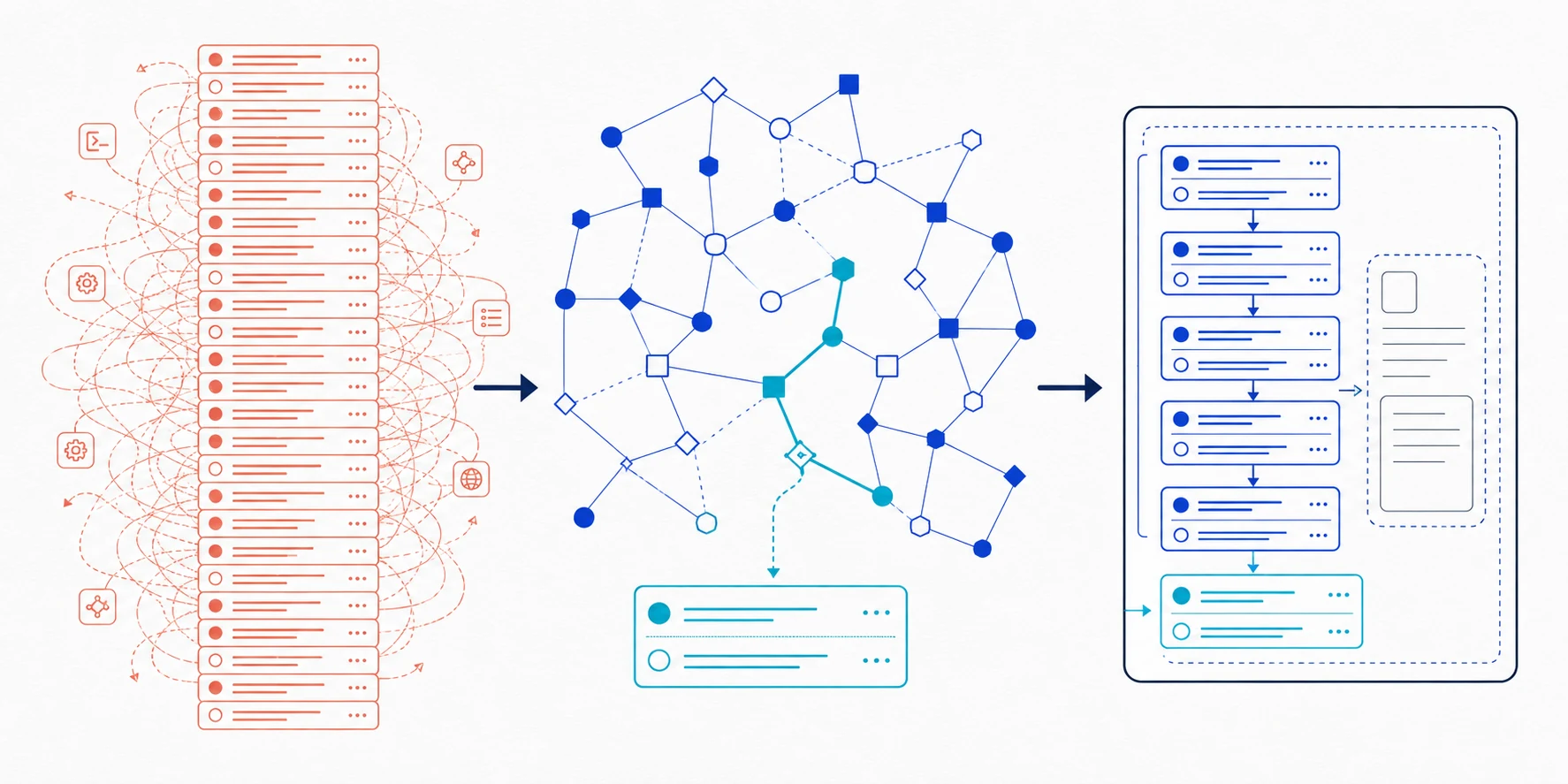
Graph Memory owns the model-visible historical surface without deleting DSH's event log. By default it keeps the newest five completed user turns, removes completed reasoning/tool traces from future requests, and recalls relevant older or cross-session source Q/A automatically.
The 1.6 turn-memory navigation upgrade
| Before | Now |
|---|---|
| Extract TASK / SKILL / EVENT directly from messages | Create one self-contained turn summary, then derive SPO from that same sentence |
| Graph nodes could become the factual payload | Summary, SPO, and communities only navigate; original question and final answer remain the evidence |
| Old memories from the active session could be filtered wholesale | Exclude only sources still visible in the fresh window; archived same-session and cross-session recall share one path |
| Community expansion could pull a whole neighborhood | Local LPA narrows candidates, query-time PPR ranks them, and only matched Q/A is recovered |
| DSH retained complete tool and reasoning traces | Completed turns retain question + final answer; older prefixes collapse to one fixed marker |
Showing the opening section of the README — the full document lives in the repository以上为 README 开头摘要,完整文档在仓库内 · View the full README on GitHub →在 GitHub 查看完整 README →
Related相关推荐
-
 vshulcz/deja-vu
The most accurate, cheapest and fastest memory for coding agents: searchable session history from Claude Code, Codex, Cu…
vshulcz/deja-vu
The most accurate, cheapest and fastest memory for coding agents: searchable session history from Claude Code, Codex, Cu…
-
 mnemon-dev/mnemon
LLM-supervised persistent memory for AI agents — graph-based recall, cross-session knowledge, single binary. Works with …
mnemon-dev/mnemon
LLM-supervised persistent memory for AI agents — graph-based recall, cross-session knowledge, single binary. Works with …
-
 Phant0Meow/dsh-meow-memory
Cross-session memory plugin for DeepSeek Harness: seven-layer SQLite store (soul/user/project/fact/lesson/topic/rules), …
Phant0Meow/dsh-meow-memory
Cross-session memory plugin for DeepSeek Harness: seven-layer SQLite store (soul/user/project/fact/lesson/topic/rules), …
-
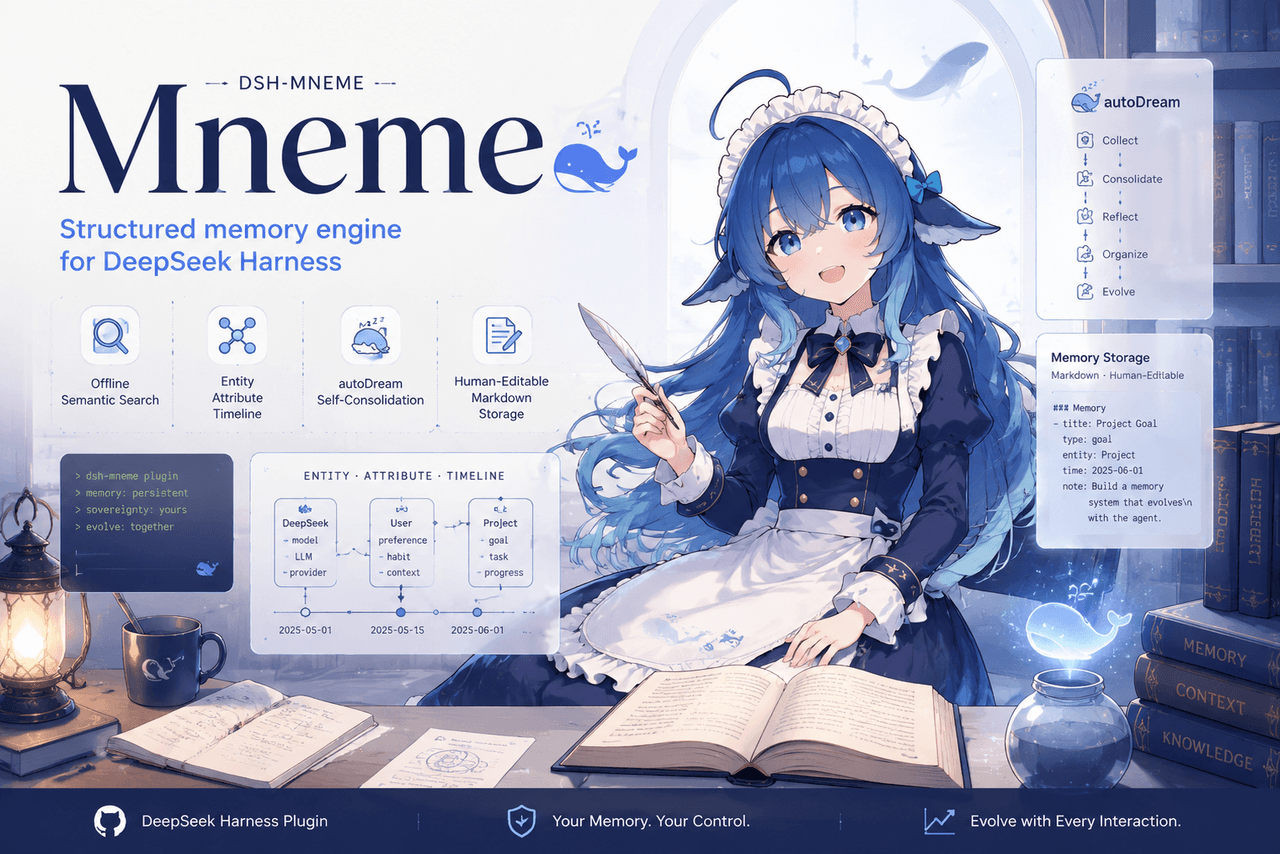 slow-stack/mneme
🧠 The memory that dreams — cross-session memory for DeepSeek Harness. Offline & private, auto-consolidates in its sleep…
slow-stack/mneme
🧠 The memory that dreams — cross-session memory for DeepSeek Harness. Offline & private, auto-consolidates in its sleep…
- hg1048596-pixel/dsh-recall-unread DeepSeek Harness (DSH) 插件:在模型读取前撤回已发送的文字消息,支持单条与全部撤回。A DeepSeek Harness plugin that recalls sent-but-unread text message…
- Tasihi89/dsh-talk-map Visual conversation map for DeepSeek Harness — sessions as cards on a whiteboard: drag to arrange, double-click to chat,…
-
 Aik358/dsh-auto-memory
Proactive associative memory for DSH: system-prompt recall before the model speaks, three-layer auto-consolidation, skil…
Aik358/dsh-auto-memory
Proactive associative memory for DSH: system-prompt recall before the model speaks, three-layer auto-consolidation, skil…
-
 JingxuanC/causal-memory
Causal memory layer for AI agents — MCP server that records decision→outcome relationships. Survives compaction.
JingxuanC/causal-memory
Causal memory layer for AI agents — MCP server that records decision→outcome relationships. Survives compaction.