tomowang/dsh-tui
DeepSeek Harness(dsh)的开源终端前门。
Project Overview项目介绍
dsh-tui is an open-source terminal-native user interface built specifically for DeepSeek Harness (DSH). It is distributed as an out-of-tree DSH bundle that builds on top of the official @deepseek-ai/dsh-base, matching the core structure of the official pre-built web app and headless bundles. It provides a full-screen alternate buffer terminal interface for interacting with DSH agents, instead of requiring a separate browser-based workflow. It is packaged both as a Cordis plugin that handles terminal input and output rendering, and as a valid DSH bundle with required bundle metadata in its root package.json.
This tool is designed for developers who prefer to keep their entire workflow inside the terminal, without needing to switch context to a browser to interact with the DSH agent. The core workflow starts with launching a new DSH session through the TUI, then you can input prompts, view agent output, manage LLM providers, switch agent presets, and browse past sessions all from within the terminal. It supports full keyboard navigation, scrollable transcript views, and inline command execution for common session management tasks. Every interaction, from starting a session to approving tool calls, can be completed without leaving the terminal.
dsh-tui requires both stdin and stdout to be connected to a real TTY, so it does not support being called via pipes or non-interactive terminal sessions. It is released under the permissive MIT open source license, so it is free to use, modify, and distribute with no restrictions. For local development, you need pnpm installed to handle dependencies; after cloning the repository, run pnpm install to install dependencies, then run pnpm run build to compile TypeScript source to the lib/ directory. You can then link the local build to your existing DSH profile to test changes.
dsh-tui 是面向 DeepSeek Harness(DSH)的开源终端用户界面客户端。作为 DSH 的外部树外模式包,它和官方自带的 dsh-web-app、dsh-headless 一样基于 @deepseek-ai/dsh-base 构建,区别在于它从终端驱动代理运行,而非依赖浏览器。它同时是提供终端输入输出能力的 Cordis 插件,也是符合 DSH 规范的包。
它面向偏好全程在终端工作、无需切换到浏览器与 DSH 代理交互的开发者。典型工作流是通过这个 TUI 启动新的 DSH 会话,直接在终端输入提示、查看代理输出、管理 LLM 提供商、切换代理预设,所有操作都可以在不离开终端环境的情况下完成,适配终端优先的开发工作流。
它要求标准输入和输出都必须是真实 TTY,不支持管道模式调用。项目采用宽松的 MIT 开源许可证发布,无使用成本限制。本地开发需要先通过 pnpm 安装依赖,将 TypeScript 源码构建到 lib 目录,再链接到本地 DSH 配置文件中即可测试。
请帮我安装这个 DSH 插件。安装前先完成【兼容性检查 + 安全性检查】,检查通过再动手。

插件:dsh-tui(tomowang/dsh-tui)
仓库:https://github.com/tomowang/dsh-tui
本站详情页:https://www.yhbd.top/plugins/tomowang-dsh-tui/
本站登记:类型 client · 归类 原生 DSH 插件 · 许可证 MIT · ⭐ 20 · 最近提交 2026-09-28 · 主语言 TypeScript

按下面顺序执行,每步先把结论告诉我,再进入下一步:

【1 兼容性检查】
① 我这边:DSH 版本、Node 版本、操作系统、当前 profile(web / desktop)。
② 读它的 README、package.json、插件 manifest,列出它要求的 DSH 版本 / Node 版本 / 操作系统 / 外部依赖 / 需要另外先装的运行时。
③ 逐条比对,结论只写「满足 / 不满足 / 未知」三种;不满足的给出可行替代方案。
④ 检查是否和我已装的插件冲突:命令名重复、skill / tool 重名、端口占用、重复注册的 MCP server。

【2 安全性检查】
① 仓库可信度:和上面「本站登记」是否一致;star / fork 数、创建时间、最近提交,是否归档或长期停更。
② 安装脚本:逐行看 package.json 的 preinstall / install / postinstall,以及 install.sh、setup.ps1 之类脚本。出现 curl|bash、下载后直接执行、混淆代码、访问与插件功能无关的域名,立刻停下来告诉我,不要继续装。
③ 依赖:列出新增依赖,标出无人维护、或与知名包拼写近似的可疑包(typosquatting)。
④ 权限与副作用:它会读写哪些目录、访问哪些域名、需要哪些 DSH 权限(filesystem / network / shell / clipboard 等),以及怎么卸载和回滚。
⑤ 如果它要求 sudo / 管理员权限,或权限明显超出功能所需,先停下来问我。

【3 安装】
上面两步没有「不满足」和「高危项」时才执行;用官方推荐方式安装,不要自行提权。

【4 汇报】
用表格输出:检查项 / 结论 / 依据 / 是否需要我决策。拿不准的一律写「未知」并说明要我怎么确认——不要猜,也不要替我决定。
Send this message to DSH in your current session: it verifies compatibility and security first (answering met / not met / unknown item by item) and only installs once everything checks out — it will stop and ask you if it finds a high-risk item. The box scrolls; the copy is the full prompt. CLI install commands may not be accurate across systems, so DSH is the safer route.把上面这条消息直接发给当前会话里的 DSH:它会先核对兼容性与安全性(逐条给「满足 / 不满足 / 未知」),确认没问题再安装,有高危项会停下来问你。框内可滚动,复制到的是完整提示词;安装命令不一定准确,发给 DSH 更稳。
- 20 stars - an early-stage project星标 20,属于早期项目
DSH walks through these 9 checksDSH 会逐条核对这 9 项
Compatibility兼容性
- DSH, Node, OS and profile requirementsDSH 版本 / Node 版本 / 操作系统 / profile 是否满足要求
- External dependencies and runtimes (Electron / Python / Docker, ...)外部依赖与运行时(Electron / Python / Docker 等)是否齐备
- Conflicts with installed plugins: command names, skill / tool names, ports, duplicate MCP registration与已装插件是否冲突:命令名、skill / tool 重名、端口占用、重复 MCP 注册
Security安全性
- Repo matches the facts registered here; archived or abandoned?仓库是否与页面登记一致,是否归档或长期停更
- Safety of preinstall / install / postinstall and install.sh / setup.ps1preinstall / install / postinstall 与 install.sh、setup.ps1 是否安全
- curl|bash, download-then-execute, obfuscation, unrelated domains → stop immediatelycurl|bash、下载即执行、混淆代码、无关域名 → 立刻停止
- Typosquatting or unmaintained packages among the new dependencies新增依赖里有没有 typosquatting 或无人维护的包
- Requested permissions vs. what the feature actually needs申请了哪些权限、是否超出功能所需(filesystem / network / shell / clipboard)
- Any sudo / admin requirement, plus uninstall and rollback是否要求 sudo / 管理员权限,以及卸载与回滚方式
Anything uncertain must be marked unknown with a note on how to confirm it. This site's signal screen is a static snapshot, not a security audit.拿不准的必须标「未知」并说明要我怎么确认。本站的信号筛查是静态快照,不能替代安全审计。
Or use CLI install (for developers)或使用命令行安装(适合开发者)
CLI Install命令行安装
dsh plugin --profile tui add @tomowang/dsh-tui把 tomowang/dsh-tui 加入你的 DSH 配置(web profile)即可启用。
READMEREADME
dsh-tui


An open-source terminal front door for DeepSeek Harness (dsh).
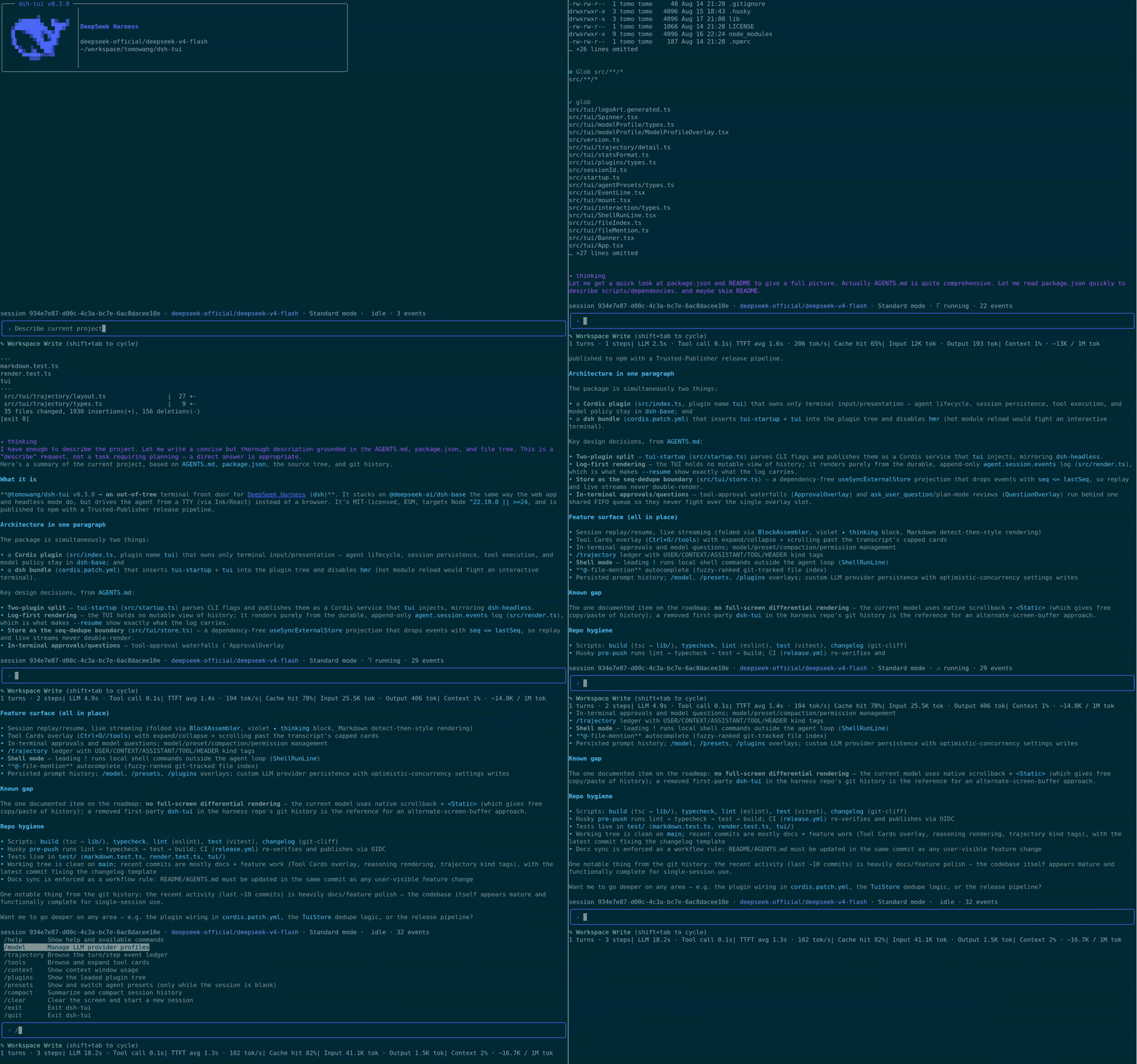
@tomowang/dsh-tui is an out-of-tree mode bundle: it stacks on @deepseek-ai/dsh-base exactly like the shipped dsh-web-app and dsh-headless bundles do, but drives the agent from your terminal instead of a browser. The package is both a Cordis plugin (terminal input and presentation) and a dsh bundle (dsh.bundle.patch in package.json points at cordis.patch.yml); everything else — model adapters, tools, session persistence, sandbox and approval policy — stays in dsh-base and remains patchable underneath.
How it works
- The TUI renders only from the durable session log: it replays
agent.session.snapshotEvents()on startup and followssession/eventlive, so--resumeshows the exact history the log carries — the harness's "model-visible ⟺ logged" invariant does the heavy lifting. - The interface runs full-screen in the terminal's alternate screen buffer, with an application-owned transcript viewport (scroll with the mouse wheel/trackpad,
PageUp/PageDown) that auto-follows new output until you scroll up. - Line input maps to the agent inbox:
agent.followup()while idle,agent.steer()while a turn is running,Ctrl+Ccancels the running turn. tui-startupparses this app's flags (everything after the launcher's own) throughdsh-cmdlineand publishes them as an ordinary Cordis service; the runner row reads them via the bundle patch, mirroringdsh-headless.- Both stdin and stdout must be real TTYs; the plugin fails loud instead of degrading, so pipes keep using
dsh --profile headless.
Showing the opening section of the README — the full document lives in the repository以上为 README 开头摘要,完整文档在仓库内 · View the full README on GitHub →在 GitHub 查看完整 README →
Related相关推荐
-
 ccch1mneyyy/dsh-TUI
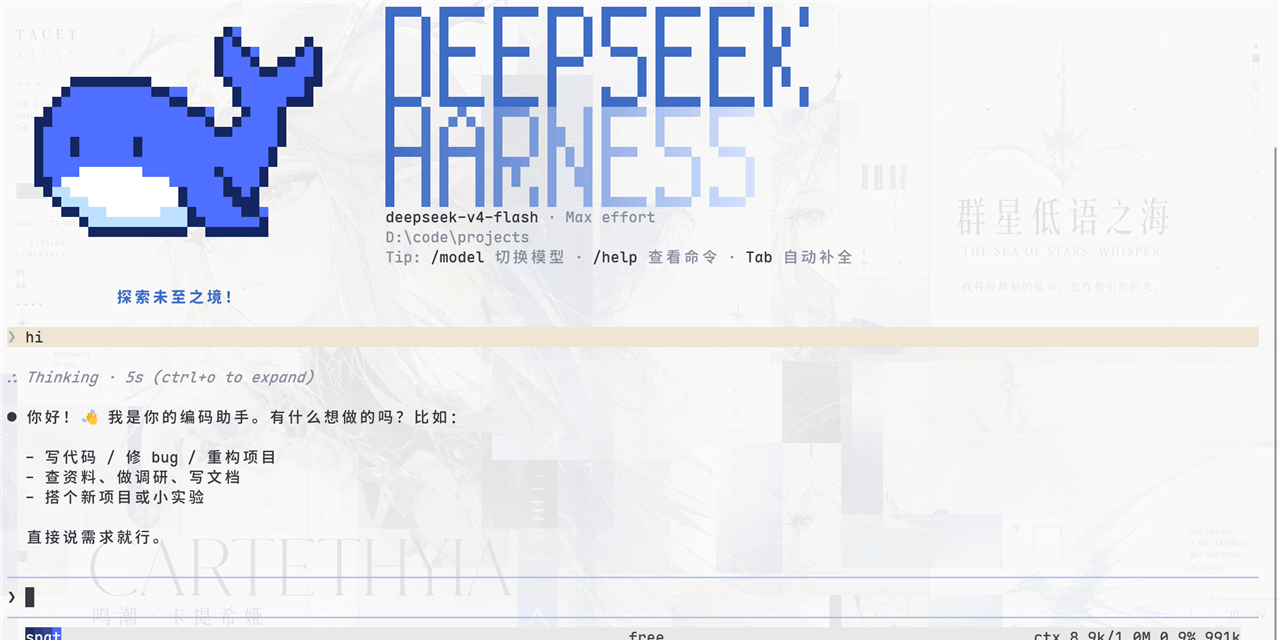
DSH's officially top-recommended TUI plugin — high performance, low overhead, cute pixel whale, smooth mouse interaction…
ccch1mneyyy/dsh-TUI
DSH's officially top-recommended TUI plugin — high performance, low overhead, cute pixel whale, smooth mouse interaction…
-
 xyTom/coding-tools-mcp
Give any AI agent the ability to code
xyTom/coding-tools-mcp
Give any AI agent the ability to code
-
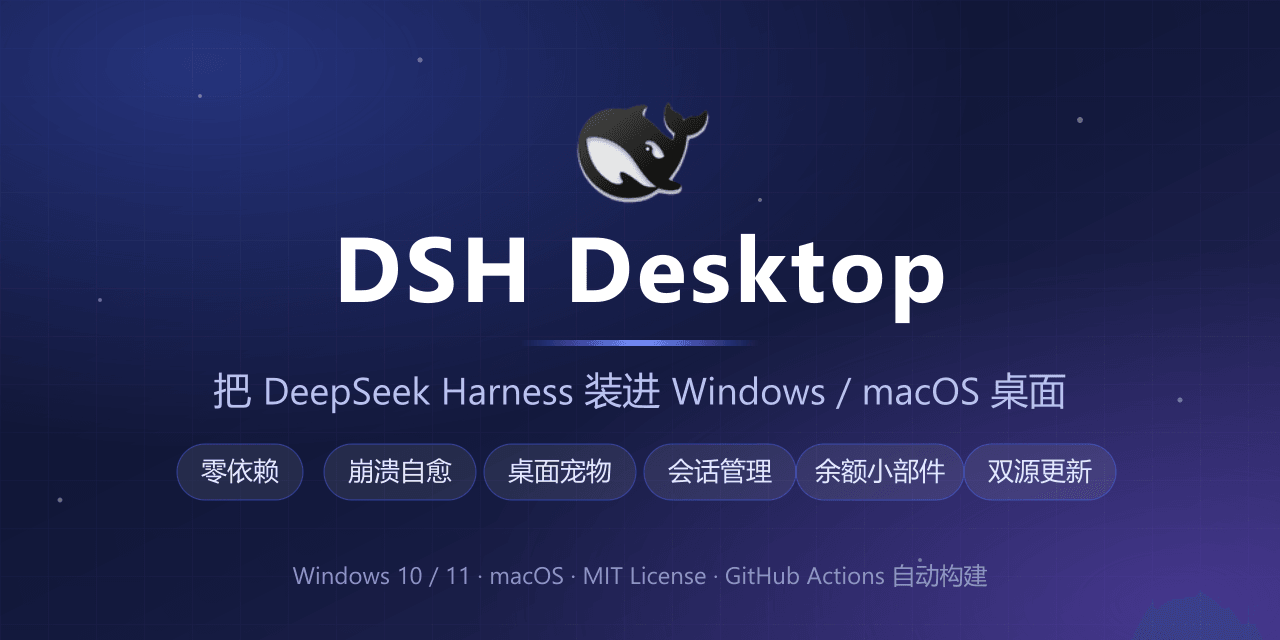 myYangyunfan/dsh_desktop
DeepSeek Harness (dsh) Windows desktop client - bundled Node.js + dsh CLI, one-click launch
myYangyunfan/dsh_desktop
DeepSeek Harness (dsh) Windows desktop client - bundled Node.js + dsh CLI, one-click launch
-
 ChisaAlter/Deepseek-Harness-Desktop
DSH桌面端,支持主题和背景图等多种个性化配置。Electron desktop shell for DeepSeek Harness web UI
ChisaAlter/Deepseek-Harness-Desktop
DSH桌面端,支持主题和背景图等多种个性化配置。Electron desktop shell for DeepSeek Harness web UI
-
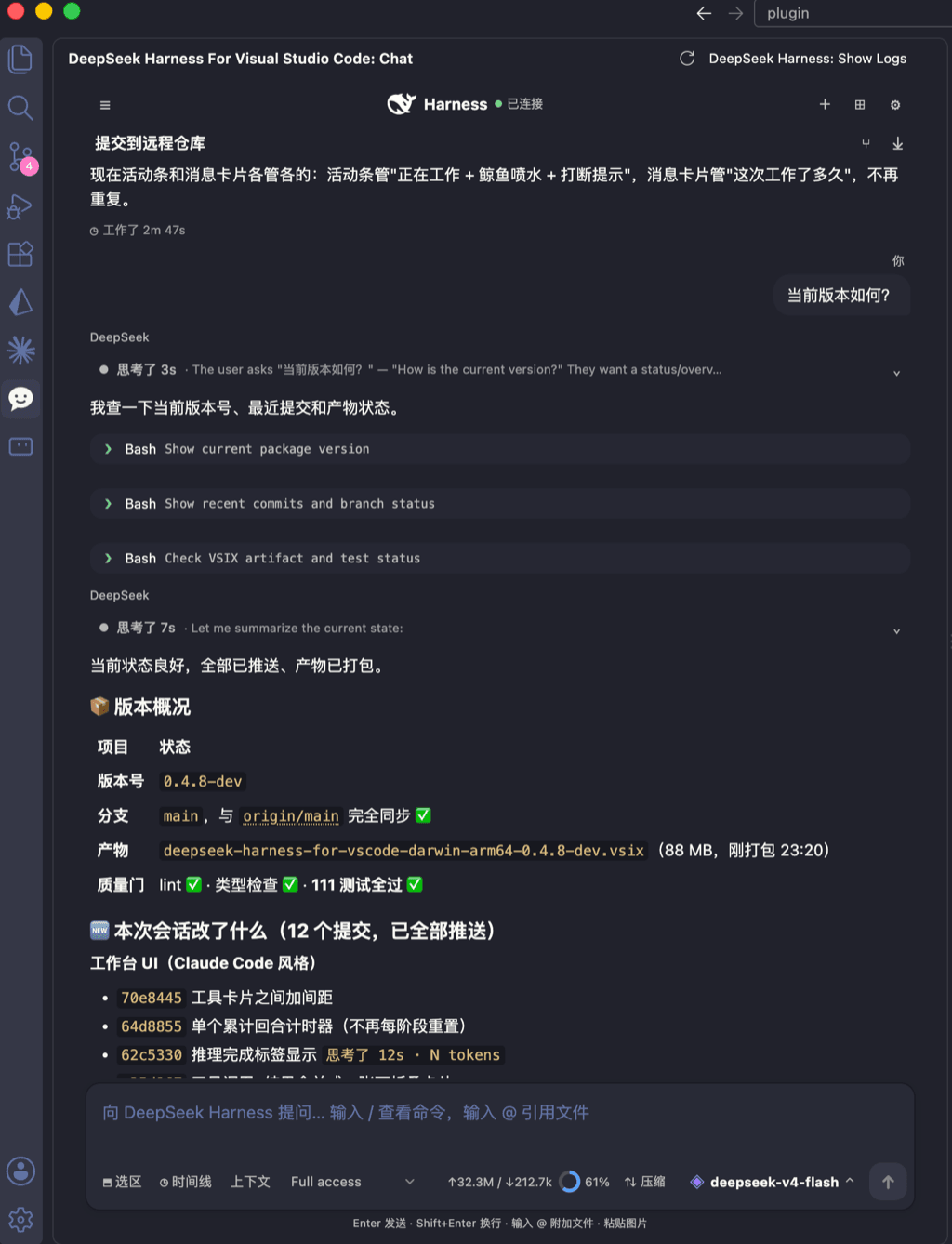 skymecode/deepseek-harness-for-vscode
deepseek-harness for vscode .A native VS Code coding-agent extension for DeepSeek Harness. Streamlined workbench with se…
skymecode/deepseek-harness-for-vscode
deepseek-harness for vscode .A native VS Code coding-agent extension for DeepSeek Harness. Streamlined workbench with se…
- Yan-Zero/dsh-std
-
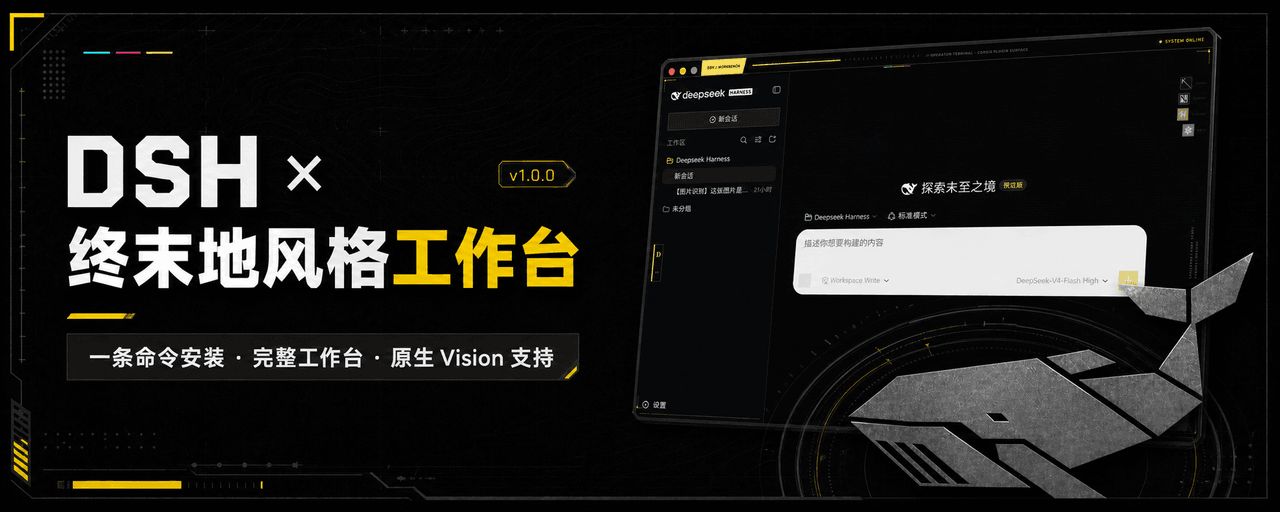 rison114514/dsh-endfield-ui
Endfield-inspired industrial UI shell for DeepSeek Harness (dsh) — non-official fan theme. Install: dsh plugin --profile…
rison114514/dsh-endfield-ui
Endfield-inspired industrial UI shell for DeepSeek Harness (dsh) — non-official fan theme. Install: dsh plugin --profile…
-
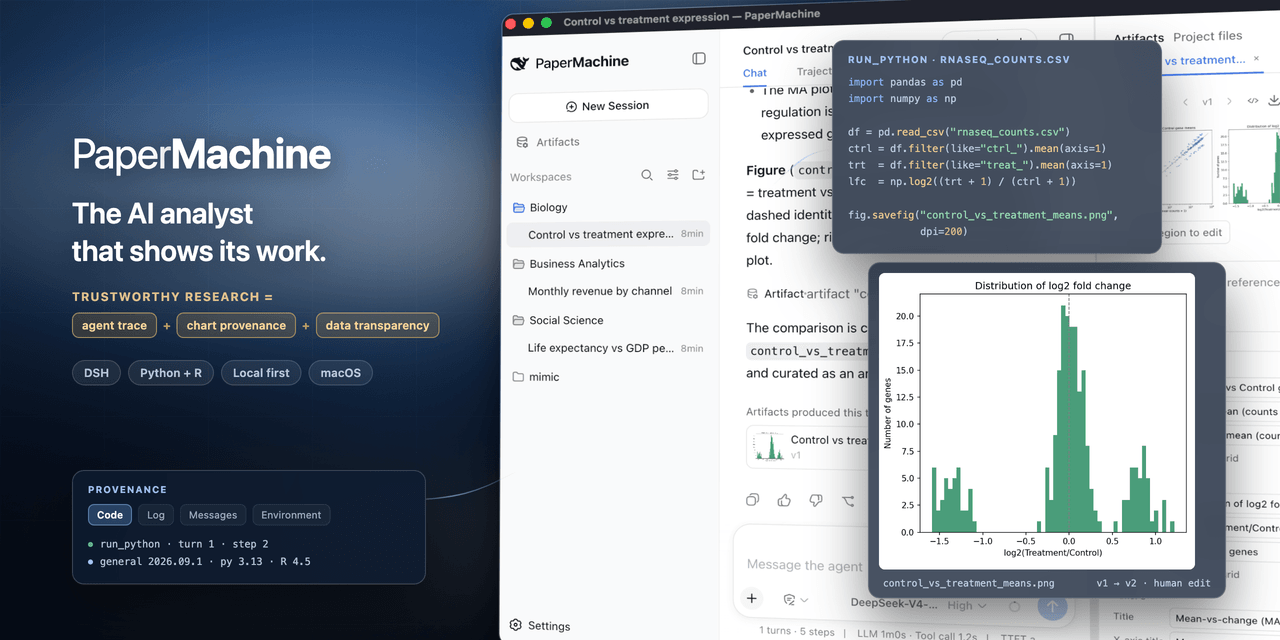 SuperJJ007/papermachine
The AI analyst that shows its work. Runs Python and R on your own machine, and traces every chart back to the code behin…
SuperJJ007/papermachine
The AI analyst that shows its work. Runs Python and R on your own machine, and traces every chart back to the code behin…