Yiipu/dsh-agentmemory
一个DSH(DeepSeek Harness)Cordis插件,将会话活动桥接到agentmemory,一个本地、自托管的记忆守护进程。
项目介绍Project Overview
dsh-agentmemory 是一款 DSH Cordis 插件,把每次会话的活动以标准 hookType 写入本地自托管的 agentmemory 守护进程,并在上下文窗口按需注入历史记忆。同时向模型注册 memory_recall、memory_remember 工具,供显式检索与写入使用。适用于希望跨会话保留工具调用、错误与决策痕迹的 dsh 场景。需注意:agentmemory 是硬依赖,启动前必须先运行守护进程,否则插件加载失败。
dsh-agentmemory is a DSH Cordis plugin that gives every dsh session a persistent, searchable memory by writing session activity into a local agentmemory daemon as standard hookType observations and injecting recalled context at the right steps. It also registers memory_recall and memory_remember as model tools for explicit lookups. Use it when you need cross-session continuity for tool calls, errors, and decisions. Caveat: the agentmemory daemon is a hard dependency, and the plugin fails to load if it is unreachable.
请帮我了解并安装插件:【dsh-agentmemory】【https://github.com/Yiipu/dsh-agentmemory】把上面这条消息直接发给当前会话里的 DSH,让它帮你了解并安装。安装命令不一定准确,发给 DSH 更稳。Send this message to DSH in your current session. CLI install commands may not be accurate across systems — DSH will figure it out for you.
或使用命令行安装(适合开发者)Or use CLI install (for developers)
命令行安装CLI Install
dsh plugin --profile web add github:Yiipu/dsh-agentmemory把 Yiipu/dsh-agentmemory 加入你的 DSH 配置(web profile)即可启用。
READMEREADME
dsh-agentmemory
A DSH (DeepSeek Harness) Cordis plugin that gives every dsh session a persistent, searchable memory in agentmemory — a local, self-hosted memory daemon with a REST API.
English | 中文
dsh sessions are ephemeral: once a session ends, everything the agent learned — the tool calls it made, the errors it recovered from, the decisions it settled on — is gone. agentmemory fixes that with cross-session, cross-harness persistence (it already serves Claude Code, OpenCode, Hermes and more). This plugin is the dsh side of that ecosystem: it writes every session's activity into the daemon as observations, reads memory back into the model at the right moments, and exposes explicit memory tools the agent can call.
Three surfaces, one plugin:
| Surface | What it does |
|---|---|
| Write (observation bridge) | Maps every DSH session event to an agentmemory standard hookType so the daemon's compression pipeline, search index, and viewer all read real content — see the mapping registry |
| Read (context injection) | Appends sourced user/message rows via the agent/pre-step waterfall: a project recall window once per session, optional per-message semantic recall, and a pre-compaction re-inject |
| Agent tools | memory_recall / memory_remember, registered as model tools for explicit, precise recall and curated writes |
agentmemory is a hard dependency. On load, the plugin checks
<baseUrl>/agentmemory/livezbefore registering any capability. If the daemon is unreachable or does not reportstatus: ok, the plugin fails to load loudly — it does not silently degrade.
All configuration comes from the plugin's row in cordis.yml — editing the config field of that row (or the file that carries it) is how you change configuration. There is no browser UI and no persisted config file.
Install (static composition)
Start the agentmemory daemon first (default http://localhost:3111) — the plugin's load gate requires it. Then install the package from GitHub into a profile:
dsh plugin --profile web add github:Yiipu/dsh-agentmemory
(A local dev checkout also works via dsh plugin --profile web add /path/to/checkout.)
Mount the row from cordis-row.example.yml into a host composition cordis.yml (or into a per-session agent preset's composition under ${DSH_HOME:-$HOME/.dsh}/.agent-presets/<id>/). The minimal row is just {name} — Cordis validates it against the plugin's Config schema and fills defaults (quote the name if it is a scoped package, i.e. starts with @, which YAML treats as a reserved scalar):
- insert:
    - id: agentmemory-bridge
      name: "dsh-agentmemory"
      config:
        baseUrl: http://localhost:3111
        enabled: true
Requires Node >= 20 and a
shellcapability seam (the standard bash/pwsh executors). Validation commands: see Verification.
DSH event → agentmemory mapping registry
This table is the authoritative registry of what the bridge sends to the daemon. Every observation uses an agentmemory standard hookType — the daemon's mem::observe extracts searchable fields (prompt, tool_name, tool_input, tool_output) only for prompt_submit / post_tool_use / post_tool_failure; anything else keeps data in raw.raw and never reaches the synthetic narrative (title + toolInput/output/prompt) that search and compression read. The plugin therefore emits no custom hookTypes — every row lands in a bucket the daemon already knows.
| DSH event | agentmemory call | hookType | data fields |
dedup discriminator |
|---|---|---|---|---|
session/created |
POST /agentmemory/session/start (when enableSessionStartEnd) |
— | sessionId, project, cwd, agentId; the response's context is cached for injection |
— |
user/message |
observe |
prompt_submit |
prompt=content, source (plus a raw content) |
tool_input=content (identical prompts merge naturally) |
assistant/message |
observe |
post_tool_use |
tool_name='assistant_message', tool_output=content, provider, model (plus a raw content) |
tool_input='#'+seq (unique; content not in input) |
tool/call |
no observation row (see below) | — | — | — |
tool/result (ok) |
observe |
post_tool_use |
tool_name/tool_input/tool_output from the callMeta stash (falls back to event fields), plus callId and raw content |
tool_input=args |
tool/result (err) |
observe |
post_tool_failure |
same, plus isError: true and errorName |
tool_input=args |
turn/end |
observe |
post_tool_use |
tool_name='turn_end', tool_output=reason (e.g. completed) |
tool_input='turn#'+seq (unique) |
approval/asked |
observe |
notification |
notification_type='permission_prompt' + tool_name, request_id, call_id, reason |
no tool_input: the dedup hash covers the whole data, whose unique request id keeps distinct prompts apart |
compaction/start |
POST /agentmemory/context refresh + re-inject flag (when injectContext + injectContextOnCompaction) |
— | — | — |
compaction/summary |
POST /agentmemory/remember (when compactionBridge) |
— | content='[dsh compaction] '+summary, type='fact', concepts=['compaction'] |
— |
session/flush |
flush the buffered observations | — | — | — |
session/disposed |
final flush; POST /agentmemory/session/end (when enableSessionStartEnd) |
— | — | — |
Events not listed (boundaries, chunks, todo/write, request/*) are log-only noise and emit nothing.
Why tool/call emits no observation row
The tool/result row already carries name + args (via callMeta, stashed when the call event passes through) plus the output as one standard post_tool_use. A separate call row would either fall outside the fields the daemon extracts (custom hookType → empty narrative, unsearchable) or collide with the result row's dedup key (same tool_name + args) and silently drop the result's output. So the call is recorded, but only as metadata for the result row.
Why turn/end borrows post_tool_use
Purely so the turn's reason reaches tool_output and thus the searchable synthetic narrative — a custom hookType would leave it invisible. assistant/message does the same for its content.
Why approval/asked maps to notification
notification is the hookType Claude Code's Notification hook and OpenCode's permission events produce, so approval prompts from dsh land in the same typed, rendered bucket the daemon already knows. By design the daemon does not content-index notifications, so no field here needs extraction-friendly placement.
Why compaction/summary goes to /remember
The distilled summary is free, daemon-adjacent memory — persisting it as a durable fact means it survives the very history compression that produced it, instead of dying with the compacted transcript. Capped at 6000 chars, off via compactionBridge: false.
Dedup-safe design
agentmemory's mem::observe drops duplicates by sha256(sessionId, tool_name||hookType, tool_input[0..500]) with a 5-minute TTL; a hit discards the observation entirely. The bridge uses a per-session monotonic seq and natural content/callId as the tool_input discriminator, so multiple rows of the same kind all persist while identical prompts / identical (tool, args) results still merge naturally.
Memory injection (read side)
The bridge uses DSH's native agent/pre-step injection channel (the same pattern as the harness's built-in dsh-time-context plugin) and appends sourced user/message rows to the tail of the incoming message batch. Both routes deduplicate at the event level — they do not re-inject on every tool step. The front end renders each injection as an independent "context injection" block (ContextMessageNode).
Route 1 — Project recall (form: 'recall', on by default)
Injects once per session the agentmemory /context project-level cross-session window ("what this project has done before", excluding the current session). session/created → /session/start caches context from the response; the first step in agent/pre-step that has a cached window appends it once (injectedContext dedup); every user/message still refreshes the cache asynchronously.
Route 2 — Semantic recall (form: 'semantic', off by default)
Each user/message runs a /smart-search (BM25 + vector + graph) on the raw text and assembles the recalled memory titles into one injected message (semanticSeq dedups per message). Precise recall (/search) is still left to the agent's explicit memory_recall tool.
Pre-compaction re-inject (injectContextOnCompaction, on by default)
compaction/start triggers a /context refresh and the next agent/pre-step re-injects the latest project window so project background survives history compression.
Model tools
| Tool | Arguments | Description |
|---|---|---|
memory_recall |
query (required), limit?, project?, agentId? |
Auto-locates project from the calling session; recalls across sessions. Scope by project, and optionally by agentId (omit = across every agent of the project, so historical pre-agentId rows stay recallable). Written rows are stamped with the plugin agentId: env AGENT_ID → config agentId → default "dsh" |
memory_remember |
content (required), type?, concepts?, ttlDays? |
Curated, durable memory; type ∈ pattern/preference/architecture/bug/workflow/fact |
Tools are defined with defineTool and registered through ctx.tools.register, and daemon transport runs over the host shell seam (inject: ['tools', 'shell']); both are cleaned up automatically with the plugin Fiber lifecycle. On failure, execute returns {ok: false, error} rather than throwing.
Configuration keys
baseUrl, secret (below), enabled (lifecycle-bridge master switch: when false, no observations, session rows, or injection data sources — model tools stay live), enableTools, enableSessionStartEnd (mirror session/start and session/end rows), compactionBridge (persist compaction summaries via /remember, default true), agentId (identity stamped on written rows, default "dsh"), curlTimeoutMs, observeBatchLimit, maxContentChars, maxArgsChars,
injectContext (project recall switch, default true), injectContextMaxChars (default 6000), injectContextOnCompaction (pre-compaction re-inject, default true),
injectSemantic (semantic recall switch, default false), injectSemanticMaxResults (default 8), injectSemanticMaxChars (default 3000).
Keys omitted from a row are filled with defaults by Cordis according to the plugin's Config schema — do not hand-write a merge. Cordis validates natively: an invalid value (such as curlTimeoutMs: -5) makes the plugin fail to load with a clear error. The full numeric bounds (min/max) are declared on each key in index.js.
secret: plaintext or an environment-variable reference
secret accepts two forms — plaintext or an environment-variable reference (the latter with three variants); whether you write plaintext is your choice:
| Form | Behavior |
|---|---|
secret: "xxx" |
Plaintext, used verbatim as the Bearer token |
secret: '${AGENTMEMORY_SECRET}' |
Reads the env var; if unset → load fails (loudly) |
secret: '${AGENTMEMORY_SECRET:default}' |
Reads the env var; if unset → uses default |
secret: '${AGENTMEMORY_SECRET:?goes nowhere}' |
Reads the env var; if unset → fails with the message goes nowhere |
Environment variables are resolved through the shell seam at the start of apply() (the sandbox has no direct env access).
Model experience
What the model sees. The bridge does not alter accepted input. Its observable model input is additive after the incoming batch: one injected sourced user/message per dedup boundary, whose text is the project /context window (route 1), the semantic recall titles (route 2), or a pre-compaction re-inject of the project window (source.kind === 'plugin', plugin === 'agentmemory', form 'recall' / 'semantic'). Tool calls memory_recall and memory_remember are registered only when enableTools is true.
Token effect. Conditional. Injection contributes extra input tokens only at the dedup boundaries — once per session for project recall, once per user message for semantic recall when enabled, and once per compaction — not per tool step. Capped by injectContextMaxChars / injectSemanticMaxChars. Tool schemas add a small fixed token cost while enableTools is true. Tool responses are returned to the model's context window normally.
KV cache effect. Append-only, prefix-stable. Injected messages are appended at the tail of the step's message batch, so the prior message prefix is preserved and reusable; re-injection changes the suffix. The dedup conditions (injectedContext, injectedSemanticKey, compactionInject) prevent repeated appends of the same block at the same boundary, so a stable prefix is not invalidated by the bridge's own activity across steps.
Transport and failure semantics
- The sandbox has no
fetch/require/timers; outbound traffic goes through theshellcapability seam, one curl per call with the JSON body on stdin (--data-binary @-). - Never veto a lifecycle event: listeners are fully try/catch guarded; an
AbortSignalis honored on tool calls. - Infrastructure failures re-queue and retry at the next checkpoint; payload-level failures are logged and dropped.
- Flush race: if a flush is in flight when new events arrive, the
dirtyflag makes the in-flight loop re-send them, so nothing is lost.
Verification
node scripts/boot-check.mjs   # module + Config schema + daemon livez + peer deps (7 checks)
node test/smoke.mjs           # end-to-end (needs the daemon on :3111)
The smoke test covers the full registry above: schema validation, the livez hard gate, tool registration, all three secret env-reference forms, observation persistence (title/type/narrative shape), the approval → notification row, turn/end reason searchable in the narrative, no phantom tool/call row, the compaction → /remember bridge, and the agent/pre-step injection shape.
For local development — peer-dependency linking, smoke-fixture cleanup, the ESM cache — see DEVELOPMENT.md.
Known limitations
- Tool-side vs bridge-side project resolution: the observation bridge resolves the project as
AGENTMEMORY_PROJECT_NAMEenv → git toplevel → cwd basename, butmemory_recall/memory_rememberdefault to the session cwd basename only. When the session cwd is a subdirectory of a git repo, observations land under the toplevel project name while the tools query the cwd basename — passprojectexplicitly to bridge the gap. - Memory is shared across sessions by default (observations are stamped with the plugin agentId, not the DSH session id); to isolate one agent, set
agentIdor filtermemory_recallby it. - Agent isolation is opt-in: written rows carry the plugin agentId (env
AGENT_ID→ configagentId→ default"dsh"); rows written by plugin versions that predate agentId stamping haveagentIdundefined and stay recallable when the filter is omitted. - The bridge does not modify any
@deepseek-aipackage and does not touch the shipped preset install directory.
相关推荐Related
- says693/dsh-log-memory 一个抽象娱乐性插件,许多功能是错误的,但有点乐子,故此发出,主要功能是在dsh每次开启时,与使用中,隔一段时间提醒保存当前聊天记录,鱼话版主要考虑到跨设备办公,可以直接将另外一台设备的聊天记录直接喂给另外一台设备,人话版主要是想做
-
 Stu-KatoMegumi/dsh-message
dsh-message 是面向 DeepSeek Harness 的统一消息接入插件,仅包含微信、飞书、QQ、企业微信和钉钉。项目采用一套 Host/Client 插件、统一设置页和统一 HTTP Harness 会话链路,并在五个渠道上共…
Stu-KatoMegumi/dsh-message
dsh-message 是面向 DeepSeek Harness 的统一消息接入插件,仅包含微信、飞书、QQ、企业微信和钉钉。项目采用一套 Host/Client 插件、统一设置页和统一 HTTP Harness 会话链路,并在五个渠道上共…
- SiriusWJ/dsh-lite-memory DSH 简化版记忆插件:SQLite 条目化记忆(标题/重要程度/来源/内容,增删改查)+ 日历与到点提醒(月视图+时间轴+待执行/已完成双tab),对话面板记忆 tab 与设置二级菜单,中英双语自动跟随。
-
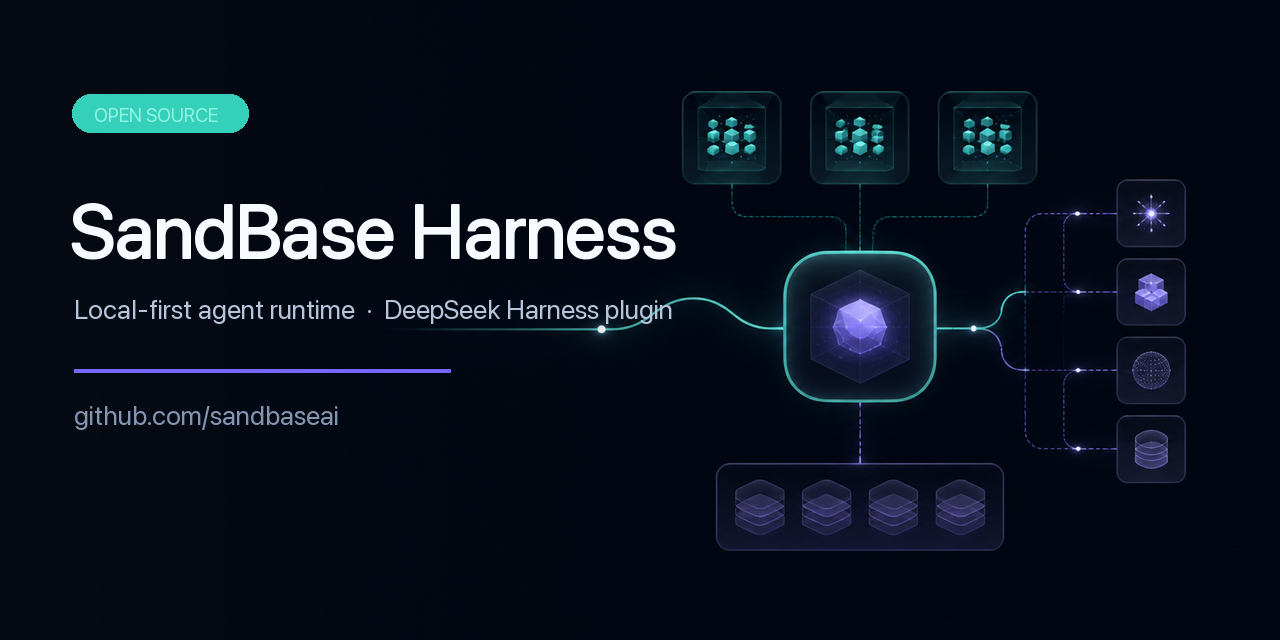 sandbaseai/sandbase-harness
Local-first AI agent runtime with sandboxed sessions, MCP tools, memory, credentials, audit/replay, and a built-in conso…
sandbaseai/sandbase-harness
Local-first AI agent runtime with sandboxed sessions, MCP tools, memory, credentials, audit/replay, and a built-in conso…
-
 adoresever/graph-memory
Deepseek Harness、Openclaw知识图谱记忆插件。2026年4月受邀发布在清华大学讨论会。Knowledge Graph + Memory;Knowledge Graph Context Engine for OpenCl…
adoresever/graph-memory
Deepseek Harness、Openclaw知识图谱记忆插件。2026年4月受邀发布在清华大学讨论会。Knowledge Graph + Memory;Knowledge Graph Context Engine for OpenCl…
-
 mnemon-dev/mnemon
LLM-supervised persistent memory for AI agents — graph-based recall, cross-session knowledge, single binary. Works with …
mnemon-dev/mnemon
LLM-supervised persistent memory for AI agents — graph-based recall, cross-session knowledge, single binary. Works with …
- hg1048596-pixel/dsh-recall-unread DeepSeek Harness (DSH) 插件:在模型读取前撤回已发送的文字消息,支持单条与全部撤回。A DeepSeek Harness plugin that recalls sent-but-unread text message…
-
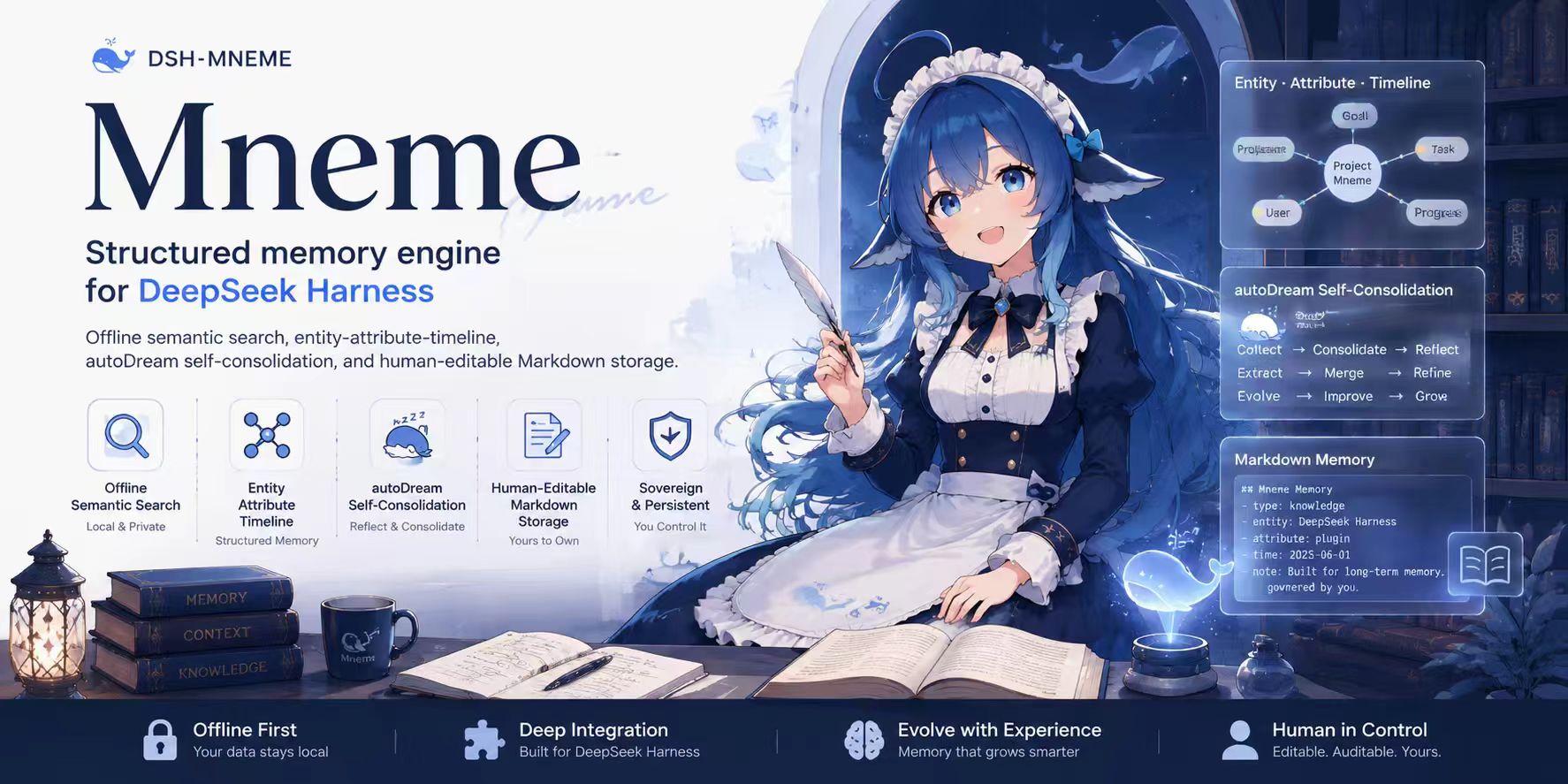 modusensus/dsh-mneme
🧠 The memory that dreams — self-evolving memory for DeepSeek Harness: your AI remembers across sessions, consolidates i…
modusensus/dsh-mneme
🧠 The memory that dreams — self-evolving memory for DeepSeek Harness: your AI remembers across sessions, consolidates i…