AI 训练与推理到底有什么区别?What Is the Difference Between AI Training and Inference?
这两个词在科技报道里天天出现,可它们究竟指什么?本文把 AI 模型生命中的两个阶段分开讲:学习阶段叫训练,工作阶段叫推理。
Both words turn up in tech coverage constantly — but what do they mean? This piece separates the two phases in the life of an AI model: the learning stage, training, and the working stage, inference.
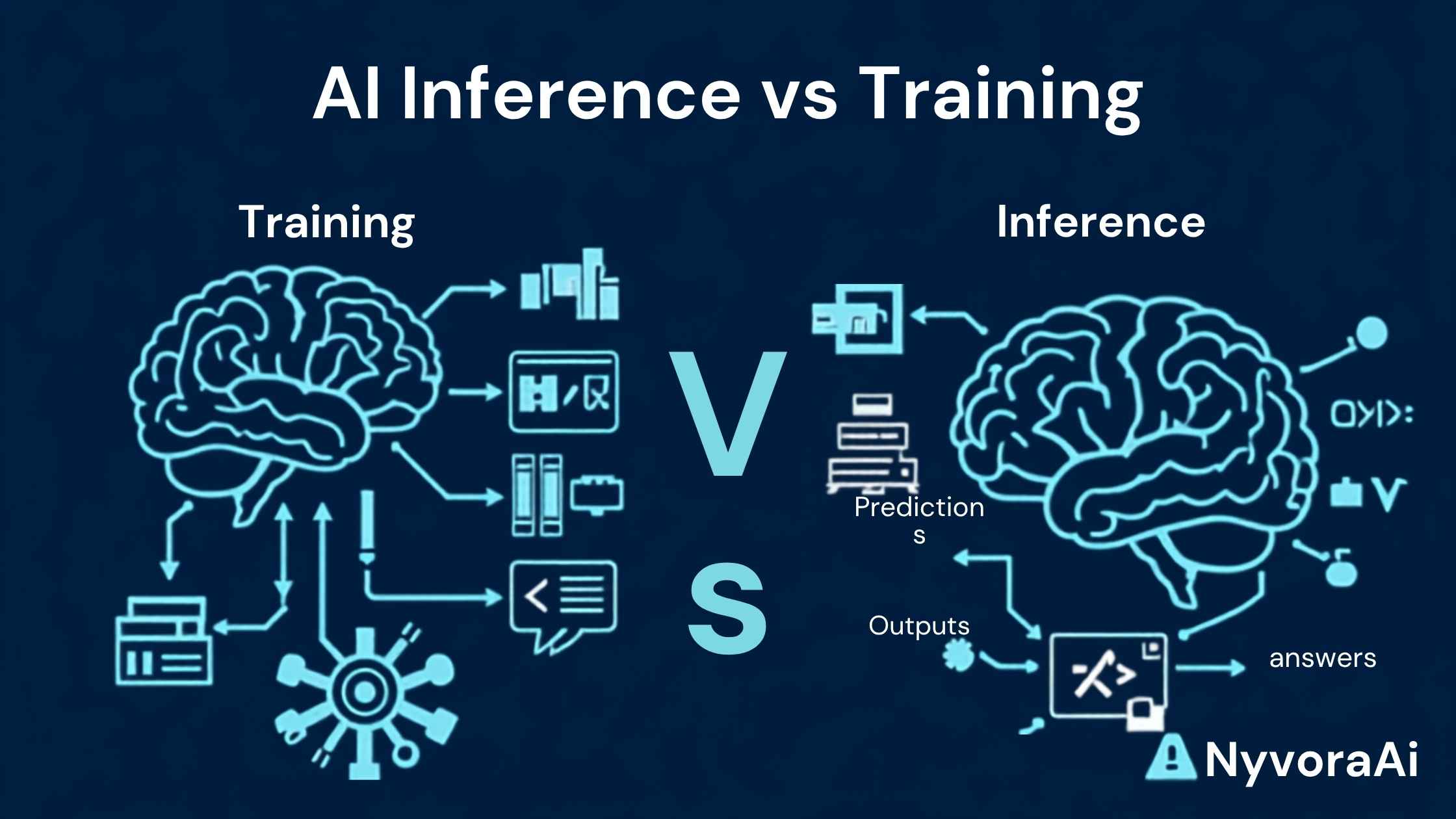
只要读过人工智能相关的内容,你多半撞见过两个听起来很唬人的词:训练与推理。没弄清区别的人常常把它们当成一回事,但在 AI 开发里,它们描述的是模型生命中两个完全不同的阶段。
把这两者的差别弄明白,你基本就搞懂了 AI 是怎么运作的、为什么造它这么贵,以及你的聊天机器人为什么偶尔会卡。一个讲的是「学」,一个讲的是「做」。下面我们把术语剥掉,按实际发生的顺序把两个阶段讲清楚,配上日常类比和真实例子。
01用厨房打个比方
要看清两者的差别,不妨想象一位以做菜为生的人。
训练对应的是在烹饪学校念书、跟着师傅当学徒的那些年。尝过成千上万道菜、学会味道如何搭配、把菜谱背下来、刀工练到手熟。这期间他一直在大量摄入「数据」——食材和技法——并不断修正自己对烹饪的内部理解。慢、贵、吃资源,就是这个阶段。
推理从客人进门点菜的那一刻开始。没人会为了搞清这道意面怎么做而重回烹饪学校;厨师只是调动已经掌握的技能,迅速把菜端出去。快、重复、目标是把成品交到客人面前,这就是这个阶段。
对应到 AI:厨师就是模型,烹饪学校代表训练,「把菜端上去」就是推理。
02第一阶段:训练,学习在这里发生
一切都从训练开始,模型就是在这一阶段从无到有被造出来的。庞大的数据集被喂进去——通常是数 TB 的文本、图片或代码——然后让模型自己去发现其中的规律。
训练过程中发生了什么
- 数据摄入:数十亿条样本流经模型。对语言模型而言,这相当于把公开互联网的绝大部分读一遍。
- 参数调整:模型的内部设置(参数)一开始是随机值。数据流过时它会做出预测,每错一次就微调一点参数来降低误差。这样的重复会发生数十亿次。
- 损失计算:一个数学函数会衡量模型预测与正确答案之间差多远,而训练的目标就是把这个「损失」压下去。
这种规模的计算极其吃资源。训练一个顶尖模型可能要耗掉几周、甚至几个月,期间数千块专用 GPU 全天候 24/7 运转。想知道为什么资源需求会这么夸张?我们那篇 为什么训练数据必须那么多 有详细拆解。
03第二阶段:推理,干活在这里发生
推理发生在训练完成、模型上线之后。你在 ChatGPT 里敲一个问题,或者问 Siri 今天天气如何,都是在触发一次推理请求。输入进去,穿过那套冻结的参数网络,输出出来。
推理过程中发生了什么
- 输入处理:你的问题被转换成 token——也就是模型能处理的数字。
- 前向传播:数据沿着神经网络各层向上走。这里不会像训练那样调整权重,只是把结果算出来。
- 输出生成:模型给出回答,再转换回人类可读的文字,或者转成一个动作。
推理拼的就是速度和效率。用户要的是立刻得到答案,所以工程师会想办法让这些计算跑得越快越好。也正因如此,模型如何挑出下一个词 成了提升推理性能的一个关键研究方向。
04训练与推理并排对比
🎓 训练
- 频率:一次,或隔一段时间一次
- 算力:极高
- 数据:超大规模数据集(数 TB)
- 延迟:不关键(花上几周也可以)
- 硬件:数千块 GPU/TPU
🚀 推理
- 频率:持续不断(每一次查询)
- 算力:中等偏低
- 数据:单个用户的输入
- 延迟:至关重要(必须像瞬间一样)
- 硬件:经过优化的 CPU/GPU
05成本这一面:推理正在变贵
过去花钱的大头是训练。可随着模型被越来越多人使用,推理的账单涨得飞快。原因很简单:训练只做一次,或者隔很久做一次;而推理会在每一次用户交互时发生。
一百万人每人向 AI 助手问一个问题,就是一百万次推理请求,每一次都要消耗算力。于是全行业都在抢着把模型做得更小、更省。量化(降低数字精度)和蒸馏(让小模型模仿大模型)这类手段,就是企业压住成本的办法。
这种成本压力也解释了 AI 与普通自动化之间的一部分差别。自动化脚本运行起来很便宜,推理却带着一笔每次请求都会回来的算力税。想弄清这条界线,可以看我们那篇 AI 与自动化的分界在哪里。
06硬件:两种活,两种芯片
两个阶段想要的东西不一样,底下该配什么硬件,选法自然也不同。
- 1
训练用的芯片
1 关键是原始并行吞吐能力。企业把成集群的 NVIDIA H100 或 B200 GPU 用高速网络连起来,追求的是量:让尽可能多的数据被处理过去。
- 2
推理用的芯片
2 这里的优先级换成了低延迟和低功耗。GPU 依然在用,但 TPU(张量处理单元)、NPU(神经网络处理单元)这类专用芯片越来越常见。目标变成了速度——用尽可能快的方式把答案送回给用户。
07一个真实例子:机器翻译
拿很多人每天都在用的东西来说:AI 翻译。
训练时:数百万对两种语言的句子(比如英语和法语)被喂进去。模型从中习得词语与语法结构之间的统计关联。它并不「懂」某个词是什么意思,只知道某些法语词总在某些英语词出现时一并出现。
运行时:你把一段英文粘进翻译工具。这里不存在重新学习。文字被送进训练好的网络,逐个 token 预测出最可能的法语对应表达,整个过程只要几毫秒。想看更细的机制,我们那篇 AI 翻译内部是怎么运转的 拆得更细。
08为什么这里离不开 Transformer
如今几乎所有模型,无论处在哪个阶段,都建立在 Transformer 架构之上。文本这类序列数据特别适合交给 Transformer,因为它能同时「关注」输入的多个部分。于是它在训练时擅长吸收复杂规律,在运行时也擅长生成连贯输出。想多了解这台引擎,可以读我们那篇 Transformer 模型究竟是什么。
09接下来会怎样:推理搬到你的设备上
把推理从云端挪到手上这台设备,是 2026 年的一股大潮流。你的问题不再被送到庞大的服务器农场,而是由手机或笔记本本地运行模型。隐私更好,延迟更低——但模型必须经过高度优化,才能在有限的硬件上跑起来。也正因如此,如今懂推理的效率,和懂模型怎么训练一样重要。
如果想更深入了解学习过程本身,我们那份 机器学习是什么、又是怎么训练的 完整指南是最好的起点。
10常见问题
训练和推理有什么区别?
训练和推理哪个更贵?
模型在推理时还在学习吗?
为什么推理需要这么强的硬件?
我能在自己的电脑上跑推理吗?
Anyone who reads about artificial intelligence will have bumped into two terms that sound forbiddingly technical: training and inference. People who have not nailed the distinction often use them as if they meant the same thing, yet in AI development they describe two wholly separate stages in a model's existence.
Grasp the gap between the two and you are most of the way to understanding how AI works, why building it is so costly, and why your chatbot occasionally drags. Learning is one of them; doing is the other. Below, the jargon gets stripped away and each phase is explained exactly as it happens, with everyday comparisons and real examples.
01A Kitchen Comparison
For a picture of how the two differ, imagine someone who cooks for a living.
Training covers the years in culinary school and the apprenticeships under experienced mentors. Thousands of dishes get tasted, flavour pairings learned, recipes committed to memory, knife work drilled. All the while the chef is consuming "data" in bulk — ingredients, techniques — and revising an internal sense of how cooking works. Slow, costly and resource-hungry: that is this stage.
Inference begins the moment a customer walks in and orders. Nobody re-enrols at culinary school to work out how the pasta should be made; the chef simply draws on skills already acquired and turns the dish out quickly. Fast, repetitive, aimed at putting a result in front of a paying customer — that is this stage.
Map that onto AI: the chef is the model, culinary school stands for training, and serving the meal is inference.
02Phase 1: Training, Where Learning Happens
Everything starts with training, the phase in which a model is built from nothing. Vast datasets go in — terabytes of text, images or code is typical — and the model is left to discover the patterns hidden inside them.
The Steps Inside Training
- Data ingestion: billions of examples pass through the model. For a language model, that amounts to reading the bulk of the public internet.
- Parameter adjustment: the internal settings (parameters) begin as random values. Predictions get made as data flows through; each wrong one triggers a small tweak to reduce the error. Billions of repetitions follow.
- Loss calculation: a mathematical function measures the distance between what the model predicted and what was correct, and training aims to squeeze that "loss" down.
Computation on this scale is punishing. Weeks, sometimes months, can disappear into training a state-of-the-art model, with thousands of specialised GPUs humming 24/7 all the while. Wondering why the resource demands are quite so huge? Our deep dive on why training sets have to be so large has the answer.
03Phase 2: Inference, Where the Work Gets Done
Inference comes after training, once the model is deployed. Put a question to ChatGPT, or ask Siri about the weather, and an inference request fires. Your input goes in, travels through the frozen parameter network, and an output comes out.
The Steps Inside Inference
- Input processing: your question is turned into tokens — numbers the model can work with.
- Forward pass: data travels up through the layers of the neural network. No weight adjustments happen here, as they would in training; the calculation simply runs.
- Output generation: a response is produced and converted back into readable text, or into an action.
Speed and efficiency are the whole game in inference. Instant answers are what users demand, so engineers tune models to complete these calculations as fast as they can. It is why how a model chooses its next word has become such a critical research area for squeezing more performance out of inference.
04Training and Inference Side by Side
🎓 Training
- Frequency: once, or now and then
- Compute: extremely high
- Data: enormous datasets (terabytes)
- Latency: not critical (weeks are acceptable)
- Hardware: thousands of GPUs/TPUs
🚀 Inference
- Frequency: constant (every query)
- Compute: moderate to low
- Data: one user input
- Latency: critical (must feel instant)
- Hardware: tuned CPUs/GPUs
05The Cost Angle: Inference Is Getting Pricier
Training used to be where the money went. As models have grown popular, though, inference bills have been climbing fast. The reason is simple: training happens once, or every so often, whereas inference runs on every single user interaction.
A million people posing one question each to an AI assistant adds up to a million inference requests, every one of them drawing compute. Hence the industry-wide rush toward leaner, cheaper models. Techniques such as quantization (trimming the precision of numbers) and distillation (getting a small model to copy a large one) are how companies hold those costs down.
That economic squeeze also explains part of the split between AI and plain automation. Automation scripts run cheaply; inference levies a computational tax that comes back with every request. Our guide to where AI ends and automation begins digs into it.
06Hardware: Two Jobs, Two Kinds of Chip
The two phases want different things, so the hardware underneath them gets chosen differently.
- 1
Chips for Training
1 Raw parallel throughput is what matters. Companies wire together clusters of NVIDIA H100 or B200 GPUs over high-speed networks, chasing volume: as much data pushed through as possible.
- 2
Chips for Inference
2 Here the priorities flip to low latency and low power draw. GPUs still feature, yet specialised silicon such as TPUs (Tensor Processing Units) and NPUs (Neural Processing Units) is increasingly common. The target is speed — an answer back to the user as quickly as it can be delivered.
07A Real Case: Machine Translation
Take a tool plenty of people touch every day: AI translation.
While training: millions of sentence pairs in two languages (English and French, say) are fed in. The model picks up the statistical links between words and grammatical structures. It has no notion of "what" a word means; it knows only which French words tend to co-occur with which English ones.
While running: you paste an English paragraph into a translator. No relearning takes place. The text is pushed through the trained network and the likeliest French counterpart is predicted token by token, all inside a few milliseconds. For the mechanics in more detail, our article on what happens under the hood in AI translation takes it apart.
08Why Transformers Matter Here
Nearly every current model, in both phases, rests on the Transformer architecture. Sequential material such as text suits Transformers unusually well, because they "pay attention" to several parts of the input at the same time. That makes them strong both at absorbing intricate patterns while training and at producing coherent output while running. For more on the engine underneath, see our guide to what a Transformer model actually is.
09Where This Is Heading: Inference on Your Device
Shifting inference off the cloud and onto the device in your hand is one of 2026's big currents. Rather than shipping your question out to a huge server farm, the phone or laptop runs the model itself. Privacy improves and latency drops — but the models must be highly optimised to cope with modest hardware. Which is why knowing how efficient inference can be now matters as much as knowing how a model is trained.
For a deeper look at the learning process itself, our full guide to machine learning and how it gets trained is the place to start.