自由撰稿工作该怎么用 AI?How Do You Use AI for Freelance Writing Jobs?
自由撰稿并没有被 AI 干掉,改变的只是客户愿意掏钱买的东西。下面按阶段、不加粉饰地讲清 AI 在自由撰稿工作中能站的位置——从接单到收款——同时保住那个让客户回头找你的文风。
Freelance writing is alive; what clients hand over money for has simply moved. Below is an unhyped, stage-by-stage account of where AI earns its place in freelance work — from landing gigs through to getting paid — while the voice that brings clients back stays intact.
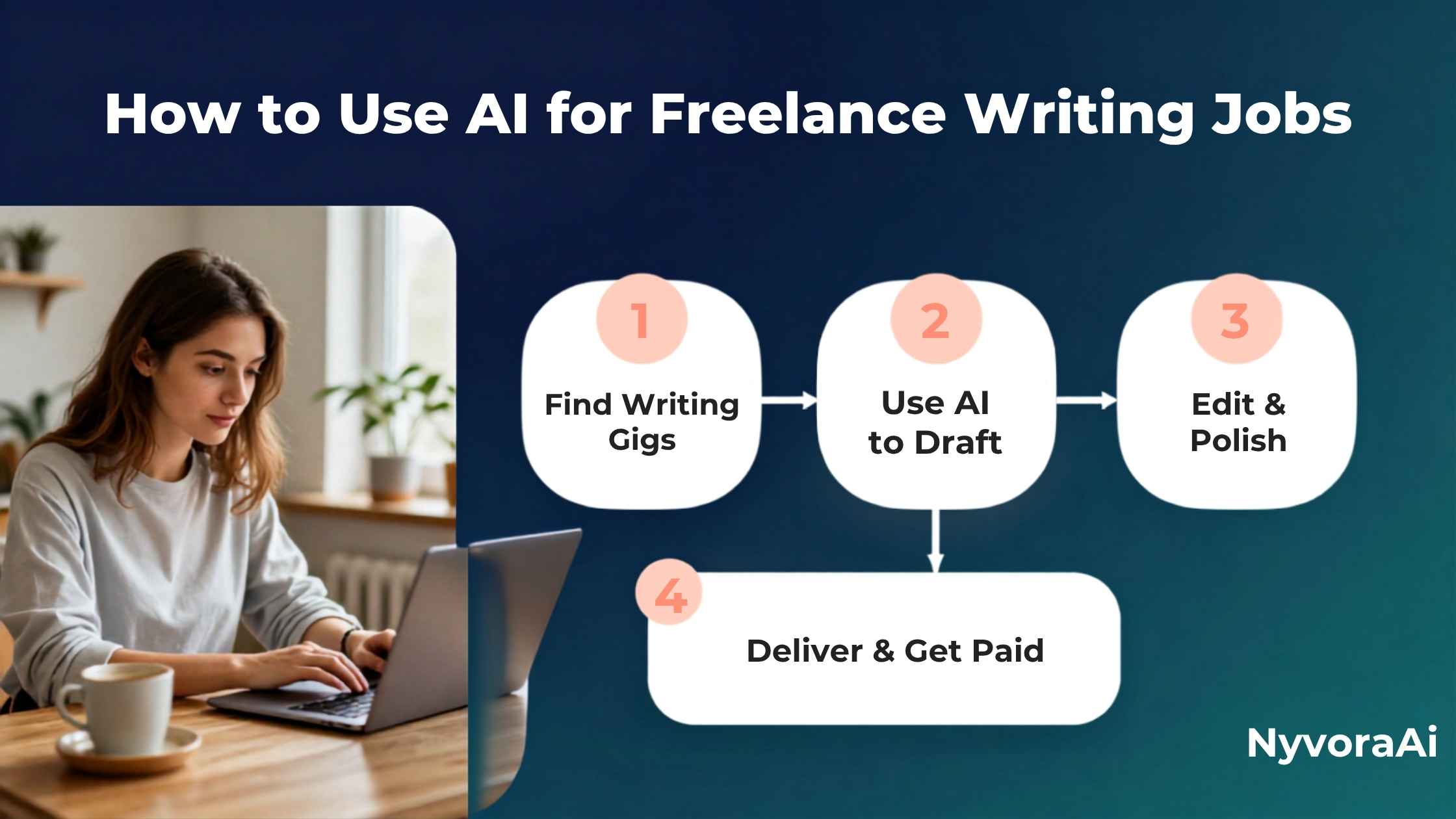
如今在自由撰稿人的社群里待上一会儿,就能看到明显的分裂。一边是坚信自己一身本事即将一文不值的写作者;另一边是每天默默借力 AI、接下过去根本不可能承担那么多客户的写作者。现实更靠近后者——原因在于他们想通了一件前者没想通的事:AI 听人指挥,它替代不了客户真正买单的判断力、文风和靠谱程度。
把词排对顺序,从来就不是这份工作的全部。客户买的是有人能读懂他的受众、按时交稿、听得进意见,并且交出的东西不需要他再改一遍。这些环节几乎每一个都能借 AI 提速。唯独信任不行——而信任恰恰是带来回头单和转介绍的东西。
接下来会按阶段说明,如何把 AI 嵌进真实的自由撰稿流程:每一步都更快、更有竞争力,又不会滑向那种客户自己就能生成的、毫无个性的内容。
01简短回答
一句话版本:让 AI 加速写作之外的周边工作——压缩需求说明、写提案邮件、整理研究笔记、抓语法错误——而真正的起草和最终文风必须牢牢握在自己手里。如果让 AI 给个粗纲或初稿能帮你跨过空白页,那也无妨,但它必须经过大幅重写才能送到客户眼前。
眼下因为 AI 丢掉活儿的是哪些人?通常是把模型输出未经编辑就交出去的人。接到更多活儿的又是哪些人?把杂事甩给 AI,由此能多接客户、更稳地赶上截稿,并把真正用来写作的时间花在聊天机器人独自给不出的洞见和文风上。
02AI 究竟对自由撰稿做了什么
「AI 把自由撰稿的活儿抢走了」并不是事实。事实是:客户还愿意掏钱的那类写作变了。仅仅把谷歌首页已有的内容换个说法、浮在表面的稿子,如今很难卖出去,因为客户自己几秒就能生成一个勉强能看的版本。价值转移到了建立在原创调研、真实访谈、专业积累或鲜明文风之上的写作——这些恰恰是 AI 独自造不出来的。
所以,今天活得好的写作者,通常并不是那些彻底拒绝 AI 的人,而是把工作中机械的那段交给 AI、从而换回时间去做真正撑得起报价的那部分工作的人:别人没做过的访谈、更锐利的角度、更深入的研究,以及读者真正信得过的文风。
如果你对 AI 工具整体上还比较陌生,想先把基础打好再引入客户项目,可以从我们这篇入门文章看起:没有技术背景的人能每天使用 AI 工具吗。自由撰稿人无需会写代码、也无需技术背景,就能从 AI 中获得实际好处。
03第一步:更快地寻找与筛选线索
在自由职业里,很少有哪件事比每天刷几十条招聘板帖子更吃时间——也很少有哪件事更容易用 AI 加速。把几条招聘信息丢进 AI 对话工具,让它提炼每一条的要求、指出范围含糊或工期不现实之类的危险信号,并按它们与你专长和期望报价的契合度排个序。
这一切都不能替代你自己对客户的判断。它能做的是把你快速浏览又长又雷同的需求说明的时间,从二十分钟压缩到两分钟,让你一天里有更大一块拿去做提案和写作,而不是到处找活。
04第二步:提案写得更好,也写得更快
对一个已经看过五十份提案的客户来说,没有什么比一份从别处复制来的模板更快被丢到一边。AI 在这个环节确实派得上用场——前提是你喂给它真实的背景:客户的需求说明、你相关的经验,以及一两个能证明你读过对方招聘信息、而不是到处群发申请的细节。
让模型写出两三个长短不同的提案版本,挑出最接近你平时说话方式的那一版,然后至少由你亲手改写开头一句和结尾的请求。你要的是读起来像一个真正读懂了需求的人在说话,而不是一份模板信。
| 提案要素 | 较弱的做法 | 较强的做法 |
|---|---|---|
| 开头一句 | 把同一套泛泛的 AI 开场白粘贴进一份又一份提案 | 具体点出客户的需求说明、品牌或近期内容中的一处——由你亲手撰写或改写 |
| 能证明你能交付 | 像「我是一位经验丰富的写手」这类空泛说法 | 先由 AI 起草,再经编辑放入一个具体成果,或一份贴合这一细分领域的样本 |
| 结尾的请求 | 「有兴趣请联系我」——太空泛,很容易被直接划过去 | 给出明确下一步:提议简短通话,或就项目范围提一个澄清问题 |
提示词的具体措辞对输出质量的影响,比多数人以为的要大。我们在 如何为 AI 工具写出更好的提示词 这篇详解里给出一套可复用的公式,尤其适合提案邮件和客户沟通。
05第三步:加快调研,但不偷工减料
一篇文章动笔之前,要先读一份份资料、记笔记、把零散内容理出头绪——这曾是最慢的一段。AI 能压缩长文、提取关键统计数据、把散乱的笔记整理成清晰提纲;对一篇普通稿件来说,研究时间几乎不费力就能砍掉一半。
有一条前提最要紧:事实、数据和引文都要另找来源核实,不能直接采信 AI 的摘要,因为模型偶尔会记错细节,或者把不同来源的信息糅在一起。把 AI 摘要当作出发时的地图,而不是终点。
06第四步:让 AI 起笔,但绝不由它收尾
这一步既能帮你建立可用的 AI 工作流,也可能在不知不觉中损害你的口碑。让 AI 生成粗纲或初稿,确实能帮你打败空白页,尤其当交稿日期逼到眼前时——但只做轻微修补就把这份初稿交出去,是产出平淡、泛泛、和你平时文风明显不同内容的最快方式。
有一套流程在现实中经得起考验:先让 AI 基于你自己的调研和客户的需求说明,给出结构提纲和一版粗初稿;然后关掉标签页,用自己的话整篇重写,把独到的见解、衔接的过渡和属于你的语气都加进去。把 AI 那份初稿当成初级写手的潦草笔记——脚手架有用,但不是成品。
07第五步:编辑与润色,让 AI 打配合
只有等稿子听起来已经像你写的,AI 编辑工具才该上场——这时它极擅长抓那些盯着同一篇文字看几小时后谁都容易漏掉的小毛病:语法磕绊、用词重复、句子过长、时态前后不一。交稿前把稿子过一遍语法与文风工具,但采纳建议要有取舍。这类工具往往把一切推向平淡「安全」的语气,若不加判断地逐条接受,你的个人特色就会被抹平。
有一个习惯很有效:发送前把改好的稿子朗读一遍。如果读出来还是你自己的语气,那就可以交了。如果听着生硬、莫名正式,多半是编辑工具在修掉错字的同时也磨平了性格。
08第六步:报价与管理自由职业工作量
AI 发挥作用的地方不只是写作本身,自由职业的经营侧同样受益——而恰恰是在这里,很多写作者不知不觉地流失时间和收入。可以用 AI 来:依据字数、调研深度和修改轮次估算一个项目实际要花多久;起草整洁专业的发票;以及把多位客户的截稿日期集中到一处查看。
- 1
如实估算耗时
1 让 AI 把项目拆成调研、起草、编辑几块用时,这样你的报价反映的是真实工作量,而不是凭感觉。
- 2
生成规范的发票
2 用 AI 生成一份整洁专业的发票模板,之后每接一位客户只需调整复用。
- 3
统一跟踪截稿日期
3 用一个 AI 辅助的项目追踪或笔记工具,把每位客户的截稿日和修改轮次都集中显示在一处。
如果你的自由撰稿业务里也有博客写作,不妨把上面的流程和我们这篇专文配合使用:如何用 AI 更快写出博客文章,它更深入地讲了如何高效组织长文结构。如果客户的社交媒体也在你的职责范围内,同一套 AI 原则照样适用——这一侧的流程可参考我们的 AI 社交媒体实操分步指南。
09披露、伦理与口碑保护
随着 AI 使用越来越普遍,合同里针对它的条款也多了起来。有些客户只要最终稿经过人工审阅就接受;也有客户对某些类型的内容直接禁用,尤其是需要署名专业判断或一手报道的。仔细读合同,遇到不确定的地方直接问客户,不要自己揣测。
无论在哪种情况下,有一条简单规则能保住你的名声:凡是 AI 给出的事实、数据或引文,未经真实来源核对,绝不提交。客户已发表文章里出现一个捏造的数据,损失的信任远远超过它替你省下的起草时间。对这类模型如何生成语言稍有了解,也能帮你保持恰当的怀疑——我们在 机器学习是什么、如何训练 这篇解说里讲了,为什么模型可以语气笃定却依然说错。
10自由撰稿人常问的问题
我可以用 AI 写稿而不让客户发现吗?
AI 会取代自由撰稿人吗?
哪些 AI 工具最适合自由撰稿人?
AI 能帮我找到自由撰稿客户吗?
在客户稿件中使用 AI 合乎伦理吗?
11结语
把 AI 引入自由撰稿,不是为了抄近道,也不是想把未经编辑的机器输出偷偷塞给谁。它是为了把原本被杂事吞掉的时间夺回来,让注意力落在只有人才能完成的部分:做判断、产出独到的见解、用读者信得过的声音去写。用得好,AI 能让你的提案更快、调研更深、承接更多工作而不至于透支——而纸面上的文字,依然一眼能认出是你的。
如果你才刚开始把 AI 融入自由职业流程,别想着一次推翻重来。从上面挑一个环节——提案、调研或编辑——先在那里把习惯养起来。等它变得自然之后,其余环节往往会自己归位;几周之后,你多半会发现自己接的活更多、压力更小,而文字里的你并没有少一分。
Spend a little time in freelancer communities these days and the split is obvious. On one side sit writers certain their skills are about to be devalued to nothing; on the other, writers who quietly lean on AI every day and carry a client load they could never have managed alone. Reality belongs to the second camp, and the reason is a realisation the first camp has missed: AI responds to direction. It cannot stand in for the judgment, the voice or the dependability that clients are really buying.
Putting words in the right sequence was never the whole job. What a client buys is someone who grasps their readership, delivers on time, absorbs criticism without friction, and hands over copy needing no repair. Nearly all of those boxes can be ticked faster with AI's help. Trust is the exception — and trust is still the currency behind repeat commissions and referrals.
What follows is a stage-by-stage account of folding AI into an actual freelance writing workflow: quicker and more competitive at every step, yet never sliding into the interchangeable output a client could have produced unaided.
01The Short Version
In one paragraph: let AI accelerate everything surrounding the writing — condensing briefs, knocking out pitch emails, tidying research notes, catching grammar slips — and keep both the drafting and the final voice firmly in your own hands. Should a rough outline or an opening pass from AI get you past the empty page, fine, but it needs heavy reworking before a client ever sets eyes on it.
Who is losing assignments to AI today? Usually the writer who ships raw model output unedited. Who is winning more of them? The writer who offloads the chores to AI, and in return takes on more clients, meets deadlines more consistently, and spends genuine writing hours on the insight and the voice no chatbot can supply alone.
02What AI Is Really Doing to Freelance Writing
"AI took the freelance writing jobs" is not what happened. What happened is a shift in which kinds of writing clients will still open their wallets for. Thin, surface-level copy that merely restates what already ranks on page one of Google is a hard sell now, since a client can spin up a passable version of it in seconds. Value has migrated toward work built on original research, genuine interviews, specialist knowledge or a recognisable voice — none of which AI conjures by itself.
So the writers flourishing today are not, as a rule, the ones refusing AI outright. They are the ones who hand it the mechanical stretch of the job and buy back hours for the work that genuinely justifies their fee: interviews nobody else has done, angles that cut deeper, research that goes further, and a voice readers believe.
New to AI tools altogether, and want the basics nailed down before bringing them into client work? Start with our beginner-level piece on whether someone without a technical background can work with AI tools every day. No coding and no technical training are needed before a freelance writer can get real benefit from AI.
03Step 1: Sourcing and Screening Leads More Quickly
Few chores eat more freelancing hours than working through dozens of job-board postings daily — and few are simpler to accelerate. Drop several listings into an AI chat tool and have it boil down what each one asks for, point out warning signs such as fuzzy scope or impossible timelines, and order them by how well they line up with your specialism and the rate you want.
None of that substitutes for your own read on a client. What it does do is shrink the slog of skimming long, samey briefs from twenty minutes to two, so a larger share of the day goes into pitching and writing rather than hunting.
04Step 2: Better Pitches, Written Quicker
Nothing gets you ignored faster by a client who has already waded through fifty pitches than boilerplate pasted from elsewhere. AI does earn its keep at this stage — provided you hand it genuine context: their brief, the experience of yours that is relevant, and a detail or two showing you read the listing rather than blasting applications everywhere.
Have the model turn out two or three versions of the pitch at varying lengths. Choose whichever comes closest to how you would phrase it unaided, then personally rewrite at minimum the first line and the closing ask. What you want is something reading like a person who grasped the brief — not a form letter.
| Pitch component | Weak version | Stronger version |
|---|---|---|
| The first line | The same generic AI greeting pasted into pitch after pitch | A single concrete nod to their brief, their brand or something they recently published — written or adapted by you |
| Proof you can deliver | A vague line such as "I'm an experienced writer" | Started by AI, then edited so it carries one concrete result or a sample that speaks to this exact niche |
| The closing ask | "Let me know if interested" — bland enough to scroll straight past | A defined next step: offering a brief call, or putting one clarifying question about scope |
How you word an AI prompt shapes the quality of what comes back more than people generally assume. A repeatable formula that suits pitch emails and client correspondence especially well is set out in our fuller guide to writing stronger prompts for AI tools.
05Step 3: Speeding Up Research Without Skimping
Reading source after source, jotting notes and imposing order on them all before a single line could be drafted — that used to be the slowest stretch of the job. AI can condense long articles, lift out the key statistics and turn scattered notes into a tidy outline, which on a typical article halves the research time with little effort.
One caveat matters above all: check facts, figures and quotations against a separate source instead of taking a summary at face value, because a model will now and then garble a detail or merge material from two different places. Use an AI summary as a map for the journey, never as the destination.
06Step 4: Let AI Open the Draft, Never Close It
Here is where a freelance career either gains a workable AI routine or quietly takes damage. Letting AI turn out a rough outline or an initial pass does help defeat the empty page, particularly with a deadline breathing down your neck — yet handing that first pass in after a light tidy is the quickest route to copy that reads flat, sounds generic and stands out as unlike anything else you have written.
One routine survives contact with real deadlines: get a structural outline plus a rough opening pass out of AI, grounded in your own research and the client's brief; then shut the tab and rewrite the whole thing yourself, layering in the particular insight, the connective tissue and the voice that mark it as yours. Think of that AI draft as a junior writer's scribbled notes — scaffolding worth having, but not the deliverable.
07Step 5: Editing and Polishing, With AI Assisting
Only once the draft sounds like you should an AI editor come into play — and at that point it is superb at the minor faults that slip past anyone who has stared at the same text for hours: a grammar stumble, a word used twice, a sentence that runs on, a tense that wanders. Before delivery, run the piece past a style-and-grammar checker one final time, but take its advice selectively. Style tools nudge everything toward a bland "safe" register, and clicking accept on each suggestion flattens whatever was distinctive about your writing.
One habit pays off consistently: read the edited draft aloud before you send it. Hearing your own voice come through means it is done. If it lands stiff or strangely corporate, an editing tool has most likely sanded away character along with the mistakes.
08Step 6: Quoting and Managing the Freelance Workload
The writing is not the only place AI pulls its weight; the business side of freelancing benefits too, and that is exactly where many writers haemorrhage hours and income without noticing. Turn to AI for a realistic estimate of how long a project will run given its word count, how deep the research goes and how many revision rounds it needs; for invoices that look clean and professional; and for bringing deadlines from several clients together into a single view.
- 1
Size up the hours realistically
1 Have AI carve a project into blocks for research, drafting and editing, so the figure you quote reflects real effort rather than a hunch.
- 2
Produce tidy invoices
2 Generate one clean, professional invoice template with AI, then adapt and reuse it for each new client.
- 3
Keep deadlines in one place
3 Let an AI-assisted tracker or notes app hold every client's deadline and revision round in a single, visible place.
Should blog writing also feature in your mix of freelance work, pair the workflow above with our dedicated piece on speeding up blog posts with AI, which digs further into organising long-form content efficiently. And when a client's social channels fall inside your remit, the underlying principles carry over — our walkthrough for putting AI to work on social media handles that half of the job.
09Disclosure, Ethics and Safeguarding Your Reputation
With AI use spreading, contracts increasingly carry clauses that address it head-on. Some clients are happy for it to be used provided a human reviews the final piece; others ban it for particular categories of content, above all anything depending on named expertise or first-hand reporting. Read the contract closely, and if anything is unclear, put the question to the client rather than guessing.
One straightforward rule keeps your name safe in either scenario: never let a fact, a statistic or a quotation that came out of AI go out unchecked against a real source. One invented figure in an article the client has published costs far more trust than the drafting time it saved you. A little grounding in how these models produce language helps you stay sceptical in the right measure — our explainer on machine learning and how it is trained sets out why a model can sound certain and still be mistaken.
10Questions Freelancers Ask
Could I use AI on freelance writing work and keep clients from noticing?
Is AI going to replace freelance writers?
Which AI tools suit freelance writers best?
Can AI help me land freelance writing clients?
Is using AI on client work ethically acceptable?
11The Bottom Line
Bringing AI into freelance writing is not a shortcut, and it is not an attempt to slip unedited machine output past anyone. It is about winning back the hours once swallowed by busywork, so that attention goes to the parts of the job only a person can do: exercising judgment, generating original insight, and writing in a voice readers believe. Handled well, AI quickens your pitching, deepens your research and lets you carry more work without exhausting yourself — while the writing on the page stays recognisably your own.
Just beginning to work AI into your freelance routine? Resist the urge to rebuild everything in one go. Take a single stage from the list above — pitching, research or editing — and let the habit take root there first. Once it stops feeling effortful, the other stages settle into place by themselves; a few weeks on, you will probably be handling more projects with less strain, and no less of yourself in what you write.