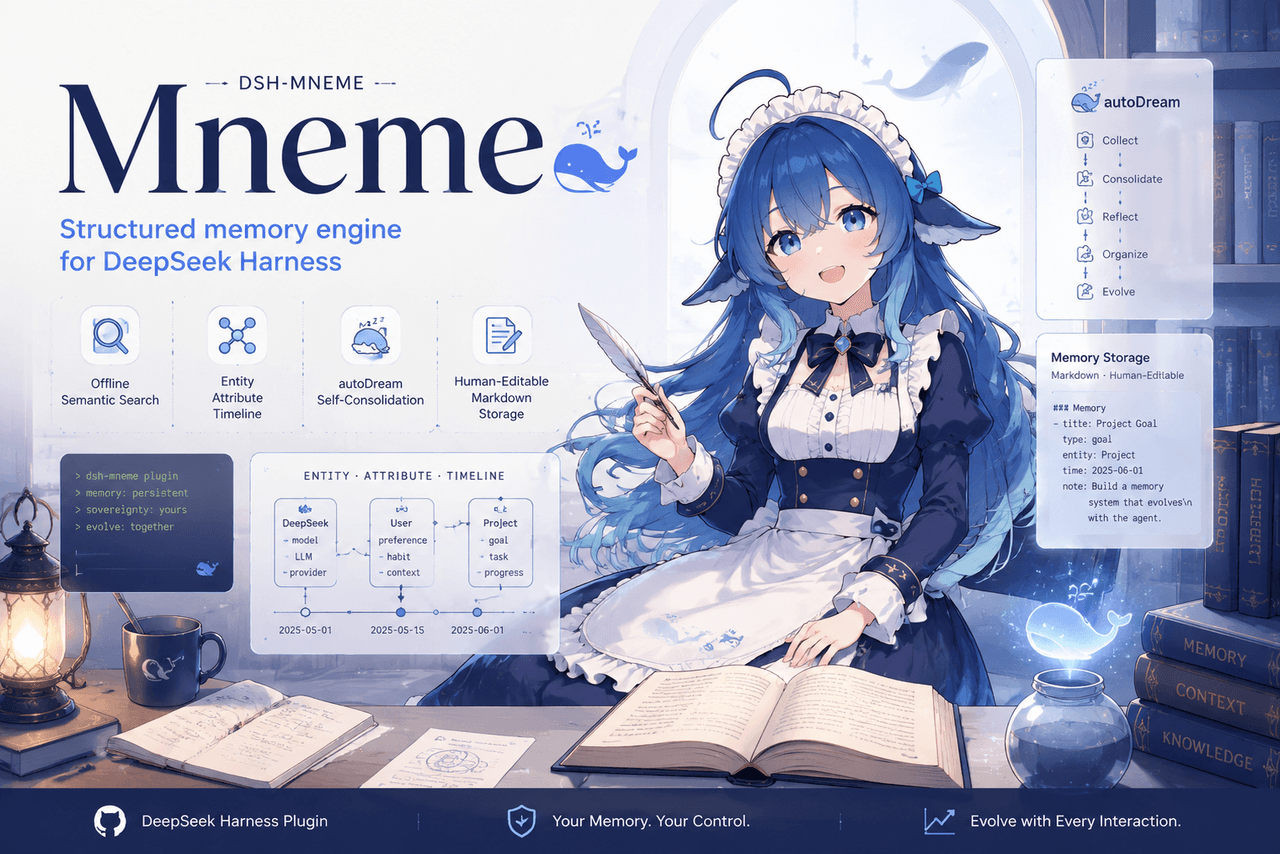
slow-stack/mneme
🧠 The memory that dreams — cross-session memory for DeepSeek Harness. Offline & private, auto-consolidates in its sleep (autoDream), visualized in a memory panel.
Project Overview项目介绍
dsh-mneme (npm: @modusensus/dsh-mneme) is a cross-session memory plugin built for DeepSeek Harness. It installs with dsh plugin --profile web add @modusensus/dsh-mneme and ships with an embedded local embedding model, SQLite storage, and a bidirectional Markdown mirror. The package also bundles a standalone stdio MCP server distributed as the separate npm package mneme-memory, which exposes six tools — memory_save, memory_search, memory_list, memory_get, memory_update, and memory_delete — to any MCP-compatible client such as Claude Code, Codex, OpenCode, or Cursor via npx -p mneme-memory mneme-mcp with the appropriate args array.
The intended workflow is conversational: a user tells DSH their coding preferences or project context during a chat, and the background autoDream subsystem then deduplicates, merges, archives, and consolidates entries during idle periods without further intervention. Subsequent DSH sessions automatically recall and inject the relevant memories into context, so the assistant can reference earlier decisions instead of asking the user to repeat themselves. Conflicts are frozen rather than auto-resolved, scopeEnabled plus strictScope separate memories by agent and workspace, and every consolidation run produces a replayable sha256 decision receipt for full auditability.
The plugin targets heavy DSH users and individual developers who want a long-running, self-evolving knowledge base that stays on-device rather than syncing to a cloud service. Dependencies are minimal: Node.js 22 or newer, and a local DSH profile with the memory panel enabled. Data never leaves the machine by default, telemetry is disabled, and an optional write-protection token plus localized feedback channel are documented for hardening. The license is MIT, the test suite reports 1317 passing cases, and the README walks through a five-minute onboarding flow plus per-flag configuration for offline embedding, session lifecycle, entity extraction, and scope isolation.
dsh-mneme(npm 包名 @modusensus/dsh-mneme)是面向 DeepSeek Harness(DSH)的跨会话记忆插件,使用 dsh plugin --profile web add @modusensus/dsh-mneme 即可安装到 DSH Web 端使用。它内置本地 Embedding、SQLite 存储与 Markdown 双向镜像,并附带独立的 stdio MCP server 包 mneme-memory,可被 Claude Code、Codex、OpenCode、Cursor 等任意 MCP 客户端以 npx -p mneme-memory mneme-mcp 挂载调用 memory_save、memory_search、memory_list、memory_get、memory_update、memory_delete 六件工具。
典型用法是用户在 DSH 会话里聊项目偏好,autoDream 在空闲时自动去重、合并、归档、补全;下次新开会话时 AI 仍能主动引用历史背景。冲突先冻结、scopeEnabled/strictScope 做按 agent 与工作区的隔离,决策凭证全程可回放。它适合需要长期累积知识、跨会话保持上下文连贯,又不愿把数据交给云端的个人开发者与重度 DSH 用户。
依赖 Node.js 22+,需在 DSH 设置面板启用记忆库相关开关;数据完全本地、默认零网络与零遥测。授权 MIT,CI 含 1317 个测试。首次运行建议保持默认 openai 嵌入,按需切换 local 以离线;多 Agent 场景务必启用 scopeEnabled,跨工具使用请按各客户端的 args 写法配置 MCP。
请帮我安装这个 DSH 插件。安装前先完成【兼容性检查 + 安全性检查】,检查通过再动手。

插件:mneme(slow-stack/mneme)
仓库:https://github.com/slow-stack/mneme
本站详情页:https://www.yhbd.top/plugins/slow-stack-mneme/
本站登记:类型 plugin · 归类 原生 DSH 插件 · 许可证 MIT · ⭐ 138 · 最近提交 2026-10-03 · 主语言 JavaScript · 未检测到 DSH 插件清单

按下面顺序执行,每步先把结论告诉我,再进入下一步:

【1 兼容性检查】
① 我这边:DSH 版本、Node 版本、操作系统、当前 profile(web / desktop)。
② 读它的 README、package.json、插件 manifest,列出它要求的 DSH 版本 / Node 版本 / 操作系统 / 外部依赖 / 需要另外先装的运行时。
③ 逐条比对,结论只写「满足 / 不满足 / 未知」三种;不满足的给出可行替代方案。
④ 检查是否和我已装的插件冲突:命令名重复、skill / tool 重名、端口占用、重复注册的 MCP server。

【2 安全性检查】
① 仓库可信度:和上面「本站登记」是否一致;star / fork 数、创建时间、最近提交,是否归档或长期停更。
② 安装脚本:逐行看 package.json 的 preinstall / install / postinstall,以及 install.sh、setup.ps1 之类脚本。出现 curl|bash、下载后直接执行、混淆代码、访问与插件功能无关的域名,立刻停下来告诉我,不要继续装。
③ 依赖:列出新增依赖,标出无人维护、或与知名包拼写近似的可疑包(typosquatting)。
④ 权限与副作用:它会读写哪些目录、访问哪些域名、需要哪些 DSH 权限(filesystem / network / shell / clipboard 等),以及怎么卸载和回滚。
⑤ 如果它要求 sudo / 管理员权限,或权限明显超出功能所需,先停下来问我。

【3 安装】
上面两步没有「不满足」和「高危项」时才执行;用官方推荐方式安装,不要自行提权。

【4 汇报】
用表格输出:检查项 / 结论 / 依据 / 是否需要我决策。拿不准的一律写「未知」并说明要我怎么确认——不要猜,也不要替我决定。
Send this message to DSH in your current session: it verifies compatibility and security first (answering met / not met / unknown item by item) and only installs once everything checks out — it will stop and ask you if it finds a high-risk item. The box scrolls; the copy is the full prompt. CLI install commands may not be accurate across systems, so DSH is the safer route.把上面这条消息直接发给当前会话里的 DSH:它会先核对兼容性与安全性(逐条给「满足 / 不满足 / 未知」),确认没问题再安装,有高危项会停下来问你。框内可滚动,复制到的是完整提示词;安装命令不一定准确,发给 DSH 更稳。
- No DSH plugin manifest detected - it may only carry the dsh-plugin topic, so the install method must be confirmed on the spot未检测到 DSH 插件清单:可能只是打了 dsh-plugin 话题,安装方式要现场确认
DSH walks through these 9 checksDSH 会逐条核对这 9 项
Compatibility兼容性
- DSH, Node, OS and profile requirementsDSH 版本 / Node 版本 / 操作系统 / profile 是否满足要求
- External dependencies and runtimes (Electron / Python / Docker, ...)外部依赖与运行时(Electron / Python / Docker 等)是否齐备
- Conflicts with installed plugins: command names, skill / tool names, ports, duplicate MCP registration与已装插件是否冲突:命令名、skill / tool 重名、端口占用、重复 MCP 注册
Security安全性
- Repo matches the facts registered here; archived or abandoned?仓库是否与页面登记一致,是否归档或长期停更
- Safety of preinstall / install / postinstall and install.sh / setup.ps1preinstall / install / postinstall 与 install.sh、setup.ps1 是否安全
- curl|bash, download-then-execute, obfuscation, unrelated domains → stop immediatelycurl|bash、下载即执行、混淆代码、无关域名 → 立刻停止
- Typosquatting or unmaintained packages among the new dependencies新增依赖里有没有 typosquatting 或无人维护的包
- Requested permissions vs. what the feature actually needs申请了哪些权限、是否超出功能所需(filesystem / network / shell / clipboard)
- Any sudo / admin requirement, plus uninstall and rollback是否要求 sudo / 管理员权限,以及卸载与回滚方式
Anything uncertain must be marked unknown with a note on how to confirm it. This site's signal screen is a static snapshot, not a security audit.拿不准的必须标「未知」并说明要我怎么确认。本站的信号筛查是静态快照,不能替代安全审计。
Or use CLI install (for developers)或使用命令行安装(适合开发者)
CLI Install命令行安装
dsh plugin --profile web add @modusensus/dsh-mneme把 slow-stack/mneme 加入你的 DSH 配置(web profile)即可启用。
READMEREADME
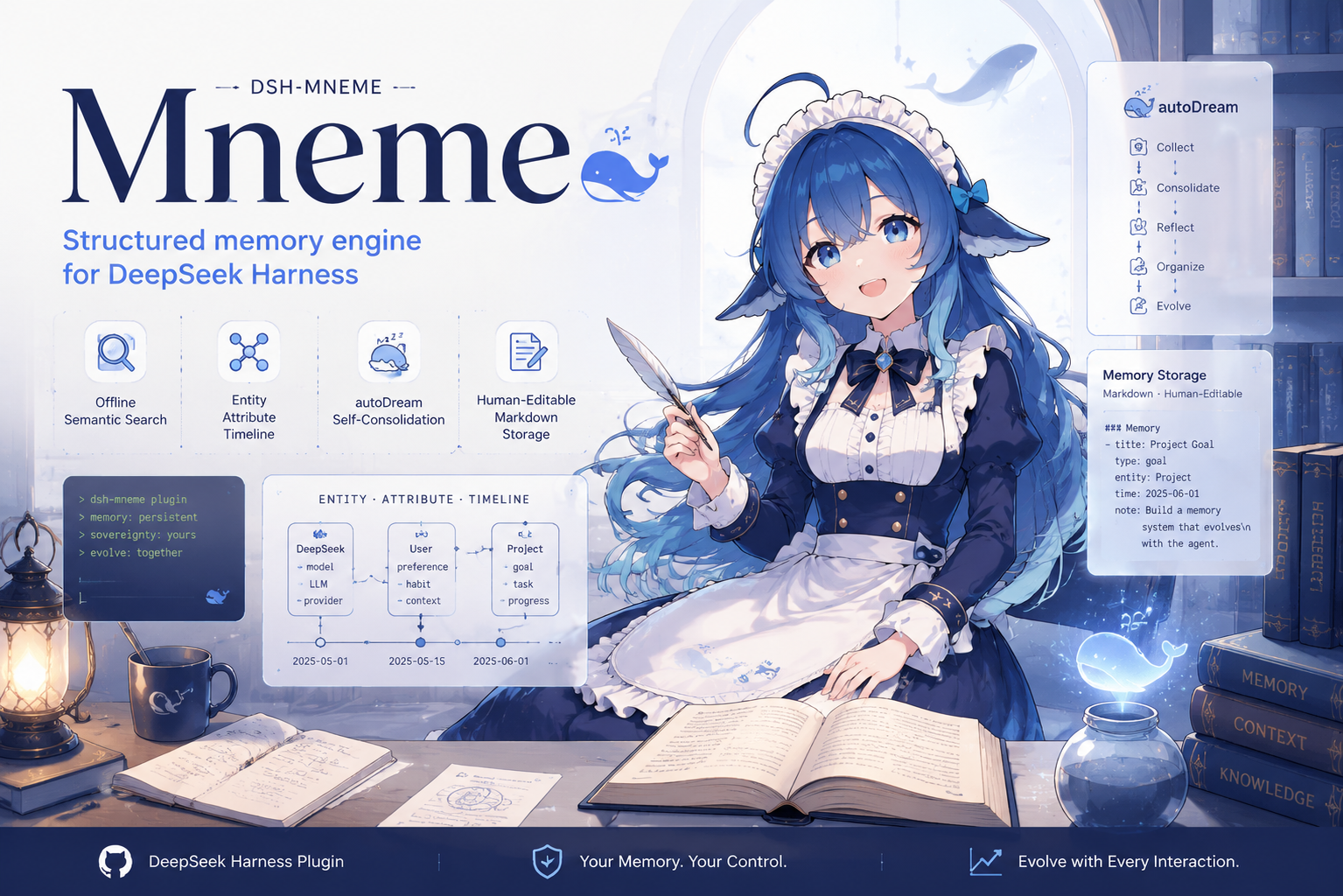
dsh-mneme





🧬 给 LLM 装上会自我进化的记忆
dsh-mneme 是 DeepSeek Harness (DSH) 的跨会话记忆插件。它不只「存得下」,更「管得好」:后台自动去重合并、矛盾先冻结等你裁决、全程可回放审计、默认全离线,还支持导出成人可读的 Markdown。
Mneme(Μνήμη)源自希腊记忆女神 Mnemosyne。她掌管记忆与梦境——正如
autoDream在后台默默巩固你的记忆库。
它解决什么问题
每次新开对话,AI 都像第一次认识你?
dsh-mneme 给 DeepSeek Harness 装上跨会话记忆。 你聊过的项目、提过的偏好、做过的决定,AI 都记得——即使关掉了窗口,下次打开还在。
| 场景 | 没装插件 | 装了插件 |
|---|---|---|
| 周一聊完项目需求,周三继续 | "能再描述一下你的项目吗?" | "你指的是上周提到的博客重构吗?当时你说想用 Astro。" |
| 告诉 AI 你的编码习惯 | 每轮都要重复交代 | 一次设定,长期生效 |
| 整理大量资料后关窗口 | 资料丢了 | 自动归档,随时检索找回 |
但 dsh-mneme 的可信之处,恰恰在你看不见的后台。下面这些,才是它和「一个会存东西的插件」的本质区别。
Showing the opening section of the README — the full document lives in the repository以上为 README 开头摘要,完整文档在仓库内 · View the full README on GitHub →在 GitHub 查看完整 README →
Related相关推荐
- CraZY222123/dsh-self-evolve Self-evolve memory plugin for DeepSeek Harness: learns from your own sessions, injects token-budgeted preference summari…
- Fishsb/dsh-shoucang-memory 守藏 Shoucang — DeepSeek Harness (DSH) 长期记忆插件:会话蒸馏自动沉淀 × 深度睡眠反思归纳 × 词法+向量混合召回 × 认知环引导 × 主动遗忘,配本地设置面板。一条命令装上,助理即拥有跨会话记忆——数据…
-
 vshulcz/deja-vu
The most accurate, cheapest and fastest memory for coding agents: searchable session history from Claude Code, Codex, Cu…
vshulcz/deja-vu
The most accurate, cheapest and fastest memory for coding agents: searchable session history from Claude Code, Codex, Cu…
-
 adoresever/graph-memory
Deepseek Harness、Openclaw知识图谱记忆插件。2026年4月受邀发布在清华大学讨论会。Knowledge Graph + Memory;Knowledge Graph Context Engine for OpenCl…
adoresever/graph-memory
Deepseek Harness、Openclaw知识图谱记忆插件。2026年4月受邀发布在清华大学讨论会。Knowledge Graph + Memory;Knowledge Graph Context Engine for OpenCl…
-
 mnemon-dev/mnemon
LLM-supervised persistent memory for AI agents — graph-based recall, cross-session knowledge, single binary. Works with …
mnemon-dev/mnemon
LLM-supervised persistent memory for AI agents — graph-based recall, cross-session knowledge, single binary. Works with …
-
 Phant0Meow/dsh-meow-memory
Cross-session memory plugin for DeepSeek Harness: seven-layer SQLite store (soul/user/project/fact/lesson/topic/rules), …
Phant0Meow/dsh-meow-memory
Cross-session memory plugin for DeepSeek Harness: seven-layer SQLite store (soul/user/project/fact/lesson/topic/rules), …
- hg1048596-pixel/dsh-recall-unread DeepSeek Harness (DSH) 插件:在模型读取前撤回已发送的文字消息,支持单条与全部撤回。A DeepSeek Harness plugin that recalls sent-but-unread text message…
-
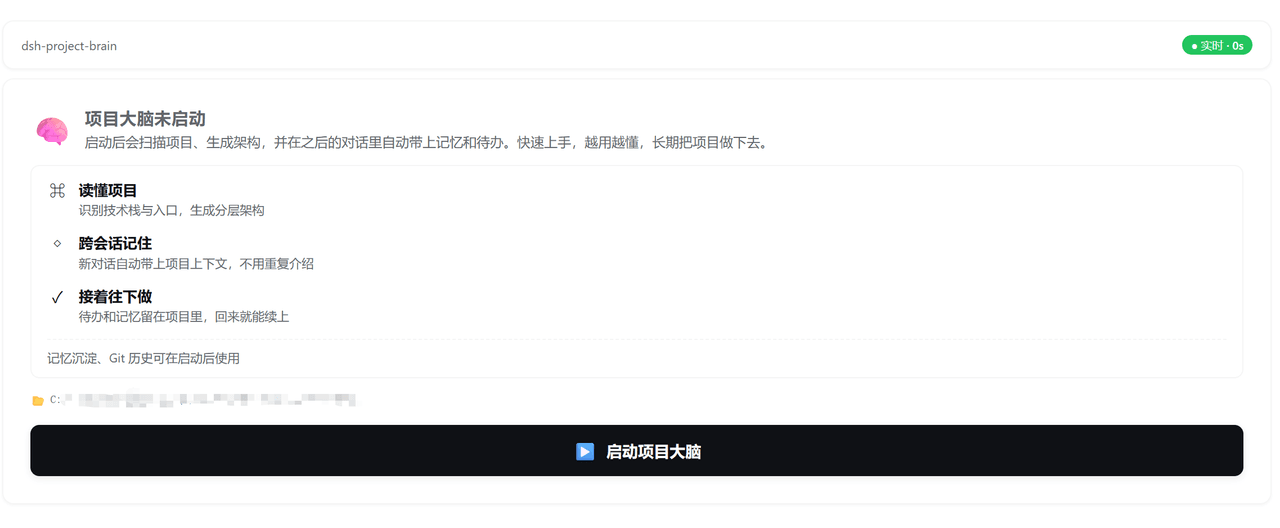 yj-liuzepeng/dsh-project-brain
Persistent project intelligence and memory plugin for DSH: architecture analysis, cross-session context, TODOs, and opti…
yj-liuzepeng/dsh-project-brain
Persistent project intelligence and memory plugin for DSH: architecture analysis, cross-session context, TODOs, and opti…