Jannchie/dsh-bill
DSH(DeepSeek Harness)插件:按会话成本行 + 成本归属报告,基于llm-pricing定价。
Project Overview项目介绍
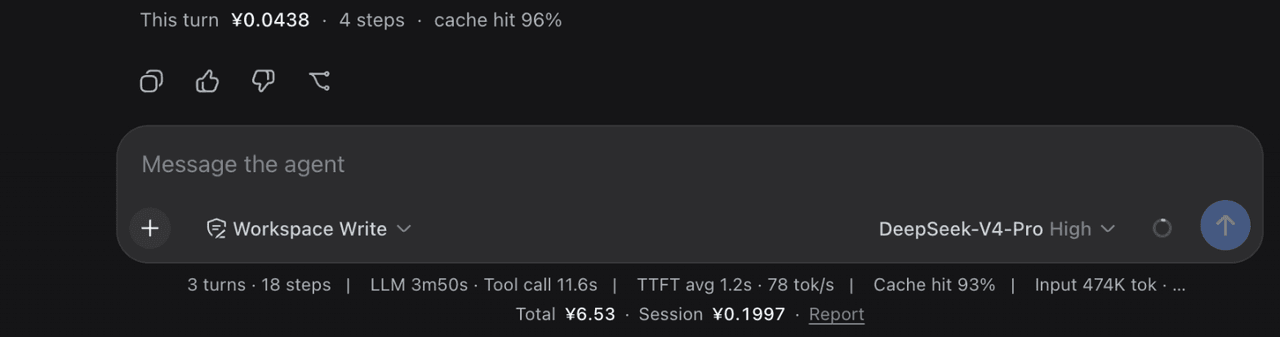
dsh-bill is a cost-tracking plugin for DSH. It attributes spend by content type, covers 8000+ models across 166 currencies with live rates, and shows cost, step count, and cache-hit rate under each turn. Use it for real-time attribution, budget control, and multi-model billing. Caveat: per-segment tokens are estimated from character share, and catalogue prices refresh every 24 hours.
dsh-bill 是 DSH 的成本追踪插件。它按内容类型拆解账单,覆盖 8000+ 模型与 166 种货币,每条回合显示花费、步数与缓存命中率。用于需要实时成本归因、预算管控和多模型计价的场景。注意点:单段 token 数按字符占比估算,目录价格每 24 小时刷新。
请帮我了解并安装插件:【dsh-bill】【https://github.com/Jannchie/dsh-bill】Send this message to DSH in your current session. CLI install commands may not be accurate across systems — DSH will figure it out for you.把上面这条消息直接发给当前会话里的 DSH,让它帮你了解并安装。安装命令不一定准确,发给 DSH 更稳。
Or use CLI install (for developers)或使用命令行安装(适合开发者)
CLI Install命令行安装
dsh plugin --profile web add dsh-bill把 Jannchie/dsh-bill 加入你的 DSH 配置(web profile)即可启用。
READMEREADME
dsh-bill
English | 中文
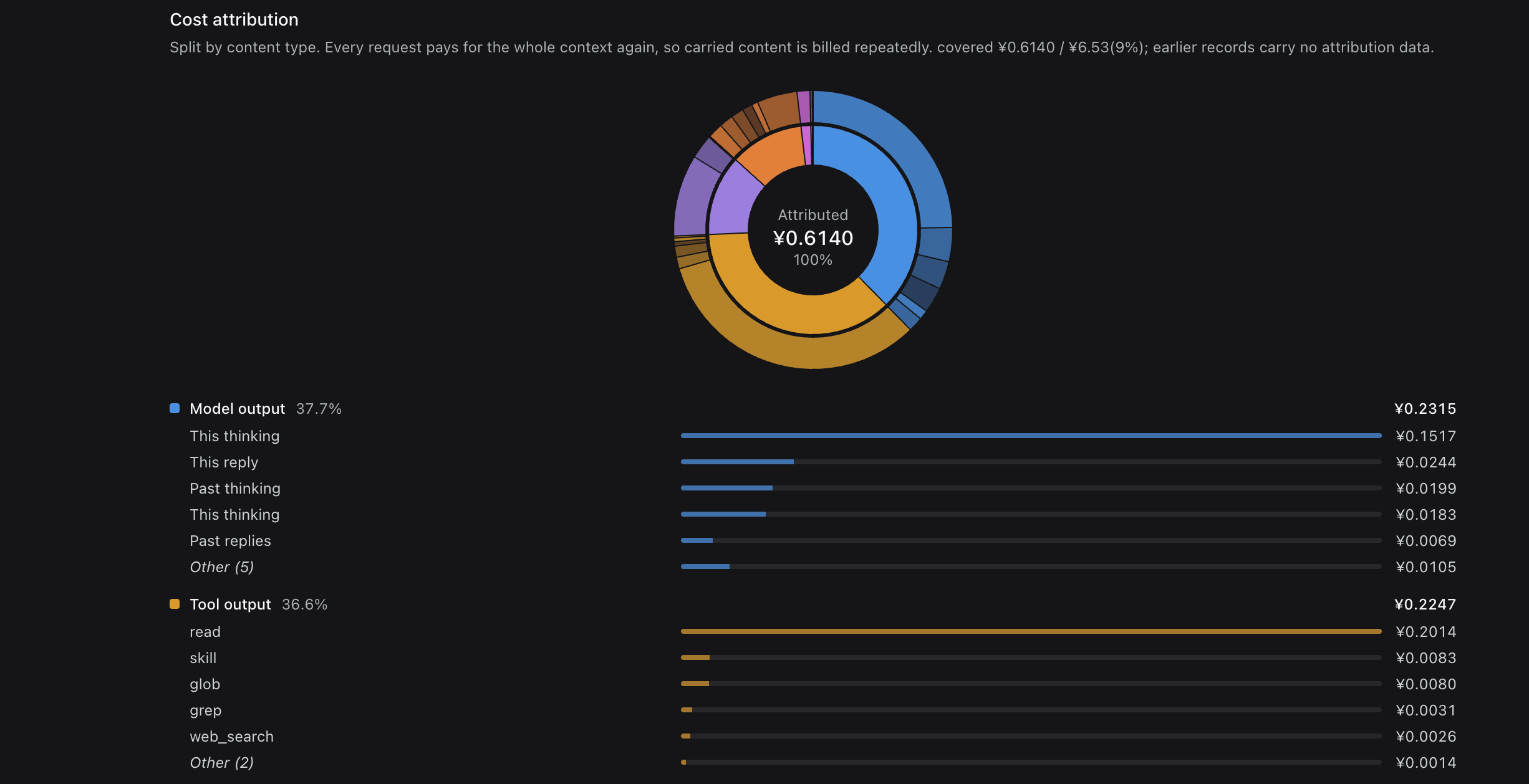
Cost tracking for DSH (DeepSeek Harness). A line under each turn tells you what that turn cost; the Cost tab tells you what the money went on.
Install
dsh plugin --profile web add dsh-bill
Restart dsh web to pick it up.
Features
- Cost attribution — the bill split by kind of content: tool output, model output, system prompt, terminal commands (grouped by
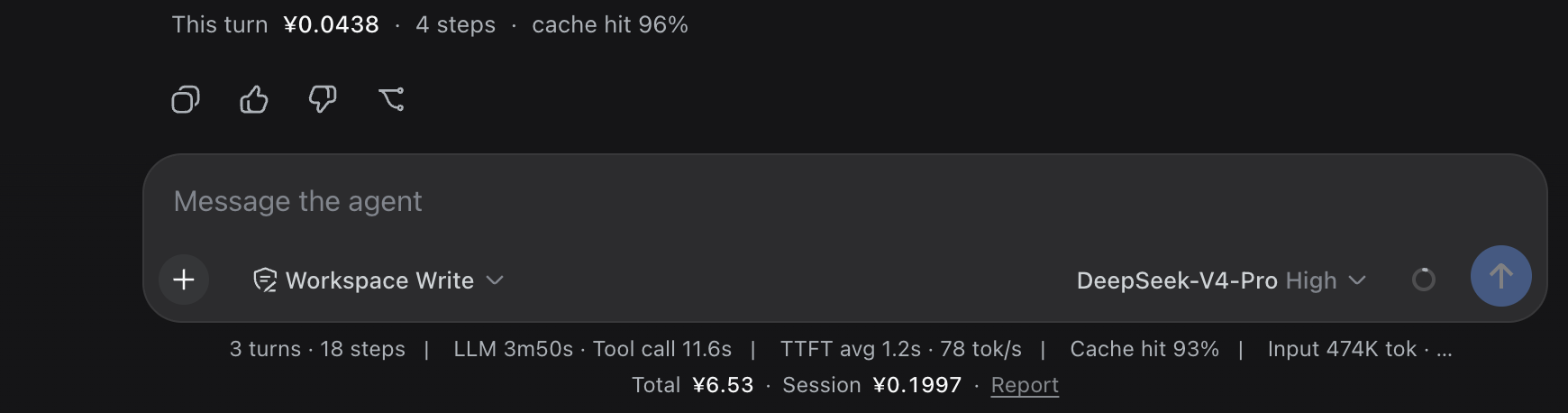
git/pnpm/rg), tool input, attachments, system reminders, user input. The sunburst drills in. - Per-turn cost — one line under every finished turn: what it cost, how many steps, the cache-hit rate. It reads the session log itself, so turns from before you installed the plugin are covered too.
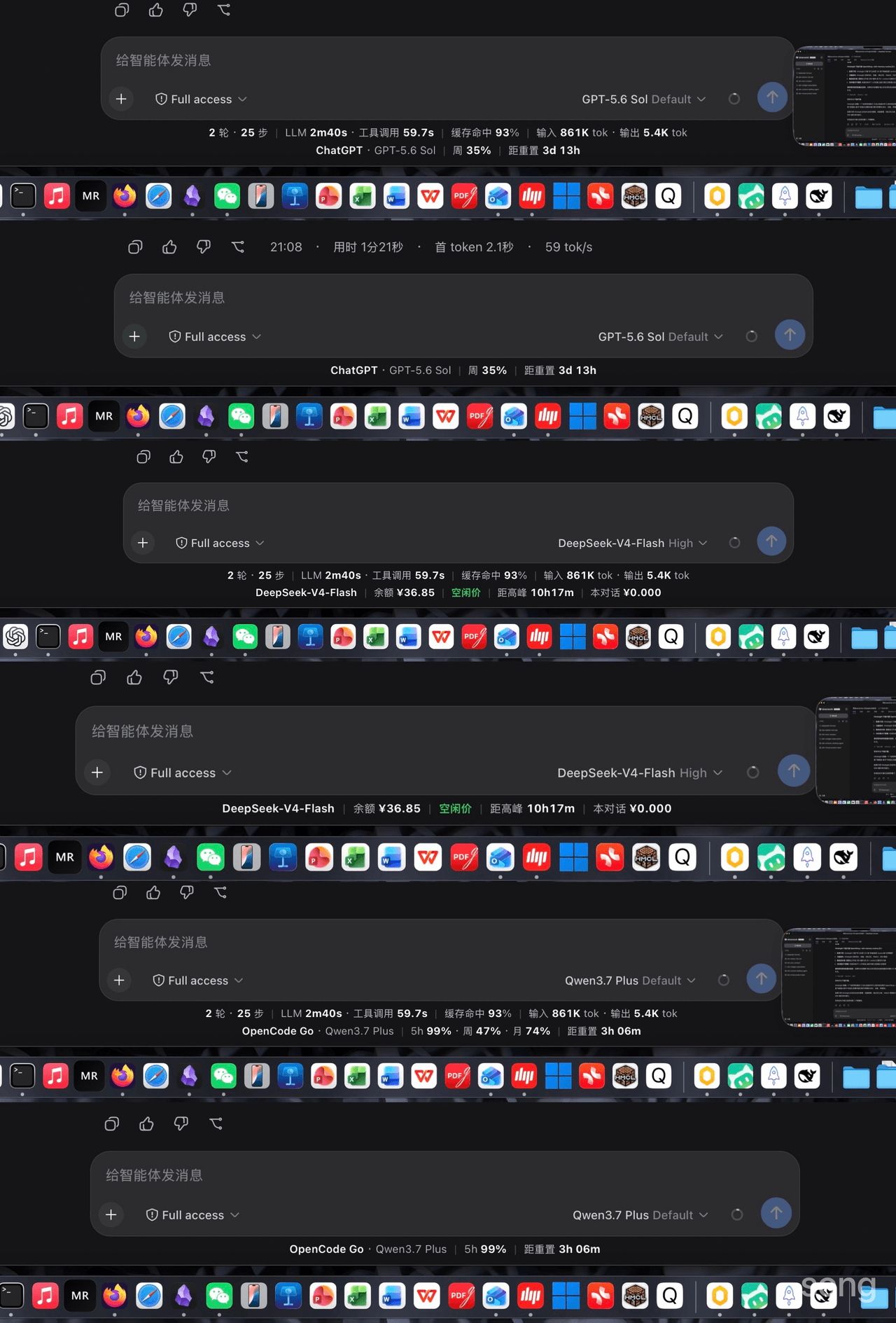
- Always on screen — a line under the shipped stats line (all-time, this session, peak share), and today's spend against the budget in the sidebar. Each of the four surfaces can be turned off individually in settings.
- Report — a Cost tab in the conversation, beside Chat and Trajectory: total, tokens, cache hit, peak share, monthly forecast, account balance; broken down by model, by session, and by purpose (including loop overhead such as context compaction); a daily trend and a weekday × hour heatmap.
- Budget — a daily / monthly / all-time limit that turns amber past 80% and red when you go over.
- Multi-currency — live rates for ~166 currencies; each model's base rate is shown in the currency its vendor prices it in.
- Agent tool —
bill_stats, so the model can answer questions about spend directly. - English and Chinese follow the DSH language setting; history from before the install is backfilled from the session log.
How it differs from similar plugins
Three substantive differences:
No hand-maintained price table. Every other plugin ships a built-in table of 2–4 DeepSeek models, which means no prices at all once you switch provider — and which is why they all need a "edit the price table by hand" entry point. dsh-bill pulls models.dev and OpenRouter through llm-pricing, covering 8000+ entries, so a new model is priced the day it ships.
Price is a timeline, not a number. The others compute a cost and store it (or recompute at today's price), so history goes wrong the moment a vendor changes its rates or a call crosses a peak/off-peak boundary. dsh-bill prices each call at that call's own instant, and never recomputes history.
It answers "on what". The others answer only "how much" — they consume the provider's aggregate token counts and never look at the request content. dsh-bill splits the request into classified segments at capture time and apportions cost by position in the cache prefix.
They do some things better: usage-stats reads balances and subscription quotas from 11 providers (dsh-bill only does DeepSeek), cost-meter can read OpenCode Go's subscription quota, and both surface more always-on entry points than dsh-bill does.
Point-by-point comparison (read from source, sampled 2026-08-16)
The sample is the cost-related plugins under the GitHub dsh-plugin topic with ★ ≥ 40, plus the four published to npm. Lower-starred plugins such as deepseek-harness-wallet were not checked individually.
| dsh-bill | cost-meter | usage-stats | dsh-cost | cost-log | dsh-usage | usage-billing | |
|---|---|---|---|---|---|---|---|
| stars / version | — | ★42 / 1.3.1 | ★40 / 0.2.0 | ★3 / 0.2.1 | ★2 / 1.0.0 | ★2 / 0.1.1 | 0.2.2 |
| price source | online catalogue | built-in table + hand-scraped docs | none | built-in table | built-in table | user-entered | built-in table |
| models covered | 8000+ entries | 4 DeepSeek | — | 4 DeepSeek | 2 DeepSeek | one at a time, by hand | DeepSeek |
| unlisted model | flagged, excluded from totals | billed at flash rate | flagged unknown | billed as v4-pro | flagged ≈ |
flagged -- |
counted as 0 |
| history never recomputed | ✓ | ✗ | — | ✗ | ✓ | ✓ | manual backfill |
| content attribution | ✓ | ✗ | ✗ | ✗ | ✗ | ✗ | ✗ |
| forecast | ✓ | ✗ | ✗ | ✗ | ✗ | ✗ | ✗ |
| budget | ✓ | ✓ | ✗ | ✗ | ✗ | ✗ | ✗ |
| account balance | ✓ | ✓ | ✓ | ✓ | ✗ | ✗ | ✗ |
| pre-install history | ✓ | ✗ | ✓ | ✗ | ✓ | ✓ | ✓ |
| agent tool | ✓ | ✗ | ✗ | ✗ | ✗ | ✗ | ✓ |
| currencies | 166, live rates | 3, fixed rates | — | follows UI language | ¥/$ | single | ¥ only |
Pricing
- two catalogues, models.dev and OpenRouter, cached for 24h and written to disk, falling back to a built-in historical snapshot on failure;
- DeepSeek's own direct rates override the catalogue, and the peak / off-peak rate is chosen from the call's timestamp;
- model names are normalised, and anything that still fails to match is flagged
?and excluded from totals — nothing is estimated; priceOverridescan override or add any price (rarely needed).
Attribution method
Every request pays for the full context again, so one tool output read into the conversation keeps being billed on every subsequent request until it slides out of the window. Attribution is computed per request and summed.
Two things matter:
- Price by position. Under prefix caching the first N tokens of the prompt bill at the cache rate and the rest at full rate — on DeepSeek the two differ by up to 156×. Segments are ordered exactly as the provider received them, the cached prefix is charged at the cache rate, and only the tail pays full price. Apportioning by an average unit price files the money under the wrong category.
- Counts only. Attribution happens at capture time on the live request; only the per-category amounts are written to disk. No prompt text is stored.
Per-segment token counts are estimated from character share (providers return only a total), and the total is the real billed figure, so the parts sum exactly to what you paid.
The session log holds token counts and model routes but not the request bodies — which is why pre-install history can be backfilled as spend, but cannot be attributed retroactively. The report states what fraction is covered.
Configuration
The budget, its currency, the display currency shared by every figure, and which of the four surfaces are shown are all set on the Cost page in settings, and stored in $DSH_HOME/dsh-bill/prefs.json. The two currencies are separate settings: the budget's is the promise ("¥100 a month") and does not follow the display. (Not in the harness's own settings document: its API proxy serves a fixed allowlist of namespaces to the browser, so a plugin's namespace is never readable or writable from there.)
maxRecords (the in-memory ring buffer size, default 20000) and priceOverrides are plugin config and are validated at startup — a mistyped field is reported by name rather than leaving the report quietly empty. ~/.dsh/profiles/web/cordis.patch.yml is only needed when you want to override a price:
- insert:
    - id: bill
      name: 'dsh-bill'
      config:
        priceOverrides:
          'anthropic/claude-sonnet-4-6':
            inputPerM: 3.0        # USD per million input tokens (uncached)
            outputPerM: 15.0
            cacheReadPerM: 0.3
            cacheWritePerM: 3.75
Data and privacy
- each call's provider / model / token usage and attributed amounts are written to
$DSH_HOME/dsh-bill/records.jsonl(a 20 000-entry ring buffer; older entries are folded into a rollup); - the API key used for the account balance is read and used host-side and never reaches the browser;
- nothing is sent anywhere except the price catalogues, the exchange-rate endpoint, and the balance query; no conversation content is stored.
Implementation
| Layer | How |
|---|---|
| Capture | hooks the llm/stream waterfall, wraps the stream to observe usage chunks, passes everything through untouched |
| Pricing | llm-pricing resolves catalogue / peak rate / override at the call's own instant |
| Attribution | the request is split into classified segments at capture time and apportioned by position in the cache prefix |
| Backfill | scans the session log for sessions it never recorded, deduplicating on turn:step |
| Per turn | the billTurns session projection folds the session log host-side and pushes to the client — no polling |
| Storage | in-memory ring buffer plus append-only JSONL, folded into a rollup before eviction; preferences in their own small JSON document; atomic replace and file locking borrowed from dsh-atomic-write |
| Transport | the ctx.connection.rpc channel /dsh-bill when there is one, falling back to POST /dsh-bill/api |
| UI | conversation.view / conversation.chat.turnTail / conversation.composer.dock / sidebar.footer.action / settings.section, built on the host's --dsw-* design tokens |
License
MIT
Related相关推荐
-
 songoao25/dsh-bottom-info-bar
Bottom Info Bar — an information bar plugin for DeepSeek Harness: provider/model, live balance, peak/off-peak pricing wi…
songoao25/dsh-bottom-info-bar
Bottom Info Bar — an information bar plugin for DeepSeek Harness: provider/model, live balance, peak/off-peak pricing wi…
-
 tianji-qingtian/dsh-model-router
模型路由与成本优化器:简单问题 flash 直答、故障自动降级、会话 token/缓存/成本实时面板 | Model router & cost optimizer for DeepSeek Harness: flash quick-ans…
tianji-qingtian/dsh-model-router
模型路由与成本优化器:简单问题 flash 直答、故障自动降级、会话 token/缓存/成本实时面板 | Model router & cost optimizer for DeepSeek Harness: flash quick-ans…
- YZz-S/dsh-token-cost-meter Community plugins for DeepSeek Harness (DSH) Web GUI: session token cost meter with official dynamic pricing, DeepSeek &…
-
 jiay98528-dev/dsh-model-sync
Writes live provider model lists into DSH settings. Composer rings show 5h/7d plan windows or metered balance for the cu…
jiay98528-dev/dsh-model-sync
Writes live provider model lists into DSH settings. Composer rings show 5h/7d plan windows or metered balance for the cu…
- bjzkhy/dsh-token-ledger-pro DSH cost panel: meters every request from session events, prices it against a built-in catalog of 136 models across 16 p…
- GeekRicardo/dsh-balance DeepSeek Harness web 插件:输入框下方状态栏展示当前供应商的余额/用量 —— DeepSeek 官方余额 + 本会话花费,Kimi Coding、OpenCode Go、GLM Coding Plan 等订阅用量(支持的…
-
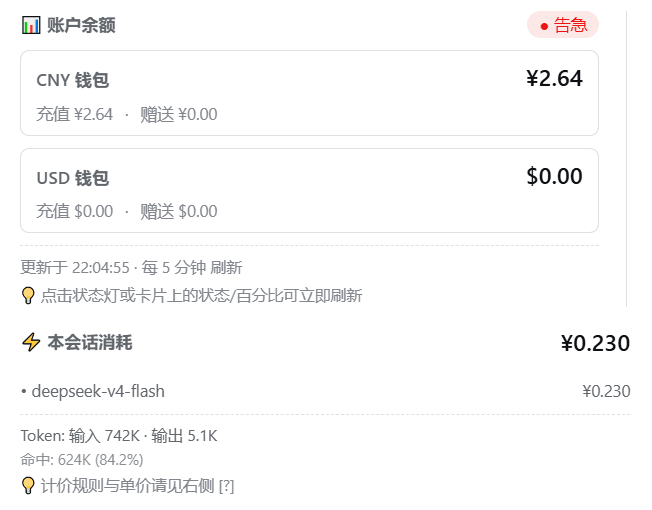 AnLifeX/dsh-credits
DeepSeek Harness(dsh web)额度插件:跟随当前模型显示官方余额或 OpenCode Go 订阅用量,支持本会话估算、跨会话累计消耗与可视化设置。
AnLifeX/dsh-credits
DeepSeek Harness(dsh web)额度插件:跟随当前模型显示官方余额或 OpenCode Go 订阅用量,支持本会话估算、跨会话累计消耗与可视化设置。
-
 Han-1413141/dsh-cost-meter
DeepSeek Harness session cost meter plugin: session/daily cost, budget, history, OpenCode Go quota, official & custom-pr…
Han-1413141/dsh-cost-meter
DeepSeek Harness session cost meter plugin: session/daily cost, budget, history, OpenCode Go quota, official & custom-pr…