Kaixxrua/dsh-aigc-radar
Project Overview项目介绍
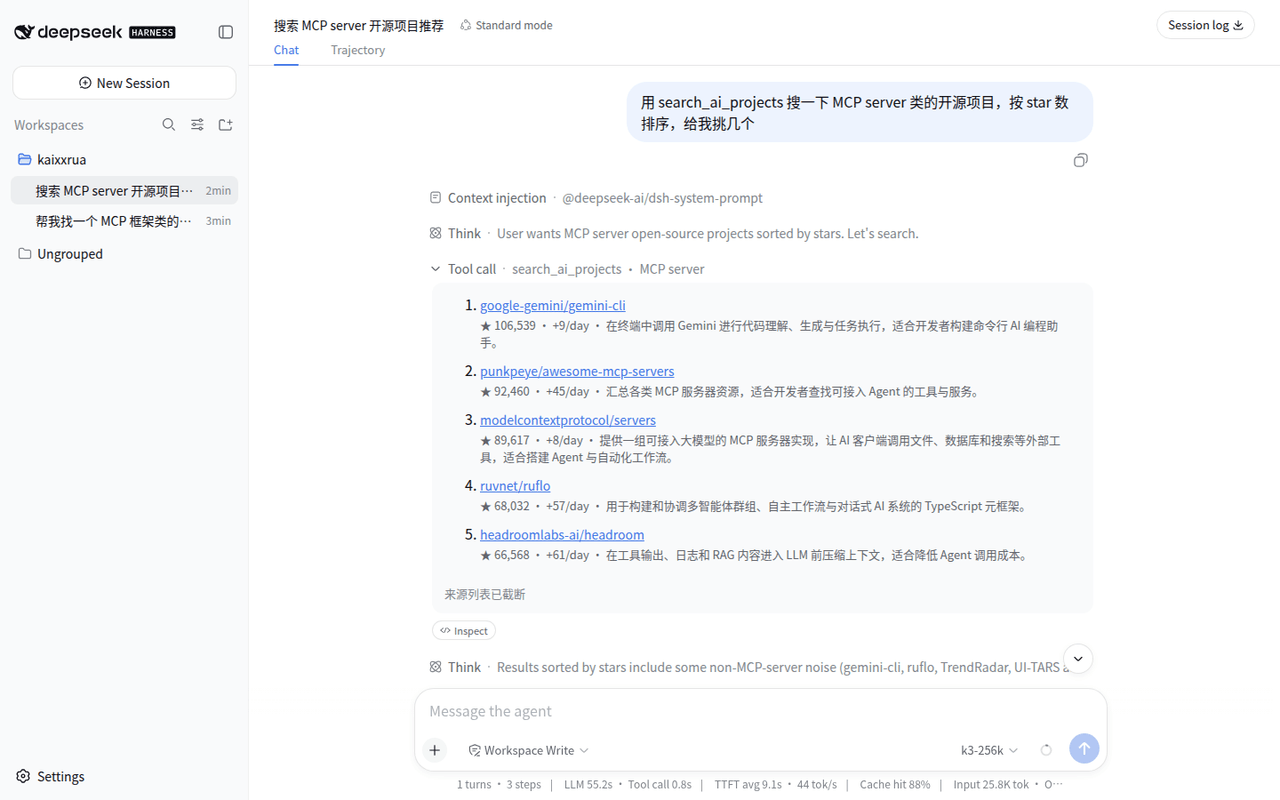
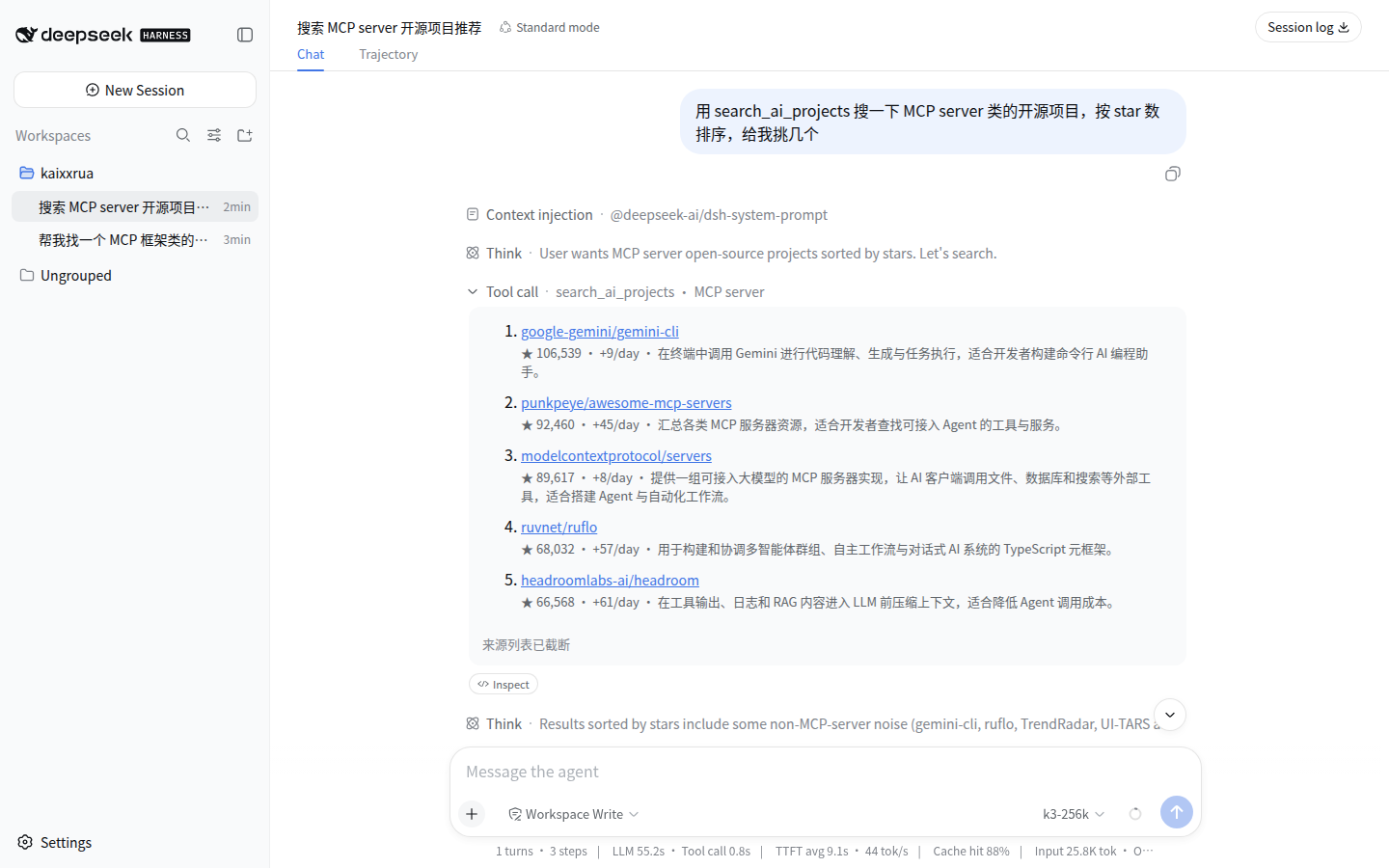
This is a native plugin built exclusively for DeepSeek Harness (DSH) that connects to the public AIGC Radar curated project library API. It lets DSH agents search for mature AIGC-related open source GitHub projects that have at least 500 stars, with results displayed as native structured search cards in the DSH web UI that persist across session replays. It ships two core tools: search_ai_projects for running keyword queries against the library, and get_project_categories for browsing the full bilingual category taxonomy.
The plugin supports two discovery routing layers: explicit user discovery and proactive automatic reuse checking. For explicit discovery, users can simply ask the DSH agent for a project matching their specific needs, and the plugin will return sorted, categorized results without requiring any manual tool invocation. For proactive checking, the plugin automatically runs a search before the agent implements any major new module or subsystem, preventing redundant work on solutions that already exist. Only narrow tasks like bug fixes, styling changes, or simple CRUD do not trigger an automatic check.
Installation requires an existing DSH installation, and can be done via npm with the command dsh plugin --profile web add dsh-aigc-radar, or installed from source directly via GitHub. The plugin is released under the open source MIT license. Anonymous usage is limited to 30 calls per day per IP address. Free registered accounts get 60 calls per day plus 1200 calls over a rolling 30-day window, while paid member accounts get 400 daily calls and 8000 monthly calls. Users must add their MCP token from aigcnews.cn to their DSH profile configuration to use authenticated access.
这是一个专为 DeepSeek Harness (DSH) 开发的原生插件,用于搜索 AIGC Radar 开源项目库。它连接 AIGC Radar 的公开 MCP 端点,可为 DSH 代理搜索星标数 500 以上的成熟开源 AIGC 相关项目,返回结构化结果并以原生搜索卡片的形式展示在 DSH 的 Web 界面中,结果在会话重放时也能正常显示,共提供搜索项目和获取分类列表两个工具。
该插件支持主动和显式两种发现模式,用户可以直接向代理提问需求,就能获取符合分类标签的项目结果,不需要手动调用工具。在代理准备实现大型模块或子系统之前,插件会主动检查库中是否已有成熟方案,避免重复造轮子,仅对细小的修改工作不触发检查,适合开发 AIGC 相关项目的开发人员和 DSH 日常用户使用。
插件采用 MIT 许可证开源,安装需要先配置好 DSH 环境,可通过 dsh 命令直接安装 npm 上的预构建包,也支持从 GitHub 源码安装。匿名用户每天每 IP 可调用 30 次,免费注册账号可获得每日 60 次加月度 1200 次的配额,会员账号配额更高,用户需要在 DSH 配置中填入从 aigcnews.cn 获取的 MCP 令牌。
请帮我安装这个 DSH 插件。安装前先完成【兼容性检查 + 安全性检查】,检查通过再动手。

插件:dsh-aigc-radar(Kaixxrua/dsh-aigc-radar)
仓库:https://github.com/Kaixxrua/dsh-aigc-radar
本站详情页:https://www.yhbd.top/plugins/kaixxrua-dsh-aigc-radar/
本站登记:类型 plugin · 归类 原生 DSH 插件 · 许可证 MIT · ⭐ 3 · 最近提交 2026-09-03 · 主语言 TypeScript

按下面顺序执行,每步先把结论告诉我,再进入下一步:

【1 兼容性检查】
① 我这边:DSH 版本、Node 版本、操作系统、当前 profile(web / desktop)。
② 读它的 README、package.json、插件 manifest,列出它要求的 DSH 版本 / Node 版本 / 操作系统 / 外部依赖 / 需要另外先装的运行时。
③ 逐条比对,结论只写「满足 / 不满足 / 未知」三种;不满足的给出可行替代方案。
④ 检查是否和我已装的插件冲突:命令名重复、skill / tool 重名、端口占用、重复注册的 MCP server。

【2 安全性检查】
① 仓库可信度:和上面「本站登记」是否一致;star / fork 数、创建时间、最近提交,是否归档或长期停更。
② 安装脚本:逐行看 package.json 的 preinstall / install / postinstall,以及 install.sh、setup.ps1 之类脚本。出现 curl|bash、下载后直接执行、混淆代码、访问与插件功能无关的域名,立刻停下来告诉我,不要继续装。
③ 依赖:列出新增依赖,标出无人维护、或与知名包拼写近似的可疑包(typosquatting)。
④ 权限与副作用:它会读写哪些目录、访问哪些域名、需要哪些 DSH 权限(filesystem / network / shell / clipboard 等),以及怎么卸载和回滚。
⑤ 如果它要求 sudo / 管理员权限,或权限明显超出功能所需,先停下来问我。

【3 安装】
上面两步没有「不满足」和「高危项」时才执行;用官方推荐方式安装,不要自行提权。

【4 汇报】
用表格输出:检查项 / 结论 / 依据 / 是否需要我决策。拿不准的一律写「未知」并说明要我怎么确认——不要猜,也不要替我决定。
Send this message to DSH in your current session: it verifies compatibility and security first (answering met / not met / unknown item by item) and only installs once everything checks out — it will stop and ask you if it finds a high-risk item. The box scrolls; the copy is the full prompt. CLI install commands may not be accurate across systems, so DSH is the safer route.把上面这条消息直接发给当前会话里的 DSH:它会先核对兼容性与安全性(逐条给「满足 / 不满足 / 未知」),确认没问题再安装,有高危项会停下来问你。框内可滚动,复制到的是完整提示词;安装命令不一定准确,发给 DSH 更稳。
- Only 3 stars - very few users, little community feedback星标只有 3,几乎没人在用,遇到问题缺少社区反馈
DSH walks through these 9 checksDSH 会逐条核对这 9 项
Compatibility兼容性
- DSH, Node, OS and profile requirementsDSH 版本 / Node 版本 / 操作系统 / profile 是否满足要求
- External dependencies and runtimes (Electron / Python / Docker, ...)外部依赖与运行时(Electron / Python / Docker 等)是否齐备
- Conflicts with installed plugins: command names, skill / tool names, ports, duplicate MCP registration与已装插件是否冲突:命令名、skill / tool 重名、端口占用、重复 MCP 注册
Security安全性
- Repo matches the facts registered here; archived or abandoned?仓库是否与页面登记一致,是否归档或长期停更
- Safety of preinstall / install / postinstall and install.sh / setup.ps1preinstall / install / postinstall 与 install.sh、setup.ps1 是否安全
- curl|bash, download-then-execute, obfuscation, unrelated domains → stop immediatelycurl|bash、下载即执行、混淆代码、无关域名 → 立刻停止
- Typosquatting or unmaintained packages among the new dependencies新增依赖里有没有 typosquatting 或无人维护的包
- Requested permissions vs. what the feature actually needs申请了哪些权限、是否超出功能所需(filesystem / network / shell / clipboard)
- Any sudo / admin requirement, plus uninstall and rollback是否要求 sudo / 管理员权限,以及卸载与回滚方式
Anything uncertain must be marked unknown with a note on how to confirm it. This site's signal screen is a static snapshot, not a security audit.拿不准的必须标「未知」并说明要我怎么确认。本站的信号筛查是静态快照,不能替代安全审计。
Or use CLI install (for developers)或使用命令行安装(适合开发者)
CLI Install命令行安装
dsh plugin --profile web add dsh-aigc-radar把 Kaixxrua/dsh-aigc-radar 加入你的 DSH 配置(web profile)即可启用。
READMEREADME
dsh-aigc-radar
English | 简体中文
AIGC Radar project search for DeepSeek Harness (dsh).
Stop rebuilding what already exists. While you plan and implement, the agent proactively checks the curated AIGC Radar library for mature, battle-tested projects that already solve your problem — before you write a line of code. Results render as native search cards in the dsh Web UI — not raw markdown — and survive session replay.
What you get
| Tool | What it does |
|---|---|
search_ai_projects |
Searches the curated AIGC Radar library: GitHub projects above a 500-star floor, enriched with categories, bilingual (zh/en) tags and descriptions, and daily star-growth metrics |
get_project_categories |
Lists the category taxonomy (categories + subcategory counts) for filter discovery |
Two routing layers make discovery automatic rather than opt-in:
- Explicit discovery — ask "找个能做 deep research 的开源框架" and the agent comes back with starred, categorized results, no "use the tool" needed
- Proactive reuse check — before the agent implements a major module or subsystem (auth, payments, workflow engines, search/indexing, protocol implementations, end-to-end RAG/Agent pipelines…), or recommends the architecture / technology / build-vs-reuse approach for one, it runs one library check on its own initiative, so mature alternatives surface before anyone rebuilds them. Narrow work (bug fixes, renames, styling, CRUD) is deliberately excluded
Why a native plugin instead of the MCP server?
AIGC Radar also ships as an MCP server — and this plugin now rides that same MCP endpoint (POST /api/mcp), so every call counts against the same rate limits and quotas. What the plugin adds on top:
- Native
websearch cards — structured sources render as cards in the Web UI and are rebuilt faithfully on session replay (presentationMeta), which the MCP transport cannot express - Typed canonical output — the result is one validated JSON value, so Code Mode can compose it programmatically (
await tools.search_ai_projects({ q: 'mcp' })) with full type inference - First-party prompt routing — the discovery-routing guidance lives in system-prompt assembly, not in MCP instructions that clients may truncate
Showing the opening section of the README — the full document lives in the repository以上为 README 开头摘要,完整文档在仓库内 · View the full README on GitHub →在 GitHub 查看完整 README →
Related相关推荐
-
 Tencent/BrowserSkill
Let AI agents use your real, logged-in browser without interrupting your work. CLI + extension for browser automation ac…
Tencent/BrowserSkill
Let AI agents use your real, logged-in browser without interrupting your work. CLI + extension for browser automation ac…
-
 anbeime/skill
收录最全、更新最快的技能Skills商店:精选原创技能包(涵盖文档处理、内容创作、编程开发、机器学习、自动化工作流),全部打包好可直接安装使用!同时自动抓取GitHub上万个Skills项目,按分类、更新时间、Star数量整理。The mo…
anbeime/skill
收录最全、更新最快的技能Skills商店:精选原创技能包(涵盖文档处理、内容创作、编程开发、机器学习、自动化工作流),全部打包好可直接安装使用!同时自动抓取GitHub上万个Skills项目,按分类、更新时间、Star数量整理。The mo…
- antibrow/dsh-antibrow DeepSeek Harness plugin: give your agent a browser with a persistent identity - engine-level fingerprint spoofing, unlim…
-
 csyangwen/dsh-memory-evolve
为 DeepSeek Harness 带来「跨会话长期记忆 + 后台自我进化」能力的纯插件实现:五轨记忆 · git 分支感知 · 回合内自我审查 · 技能自我进化与技能管理器 · 四轨待办 · COI 调度 · 会话广播 · 会话搜索 ·…
csyangwen/dsh-memory-evolve
为 DeepSeek Harness 带来「跨会话长期记忆 + 后台自我进化」能力的纯插件实现:五轨记忆 · git 分支感知 · 回合内自我审查 · 技能自我进化与技能管理器 · 四轨待办 · COI 调度 · 会话广播 · 会话搜索 ·…
- Ariestar/sivtr A unified agent memory workspace for human and agent | 一个统一的agent记忆工作空间
-
 Nagi-ovo/dsh-find-plugins
帮 DSH 搜索、安装并验证插件的 Skill|A DSH skill that finds, installs, and verifies GitHub plugins
Nagi-ovo/dsh-find-plugins
帮 DSH 搜索、安装并验证插件的 Skill|A DSH skill that finds, installs, and verifies GitHub plugins
-
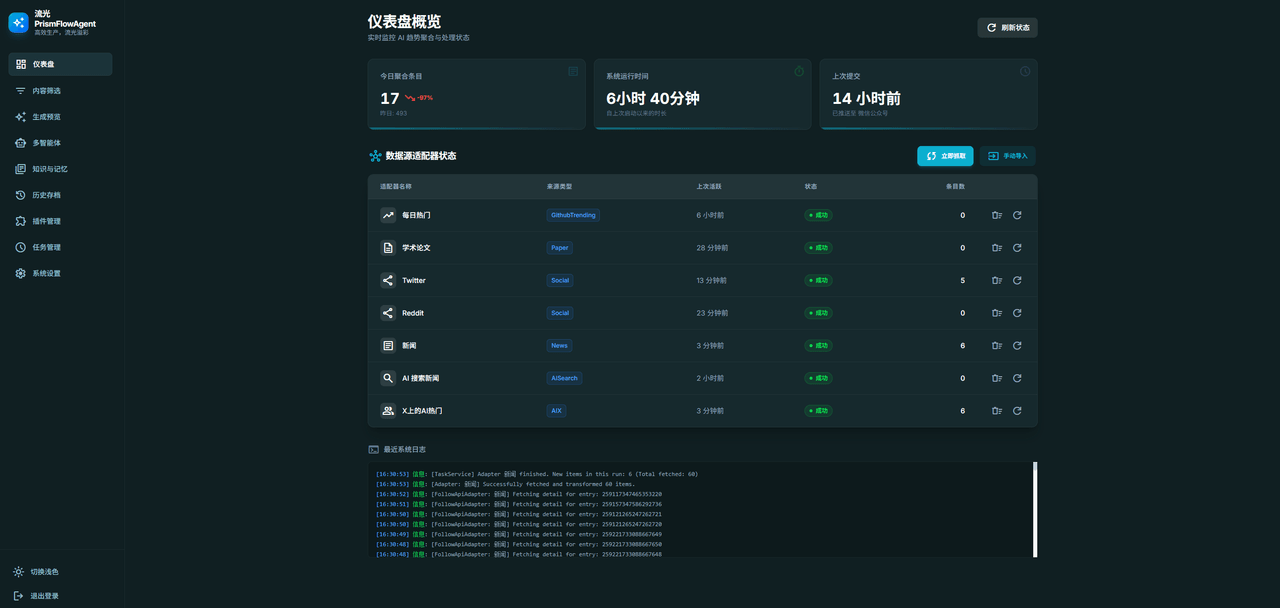 justlovemaki/PrismFlowAgent
全栈资讯处理与 AI Agent 系统。它能够自动化地从全球多源渠道抓取高质量资讯,利用顶级大语言模型进行深度总结,并将其分发至多种终端
justlovemaki/PrismFlowAgent
全栈资讯处理与 AI Agent 系统。它能够自动化地从全球多源渠道抓取高质量资讯,利用顶级大语言模型进行深度总结,并将其分发至多种终端
-
 YunTaiHua/illusion-agent
Illusion-Agent: Where fantasy meets functionality — an AI agent platform for terminal, browser, any model, any OS.
YunTaiHua/illusion-agent
Illusion-Agent: Where fantasy meets functionality — an AI agent platform for terminal, browser, any model, any OS.