raullenchai/rapid-mlx-dsh-provider
DeepSeek Harness(dsh)的原生 Rapid-MLX 提供商——dsh 从服务器读取模型信息,而非你的 settings.yaml。
Project Overview项目介绍
This is a native DeepSeek Harness (DSH) plugin that acts as a provider for Rapid-MLX, a local LLM runtime for Apple Silicon. It eliminates the need for users to manually enter model metadata like context window size and reasoning capabilities into DSH’s settings.yaml file, instead pulling all up-to-date information automatically from a running Rapid-MLX server. To install it, users can run dsh plugin --profile web add @raullenchai/dsh-provider from npm, or install directly from source via GitHub. After installation, users just need to add an environment variable pointing to the Rapid-MLX base URL (defaults to http://localhost:8000/v1) and update their DSH settings to use rapid-mlx as the default provider.
This plugin is built for DSH users who run local LLMs on Apple Silicon Macs, to connect DSH to a local Rapid-MLX instance easily. It adds five built-in tools and a dedicated /rapid-mlx command that lets users manage models directly within a DSH session, without switching to a separate terminal window. Users can check running model status, view cached downloaded models, pull new models, delete old cached models, and check service health all from the DSH interface. When switching between different models, users only need to update what the rapid-mlx serve command is running, and DSH automatically pulls the new model metadata with no manual configuration changes.
This plugin is released under the open-source Apache 2.0 license, matching the license of Rapid-MLX. It requires Node.js version 22.15 or newer, because DSH relies on Node’s Zstd stream API that is not available in older Node versions. Users should note that DSH is currently a developer preview with fast API changes, so this plugin tracks the latest DSH changes but does not guarantee compatibility with older DSH versions. Local development requires manually linking DSH’s peer dependencies, but production installs from npm work without any extra steps. It also pins the model interface fields from Rapid-MLX to prevent silent breakages from upstream changes.
这是一个专为 DeepSeek Harness (DSH) 开发的原生 Rapid-MLX 提供商插件,用来让 DSH 从运行中的 Rapid-MLX 服务器自动获取模型信息,替代原先需要用户在 settings.yaml 中手动填写的模型上下文窗口、推理能力等配置。插件还内置了五个管理工具和一个 /rapid-mlx 命令,让用户可以直接在 DSH 会话中查看、拉取、删除模型,无需切换到终端操作。已验证兼容 DSH 0.1.0-rc7 和 rc8 版本,要求 Node 22.15+ 以及一个正在运行的 Rapid-MLX 服务器。
面向使用 Apple Silicon 芯片 Mac 的 DSH 用户,适合想要在本地运行大语言模型给 DSH 提供服务的场景。用户只需要通过 dsh plugin 命令安装本插件,设置环境变量指定 Rapid-MLX 服务器地址(默认是 http://localhost:8000/v1),然后在 DSH 的 settings.yaml 里指定默认模型提供商为 rapid-mlx 就可以开始使用。切换模型时只需要修改 rapid-mlx serve 运行的模型,DSH 会自动同步更新信息,不需要修改配置文件,还能保证压缩策略匹配当前机器的实际容量。
本插件采用 Apache-2.0 许可证开源,和 Rapid-MLX 保持一致。目前需要注意 DSH 仍处于开发者预览阶段,API 更新较快,本插件会跟踪适配,但不保证长期兼容所有旧版本 DSH。本地开发调试时需要手动链接 DSH 的依赖包,正式从 npm 安装则不需要额外操作。插件对 Rapid-MLX 的模型接口字段做了固定检测,避免 Rapid-MLX 变更接口导致静默故障,保障集成的稳定性。
请帮我安装这个 DSH 插件。安装前先完成【兼容性检查 + 安全性检查】,检查通过再动手。

插件:rapid-mlx-dsh-provider(raullenchai/rapid-mlx-dsh-provider)
仓库:https://github.com/raullenchai/rapid-mlx-dsh-provider
本站详情页:https://www.yhbd.top/plugins/raullenchai-rapid-mlx-dsh-provider/
本站登记:类型 plugin · 归类 原生 DSH 插件 · 许可证 Apache-2.0 · ⭐ 70 · 最近提交 2026-08-19 · 主语言 JavaScript

按下面顺序执行,每步先把结论告诉我,再进入下一步:

【1 兼容性检查】
① 我这边:DSH 版本、Node 版本、操作系统、当前 profile(web / desktop)。
② 读它的 README、package.json、插件 manifest,列出它要求的 DSH 版本 / Node 版本 / 操作系统 / 外部依赖 / 需要另外先装的运行时。
③ 逐条比对,结论只写「满足 / 不满足 / 未知」三种;不满足的给出可行替代方案。
④ 检查是否和我已装的插件冲突:命令名重复、skill / tool 重名、端口占用、重复注册的 MCP server。

【2 安全性检查】
① 仓库可信度:和上面「本站登记」是否一致;star / fork 数、创建时间、最近提交,是否归档或长期停更。
② 安装脚本:逐行看 package.json 的 preinstall / install / postinstall,以及 install.sh、setup.ps1 之类脚本。出现 curl|bash、下载后直接执行、混淆代码、访问与插件功能无关的域名,立刻停下来告诉我,不要继续装。
③ 依赖:列出新增依赖,标出无人维护、或与知名包拼写近似的可疑包(typosquatting)。
④ 权限与副作用:它会读写哪些目录、访问哪些域名、需要哪些 DSH 权限(filesystem / network / shell / clipboard 等),以及怎么卸载和回滚。
⑤ 如果它要求 sudo / 管理员权限,或权限明显超出功能所需,先停下来问我。

【3 安装】
上面两步没有「不满足」和「高危项」时才执行;用官方推荐方式安装,不要自行提权。

【4 汇报】
用表格输出:检查项 / 结论 / 依据 / 是否需要我决策。拿不准的一律写「未知」并说明要我怎么确认——不要猜,也不要替我决定。
Send this message to DSH in your current session: it verifies compatibility and security first (answering met / not met / unknown item by item) and only installs once everything checks out — it will stop and ask you if it finds a high-risk item. The box scrolls; the copy is the full prompt. CLI install commands may not be accurate across systems, so DSH is the safer route.把上面这条消息直接发给当前会话里的 DSH:它会先核对兼容性与安全性(逐条给「满足 / 不满足 / 未知」),确认没问题再安装,有高危项会停下来问你。框内可滚动,复制到的是完整提示词;安装命令不一定准确,发给 DSH 更稳。
- This site's static screen found no obvious risk signal (stars, license, activity, manifest)本站静态筛查没发现明显风险信号(星标、许可证、更新活跃度、清单完整度)
DSH walks through these 9 checksDSH 会逐条核对这 9 项
Compatibility兼容性
- DSH, Node, OS and profile requirementsDSH 版本 / Node 版本 / 操作系统 / profile 是否满足要求
- External dependencies and runtimes (Electron / Python / Docker, ...)外部依赖与运行时(Electron / Python / Docker 等)是否齐备
- Conflicts with installed plugins: command names, skill / tool names, ports, duplicate MCP registration与已装插件是否冲突:命令名、skill / tool 重名、端口占用、重复 MCP 注册
Security安全性
- Repo matches the facts registered here; archived or abandoned?仓库是否与页面登记一致,是否归档或长期停更
- Safety of preinstall / install / postinstall and install.sh / setup.ps1preinstall / install / postinstall 与 install.sh、setup.ps1 是否安全
- curl|bash, download-then-execute, obfuscation, unrelated domains → stop immediatelycurl|bash、下载即执行、混淆代码、无关域名 → 立刻停止
- Typosquatting or unmaintained packages among the new dependencies新增依赖里有没有 typosquatting 或无人维护的包
- Requested permissions vs. what the feature actually needs申请了哪些权限、是否超出功能所需(filesystem / network / shell / clipboard)
- Any sudo / admin requirement, plus uninstall and rollback是否要求 sudo / 管理员权限,以及卸载与回滚方式
Anything uncertain must be marked unknown with a note on how to confirm it. This site's signal screen is a static snapshot, not a security audit.拿不准的必须标「未知」并说明要我怎么确认。本站的信号筛查是静态快照,不能替代安全审计。
Or use CLI install (for developers)或使用命令行安装(适合开发者)
CLI Install命令行安装
dsh plugin --profile web add @raullenchai/dsh-provider把 raullenchai/rapid-mlx-dsh-provider 加入你的 DSH 配置(web profile)即可启用。
READMEREADME
@raullenchai/dsh-provider
A native Rapid-MLX provider for
DeepSeek Harness — so dsh
gets its model facts from the server instead of from whatever you typed into
settings.yaml.

Status: published to npm as
@raullenchai/dsh-provider. The end-to-enddshrun in Verified was on an M3 Ultra againstdsh 0.1.0-rc.7;dsh 0.1.0-rc.8is API-compatible — theLlmAdaptercontract is byte-identical and the only changes are additive — and the adapter is re-verified against rc.8 at the protocol and unit-test level. DSH is still a developer preview that moves fast, so treat this as tracking a moving target, not a frozen compatibility promise.
What it does for you
DSH can already talk to a local Rapid-MLX server through its generic
openai-completions provider. That route works — but it knows nothing about
your model beyond what you hand-wrote:
# what the generic route makes you maintain, by hand, per model
llm-pi-ai:
  providers:
    rapid-mlx:
      baseURL: http://localhost:8000/v1
      defaultContextWindow: 262144      # you looked this up. is it still right?
      models:
        - id: qwen3.6-35b-8bit
          contextWindow: 262144
          reasoningEfforts: {off: none, low: low, medium: medium, high: high}
Rapid-MLX's /v1/models already publishes all of that and more. This adapter
reads it, so:
1. Nothing to hand-write, and nothing to re-write when you switch models.
Swap what rapid-mlx serve is running and dsh follows. No re-running setup,
no stale numbers.
2. The reasoning control tells the truth. Rapid-MLX reports whether a model actually has a reasoning parser. A model that can't reason no longer shows an off/low/medium/high selector that does nothing.
3. Compaction is timed with the capacity that actually fits this Mac, not a
number that drifted. This is the one that quietly costs you.
dsh-compaction-basic asks the provider for the route's capacity and compacts
at thresholdRatio × capacity (0.8 by default). The provider prefers the
server's max_model_len — Rapid-MLX's memory-fitted ceiling (what fits in
unified memory: weights + KV cache), in the vLLM/SGLang-standard field — over
the native context_window, and falls back to context_window on an older
server that doesn't report it. So compaction is timed to what the machine can
actually hold, not the model's advertised window (which it may not have room
for) and not a hand-written number copied from another model.
Showing the opening section of the README — the full document lives in the repository以上为 README 开头摘要,完整文档在仓库内 · View the full README on GitHub →在 GitHub 查看完整 README →
Related相关推荐
- voyager-crew/voyager Enhancement suite for Gemini, AI Studio, Claude, ChatGPT & DeepSeek — plus a prompt manager for any website, DeepSeek Ha…
-
 Q00/ouroboros
Agent OS: the agent gets smarter on its own. We just hold the line: Interview-gated, staged evaluation, budgeted evoluti…
Q00/ouroboros
Agent OS: the agent gets smarter on its own. We just hold the line: Interview-gated, staged evaluation, budgeted evoluti…
-
 crafter-station/petdex
A public gallery of animated pets for Codex, Claude Code, DeepSeek Harness, Hermes, OpenCode, Gemini CLI, and more.
crafter-station/petdex
A public gallery of animated pets for Codex, Claude Code, DeepSeek Harness, Hermes, OpenCode, Gemini CLI, and more.
-
 whiteguo233/OpenBiliClaw
本地私有、开源的自进化跨平台 AI 内容发现 Agent:先理解你,再主动从 B站、小红书、抖音、YouTube、X、知乎、Reddit、微博等平台与开放 Web 寻找内容。(支持 deepseek harness 插件) | Local-…
whiteguo233/OpenBiliClaw
本地私有、开源的自进化跨平台 AI 内容发现 Agent:先理解你,再主动从 B站、小红书、抖音、YouTube、X、知乎、Reddit、微博等平台与开放 Web 寻找内容。(支持 deepseek harness 插件) | Local-…
-
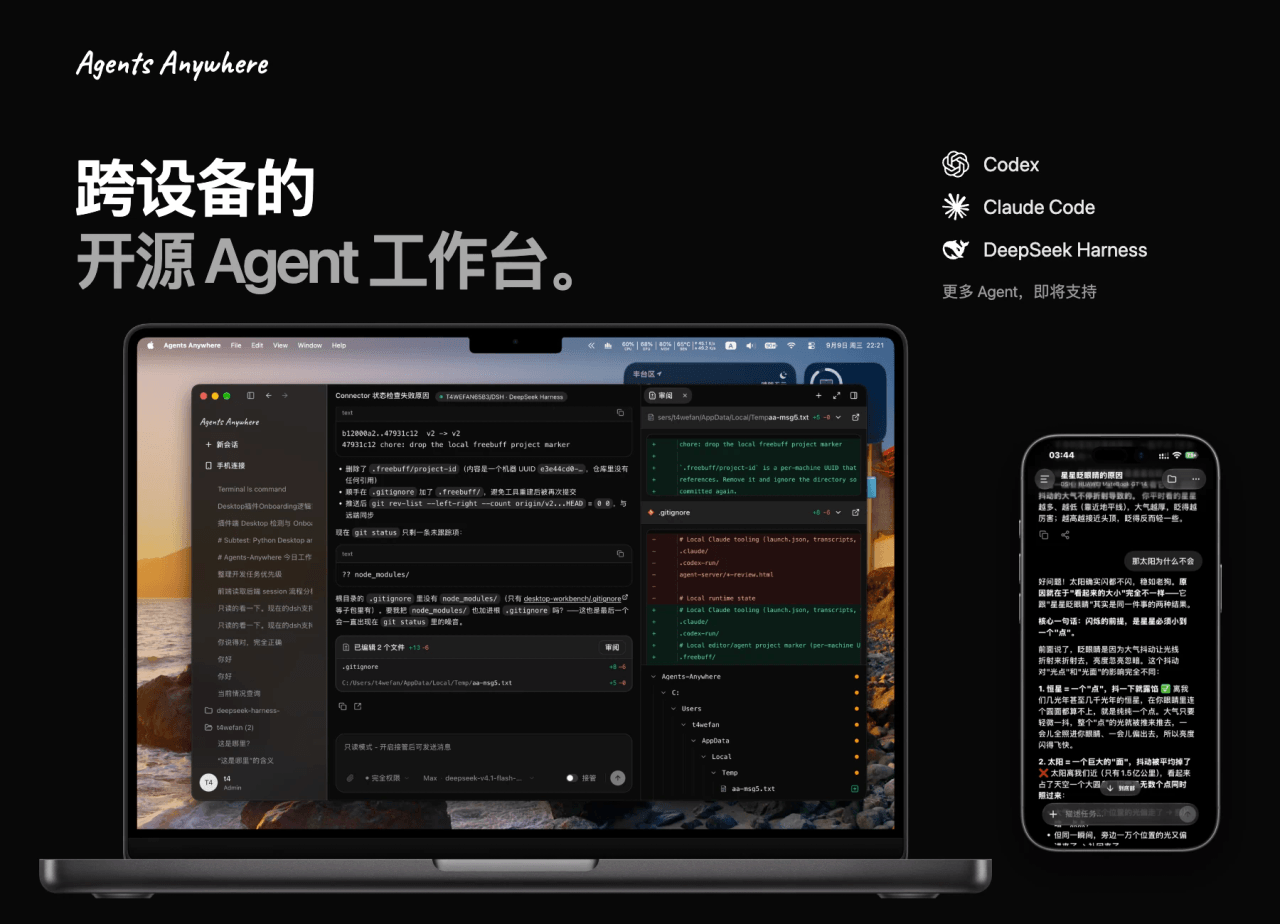 anywhere-labs/Agents-Anywhere
跨设备的开源Agent工作台
anywhere-labs/Agents-Anywhere
跨设备的开源Agent工作台
-
 agentrq/agentrq
AgentRQ: Human-in-loop realtime conversational task manager for AI Agents. Self-hosted! Control your own agents from whe…
agentrq/agentrq
AgentRQ: Human-in-loop realtime conversational task manager for AI Agents. Self-hosted! Control your own agents from whe…
-
 freestylefly/wesight
Open-source desktop AI agent workspace with one-click Claude Code, Codex, OpenClaw, Hermes Agent setup and custom LLM mo…
freestylefly/wesight
Open-source desktop AI agent workspace with one-click Claude Code, Codex, OpenClaw, Hermes Agent setup and custom LLM mo…
- zouyuxuan122/dsh-our-free-model 在 dsh 里装上这个插件即可,无需登录、注册或填 API Key,就能使用包括 Muse Spark 1.3、MiMo V2.6 在内的前沿模型——完全免费,不限量。 All you do is install this plugin i…