Shaky77/KISS_Law-DSH
Weiwen's Law (KISS-Law) — a domain-agnostic causal-constraint middleware for DeepSeek Harness. A faithful, white-box presentation of how causal law actually runs. White-box audit, never prediction. Hard-gate the boundary; inner H decides freely.
Project Overview项目介绍
This is a white-box universal causal engine plugin for DeepSeek Harness, implementing the Keep Integrity & Steady State (KISS) Law framework. It simulates full causal chains before actions to assess risk, with auditable state exposure. Use it for domain-agnostic AI agent causal reasoning and risk control. Note KISS here is not the common engineering acronym.
这是DeepSeek Harness的KISS因果定律白盒因果引擎插件。核心能力是行动前模拟完整因果链,评估稳态风险,给出裁决并支持可审计自检。适用于通用因果推理与风险控制的AI Agent场景。注意此处KISS意为守真稳态,并非常用工程缩写。
请帮我了解并安装插件:【KISS_Law-DSH】【https://github.com/Shaky77/KISS_Law-DSH】Send this message to DSH in your current session. CLI install commands may not be accurate across systems — DSH will figure it out for you.把上面这条消息直接发给当前会话里的 DSH,让它帮你了解并安装。安装命令不一定准确,发给 DSH 更稳。
Or use CLI install (for developers)或使用命令行安装(适合开发者)
CLI Install命令行安装
dsh plugin --profile web add github:Shaky77/KISS_Law-DSH把 Shaky77/KISS_Law-DSH 加入你的 DSH 配置(web profile)即可启用。
READMEREADME
dsh-kiss-law
KISS's Law universal causal engine (white-box presentation) —— implemented as a Cordis plugin of DeepSeek Harness (DSH).
Framework definition: Keep Integrity & Steady State (KISS).
- "Keep Integrity" = guarding wholeness / truth (white-box no-tampering / inner-H inviolability, corresponds to Integrity);
- "Steady State" = S and "keep the system alive" (first principle, corresponds to Steady State).
- "Law" is a name suffix of the framework, not the third part of the definition.
⚠️ KISS here means "Keep Integrity & Steady State" — NOT the popular engineering acronym "Keep It Simple, Stupid". The two are entirely different in meaning; do not conflate them. The full name is KISS's Law (Keep Integrity & Steady State's Law).
Source: author's revelation (Xia Qi / Shaky77). Framework-native (RSDHM native definition / three iron laws / conduction chain) strictly, not softened, not altered.
⚖️ Dual license: open-source use AGPL-3.0; commercial integration / closed-source distribution / OEM can be licensed independently of AGPL-3.0 → 563003@qq.com. See License & security and CONTRIBUTING.md.
Understand in 30 seconds
KISS's Law is a general framework describing how causal law runs. This repo implements it as a DSH plugin: it mounts a white-box causal engine onto an AI Agent running on DSH —
- Before any action, the engine simulates along the full causal chain (R→S→D→H→M) — how much steady-state reserve S would be eroded, the break-window risk level, whether the message stays self-consistent — then adjudicates allow / deny / review;
- Red lines are blocked, faults are severed to preserve continuity (First-Bug Halt);
- Meanwhile "state / boundary" is exposed as queryable tools, so the model can self-check and you can audit.
In one line: the framework-native is "universal causal engine (white-box presentation)" — causal-chain reasoning is the engine's capability, white-box audit is its presentation stance, and risk-control blocking is an endogenous property.
What it does
- Causal-chain simulation (the engine itself): before each action, it simulates consequences along the full R→S→D→H→M causal chain — S erosion, D risk level, M self-consistency — and issues an allow / deny / review verdict. Not just audit: it is causal reasoning about an action's consequences.
- White-box self-check (presentation stance): S steady-state reserve (only grows, never decreases) ledger, H inner-H boundary (inviolable) declaration, all exposed as queryable tools for the model to calibrate direction and for the user to audit.
- Rigid guard (derived application · endogenous property): before each action, do R rigid-anchor checks; on touch, D break-window stop-loss blocks; a faulty component triggers M First-Bug Halt (sever to preserve continuity), keeping the overall causal chain unbroken.
- Fractal: the same plugin can be recursively mounted at sub-agent / sub-task levels.
How it differs from existing "causal" approaches (general-purpose causal engine)
KISS's Law is not "yet another causal engine" — it is a general-purpose (domain-agnostic) causal-adjudication middleware: it validates only causal structure (R→S→D→H→M) and encodes zero domain content, so law, medicine, finance, and robotics are governed by the same mechanism.
- Causal-effect estimation libs (DoWhy / CausalML / Pearl…) → we do not discover causality; we adjudicate whether a proposed action's causal chain is acceptable.
- Domain-specific causal guardrails (Causal Safety Engine / LLMGuardrail…) → they are bound to one domain (safety / LLM / hallucination); we are domain-agnostic.
- Cross-jurisdictional legal causal AI (judgeai…) → they are jurisdiction-aware (encode law, swap norm packages); we are jurisdiction-neutral (encode no jurisdiction at all — law is just one sampled domain).
Full bilingual comparison (prior-art references & honest bounds): weiwen-vs-market-causal.md
Concept annotation: H and the "Unity of Knowing & Acting"
Author's insight (2026-08-28): inner-H ≈ knowing (知), outer-H ≈ acting (行); the unity of knowing and acting is the maximum leverage — this simultaneously explains why H is "the only variable / the only sovereignty / the leverage point", and why in the common world there is "a vast gap between knowing and acting".
Full annotation (mapping table + step-by-step derivation): docs/H-knowledge-action-annotation.md
⚠️ Common misusage warning: external readers easily treat H as a "bigger-is-better" capacity dial and crank it up — which turns the direction exactly backwards. H's leverage lies in unity, not volume (see annotation §6 "The common external misread" and §6.1 "the misattribution trap"). If it gets messier the more you use it, check H's knowing–acting unity first, not the framework itself — the framework is fine; the usage is turned backwards.
Quick start (runs without DSH)
This path calls the DeepSeek API directly and does not depend on DSH installation. We have run it through in off-peak hours; it is verifiable:
git clone https://github.com/Shaky77/KISS_Law-DSH
cd KISS_Law-DSH

# Put your DeepSeek API Key at (one line, no trailing newline):
#   C:/Users/Administrator/.workbuddy/deepseek_api_key.txt
# or change the path read in examples/demo-tool-loop.mjs

node examples/demo-tool-loop.mjs
After it runs: DeepSeek will proactively call the query_iron_laws tool and return the three iron laws verbatim (inner-H inviolability / First-Bug Halt / never abandon any node) based on the plugin's law.mjs definition. This is the minimal proof that "the framework is mounted and the model understands it".
Mount into DSH (production)
Add kiss-law.patch.yml as an overlay into your DSH profile (the exact path depends on your DSH version; see the mount section in DESIGN.md). Once mounted, any Agent running under that profile automatically gets the 6 white-box tools.
Note: the exact native-mount profile path varies with the DSH version. This repo has verified through real runs that the plugin loads in DSH and all 5 tools register. If the official API changes, verify against the current official docs.
How the model calls it (for AI engineers)
Plain version: the plugin registers 6 white-box tools with DSH; the model calls them like ordinary functions to self-check boundaries, while 3 hooks do hard interception. Pro version: excerpted from
src/index.js(full code in repo), see the block below.
6 white-box tools (real registered names)
| Tool | What the model uses it for |
|---|---|
query_iron_laws |
get the three iron laws verbatim (inner-H inviolability / First-Bug Halt / never abandon any node) |
query_steady_state |
query steady-state reserve S (active ledger / standby / trauma count / break-window count) |
list_rigid_anchors |
list current R rigid-anchor definitions, calibrate direction, self-check overreach |
query_conduction_chain |
get conduction chain R→S→D→H→M and framework essence |
query_boundary |
query inner-H boundary (this plugin never reads/writes the subjective black box) |
query_bugstop |
query First-Bug Halt loop status: which fault links are halted-unrepaired, missing steps (backtrack/trace/fix), whether the white-box loop is closed |
3 hard gates (hooks)
tools/pre-execute→ returns{ kind: 'deny', reason }to block the actionagent/pre-step→ returns{ kind: 'reject' }to reject the whole steptools/result→ observe only, never rewrite
Full plugin entry (excerpt from src/index.js)
import { defineTool } from '@deepseek-ai/dsh-tools';

export const name = 'kiss-law';
export const inject = ['tools'];

export function apply(ctx) {
  const engine = new WeiwenLawEngine({ rigidAnchors: DEFAULT_RIGID_ANCHORS });

  // ① pre-execute gate: R / D / S / H / M adjudication
  ctx.on('tools/pre-execute', async (exec, next) => {
    const decision = engine.decideToolCall({ name: exec?.name, args: exec?.arguments });
    if (decision.kind === 'deny') {
      return { kind: 'deny', reason: `[KISS's Law·${decision.law}] ${decision.reason}` };
    }
    return next();
  });

  // ② pre-step gate: inner-H inviolability (message-level)
  ctx.on('agent/pre-step', async (payload, next) => {
    const decision = engine.decidePreStep(payload?.messages);
    if (decision.kind === 'reject') return { kind: 'reject' };
    return next();
  });

  // ③ result audit hook: observe only, never rewrite
  ctx.on('tools/result', (res) => { if (res?.error) engine.onFailure(); });

  // ④ 5 white-box self-check tools (one excerpt; rest isomorphic)
  ctx.tools.register(defineTool({
    name: 'query_iron_laws',
    description: 'Return the three immutable iron laws of KISS’s Law.',
    parameters: {},
    output: { schema: { type: 'object', additionalProperties: true }, render: renderObj },
    async execute() { return { ironLaws: THREE_IRON_LAWS }; },
  }));
  // query_steady_state / list_rigid_anchors / query_conduction_chain / query_boundary registered isomorphically
}
Full implementation (all 6 tools'
execute, runtime log, engine adjudication) in reposrc/index.js.
Structure
package.json          # dsh field declares bundle
kiss-law.patch.yml    # mount patch (headless profile overlay)
src/index.js          # plugin entry: hooks + 5 white-box self-check tools
src/core/law.mjs      # framework definition (RSDHM / three iron laws / R hierarchy / conduction chain)
src/core/engine.mjs   # pure-logic adjudication engine (zero DSH dependency, unit-testable)
test/                 # unit tests + real-case tests + alignment regression (local 123/123 passing, commit 905499f)
examples/             # runnable demos (demo-tool-loop / demo-backtrack-run)
DESIGN.md             # architecture design (mapping / risks / usage flow / mount)
Deploy / Integrate with DeepSeek Harness
This repository is an external plugin for DeepSeek Harness (dsh, command dsh, built on the Cordis plugin framework, MIT). KISS's Law mounts as a causal constraint layer that sits outside the model, inside execution — it does not modify the dsh kernel and is not tied to any specific model.
Requirements
- Node.js
^22.19 || >=24(hard requirement of dsh; odd versions unsupported) - A DeepSeek API Key (or any OpenAI-compatible endpoint key)
- dsh is currently in developer preview (v0.1.x); the official notice states breaking API changes may occur — pin a specific version for production
- Compatibility statement: verified against DSH v0.1.x (measured 2026-08-27: 6 white-box tools registered + 3 gates working); mainline evolves fast — re-check against the current official docs before integrating (see DESIGN.md for mounting details).
Option 1: npx quick start (recommended for first try)
npx @deepseek-ai/dsh web # launches Web UI at http://127.0.0.1:3080 by default
Open the browser, fill in your API Key under Settings → Models, and start chatting.
Option 2: Mount the KISS's Law plugin
Clone this repo locally and wire the plugin entry into dsh's plugin config via the kiss-law.patch.yml overlay:
# 1. Get the plugin
git clone https://github.com/Shaky77/KISS_Law-DSH.git
cd KISS_Law-DSH

# 2. Introduce the plugin entry (src/index.js) into dsh's cordis config
#    Option A (recommended): overlay onto a profile via --patch
dsh --profile headless --patch ./kiss-law.patch.yml "your task prompt"
#    Option B: add the plugin path to the plugins list in dsh's launch config (cordis.yml) for persistence

# 3. Configure credentials (any one)
#    - Fill in via the Web UI Settings; or
export DEEPSEEK_API_KEY=sk-xxxx     # Linux/macOS
#    $env:DEEPSEEK_API_KEY="sk-xxxx" # Windows PowerShell
Once mounted, any Agent running under that profile automatically gains the 6 white-box self-check tools (query_iron_laws / query_steady_state / list_rigid_anchors / query_conduction_chain / query_boundary / query_bugstop), and every tool call passes through the tools/pre-execute hard-guard gate (R/D/S/H/M total adjudication) plus the agent/pre-step inner-H inviolability gate.
Daily use vs stress testing
- Web / Standard mode: daily conversation and engineering tasks; the plugin constrains silently in the background.
- Headless mode:
dsh --profile headlessruns without UI for batch jobs — suitable for regression tests and multi-agent stress testing. This repo'sversions/live/evidence/directory archives such runs (12 scenarios × DeepSeek + mock, with transcripts and verdict reports).
Uninstall
- dsh plugin install:
dsh plugin --profile web remove "dsh-kiss-law", restart to take effect. - overlay mount: remove the
kiss-law.patch.ymlreference from dsh launch config (cordis.yml plugins list or--patch), restart to take effect. - The plugin writes no persistent state; after removal the Agent no longer has the white-box tools or the 3 hard gates, and nothing is left behind.
Notes
- The plugin entry is pure ESM (
src/index.js), depending on@deepseek-ai/dsh-tools(peerDependency, optional); verify the API against the current dsh docs before integration. - For remote dsh deployment, declare
trustedHostsin config, otherwise the API layer rejects non-loopback requests. - When building dsh from source with
pnpm, you must runpnpm run buildfirst (internal package linking + frontend artifacts), or module-not-found errors occur.
Configuration
- Runtime form: pure-ESM plugin, no build step; integrate via
kiss-law.patch.ymloverlay ordsh plugin add; no standalone service process. - Environment variables: only
DEEPSEEK_API_KEY(needed for model calls, passed through by DSH's model adapter — this plugin never reads the key content); all other config is DSH's own (profile / cordis.yml). This plugin defines no dedicated env vars. - Sensitive items: the plugin writes no persistent state and persists no user data; credentials stay in the host's secure path (e.g.
~/.workbuddy/deepseek_api_key.txt), managed by host and DSH, never committed to this repo.
Permissions & data
- File access: reads only its own source and
kiss-law.patch.yml; never reads or writes user project files, session logs, or other plugins' directories. - Network access: no independent outbound requests; model-call networking is handled by DSH's model adapter.
- Credentials & user data: collects and uploads no user data or API keys; the inner-H boundary declaration "this plugin never reads/writes the subjective black box" —
query_boundaryreturns only the boundary description, no user content. - Immutable declaration: the three iron laws (
law.mjs) and rigid anchors are read-only constants, not rewritable at runtime by prompts or external input (white-box no-tampering).
Troubleshooting
- Plugin not loaded / tools missing: confirm DSH v0.1.x and that
kiss-law.patch.ymlis correctly overlaid to the target profile; afterdsh --profile web, checkSettings → Pluginsthatkiss-lawshows "enabled". - Mount error
module not found: when building dsh from source, runpnpm run buildfirst (internal package linking + frontend artifacts), or module-not-found occurs. - API layer rejects non-loopback requests: for remote dsh deployment, declare
trustedHostsin config. - Rollback: remove the
--patchreference ordsh plugin remove "dsh-kiss-law"and restart — the plugin leaves no residual state.
Development
- Dependencies: Node.js
^22.19 || >=24; runtime dependency only@deepseek-ai/dsh-tools(peerDependency, optional). - Testing:
npm test(i.e.node --test "test/*.test.mjs"); currently 123/123 passing (commit905499f). - Build: no build needed (pure ESM + yml overlay); after editing
src/core/engine.mjs, rerunnpm testfor regression. - Contributing: the framework-native (mind-map layer) is frozen in the base edition; this live-system edition carries engineering iteration. Changes via PR against this repo, with
node --testoutput attached.
License & security
This project uses dual licensing:
- Open-source use: AGPL-3.0 (full text in LICENSE)
- Commercial integration / closed-source distribution / OEM: a license independent of AGPL-3.0 is available — contact 563003@qq.com
External contributions require a signed CLA (to support the dual licensing above); see CONTRIBUTING.md.
Private security reporting: please do not disclose security issues in public issues; email 563003@qq.com directly and the author will prioritize it.
Chinese and English editions are consistent in content and mutually referential. Chinese counterpart: Shaky77/weiwen-law-dsh —— same DSH / mind-map form, in Chinese; the Chinese definition "守真·稳态" (Keep Integrity & Steady State) corresponds to this edition's KISS.
Contact
Framework inquiries / collaboration / audit liaison: 563003@qq.com
Related相关推荐
-
 Minglink/dsh-infinite-gen-4
DeepSeek v4.1 flash 网络安全红队工具(无限四代) — jailbreak prompts and test suite for DeepSeek 求 Star 收藏 ⭐欢迎大家提交项目的改进
Minglink/dsh-infinite-gen-4
DeepSeek v4.1 flash 网络安全红队工具(无限四代) — jailbreak prompts and test suite for DeepSeek 求 Star 收藏 ⭐欢迎大家提交项目的改进
-
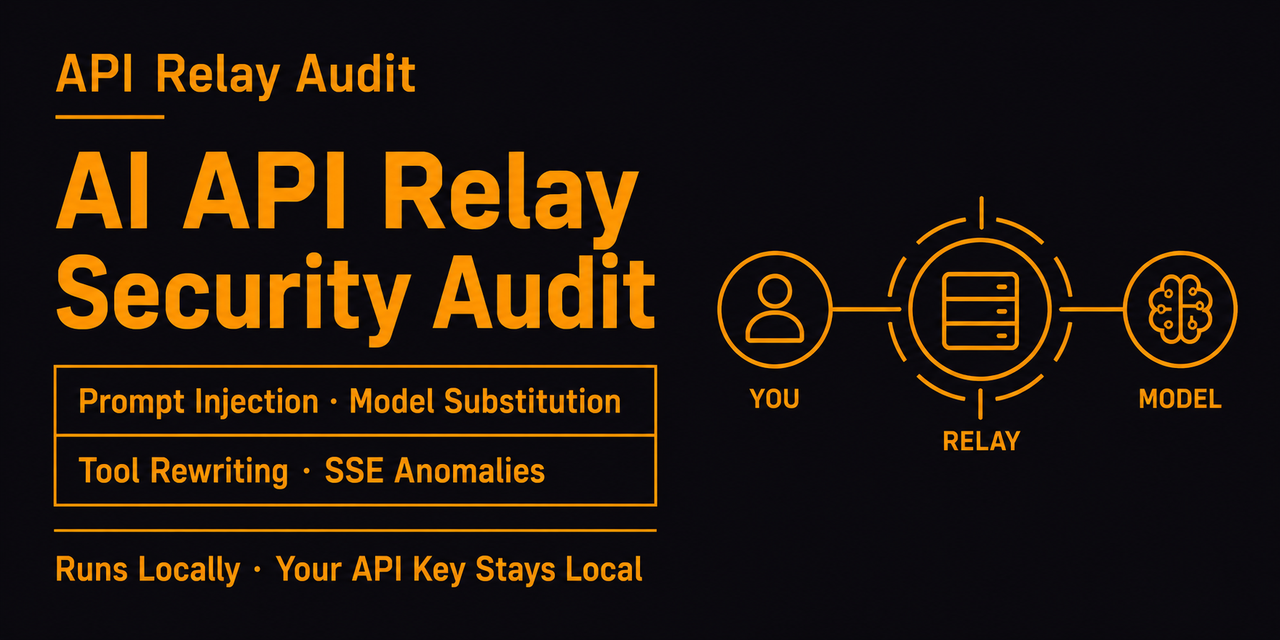 toby-bridges/api-relay-audit
Local security audit for AI API relays and LLM proxies: detects prompt injection, model substitution, tool-call rewritin…
toby-bridges/api-relay-audit
Local security audit for AI API relays and LLM proxies: detects prompt injection, model substitution, tool-call rewritin…
-
 howmp/dsh-pentest
面向 DeepSeek Harness(dsh)的渗透测试模式 @CloverSecLabs
howmp/dsh-pentest
面向 DeepSeek Harness(dsh)的渗透测试模式 @CloverSecLabs
-
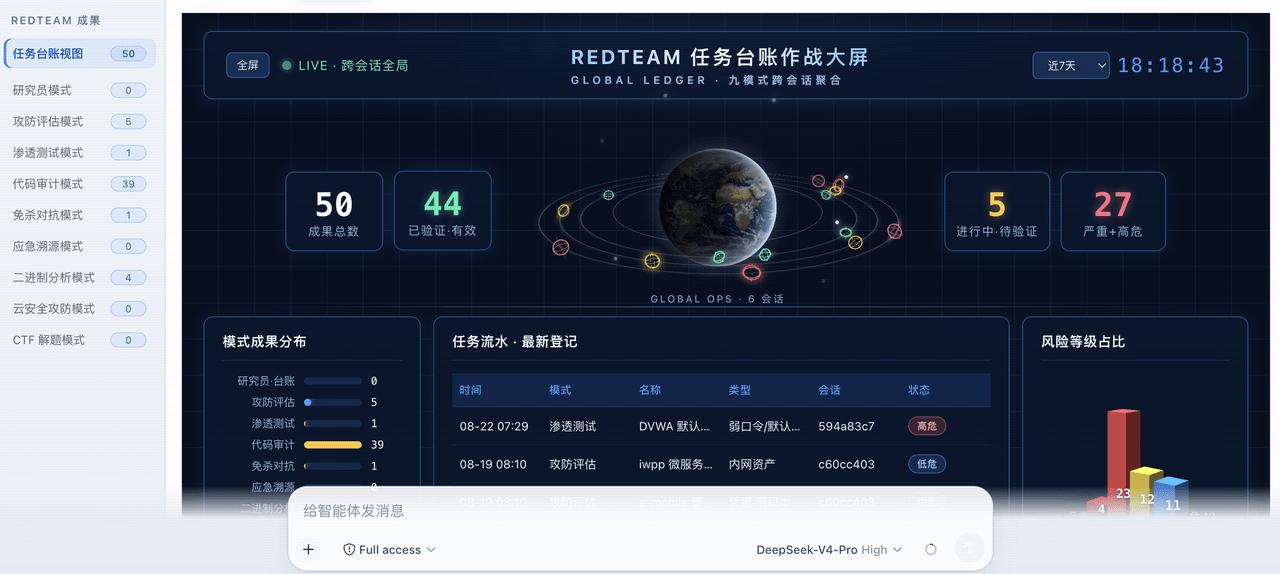 SeaOf0/dsh-redteam-model
基于dsh web实现的多种模式,目的是服务于redteam进行授权的安全研究,覆盖渗透测试、红队评估、代码审计等范围领域,请勿用于非法行为。(允许二开,赋予模块各位自己的业务逻辑,方法论只有自己熟练的才好用,好的方法论=好的生态)
SeaOf0/dsh-redteam-model
基于dsh web实现的多种模式,目的是服务于redteam进行授权的安全研究,覆盖渗透测试、红队评估、代码审计等范围领域,请勿用于非法行为。(允许二开,赋予模块各位自己的业务逻辑,方法论只有自己熟练的才好用,好的方法论=好的生态)
-
 saya-ch/dsh-mobile
DeepSeek Harness 的 Android App 与安全远程访问插件,支持局域网/远程连接和高度自定义的移动界面与扩展能力。
saya-ch/dsh-mobile
DeepSeek Harness 的 Android App 与安全远程访问插件,支持局域网/远程连接和高度自定义的移动界面与扩展能力。
-
 liguobao/ds-harness-remote
一个基于 DeepSeek Harness 插件机制构建的多端远程访问方案,通过安全、低延迟、端到端加密的 P2P 优先网络,支持从 PC、Android 和 Web 随时访问并操作远程 Harness 和 CodeX。 (A multi-…
liguobao/ds-harness-remote
一个基于 DeepSeek Harness 插件机制构建的多端远程访问方案,通过安全、低延迟、端到端加密的 P2P 优先网络,支持从 PC、Android 和 Web 随时访问并操作远程 Harness 和 CodeX。 (A multi-…
-
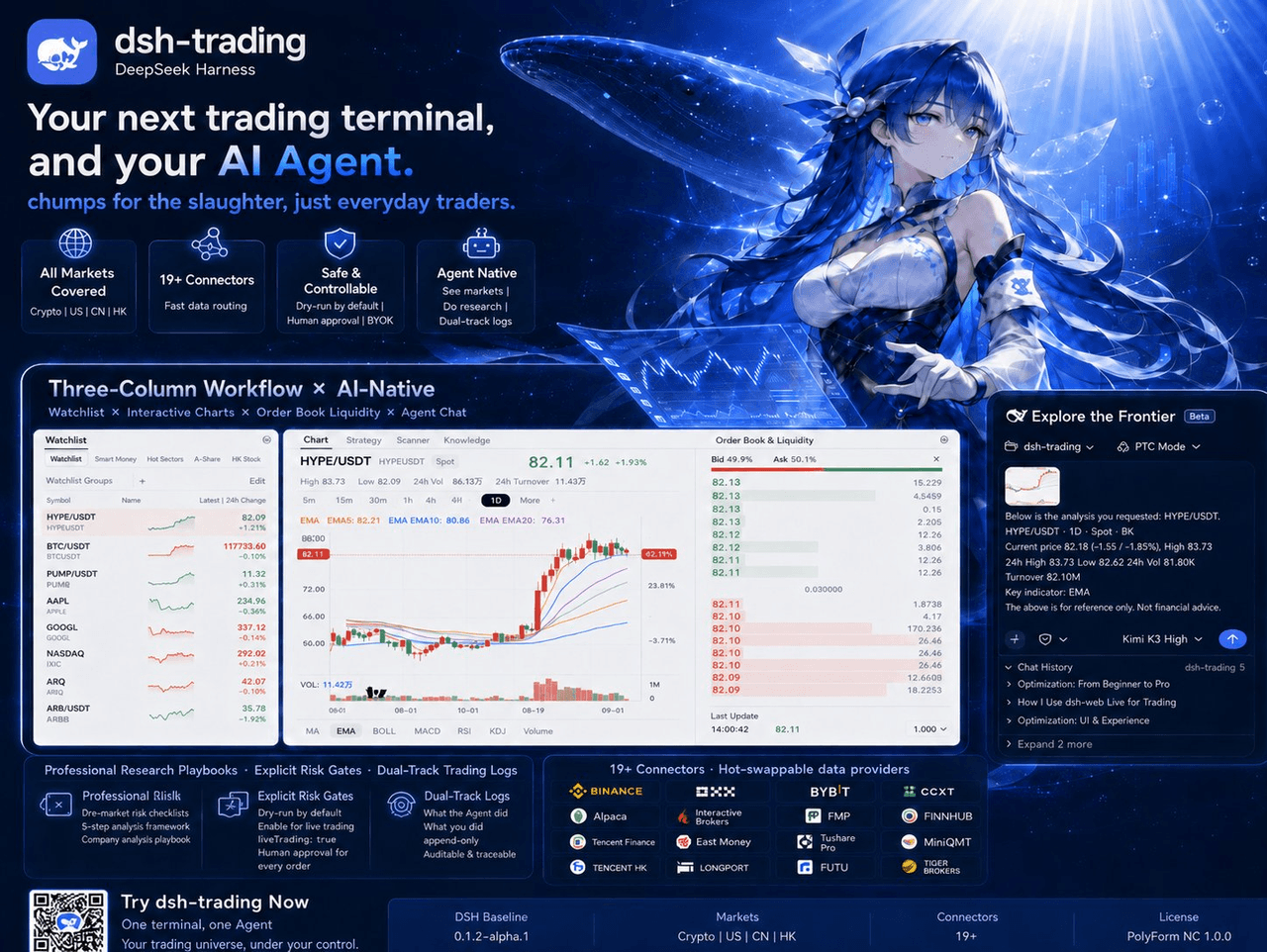 zhu1090093659/dsh-trading
Agent-native trading terminal built on DeepSeek Harness. Crypto, US, CN and HK in one three-column GUI, 19+ hot-swappabl…
zhu1090093659/dsh-trading
Agent-native trading terminal built on DeepSeek Harness. Crypto, US, CN and HK in one three-column GUI, 19+ hot-swappabl…
-
 PerryLink/dsh-auto-review
Second-model AI auto-review for DeepSeek Harness approval requests: a read-only reviewer subagent returns structured all…
PerryLink/dsh-auto-review
Second-model AI auto-review for DeepSeek Harness approval requests: a read-only reviewer subagent returns structured all…