TuringCorp-net/mosaic-memory-compress
Generic stateless dialogue compression that mimics human memory. LLM conversations stay bounded forever — no session management, no context overflow. Ships a ready-to-use adapter for DeepSeek Harness (DSH).
Project Overview项目介绍
MosaicMemoryCompress is a stateless dialogue compression library with a DeepSeek Harness adapter. It keeps recent messages raw, structurally truncates the middle zone, and folds older rounds into a single semantic pair, holding message count constant so very long conversations continue without reset-based summarization. Use it for LLM agents running extended sessions that must respect context window limits. Caveat: early details fade progressively; pair the library with persistent storage when exact retrieval of older turns is required.
MosaicMemoryCompress 是一个无状态对话压缩库,附带 DSH 适配器,通过保留最近原始消息、结构化截断中段、折叠远段为单条语义对的方式,将消息数稳定在常数级别,使超长对话无需重置摘要即可持续进行。适用于 LLM 代理处理长会话以维持上下文窗口的场景。注意:早期细节会随时间逐渐淡化,非无损归档,需精确检索时请配合持久层按需回读。
请帮我了解并安装插件:【mosaic-memory-compress】【https://github.com/TuringCorp-net/mosaic-memory-compress】Send this message to DSH in your current session. CLI install commands may not be accurate across systems — DSH will figure it out for you.把上面这条消息直接发给当前会话里的 DSH,让它帮你了解并安装。安装命令不一定准确,发给 DSH 更稳。
Or use CLI install (for developers)或使用命令行安装(适合开发者)
CLI Install命令行安装
dsh plugin --profile web add mosaic-memory-compress把 TuringCorp-net/mosaic-memory-compress 加入你的 DSH 配置(web profile)即可启用。
READMEREADME
MosaicMemoryCompress


A generic, pluggable stateless dialogue compression algorithm — works with any LLM agent framework, and ships a ready-to-use adapter module for DeepSeek Harness (DSH).




LLM conversations grow linearly. MosaicMemoryCompress keeps them bounded — automatically, invisibly, and without the user ever knowing what a "Session" is.
How It Works
Your message array (R rounds, oldest → newest):

Round 1 ────→ Round (R-30)   │ Heavy zone → ALL → 2 msgs
Round (R-29) → Round (R-10)  │ Light zone → structural truncation, count unchanged
Round (R-9) ────→ Round R    │ Raw zone  → keep as-is
Steady state: constant message count — 2 + heavyStart × (messages per round), e.g. 62 messages (31 user rounds) for pure two-message rounds, whether at round 60 or round 15,000 (higher, but still constant, when tool-call rounds add messages). The compression ratio approaches 100%.
Philosophy: Alive Memory, Not a Handover Brief
The industry-standard answer to unbounded conversations is threshold summarization: when the window fills up, summarize everything into one brief and hand it to a fresh model. The conversation looks like it continues. But structurally it is amnesia followed by reading a diary:
- A switch moment. Memory breaks, then is rebuilt from a single summary call.
- Indiscriminate loss. The freshest instructions are paraphrased too — the exact part that must stay vivid. In a controlled A/B experiment the brief paraphrased the user's latest instruction and silently dropped an action item ("write the key points into MEMORY").
- Invisible loss. The next model cannot know what the brief omitted, so it cannot compensate.
MosaicMemoryCompress models the opposite: biological forgetting. A human does not remember round 3 of a 300-round conversation — they keep the lesson, the rules, the relationship. The algorithm reproduces that curve inside one message array:
recent 10 rounds   → verbatim (vivid — what you are actually working on)
rounds 10–40       → structural truncation (reasoning/args/results trimmed, text kept)
rounds 40+         → one heavy checkpoint: identity, environment, permissions, rules
No switch moment, no reset, no length limit. The heavy zone is semantic memory (rules that must never be forgotten); the middle is recent episodic memory; the raw zone is the vivid present. Loss is visible: the zone structure tells the model what it no longer knows, so it can fetch detail from shadowed storage on demand.
| Threshold summarization (industry) | MosaicMemoryCompress | |
|---|---|---|
| Metaphor | amnesia + diary | continuous vivid memory |
| Continuity | resets on every compaction | never resets |
| Loss | indiscriminate, invisible | graduated, visible |
| Recent turns | paraphrased at the worst moment | always verbatim |
| Purpose | portable handover brief | unbounded human–AI dialogue |
The two philosophies complement each other: a handover brief serves cold starts and long pauses; MosaicMemoryCompress serves staying in the conversation. Combined with a durable host-side store (e.g. a MEMORY.md file), human and AI keep talking under the same forgetting curve indefinitely. See docs/design.md §8/§10 for the formal position-is-age model behind this design.
Quick Start
npm install mosaic-memory-compress
import { mosaicMemoryCompress, type MosaicMemoryConfig } from 'mosaic-memory-compress';

const config: MosaicMemoryConfig = {
  lightStart: 10,    // keep 10 most recent rounds raw (vivid)
  lightWindow: 30,   // compress every 30 rounds (aligned with heavy)
  heavyStart: 40,    // rounds before this enter the heavy zone
  heavyWindow: 30,   // heavy fold cadence (30-round interval)
  callLLM: async (systemPrompt, userInput) => {
    // Wire to OpenAI, Anthropic, or any LLM provider
    const res = await openai.chat.completions.create({
      model: 'gpt-4o-mini',
      messages: [
        { role: 'system', content: systemPrompt },
        { role: 'user', content: userInput },
      ],
    });
    return res.choices[0].message.content ?? '';
  },
};

// Call every turn — zero cost below threshold; structural light is millisecond-fast,
// Heavy folds take ~1-2s (one LLM summary call)
const compressed = await mosaicMemoryCompress(messages, config);
Features
- Stateless & repeatable — no session state; call it every turn, and the output can be fed back in as input
- Zero-cost below threshold — returns immediately if no compression is due
- Anti-jitter — compression only at configurable window boundaries
- LLM-agnostic — bring your own
callLLMfunction for Heavy (OpenAI, Anthropic, local models…); light runs zero-LLM - DeepSeek Harness (DSH) adapter — ships with
dsh-module/for seamless integration; the core algorithm stays framework-agnostic - Tool-call safe — tool messages don't break round counting
- Graceful degradation — LLM failures don't block the conversation
API
mosaicMemoryCompress(messages, config)
| Param | Type | Description |
|---|---|---|
messages |
Message[] |
Full message array. System prompt at [0] is preserved as-is. |
config |
MosaicMemoryConfig |
Compression config (see below). |
| Returns | Promise<Message[]> |
Compressed message array. |
MosaicMemoryConfig
| Field | Type | Default | Description |
|---|---|---|---|
lightStart |
number |
30 |
Most recent N rounds kept raw |
lightWindow |
number |
10 |
Anti-jitter: compress every N rounds |
heavyStart |
number |
50 |
Rounds beyond this → Heavy zone |
heavyWindow |
number |
10 |
Anti-jitter for heavy compression |
callLLM |
(sys: string, user: string) => Promise<string> |
optional | Your LLM call function — Heavy zone only; light is structural truncation. Omit it for light-only usage |
onCompress |
(event: CompressEvent) => void | Promise<void> |
optional | Hook after each compression; receives the original payload for host-side archiving |
DEFAULT_CONFIG
Prefer starting from the exported defaults and overriding only what you need:
import { mosaicMemoryCompress, DEFAULT_CONFIG, type MosaicMemoryConfig } from 'mosaic-memory-compress';

const config: MosaicMemoryConfig = { ...DEFAULT_CONFIG, callLLM: async (sys, user) => { /* ... */ } };
All numeric fields must be positive integers (windows) / non-negative integers (starts),
and heavyStart must be greater than lightStart. Invalid configs throw a TypeError.
Message
interface Message {
  role: 'system' | 'user' | 'assistant' | 'tool';
  content: string;
  tool_call_id?: string;
  tool_calls?: { id: string; type: 'function'; function: { name: string; arguments: string } }[];
}
Design
Read the full design document (English) or 中文设计文档.
Architecture Boundaries
MosaicMemoryCompress is intentionally stateless and lossy:
- Durable storage is the host's responsibility. The library compresses
the message array in place and never persists original payloads. Hosts
that need lossless history must archive the raw messages themselves —
through their own code, a database, or the host platform's persistence
layer (the
onCompresscallback hands every compressed-away original to the host for archiving). - Compression is lossy by design. Like any summarization approach, early details fade progressively. That is the point: the goal is an unbounded conversation, not lossless archival. If exact retrieval of early turns matters, pair this library with a persistence layer and re-read on demand.
Integration Notes
MosaicMemoryCompress is host-agnostic and works wherever a callLLM function
exists. Its primary integration reference is DeepSeek Harness (DSH)
(deepseek-ai/deepseek-harness
— everything is a plugin), whose task-level compaction / output retention /
spill complement this library's message-level compression (roles and order
preserved).
DSH compatibility
⚠️ DSH 0.1.5 and newer: use the built-in compaction, do not mount this adapter.
The stock
compaction-basicbackend in 0.1.5 already implements this adapter's core logic: the recent window stays verbatim (default = 16% of the window — 160k tokens on a 1M window) and everything older folds into one bounded checkpoint, on a pressure trigger that never interrupts the conversation. It adds overflow recovery, a durable lock, a fullcompaction/start|summary|endtransaction, replay-stability checks and a KV-cache-reusing summarization call — a far stronger safety story than this adapter. The only feature without an official equivalent is the Light zone (age-based, zero-LLM structural dehydration); carrying a second compaction engine plus per-version DSH adaptation for that one feature is not worth it, and official configuration approximates the same effect:# the compaction-basic row inside a preset composition (0.1.5 moved these rows # from the host plane into each preset's realm) config: thresholdRatio: 0.15 # condense at 15% of the window (150k on a 1M window) retainRatio: 0.05 # keep the newest 5% verbatim (50k)Alternatively leave the preset alone and lower the declared
defaultContextWindowin thellm-deepseek:section of$DSH_HOME/settings.yaml(hot-reloaded, no restart; the real request still uses the model's true window). KeepretainRatiobelowthresholdRatio: a badretainTokensbudget only warns once and then silently stops automatic compaction, so read the boot log after changing anything.Full code-level comparison and rationale (including the 0.1.5 move of compaction into each preset's isolated realm):
dsh-module/INTEGRATION-NOTES.md§21. Hosts at ≤ 0.1.2 can still use this adapter; the framework-agnostic library is unaffected either way.
Install the adapter into a DSH profile (the package declares a dsh.bundle):
dsh plugin --profile web add mosaic-memory-compress      # registry package
# no npm? straight from the public repo:
dsh plugin --profile web add github:TuringCorp-net/mosaic-memory-compress
Compression stays off until a session is listed — set
config.sessionAllowlist in the profile patch (see the safety gate below).
The adapter probes the host at runtime and adapts to its session API:
| DSH | session events | replace surfaceOp fields | status |
|---|---|---|---|
| 0.1.0 | session.events |
start / end |
supported |
| 0.1.2 | snapshotEvents() |
start / end |
supported (production, 2026-09-06) |
| 0.1.5+ | snapshotEvents() |
startSeq / endSeq |
supported (probe-verified) |
Detection is behavioural, not version parsing — and self-correcting: the
module replays a minimal append+replace log through the exported pure
foldSurface to pick an initial spelling (the two are mutually exclusive:
0.1.5 also enforces exactly three keys), and if the host still rejects a
replacement it flips the spelling and retries once. A probe can only be as
correct as the module resolution it runs under (a symlinked dev checkout
carries its own node_modules/@deepseek-ai, which shadows the host's), so
the host's own validation has the final word.
0.1.5 note: that host forbids sourceEventSeqs on assistant/message
("embeds its source stream") while requiring every shadowed node to be cited
— so assistant nodes cannot be replaced there. The light pass skips them
(user and tool nodes are still dehydrated); the heavy fold is unaffected
because it replaces a user/message with the full citation list. Optional diagnostics: set MOSAIC_DIAG=<path> to log pre-step and
exception lines to a file (journald buffering can hide stdout).
⚠️ Upgrading an existing host to 0.1.5. Conversations that mosaic
compressed before v1.3.2 on DSH ≤ 0.1.2 carry assistant-level 1:1
replacements whose citation cannot satisfy 0.1.5's migration audit, so 0.1.5
refuses to load them (assistant/message … chunk provenance is not one complete ordered attempt). The stored log itself is never modified — nothing
is lost, but the conversation will not open again, and no plugin-side repair
exists. Salvage the transcript read-only with
scripts/salvage-session.py (it reads the
.jsonl.zstd directly). Mount mosaic v1.3.2 or later before upgrading
DSH: from there the engine never writes those events on 0.1.5. Full analysis:
dsh-module/INTEGRATION-NOTES.md §19.
DSH adapter: session allowlist (safety gate)
By default the adapter compresses nothing until you explicitly list session ids — a first-time trial can never touch your other conversations:
# cordis.patch.yml (or the plugin config)
config:
  sessionAllowlist:
    - fb80be2a-99aa-42e1-9de8-2f7017d2c0b6   # only this session is compressed
Use ['*'] to allow every session (the pre-allowlist behavior). Sessions
not listed are a zero-cost no-op.
A denylist (sessionDenylist) always wins over the allowlist — it keeps
selected sessions out of a fleet-wide rollout, e.g. one reference
conversation that should stay unmanaged for diagnosis:
config:
  sessionAllowlist: ['*']              # fleet-wide
  sessionDenylist:                     # except these
    - fb80be2a-99aa-42e1-9de8-2f7017d2c0b6   # reference conversation, never compressed
A ready-to-use DSH plugin backend lives in
dsh-module/ (design docs in EN/中文).
Related:
- DeepSeek Harness — the host platform
- awesome-dsh-plugin — curated DSH plugin list
- awesome-deepseek-harness — DSH ecosystem list
- design docs (EN) / 设计文档(中文) — theory and empirical case study
See the Roadmap for upcoming work.
Benchmark
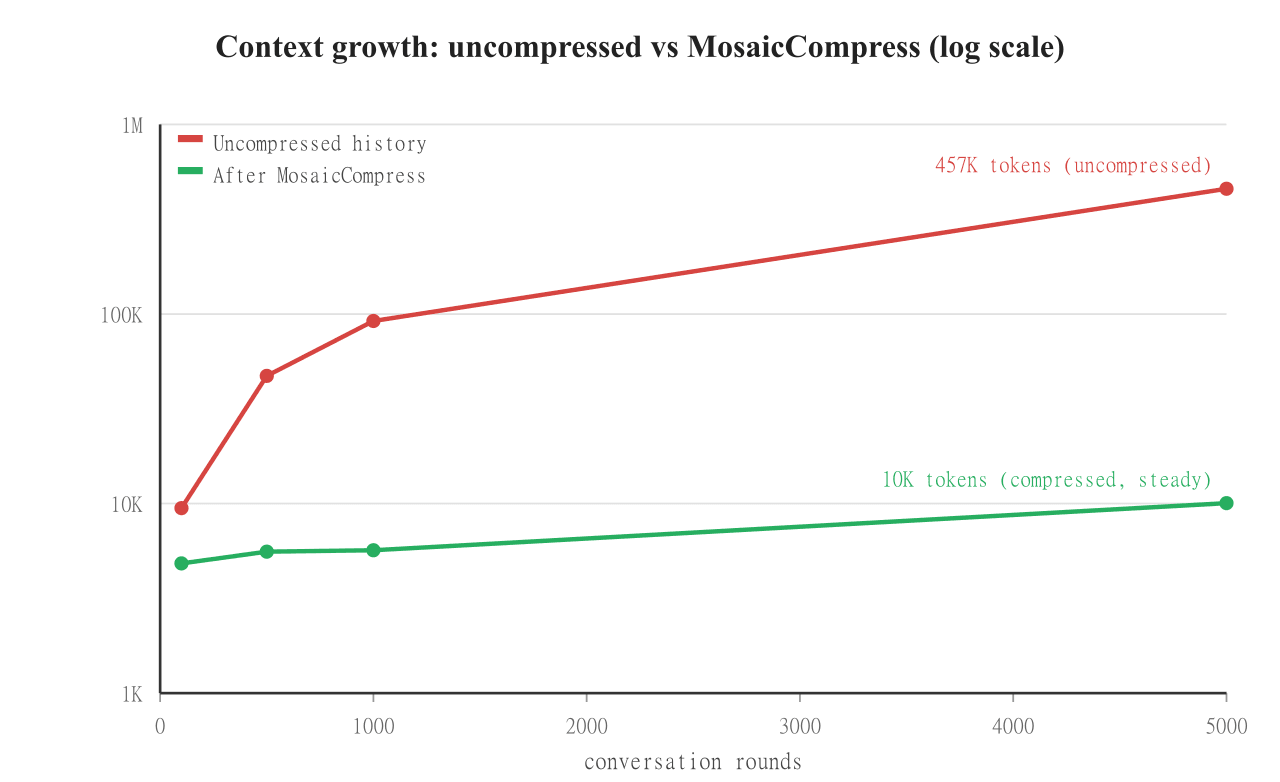
A deterministic simulation (zero LLM cost, reproducible) runs the real algorithm with a rule-based pseudo-LLM. Latest sweep (default parameters):
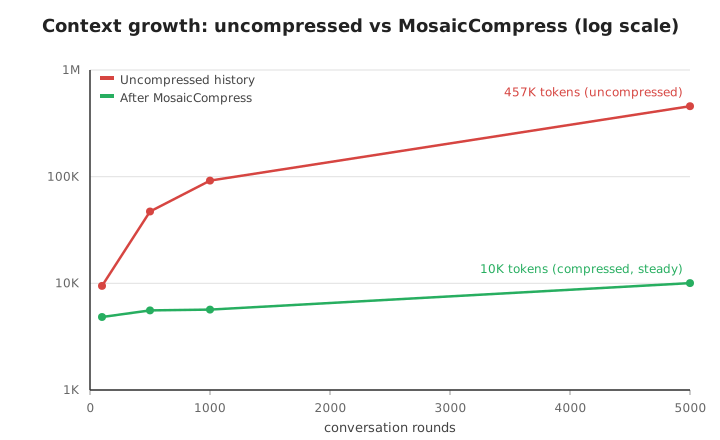
| Rounds | msgs in | msgs out | tokens in | tokens out | ratio | facts kept |
|---|---|---|---|---|---|---|
| 100 | 234 | 120 | 9,451 | 4,580 | 51.5% | 100% |
| 1,000 | 2,310 | 122 | 91,869 | 5,523 | 94.0% | 100% |
| 5,000 | 11,500 | 120 | 457,484 | 9,913 | 97.8% | 100% |
npm run bench                        # synthetic sweep: 100 / 500 / 1000 / 5000 rounds
npm run bench -- --file chat.json    # analyze your own conversation file
The file mode accepts any JSON array of messages in the library's
Message shape and reports the compression ratio:
[{"role": "system", "content": "..."},
 {"role": "user", "content": "..."},
 {"role": "assistant", "content": "..."}]
See benchmark/README.md for the full method, data
generation, findings, limitations, and the real-LLM spot check
(npm run bench:real — DeepSeek V4 Flash, <$0.01, 5/5 facts retained).
Development
# Run tests (zero LLM cost — uses mock responses)
npm test

# Type-check the whole project
npm run typecheck

# Or directly:
npx tsx tests/index.test.ts
License
MIT — TuringCorp | iAsk@turingcorp.net
Related相关推荐
-
 vshulcz/deja-vu
One memory shared by Claude Code, Codex, Cursor, Copilot CLI, OpenClaw and 20 more coding agents, built from the session…
vshulcz/deja-vu
One memory shared by Claude Code, Codex, Cursor, Copilot CLI, OpenClaw and 20 more coding agents, built from the session…
-
 adoresever/graph-memory
Deepseek Harness、Openclaw知识图谱记忆插件。2026年4月受邀发布在清华大学讨论会。Knowledge Graph + Memory;Knowledge Graph Context Engine for OpenCl…
adoresever/graph-memory
Deepseek Harness、Openclaw知识图谱记忆插件。2026年4月受邀发布在清华大学讨论会。Knowledge Graph + Memory;Knowledge Graph Context Engine for OpenCl…
-
 mnemon-dev/mnemon
LLM-supervised persistent memory for AI agents — graph-based recall, cross-session knowledge, single binary. Works with …
mnemon-dev/mnemon
LLM-supervised persistent memory for AI agents — graph-based recall, cross-session knowledge, single binary. Works with …
- hg1048596-pixel/dsh-recall-unread DeepSeek Harness (DSH) 插件:在模型读取前撤回已发送的文字消息,支持单条与全部撤回。A DeepSeek Harness plugin that recalls sent-but-unread text message…
-
 modusensus/dsh-mneme
🧠 The memory that dreams — cross-session memory for DeepSeek Harness. Offline & private, auto-consolidates in its sleep…
modusensus/dsh-mneme
🧠 The memory that dreams — cross-session memory for DeepSeek Harness. Offline & private, auto-consolidates in its sleep…
-
 Phant0Meow/dsh-meow-memory
Cross-session memory plugin for DeepSeek Harness: seven-layer SQLite store (soul/user/project/fact/lesson/topic/rules), …
Phant0Meow/dsh-meow-memory
Cross-session memory plugin for DeepSeek Harness: seven-layer SQLite store (soul/user/project/fact/lesson/topic/rules), …
- Tasihi89/dsh-talk-map Visual conversation map for DeepSeek Harness — sessions as cards on a whiteboard: drag to arrange, double-click to chat,…
-
 diqierjia/StrataGate-AgentMemory
Local-first cross-session memory for DeepSeek Harness (DSH): automatic capture, Event/Element cards, evidence-gated reca…
diqierjia/StrataGate-AgentMemory
Local-first cross-session memory for DeepSeek Harness (DSH): automatic capture, Event/Element cards, evidence-gated reca…