youngrock-labs/dsh-provider-copilot
use a GitHub Copilot subscription as a DSH LLM provider
Project Overview项目介绍
This is a DeepSeek Harness (DSH) plugin that connects an existing GitHub Copilot subscription to DSH as an LLM provider. It supports streaming chat completions, model listing, reasoning content passthrough, and auth commands. Use it when you want to use your Copilot subscription in DSH. It relies on GitHub's non-public internal endpoint, which may be changed or revoked any time.
这是DeepSeek Harness(DSH)的插件,可将你的GitHub Copilot订阅接入DSH作为LLM提供商,支持流式对话补全、模型列表获取、推理内容透传和登录管理命令,适合已有Copilot订阅想在DSH中使用的场景。注意它调用GitHub非公开接口,接口随时可能变更或失效。
请帮我了解并安装插件:【dsh-provider-copilot】【https://github.com/youngrock-labs/dsh-provider-copilot】Send this message to DSH in your current session. CLI install commands may not be accurate across systems — DSH will figure it out for you.把上面这条消息直接发给当前会话里的 DSH,让它帮你了解并安装。安装命令不一定准确,发给 DSH 更稳。
Or use CLI install (for developers)或使用命令行安装(适合开发者)
CLI Install命令行安装
dsh plugin --profile web add github:youngrock-labs/dsh-provider-copilot把 youngrock-labs/dsh-provider-copilot 加入你的 DSH 配置(web profile)即可启用。
READMEREADME
dsh-provider-copilot
Bridge a GitHub Copilot subscription into DeepSeek Harness (dsh) as a plain LLM provider.
Scope
- ✅ Chat completions (streaming)
- ✅ Model listing (whitelist ∩ remote)
- ✅ Reasoning-stream passthrough (
delta.reasoning_content→reasoningchunk) - ✅
/copilot login | logout | statuscommands - ✅ JSONL observability with strict field allowlist
- ❌ Tool / function calling (explicitly out of scope)
- ❌ Copilot CLI runtime / FFI (not used)
Architecture
The package is a dsh plugin bundle: a cordis object plugin
(name/inject/apply) whose apply(ctx) registers a provider route on
the harness LLM service. dsh discovers the model group purely from that
registration — no dsh source changes are needed.
┌────────────────────────────────────────────────────────────────────┐
│                    dsh (host, any profile)                          │
│  cordis loader ── apply(ctx, config)                               │
│    └─ ctx.llm.registerAdapter(["copilot"], CopilotAdapter)         │
└────────────────┬───────────────────────────────────────────────────┘
                 │
                 ▼
┌────────────────────────────┐   ┌────────────────────────────────┐
│     CopilotAdapter        │──▶│    CopilotClient (HTTP)        │
│  • dsh StreamChunk emit   │   │  • layered timeouts             │
│  • no tools ever          │   │  • SSE parser                   │
│  • whitelist (+ ∩/models) │   │  • 429 retry once                │
│  • alias collapse         │   │  • never hardcodes base URL      │
└────────────┬───────────────┘   └────────────────┬───────────────┘
             │                                    │
             ▼                                    ▼
┌────────────────────────────┐   ┌────────────────────────────────┐
│    JsonlLogger + Metrics   │   │    AuthManager                 │
│  • ring buffer for status  │   │  • Device Flow state machine   │
│  • JSONL 0600/0700 daily   │   │  • token exchange + cache      │
│  • strict field allowlist  │   │  • blocking + bg refresh, dedup│
└────────────────────────────┘   └────────────────────────────────┘
Inside dsh the streamed response uses the harness chunk protocol
(block-start / text-delta / reasoning-delta / block-end / usage /
finish); reasoning deltas render in dsh's collapsible "thinking" row.
The adapter is plain chat: it never forwards tools, and dsh handles that
fine — an assistant reply without tool calls ends the turn normally.
Sequence: first call after login
user       dsh         CopilotAdapter   CopilotClient   AuthManager   github
 │  /copilot login     │                │              │             │
 │────────────────────▶│                │              │             │
 │  (returns code+URL; device flow continues in the background)       │
 │◀── code: ABCD-1234 ─│                │              │             │
 │  authorize in browser                                 │◀── ghu_* ─│
 │                    │                │              │──── exchange│
 │                    │                │              │◀ Copilot bearer + endpoints
 │  first prompt      │                │              │             │
 │──────────────────▶│  stream(req)   │              │             │
 │                    │───────────────▶│ getBearer()  │             │
 │                    │                │─────────────▶│ cached      │
 │                    │                │◀── bearer ───│             │
 │                    │                │──── POST /chat/completions (SSE) ─▶
 │                    │◀── StreamChunks│◀── parsed chunks ────────────────
 │◀── rendered ───────│                │              │             │
Non-public API notice
This project uses api.github.com/copilot_internal/v2/token to exchange a
GitHub OAuth token for a Copilot bearer token. That endpoint is a
non-public, unstable interface; GitHub may change or revoke it at any
time. Use in production at your own risk.
Additional compliance notes:
- User-Agent must start with
GitHubCopilot*; anti-scraping otherwise returns a 403 that looks like an auth error. - The plugin ships the official VSCode Copilot Chat OAuth
client_id(Iv1.b507a08c87ecfe98). Tokens are minted under your GitHub account and used only against the Copilot subscription you own. - The Device Flow scope is
read:useronly. No repository / gist / issue scopes are requested. - dsh requires app attribution on every provider HTTP request; the Copilot
endpoints additionally require the
GitHubCopilot*User-Agent. Verify the header combination you ship against a live request before release.
Install
The package is a dsh bundle: its manifest declares dsh.bundle and it
ships a cordis.patch.yml that inserts the plugin row. Installing it with
dsh plugin therefore adds it to the profile's bundle layers:
# install from GitHub:
dsh plugin --profile <your-profile> add github:youngrock-labs/dsh-provider-copilot
# install from a local checkout:
dsh plugin --profile <your-profile> add /absolute/path/to/dsh-provider-copilot
Restart dsh (or reload the profile) to activate the plugin. It mounts
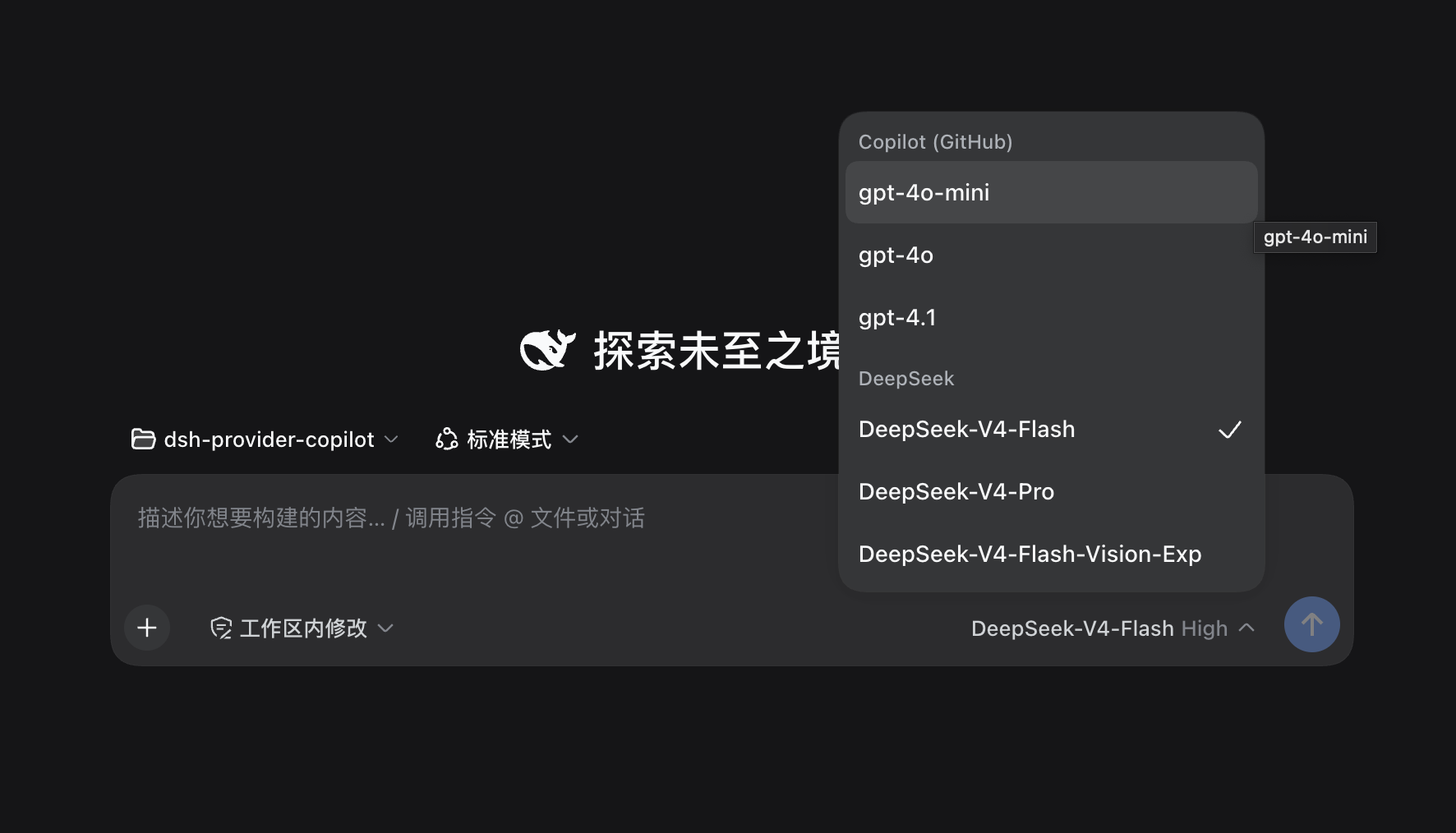
dormant: the copilot provider group is advertised immediately — it shows
up in the model picker without any sign-in — and the first request without
credentials reports MISSING_CREDENTIAL with pointers to /copilot login
and the environment variables below.
Development without packaging: add the row to the profile patch manually
- id: llm-copilot
  name: './path/to/dsh-provider-copilot/src/plugin/plugin.ts'
Usage — inside dsh
The /copilot login | logout | status commands are real dsh commands,
registered when the host command service is present (dsh Web resolves /
lines against them):
/copilot login    # Device Flow: prints the verification URL + code and
                  #   finishes authorizing in the background
/copilot status   # source, expiry, model count, p50/p95 latency
/copilot logout   # wipes cache + memory + metrics
/copilot login returns the GitHub verification URL and the one-time code
to enter there; authorization continues in the background once you approve
it in the browser:

In dsh's model picker (the group is visible from install, see above),
select a model inside the Copilot (GitHub) group. Selecting a model
makes it the default for new sessions; each session keeps its own recorded
selection. Pick again any time to switch models. Sending a request requires
a credential: set COPILOT_TOKEN / COPILOT_GITHUB_TOKEN, or run
/copilot login above. Once signed in, the advertised list is intersected
with the upstream /models catalog.
Usage — programmatic (BYOK)
import { AuthManager, CopilotClient, CopilotProvider } from "dsh-provider-copilot";

const auth = new AuthManager({
    byok: { kind: "github", token: process.env.MY_GITHUB_TOKEN! },
});
const client = new CopilotClient({
    getBearer: async () => {
        const s = await auth.getSession();
        return { token: s.token, endpoints: { api: s.endpoints.api } };
    },
});
const provider = new CopilotProvider({ client });

for await (const chunk of provider.stream({
    model: "gpt-4o-mini",
    messages: [{ role: "user", content: "hi" }],
})) {
    if (chunk.type === "text") process.stdout.write(chunk.text);
}
Token source priority
AuthManager resolves credentials in this order:
byokconstructor option — a{ kind: "bearer" | "github", token }.env COPILOT_TOKEN— a raw Copilot bearer; skips exchange.env COPILOT_GITHUB_TOKEN— a GitHub token; drives exchange.- On-disk OAuth cache from a previous
/copilot login. ~/.config/gh/hosts.yml(opt-in:DSH_COPILOT_ALLOW_GH_HOSTS=1).GH_TOKEN/GITHUB_TOKEN(opt-in:DSH_COPILOT_ALLOW_ENV_GH=1).
Sources 5–6 are opt-in because "any GitHub token" leaking into a Copilot-specific credential surface is easy to do by accident.
Configuration
| Env var | Effect |
|---|---|
COPILOT_TOKEN |
Skip exchange; use as Copilot bearer directly. |
COPILOT_GITHUB_TOKEN |
GitHub token to exchange for a Copilot bearer. |
DSH_COPILOT_ALLOW_GH_HOSTS |
1 enables reading gh hosts.yml as fallback. |
DSH_COPILOT_ALLOW_ENV_GH |
1 enables reading GH_TOKEN / GITHUB_TOKEN fallback. |
DSH_COPILOT_NO_LOG |
1 disables JSONL log writes (no directory / files). |
XDG_CONFIG_HOME |
Standard XDG override for cache & log location. |
Observability
- In-memory ring buffer: last 10 successful calls used for
/copilot statusp50/p95. - JSONL log:
~/.config/dsh/copilot/log/copilot-YYYY-MM-DD.jsonl. Fields are a hard-coded allowlist:ts, requestId, event, model, latencyMs, promptTokens, completionTokens, totalTokens, errorCode, source, sku. Any attempt to log outside that set is rejected at runtime. - Retention: 7 days by default; pruning is lazy on the first write of a new UTC day; failures are silent.
- Perms: dir 0700, files 0600, matching auth cache.
Troubleshooting
| Symptom | Likely cause / fix |
|---|---|
403 scraping from api.github.com |
Non-Copilot UA. Do not override the built-in headers. |
token_exchange_forbidden (403) |
Account has no Copilot entitlement (individual not subscribed, org/enterprise seat unassigned). |
token_exchange_unauthorized (401) |
Stale GitHub token. /copilot logout then /copilot login. |
no_token_source |
Nothing to authenticate with. Set COPILOT_TOKEN / COPILOT_GITHUB_TOKEN or run /copilot login. |
http_connect_timeout |
Network / DNS. Check corporate proxy; tune timeouts.connectMs if needed. |
http_first_byte_timeout |
Upstream slow to respond. Tune timeouts.firstByteMs. |
http_idle_timeout |
Stream stalled mid-flight. Tune timeouts.idleMs. |
Model missing from /copilot status count |
Not in the whitelist ∩ upstream. Pass a custom whitelist to CopilotProvider if you know the id. |
unknown subcommand: X |
Only login, logout, status are supported. |
Development
npm install
npm test           # 160+ tests across auth / client / provider / plugin / commands / observability / e2e
npm run typecheck
npm run lint
New dsh-facing code lives under src/plugin/ (adapter, chunk translation,
error taxonomy, plugin entry, dsh command handler); the legacy BYOK
CopilotProvider API is unchanged.
Feasibility PoC (Device Flow → models → stream):
npm run poc -- device
export GH_OAUTH_TOKEN=ghu_xxx
npm run poc
Coverage is opt-in:
npm i -D @vitest/coverage-v8@2.1.8   # match your vitest version
npx vitest run --coverage
License
MIT — see LICENSE.
Related相关推荐
-
 crafter-station/petdex
A public gallery of animated pets for Codex, Claude Code, DeepSeek Harness, Hermes, OpenCode, Gemini CLI, and more.
crafter-station/petdex
A public gallery of animated pets for Codex, Claude Code, DeepSeek Harness, Hermes, OpenCode, Gemini CLI, and more.
-
 edison7009/EchoBird
One-click install + model switch:Claude Code,Codex CLI (OpenAI), Grok Build (xAI), DeepSeek Harness, Kimi Code (Moonshot…
edison7009/EchoBird
One-click install + model switch:Claude Code,Codex CLI (OpenAI), Grok Build (xAI), DeepSeek Harness, Kimi Code (Moonshot…
-
 Nwflower/dsh-chat-import
Import 14+ external agent chat histories (Claude Code, Codex, ChatGPT, Cursor, Gemini, Reasonix, opencode, ZCode, Grok B…
Nwflower/dsh-chat-import
Import 14+ external agent chat histories (Claude Code, Codex, ChatGPT, Cursor, Gemini, Reasonix, opencode, ZCode, Grok B…
-
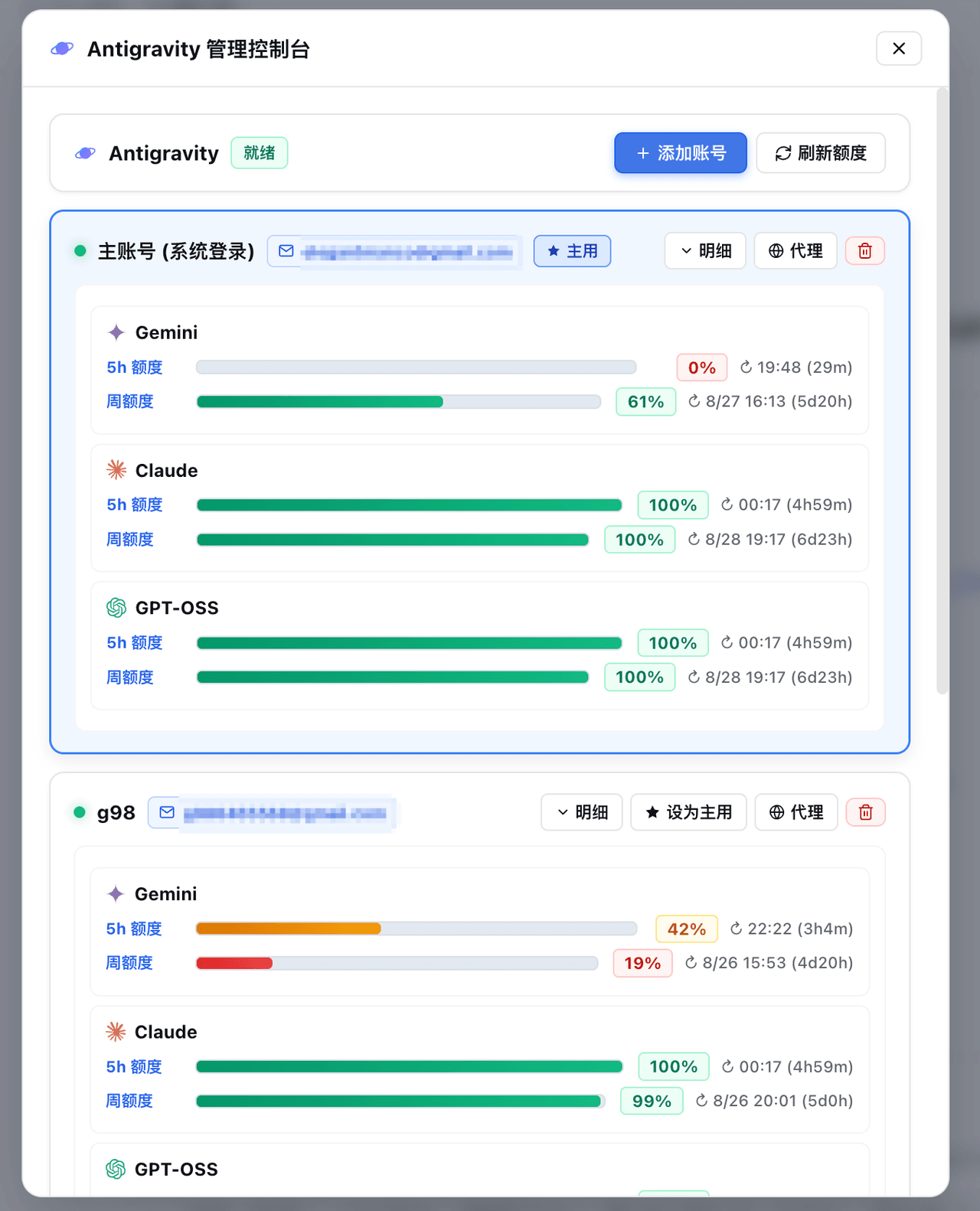 amlyczz/dsh-agy-link
Google Antigravity (agy CLI) models for DeepSeek Harness — streaming chat, thinking, tool activity, usage, in-GUI Google…
amlyczz/dsh-agy-link
Google Antigravity (agy CLI) models for DeepSeek Harness — streaming chat, thinking, tool activity, usage, in-GUI Google…
-
 opencues/opencues
The open standard for omnipresent AI. Claude Code, OpenCode, Gemini CLI, Shell, Chrome, DeepSeek Harness. Model-agnostic
opencues/opencues
The open standard for omnipresent AI. Claude Code, OpenCode, Gemini CLI, Shell, Chrome, DeepSeek Harness. Model-agnostic
-
 skyf0xx/hedgehog
HEDGEHOG codes Cleaner, Faster and with Fewer Tokens. Hedgehog's AI-driven development builds a task dependency graph fr…
skyf0xx/hedgehog
HEDGEHOG codes Cleaner, Faster and with Fewer Tokens. Hedgehog's AI-driven development builds a task dependency graph fr…
-
 chaos-03x/dsh-agy
Google Antigravity (agy) OAuth auth + model access plugin for DeepSeek Harness: multi-account pool, 429 rotation, device…
chaos-03x/dsh-agy
Google Antigravity (agy) OAuth auth + model access plugin for DeepSeek Harness: multi-account pool, 429 rotation, device…
-
 AnkoCD/dsh-server-deployment
DeepSeek Harness 多用户服务器部署:登录门户 / 每用户独立实例与 OS 级隔离 / 独立 API Key / 交付文件抽屉;文件访问经 sudo 助手降权执行(修复 issue #1 TOCTOU)。非本机工具。
AnkoCD/dsh-server-deployment
DeepSeek Harness 多用户服务器部署:登录门户 / 每用户独立实例与 OS 级隔离 / 独立 API Key / 交付文件抽屉;文件访问经 sudo 助手降权执行(修复 issue #1 TOCTOU)。非本机工具。