ziyou979/dsh-llm-oauth
DeepSeek Harness 插件:OAuth / 订阅制 LLM 提供商(Grok、GitHub Copilot、OpenAI Codex、Anthropic、OpenRouter)
Project Overview项目介绍
A standalone DeepSeek Harness plugin that wires the @earendil-works/pi-ai catalog into subscription providers such as Grok, GitHub Copilot, ChatGPT/Codex, Anthropic, OpenRouter, and Kimi. It wraps Models with a durable CredentialStore so OAuth tokens refresh on the request path, avoiding API-key routes. Use it to log into subscription plans via Settings → OAuth / Subscriptions or /oauth chat commands after a profile install. Caveat: openai-codex requires ChatGPT device-code auth enabled first and carries an account-ban risk.
DSH 独立 OAuth 插件,复用 @earendil-works/pi-ai 目录,为 Grok、GitHub Copilot、ChatGPT/Codex、Anthropic、OpenRouter、Kimi 等订阅服务构建带 CredentialStore 的 Models,实现在请求路径刷新令牌。安装后插件默认休眠,需在「OAuth / Subscriptions」面板或 /oauth enable / /oauth login 启用并登录。提示:openai-codex 需在 ChatGPT 开启 device-code 授权,且存在账号封禁风险。
请帮我了解并安装插件:【dsh-llm-oauth】【https://github.com/ziyou979/dsh-llm-oauth】Send this message to DSH in your current session. CLI install commands may not be accurate across systems — DSH will figure it out for you.把上面这条消息直接发给当前会话里的 DSH,让它帮你了解并安装。安装命令不一定准确,发给 DSH 更稳。
Or use CLI install (for developers)或使用命令行安装(适合开发者)
CLI Install命令行安装
dsh plugin --profile web add github:ziyou979/dsh-llm-oauth把 ziyou979/dsh-llm-oauth 加入你的 DSH 配置(web profile)即可启用。
READMEREADME
dsh-llm-oauth
English | 中文
Standalone OAuth / subscription-plan LLM plugin for DeepSeek Harness. Install it into your own profile with dsh plugin add — it does not patch the Harness repo.
Official dsh-llm-pi-ai authenticates with API keys only and never runs an OAuth login or refresh. This plugin reuses the same catalog package, @earendil-works/pi-ai, but constructs Models with a durable CredentialStore so subscription tokens refresh on the request path.
Packaging follows the official plugin guides — your first plugin and publish / install:
package.json→dsh.bundle.patchplus optionaldsh.client(Web Settings face)cordis.patch.ymlinserts one plugin rowpreparebundlessrc/→lib/(includinglib/client.js) on git install- function plugin: export
name,inject,Config,apply— noexport default
Providers
| Subscription | Provider id | Notes |
|---|---|---|
| Grok (SuperGrok / X Premium) | xai |
Model ids come from the installed pi-ai catalog. |
| GitHub Copilot | github-copilot |
Optional Enterprise URL defaults to public github.com. |
| ChatGPT / Codex plan | openai-codex |
Not the openai API-key route. Needs device-code authorization enabled in ChatGPT — see below. Account-ban risk. |
| Anthropic subscription | anthropic |
|
| OpenRouter | openrouter |
Large catalog — enable only if you need it. |
| Kimi For Coding | kimi-coding |
Model ids come from the installed @earendil-works/pi-ai catalog, not from this plugin. Bump that dependency and rebuild when you want a newer catalog.
Enable vs sign-in
After install the plugin is dormant: the catalog lists the providers above, but providers: {}, so the model picker is not flooded with hundreds of models.
| Concept | Meaning | How |
|---|---|---|
| Enable | Register the LLM route; provider appears in the picker | Settings → OAuth / Subscriptions, /oauth enable xai, or auto on login |
| Sign in | Store tokens in pi-ai-oauth.json |
Settings panel, /oauth login xai, or bin/login.mjs |
| Disable | Remove from picker; keep stored tokens | Settings panel or /oauth disable xai |
Only enabled providers list models. They sit alongside API-key providers under Settings → Models once enabled.
Install
dsh plugin --profile web add github:ziyou979/dsh-llm-oauth
From a local checkout:
dsh plugin --profile web add ./dsh-llm-oauth
Confirm the layer:
dsh --profile web --dump-config
A git install may ask you to allow prepare in the profile's pnpm-workspace.yaml (pnpm ≥10 refuses lifecycle scripts otherwise):
allowBuilds:
  dsh-llm-oauth: true
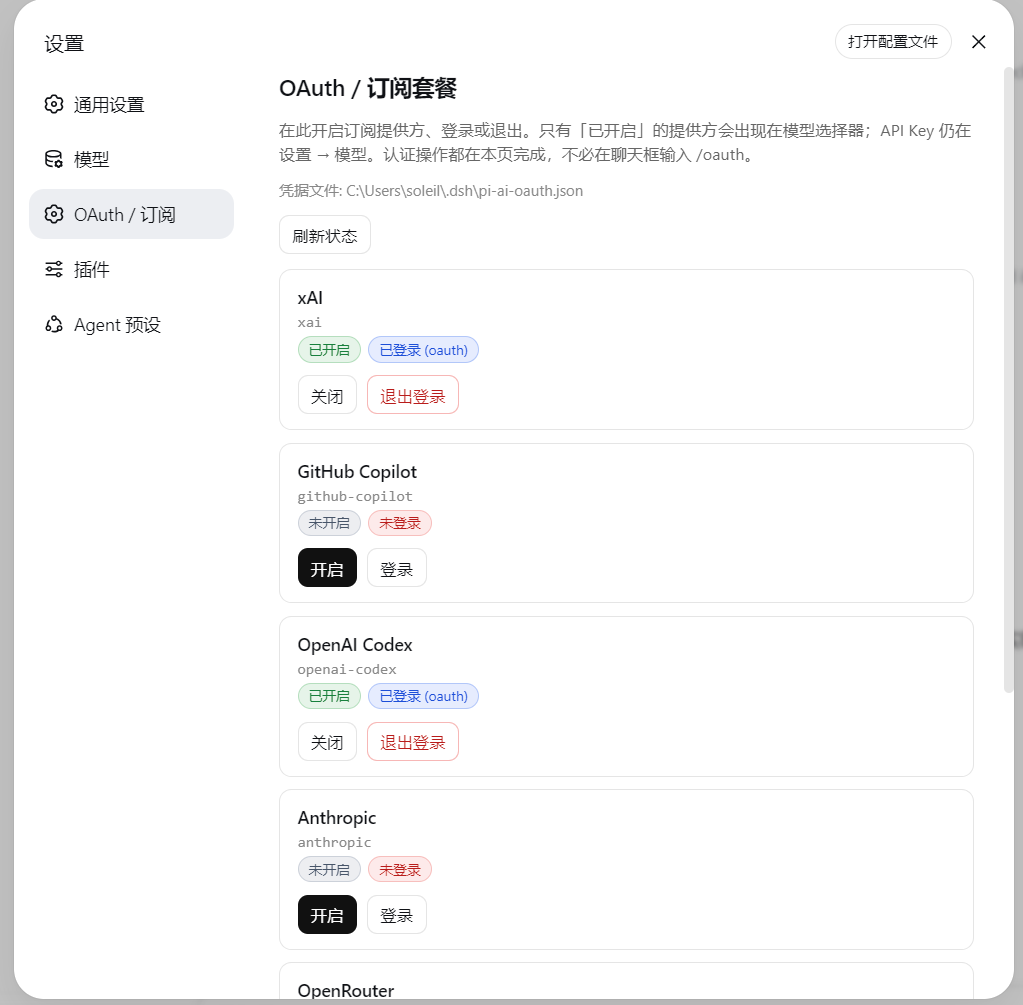
Settings → OAuth / Subscriptions
The Web UI adds a settings section (between Models and Plugins) with:
- Every catalog subscription provider
- Badges: enabled / disabled, signed-in / out, login-in-progress
- Actions: enable, disable, sign in, sign out (buttons on this page — no need to type
/oauthin chat) - Successful sign-in stores tokens and auto-enables the provider
- Device codes show on the page (with copy); authorization URLs open in a new tab, or via Open authorization page if the popup is blocked
Providers that ask “pick a login method” (e.g. openai-codex) auto-select device code on Web (browser login needs a local :1455 callback). If you still see an interactive-prompt error, use bin/login.mjs in a terminal.
After a provider is enabled (and signed in), it also appears under Settings → Models next to API-key routes:
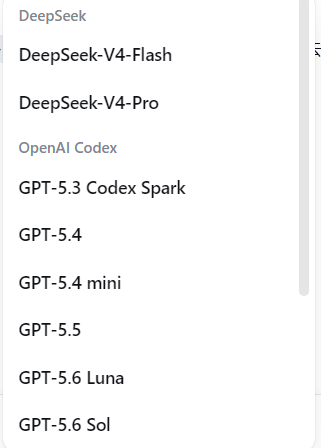
API-key providers stay curated under Settings → Models. OAuth enable + login live on this plugin’s page.
Host HTTP API (same-origin Web):
| Method | Path | Body |
|---|---|---|
GET |
/dsh-llm-oauth/status |
— |
POST |
/dsh-llm-oauth/enable |
{ "provider": "xai" } |
POST |
/dsh-llm-oauth/disable |
{ "provider": "xai" } |
POST |
/dsh-llm-oauth/login |
{ "provider": "xai" } |
POST |
/dsh-llm-oauth/logout |
{ "provider": "xai" } |
ChatGPT / Codex: enable device-code auth first
openai-codex on Web uses device code, not the localhost :1455 browser callback. ChatGPT hides that flow until you turn it on:
- Open ChatGPT → Settings → Apps & connectors (or Settings → Connectors / Codex, depending on the current UI).
- Find Codex and enable Enable device code authorization for Codex.
- Come back here, click Sign in on
openai-codex, then open the authorization URL and enter the code shown on the Settings page.
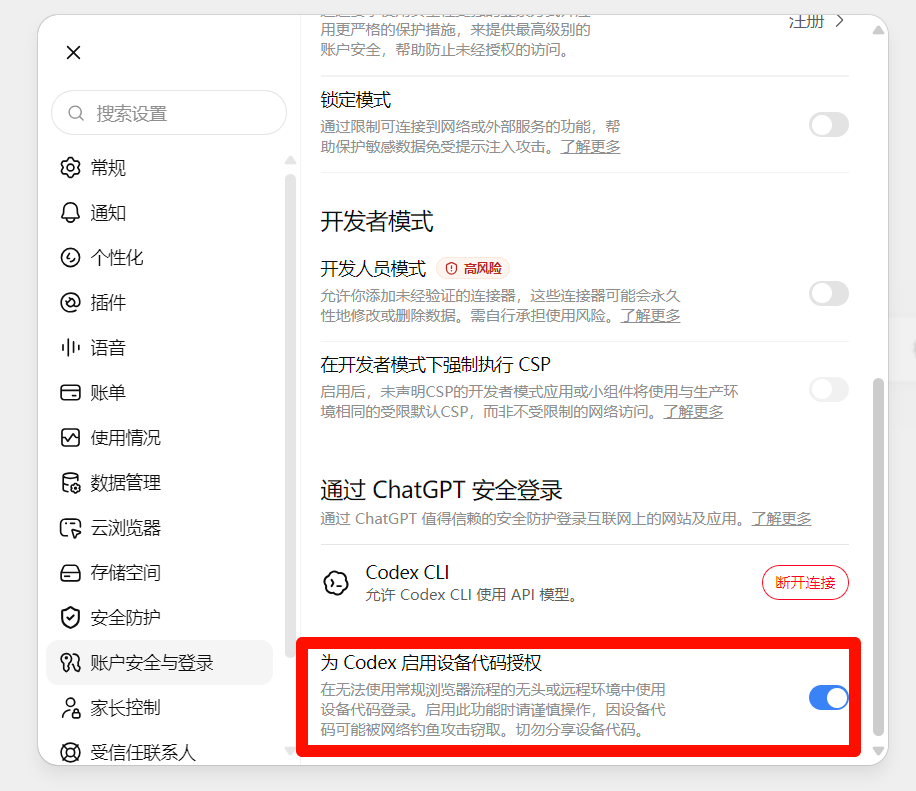
Without that toggle, the device page rejects the code even though this plugin already picked the device-code method.
Risk: signing in to Codex / ChatGPT this way (device code or any unofficial client OAuth) can get the ChatGPT account restricted or banned. OpenAI treats this as using the subscription outside official Codex / ChatGPT apps. Use a disposable account if you try it; do not put a main or paid account you cannot afford to lose on this route. This plugin cannot prevent or reverse a ban.
Login / commands
In the Web UI:
/oauth status
/oauth list
/oauth enable xai
/oauth login xai
/oauth disable xai
/oauth logout xai
/oauth login returns the authorization URL and user code immediately so the chat UI does not hang. Finish in the browser, then run /oauth status or refresh the Settings page. The poll continues in the background.
Credentials are stored at $DSH_HOME/pi-ai-oauth.json (default ~/.dsh/pi-ai-oauth.json).
If you need a terminal (or a provider still requires an interactive prompt):
node bin/login.mjs --list
node bin/login.mjs xai
After a profile install:
node %USERPROFILE%\.dsh\profiles\web\node_modules\dsh-llm-oauth\bin\login.mjs xai
Or enable in settings.yaml without the UI:
llm-oauth:
  providers:
    xai: {}
Do not collide with llm-pi-ai
dsh-base mounts dormant dsh-llm-pi-ai. Declaring the same provider id under an llm-pi-ai: settings section throws DUPLICATE_ADAPTER.
- Subscription / OAuth → this plugin only
- API keys (DeepSeek, official OpenAI API) →
llm-deepseek/llm-pi-ai
Develop
pnpm install
pnpm test
pnpm run build
node bin/login.mjs --list
@deepseek-ai/* packages are peers supplied by the DSH profile. The full test suite requires the host peers to be installed or linked locally. Git installation builds do not typecheck those peers.
Compatibility update
- Pi is pinned by the lockfile to
0.85.1; its Codex catalog includesgpt-6-astra. - Reviewed against Harness
0.1.5-rc.2(source commitc291e7961a): leading system messages, selected reasoning efforts, and theToolCallIdrename are handled. OlderCallIdexports remain supported. - Settings integration uses the
SettingsProvider.installSectionservice API;deepEqualJsoncomes from the host peer@deepseek-ai/dsh-util-values, avoiding removed standalone exports fromdsh-settings. - The lockfile no longer embeds third-party mirror tarball URLs. The project
.npmrcselects the official npm registry, fixing issue #1. Normal Git installs can runprepare; skipping scripts is not required.
Limits
- Model list follows
@earendil-works/pi-ai; this plugin does not maintain a private model table - No image / vision path
- No full native replay signatures
- No in-browser OAuth callback server (device code / open URL)
- Plain OpenAI API and DeepSeek official stay on API keys
- Settings → Models curated editors still target API keys; OAuth enable + login live under Settings → OAuth / Subscriptions
License
MIT
Related相关推荐
-
 crafter-station/petdex
A public gallery of animated pets for Codex, Claude Code, DeepSeek Harness, Hermes, OpenCode, Gemini CLI, and more.
crafter-station/petdex
A public gallery of animated pets for Codex, Claude Code, DeepSeek Harness, Hermes, OpenCode, Gemini CLI, and more.
-
 edison7009/EchoBird
One-click install + model switch:Claude Code,Codex CLI (OpenAI), Grok Build (xAI), DeepSeek Harness, Kimi Code (Moonshot…
edison7009/EchoBird
One-click install + model switch:Claude Code,Codex CLI (OpenAI), Grok Build (xAI), DeepSeek Harness, Kimi Code (Moonshot…
-
 Nwflower/dsh-chat-import
Import 14+ external agent chat histories (Claude Code, Codex, ChatGPT, Cursor, Gemini, Reasonix, opencode, ZCode, Grok B…
Nwflower/dsh-chat-import
Import 14+ external agent chat histories (Claude Code, Codex, ChatGPT, Cursor, Gemini, Reasonix, opencode, ZCode, Grok B…
-
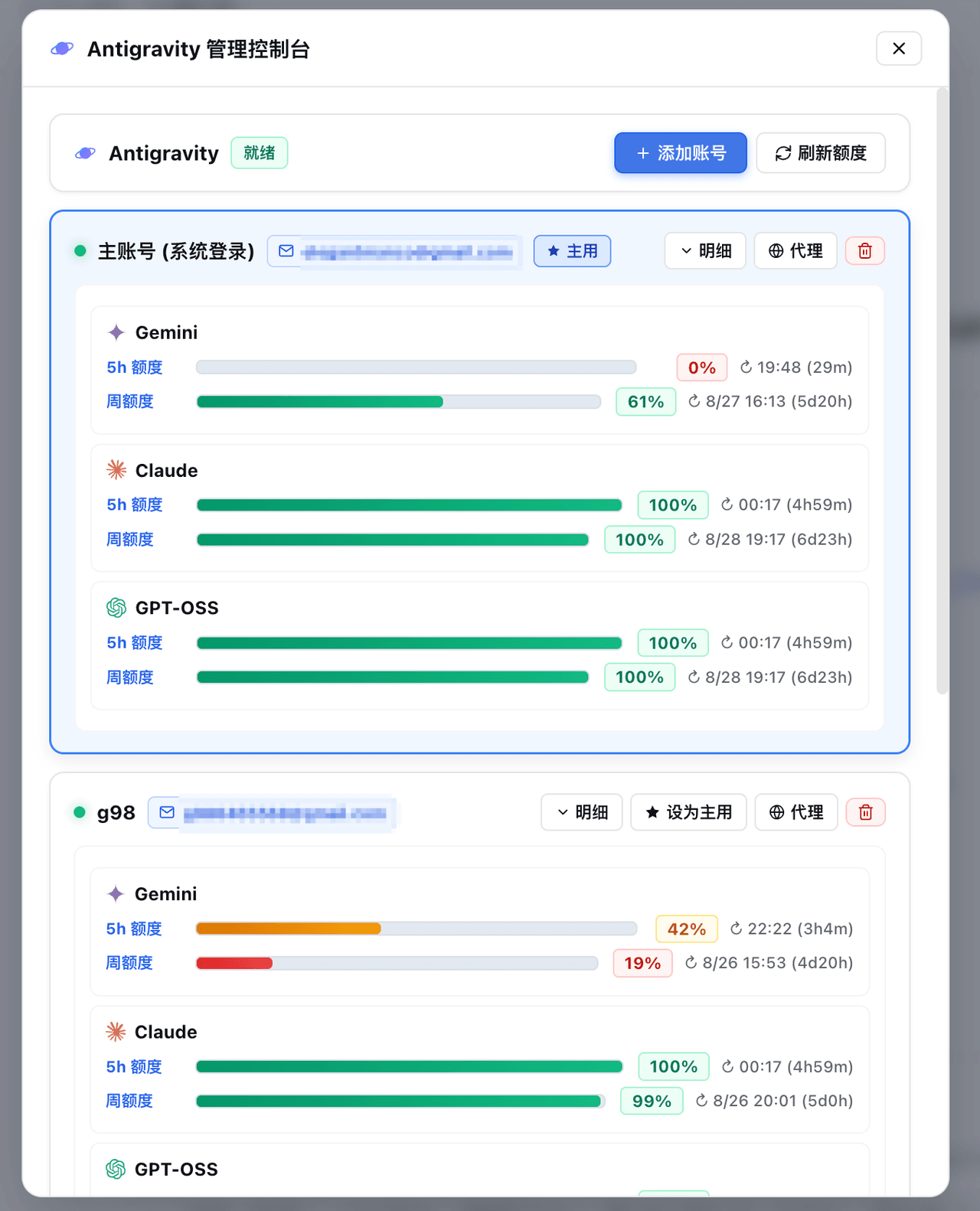 amlyczz/dsh-agy-link
Google Antigravity (agy CLI) models for DeepSeek Harness — streaming chat, thinking, tool activity, usage, in-GUI Google…
amlyczz/dsh-agy-link
Google Antigravity (agy CLI) models for DeepSeek Harness — streaming chat, thinking, tool activity, usage, in-GUI Google…
-
 opencues/opencues
The open standard for omnipresent AI. Claude Code, OpenCode, Gemini CLI, Shell, Chrome, DeepSeek Harness. Model-agnostic
opencues/opencues
The open standard for omnipresent AI. Claude Code, OpenCode, Gemini CLI, Shell, Chrome, DeepSeek Harness. Model-agnostic
-
 skyf0xx/hedgehog
HEDGEHOG codes Cleaner, Faster and with Fewer Tokens. Hedgehog's AI-driven development builds a task dependency graph fr…
skyf0xx/hedgehog
HEDGEHOG codes Cleaner, Faster and with Fewer Tokens. Hedgehog's AI-driven development builds a task dependency graph fr…
-
 chaos-03x/dsh-agy
Google Antigravity (agy) OAuth auth + model access plugin for DeepSeek Harness: multi-account pool, 429 rotation, device…
chaos-03x/dsh-agy
Google Antigravity (agy) OAuth auth + model access plugin for DeepSeek Harness: multi-account pool, 429 rotation, device…
-
 AnkoCD/dsh-server-deployment
DeepSeek Harness 多用户服务器部署:登录门户 / 每用户独立实例与 OS 级隔离 / 独立 API Key / 交付文件抽屉;文件访问经 sudo 助手降权执行(修复 issue #1 TOCTOU)。非本机工具。
AnkoCD/dsh-server-deployment
DeepSeek Harness 多用户服务器部署:登录门户 / 每用户独立实例与 OS 级隔离 / 独立 API Key / 交付文件抽屉;文件访问经 sudo 助手降权执行(修复 issue #1 TOCTOU)。非本机工具。