zlZayn/dsh-workbuddy-bridge
DSH 插件:把 WorkBuddy 桌面 App 里的模型接入 DeepSeek Harness,零配置直接用。(原生嵌入"设置-插件-插件配置")
Project Overview项目介绍
dsh-workbuddy-bridge is a native DeepSeek Harness (DSH) cordis plugin that exposes the models available inside the WorkBuddy desktop app — and its international sibling WorkBuddy AI — directly inside DSH's model selector, so users do not need to register a separate provider for either client. Installation is one CLI line, dsh plugin --profile web add dsh-workbuddy-bridge (or desktop / dsh-tui for the other shells), after which the plugin reads the WorkBuddy app's own credential files, encrypts a local copy, and surfaces a "WorkBuddy" group for the domestic build and a "WorkBuddy AI" group for the international build, each tied to its own account and credit balance with rate multipliers and promo badges appended to model names. The plugin ships as a DSH-native bundle manifest and exists exclusively to extend DSH; no other agent platforms are mentioned.
The intended workflow is to install and sign into the WorkBuddy desktop app first, enable the plugin from the Plugins sidebar entry, then either use the selector inside DSH Web/Desktop/TUI or call CLI subcommands such as status, status --json, doctor, and logout for headless checks — the latter only clears the plugin's local credential copy, never the app's own session. Inside the plugin page, two status cards follow their respective app logins, allowing per-model show/hide toggles, manual reasoning-tier detection under the "检测" tab, and a "积分" tab showing total credits plus per-plan remaining quota. The target audience is individual developers and power users who already pay for WorkBuddy and want those same models available inside DSH conversations across Web, Desktop, and TUI surfaces.
Dependencies are strict: only the DSH 0.1.7 line is supported, with the floor declared in engines.dsh; the TUI profile additionally requires the @deepseek-harness-tui/dsh-tui terminal plugin at version 0.10.0-beta.5 or higher and must be installed with pnpm 11. Credential discovery is platform-specific — macOS reads directly, Windows probes both Local and Roaming AppData, WSL prefers the mounted Windows user profile, and the WORKBUDDY_AUTH_FILE / WORKBUDDY_AI_AUTH_FILE env vars override discovery when auto-detection fails. The international group relies on a private UI endpoint that may break if the upstream client changes, enterprise account credit reporting is limited to the domestic build, and reasoning tiers are never guessed: users must opt in and run per-model checks that may spend a small amount of credit. The plugin is MIT-licensed, restricted to personal learning and research, and disclaims any affiliation with Tencent, WorkBuddy, or DeepSeek.
dsh-workbuddy-bridge 是一个面向 DSH(DeepSeek Harness)原生 cordis 插件,作用是把 WorkBuddy 国内版与国际版(WorkBuddy AI)桌面 App 的模型直接接入 DSH 对话窗口的模型选择器,无需为它们单独配置 provider。安装后通过 dsh plugin --profile web add dsh-workbuddy-bridge 命令启用,国内版以「WorkBuddy」分组、国际版以「WorkBuddy AI」分组独立出现,两套账号与积分互不串号,模型名后还附带积分倍率与促销徽章。插件复用了桌面 App 自身的登录凭据,仅在本机留有加密副本,浏览器半边不会获取令牌,界面也绝不展示凭据原文。
典型使用流程是先在前置条件中装好并登录 WorkBuddy 桌面 App,再启用插件并通过 dsh web、dsh desktop 或 dsh-tui 三种界面进入,会话中即可在选择器里挑选对应模型并粘贴或拖入图片。命令行还提供 status、status --json、doctor、logout 等子命令,便于在不动界面的情况下查询状态、诊断 App 发现与清理插件自留的凭据副本。该插件同时面向个人开发者和依赖 WorkBuddy 模型的国内/国际用户,能在 Web、Desktop 与 TUI 三端复用同一套模型分组。
依赖方面要求 DSH 0.1.7 线,具体下限见 package.json 中 engines.dsh 字段;TUI 形态需要终端插件 @deepseek-harness-tui/dsh-tui ≥ 0.10.0-beta.5 并使用 pnpm 11 安装。凭据发现按平台区分:macOS 直读、Windows 依次探测 Local 与 Roaming AppData、WSL 优先读挂载的 Windows 用户目录,未发现时可用 WORKBUDDY_AUTH_FILE(国际版 WORKBUDDY_AI_AUTH_FILE)环境变量指定。插件不自动猜测推理档位,需要在配置页手动开启并按需触发检测,可能消耗少量积分;企业账号积分目前仅覆盖国内版。项目以 MIT 协议开源,仅供个人学习与研究,并明确与腾讯、WorkBuddy、DeepSeek 均无关联。
请帮我安装这个 DSH 插件。安装前先完成【兼容性检查 + 安全性检查】,检查通过再动手。

插件:dsh-workbuddy-bridge(zlZayn/dsh-workbuddy-bridge)
仓库:https://github.com/zlZayn/dsh-workbuddy-bridge
本站详情页:https://www.yhbd.top/plugins/zlzayn-dsh-workbuddy-bridge/
本站登记:类型 client · 归类 原生 DSH 插件 · 许可证 MIT · ⭐ 4 · 最近提交 2026-10-03 · 主语言 TypeScript

按下面顺序执行,每步先把结论告诉我,再进入下一步:

【1 兼容性检查】
① 我这边:DSH 版本、Node 版本、操作系统、当前 profile(web / desktop)。
② 读它的 README、package.json、插件 manifest,列出它要求的 DSH 版本 / Node 版本 / 操作系统 / 外部依赖 / 需要另外先装的运行时。
③ 逐条比对,结论只写「满足 / 不满足 / 未知」三种;不满足的给出可行替代方案。
④ 检查是否和我已装的插件冲突:命令名重复、skill / tool 重名、端口占用、重复注册的 MCP server。

【2 安全性检查】
① 仓库可信度:和上面「本站登记」是否一致;star / fork 数、创建时间、最近提交,是否归档或长期停更。
② 安装脚本:逐行看 package.json 的 preinstall / install / postinstall,以及 install.sh、setup.ps1 之类脚本。出现 curl|bash、下载后直接执行、混淆代码、访问与插件功能无关的域名,立刻停下来告诉我,不要继续装。
③ 依赖:列出新增依赖,标出无人维护、或与知名包拼写近似的可疑包(typosquatting)。
④ 权限与副作用:它会读写哪些目录、访问哪些域名、需要哪些 DSH 权限(filesystem / network / shell / clipboard 等),以及怎么卸载和回滚。
⑤ 如果它要求 sudo / 管理员权限,或权限明显超出功能所需,先停下来问我。

【3 安装】
上面两步没有「不满足」和「高危项」时才执行;用官方推荐方式安装,不要自行提权。

【4 汇报】
用表格输出:检查项 / 结论 / 依据 / 是否需要我决策。拿不准的一律写「未知」并说明要我怎么确认——不要猜,也不要替我决定。
Send this message to DSH in your current session: it verifies compatibility and security first (answering met / not met / unknown item by item) and only installs once everything checks out — it will stop and ask you if it finds a high-risk item. The box scrolls; the copy is the full prompt. CLI install commands may not be accurate across systems, so DSH is the safer route.把上面这条消息直接发给当前会话里的 DSH:它会先核对兼容性与安全性(逐条给「满足 / 不满足 / 未知」),确认没问题再安装,有高危项会停下来问你。框内可滚动,复制到的是完整提示词;安装命令不一定准确,发给 DSH 更稳。
- Only 4 stars - very few users, little community feedback星标只有 4,几乎没人在用,遇到问题缺少社区反馈
- Desktop client: installation downloads an executable - verify the publisher and checksums桌面客户端:安装会下载可执行文件,请核对发布者与校验和
DSH walks through these 9 checksDSH 会逐条核对这 9 项
Compatibility兼容性
- DSH, Node, OS and profile requirementsDSH 版本 / Node 版本 / 操作系统 / profile 是否满足要求
- External dependencies and runtimes (Electron / Python / Docker, ...)外部依赖与运行时(Electron / Python / Docker 等)是否齐备
- Conflicts with installed plugins: command names, skill / tool names, ports, duplicate MCP registration与已装插件是否冲突:命令名、skill / tool 重名、端口占用、重复 MCP 注册
Security安全性
- Repo matches the facts registered here; archived or abandoned?仓库是否与页面登记一致,是否归档或长期停更
- Safety of preinstall / install / postinstall and install.sh / setup.ps1preinstall / install / postinstall 与 install.sh、setup.ps1 是否安全
- curl|bash, download-then-execute, obfuscation, unrelated domains → stop immediatelycurl|bash、下载即执行、混淆代码、无关域名 → 立刻停止
- Typosquatting or unmaintained packages among the new dependencies新增依赖里有没有 typosquatting 或无人维护的包
- Requested permissions vs. what the feature actually needs申请了哪些权限、是否超出功能所需(filesystem / network / shell / clipboard)
- Any sudo / admin requirement, plus uninstall and rollback是否要求 sudo / 管理员权限,以及卸载与回滚方式
Anything uncertain must be marked unknown with a note on how to confirm it. This site's signal screen is a static snapshot, not a security audit.拿不准的必须标「未知」并说明要我怎么确认。本站的信号筛查是静态快照,不能替代安全审计。
Or use CLI install (for developers)或使用命令行安装(适合开发者)
CLI Install命令行安装
dsh plugin --profile web add dsh-workbuddy-bridge把 zlZayn/dsh-workbuddy-bridge 加入你的 DSH 配置(web profile)即可启用。
READMEREADME

dsh-workbuddy-bridge
把 WorkBuddy 桌面 App 的模型接进 DSH 对话窗口
WorkBuddy desktop models in DeepSeek Harness




各版本改动 → Releases(与 npm 版本一一对应)
[!NOTE] 凭据不出本机:登录状态取自 WorkBuddy 桌面 App 自己的凭据文件,插件只在本机留一份加密副本; 浏览器半边拿不到令牌,界面里也永远不出现凭据原文。
国内版 WorkBuddy 与国际版 WorkBuddy AI 并存:装哪个 App 就出现哪个模型分组,两个都装就两组并排, 各自用自己的账号与积分。模型直接出现在 DSH 的模型选择器里,不必为它单独配一个 provider。
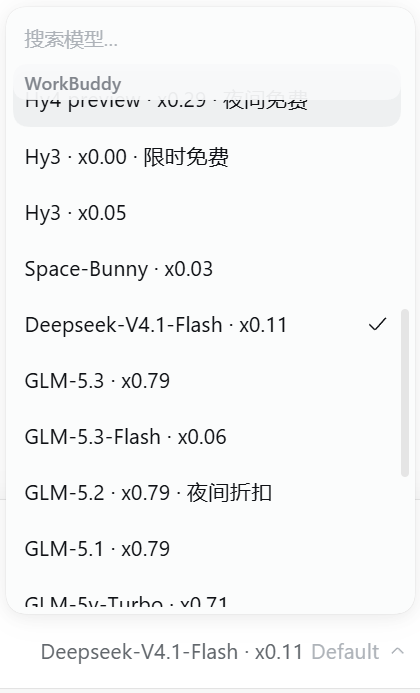
国内版在模型选择器中自成一组,模型名后直接跟积分倍率与促销徽章;装国际版则出现「WorkBuddy AI」组。
能力
- 开箱即用 —— 装完启用,模型分组自己出现。
- 两版隔离 —— 国内版与国际版各自分组,模型、账号、积分互不混用,只跟随各自 App 的登录状态。
- 推理档位 —— 上游声明了档位的模型直接可选;没声明的可在插件页手动检测。 灯泡表示「这个模型能切档位」,不是「检测过」——已声明的模型也显示灯泡,只是不需要检测。
- 积分可见 —— 每条回复下方显示本次消耗,模型选择器旁常驻剩余积分。观测不到就不显示。
- 模型显隐 —— 卡片「模型」标签里勾选哪些模型出现在选择器里,按登录账号分别保存。
- 图片输入 —— 多数模型可直接粘贴或拖入图片;纯文字模型会明确说明。
- 三种界面 —— Web / Desktop / TUI;仅 TUI 无手动检测。

对话窗口里每天看到的样子:币图标与余额、推理档位灯泡,再往右是模型名——都排在同一行。
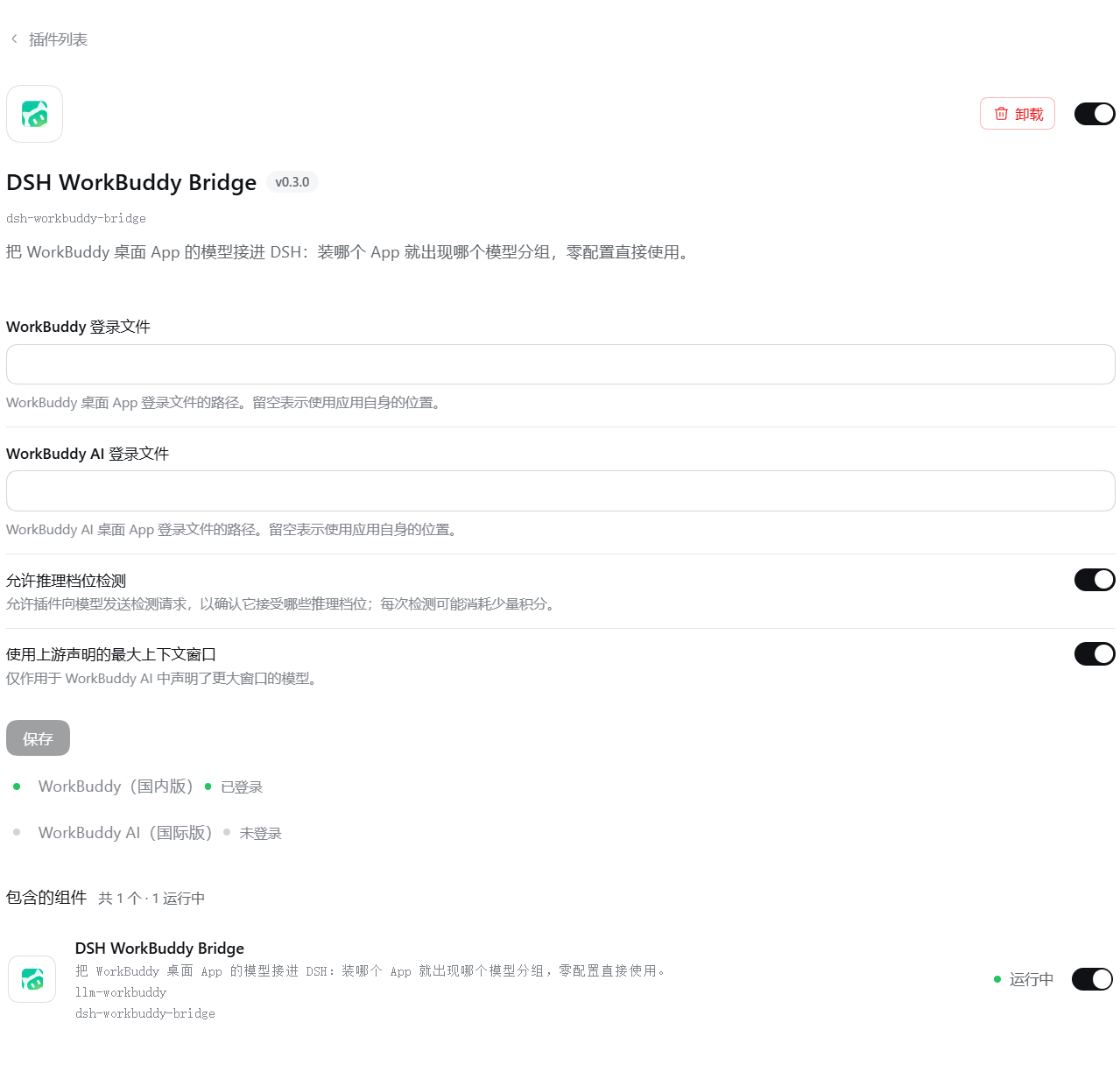
插件页:上面是配置表单,下面两张卡片各跟随自己 App 的登录状态。
Showing the opening section of the README — the full document lives in the repository以上为 README 开头摘要,完整文档在仓库内 · View the full README on GitHub →在 GitHub 查看完整 README →
Related相关推荐
-
 Ayuilos/Miffan
RikkaHub fork,Android AI 客户端。支持 ChatGPT 订阅登录使用、跨应用划词悬浮翻译、助手工作区文件隔离、远程工作区、文档与 HTML 预览、可定制动态角色。
Ayuilos/Miffan
RikkaHub fork,Android AI 客户端。支持 ChatGPT 订阅登录使用、跨应用划词悬浮翻译、助手工作区文件隔离、远程工作区、文档与 HTML 预览、可定制动态角色。
-
 cloveric/tarocub
The local-first answer to Grok Bot, OpenAI dots and Meta Muse: always-on personal AI bots that run on your own machine a…
cloveric/tarocub
The local-first answer to Grok Bot, OpenAI dots and Meta Muse: always-on personal AI bots that run on your own machine a…
-
 HuanLinOTO/dsh-plugin-aigc-canvas
provider-agnostic AIGC HTTP 桥 + 无限画布 + ffmpeg 后处理,13 个工具含画布连边/reroll/媒体编辑 | Provider-agnostic AIGC HTTP bridge + infinit…
HuanLinOTO/dsh-plugin-aigc-canvas
provider-agnostic AIGC HTTP 桥 + 无限画布 + ffmpeg 后处理,13 个工具含画布连边/reroll/媒体编辑 | Provider-agnostic AIGC HTTP bridge + infinit…
- huermi/dsh-deepseek-web-adapter 免费的 DeepSeek 网页版(chat.deepseek.com)LLM 服务提供方,用于 DeepSeek Harness——无需 API 密钥。自动启动网关,支持工具调用和连续对话。Free DeepSeek Web (chat.d…
- Victor-770/dsh-commandcode-provider A Command Code LLM provider plugin for DeepSeek Harness (dsh) — supporting all subscription plans (incl. Go & Pro) via S…
-
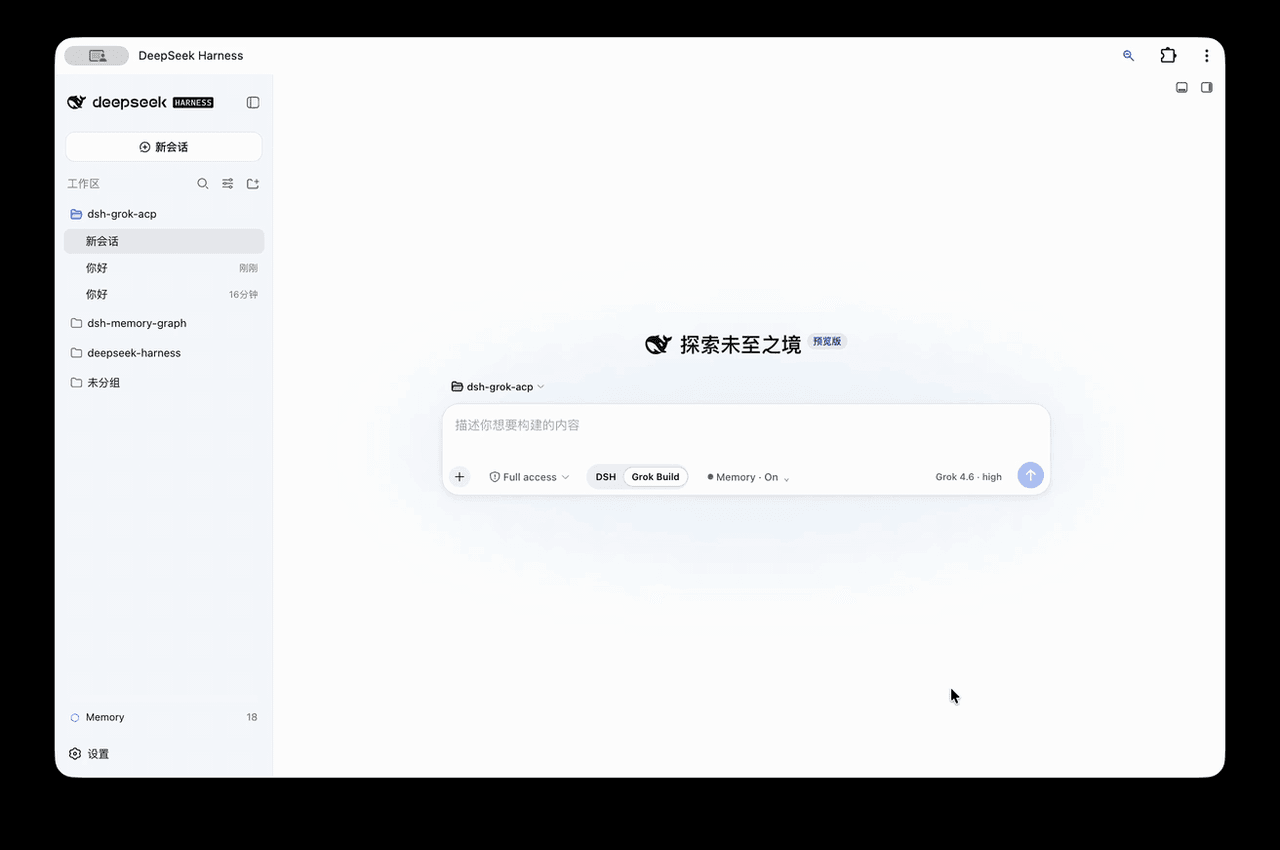 zmh2000829/DSH-agent-bridge
Use Grok Build inside DeepSeek Harness Web through ACP
zmh2000829/DSH-agent-bridge
Use Grok Build inside DeepSeek Harness Web through ACP
- clarknu/dsh-gateway Self-contained HTTPS remote-access gateway for the DeepSeek Harness web surface — the Caddy layer as a dsh plugin.
-
 wenzetan/dsh-llm-newapi
NewAPI (OpenAI-compatible gateway) LLM provider plugin for DeepSeek Harness (dsh): chat-only model discovery + Web setti…
wenzetan/dsh-llm-newapi
NewAPI (OpenAI-compatible gateway) LLM provider plugin for DeepSeek Harness (dsh): chat-only model discovery + Web setti…