如何用 AI 工具来学一门语言How to Put AI Tools to Work Learning a Language
不久前,学一门语言意味着掏钱上课、硬着头皮参加尴尬的语伴互练,或者独自啃教材、盼着哪天突然开窍。AI 确实改变了这个局面,而且不是花架子。下面就讲什么是真正有效的、为什么有效,以及怎样把它变成一种收益不断累积的日常习惯。
Not long ago, learning a language meant paying for lessons, enduring awkward meet-ups to swap conversation, or working through a textbook alone hoping something would finally click. AI has altered that picture for real, and not as a novelty. What follows is what genuinely works, the reason it works, and how to turn it into a daily habit whose returns keep building.
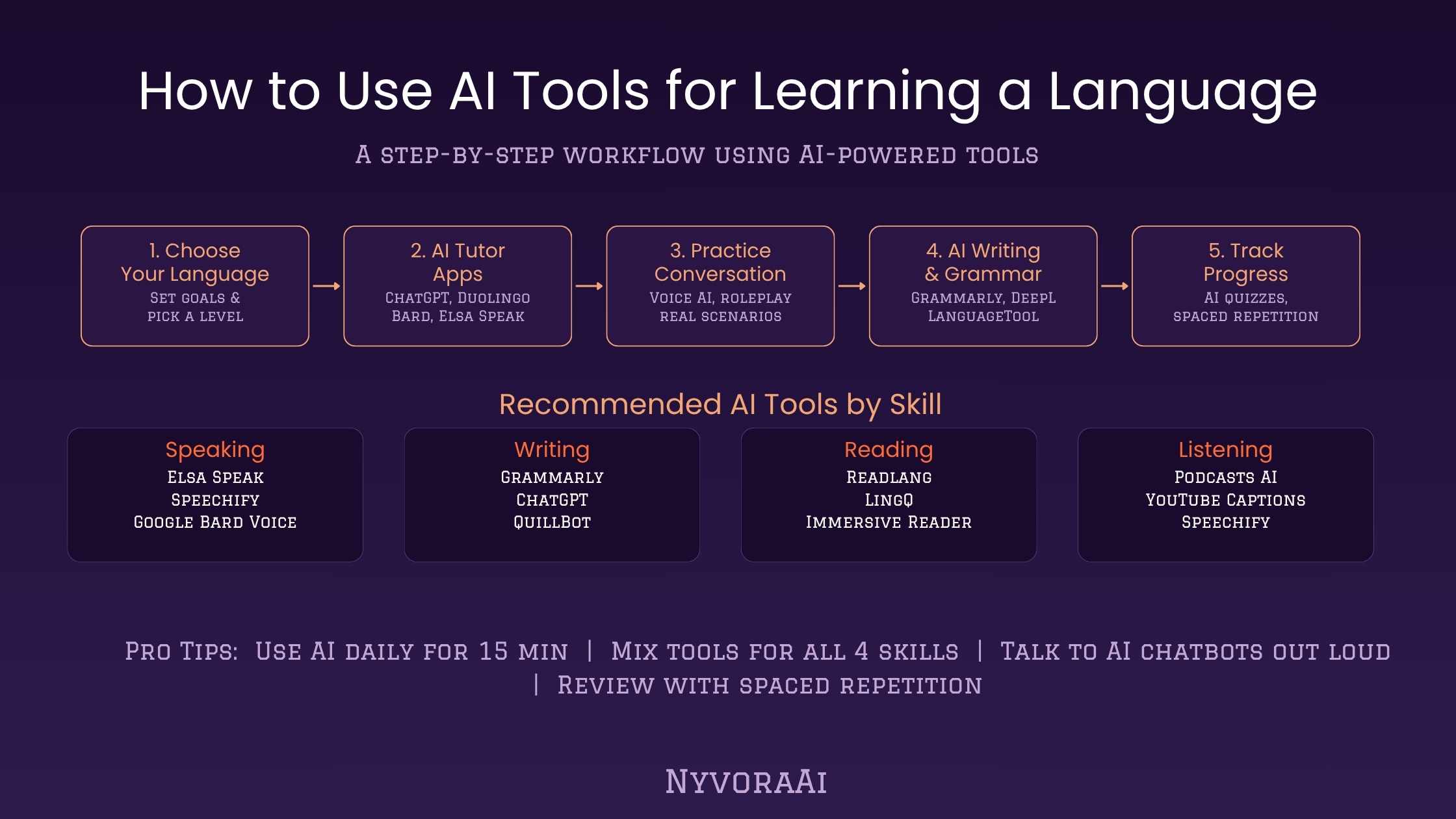
多数人放弃的位置,大致是在「能点一杯咖啡」之后、真正流利之前。缺的很少是天赋,而是一套符合语言习得真实规律的方法。进步来自持续、主动地使用这门语言——而且是大量的使用。可长期以来,要凑够这样的使用量,要么花钱、要么费时,要么就是难以塞进正常的生活节奏里。
AI 真正解决的,是「资源可得性」的问题。一个耐心无穷、随时都在的对话伙伴;一位不会因为你重复同一个错误而叹气的语法老师;一位能围绕你当下正在练的内容量身设计练习的词汇教练——代价只是一份基础订阅,有些情况下甚至免费。AI 对学语言有没有帮助,已经不是问题;问题在于哪种用法是真的在加速进步,而不只是制造「我在进步」的感觉。
01一句话回答
如果只挑一个用 AI 学语言的习惯,就选这个:每天用目标语言聊十分钟。打开一个对话工具,要求它只用你正在学的那门语言回答,指定一个简单话题,然后开始写。一旦出错,就让它纠正并说明原因。「产出—被纠正—理解」这一循环,才是语言真正被记住的方式;而它不需要你预约老师、寻找语伴,也不需要任何复杂的安排。
本文其余所有方法,要么建立在这个核心练习之上,要么是对它的加强。时间紧张的时候,最该保住的就是每天那场对话。
02AI 到底改变了语言学习的什么
传统语言学习受制于两个瓶颈:真正使用这门语言的机会太少,而用了之后得到的反馈也太少。一周一次的课,也许只给你一次反馈;语伴能不能见面,取决于两人的时间表;请老师则要花钱,课时也有限。结果是大多数学习者把绝大部分精力花在被动地读和听上,真正用于「产出」——也就是开口说、动手写——的时间远远不够。
正是这种失衡,把多数人卡在原地。读单词表练不出流利;能认出某条语法规则,也不代表压力之下能用得自然。真正能打磨出那种「日后变得自动」的通路的,是主动产出:试着表达,说错了,然后被纠正。AI 提供的正是这种随时可得的练习——量随你要、时间随你定,而且说错了也毫无社交压力。
「说错」这件事的重要程度,往往被低估。用 AI 练习有一个不那么显眼的好处:完全不必觉得难为情。和母语者说话时,大多数学习者都过分谨慎,生怕出丑。而在 AI 面前,你可以写出一段很糟的文字,被不带评判地纠正,然后立刻再试一遍。敢于输出不完美的语言并从中学习,实际上就是进步最快的路。
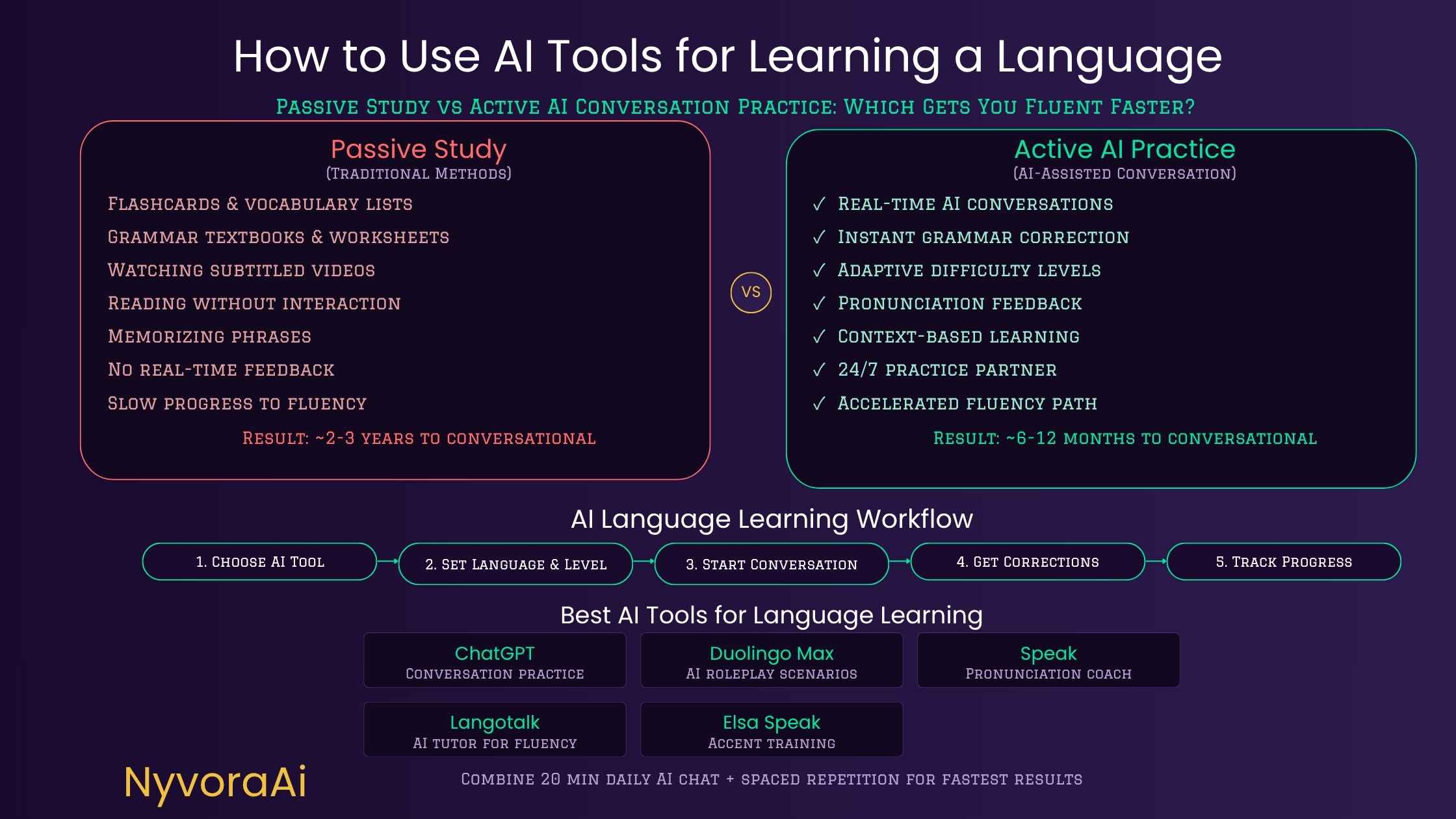
03对话练习:最重要的一项
在语言学习上,AI 最有效的一种用法就是当你的对话对象。设置很简单:告诉它你在学哪门语言、你现在处于什么水平(入门、中级等等)、你想聊什么类型的话题;然后要求它只用那门语言回应、纠正你的错误,并把用词控制在你大致能懂的范围里。
在 AI 对话练习中,有些话题效果格外好:点餐时描述自己的口味偏好、规划一趟虚构的旅行、讲讲每天的作息、聊一本你熟悉的书或一部剧,或者介绍你的工作或学业。共同点是:这些都是你确实会和母语者聊起的事,因此顺着这些话题学到的词,日后真的还会再用到。
04真正能把语法讲明白的方式
语法教材有个先天毛病:规则被孤立地讲,配的例句完全是为了演示规则而生,而不是为了表达什么意思。AI 可以换一条路——在你亲手写下的句子里面讲语法,用你自己的错误当作例子。
想从 AI 那里得到最有价值的语法帮助,就针对具体卡住你的那一点提问,而不是要一份关于某个时态或结构的通论。「描述上周六去参加派对时,为什么用『fui』而不是『iba』?」比「讲讲西班牙语的简单过去时和未完成过去时」有用得多。具体的问题逼出与真实场景绑定的具体答案,解释也就有了可依附的语境。
你也可以让 AI 就你正在攻的语法点出题考你。「给我十个句子,让我在简单过去时和未完成过去时之间做选择,然后逐一说明我的答案对在哪、错在哪」——这十分钟的收获,远胜过读三页语法讲解。自己动手套用规则,哪怕套得不完美,也总是比被动阅读记得更牢。
05把词汇学到真正留得住
在积累可用语言知识的所有办法里,背随机词表大概排在倒数。三十个词背进去了,见到也认得出,可真到要开口的时候,它们一个都不出现。原因在存储方式:一个词如果周围没有任何语境——没有句子、没有场景、没有情绪附着——它就不会被放进你真正会调用的那批词汇所在的位置。
AI 能让你按真正记得住的方式来学词。与其要一份「食物词汇」五十词清单,不如要那十五个你最可能用到的词——用来讲某道具体的菜怎么做,或者在餐厅点餐;随后把那个场景变成一小段对话来练。也可以反过来:把你想想表达的意思描述出来,问 AI 你缺哪些词——这样学的每一个词,都直接连着你真实的表达需求。
- 按场景学词——「列出谈论城市公共交通最有用的 20 个西班牙语词,并为每个词配一个简短的例句。」
- 补齐词汇缺口——「这是我试着用法语写的一段话;请指出我显然不认识的词,并逐一配例句教我。」
- 生成单词卡——「做 25 组意大利语食物词汇的单词卡,每张卡上写明意大利语词、英文释义和一个简短例句。」
- 口语表达——「给我五个葡萄牙语母语者打招呼时真的会用的随意说法,并说明各自适合什么场合。」
06用 AI 辅助阅读理解
用目标语言阅读,是提升流利度最强有力的输入之一——前提是材料的难度刚好:大部分能看懂,剩下的查一查就明白。太简单,学不到东西;太难,就只能一个词一个词地查,既累人又打击信心。
难度匹配这件事,正好可以由 AI 承担。你可以指定一个难度,让它在任意话题上生成一小段文本——比如围绕你感兴趣的事情、B1 难度的两段式新闻,或者以现在时和常用词为主、A2 难度的小故事。持续读难度合适的生成材料,比硬啃远超自己水平的母语素材更有用,而且话题能停在你真正关心的内容上,而不是教材里那些生造的场景。
遇到不认识的词或结构时,让 AI 在它出现的原句里解释,而不是孤立地解释。「在这一句里——[粘贴句子]——这个词是什么意思,为什么动词用这个形式?」得到的解释针对的正是那一处具体用法,比查词典条目更立刻管用。
07每天写几句,立刻拿到批改
在所有值得养成的习惯里,每天用目标语言写几句、然后接受批改,是回报最高的之一。它逼你主动回忆词汇和语法,会留下一条日后可以回看的进步痕迹,而且反馈来得足够快,改过的内容才真的会被注意到、被记住。
- 1
用目标语言写下三到五句话
1 挑一件你今天本来就会想的事——吃了什么早饭、周末打算做什么、路上看到什么。事先什么都别查。会的就写,不会的就猜。
- 2
交给 AI,请它批改
2 让它把每个错误都改掉,并各附一句简短说明。也请它指出哪些地方母语者会换一种说法,哪怕你原来的写法并不算错。
- 3
带着这些修改重写一遍
3 只读一遍改好的版本不够——要凭记忆、带着那些修改自己重写一遍。真正的学习就发生在这个重写的过程里。
- 4
让它把同一个话题扩展成一段对话
4 就用这几句话开启一段对话。这样你就从写作练习切换到了同一话题的口语练习,用另一种方式巩固同一批词。
08让每日练习真的坚持下来
「持续胜过强度」在语言学习上早已有共识。一个月里每天二十分钟,胜过一个周六连学四小时。难的是:真实的一天里,日常练习还要和别的一堆事抢时间,习惯怎么立得住。
最经得住考验的安排也最简单:定一个固定时段,再定一句固定的开场白。每天同一时间,对 AI 说同一句开场话——大意是「开始今天的西班牙语练习吧,从上回停的地方继续,今天我想聊这些」。省掉「每次该做什么」的决策,你就更不容易跳过。如果你在生活的其他方面已经围绕 AI 工具建立了流程,我们这篇 用 AI 工具搭建日常工作流 讲了怎么把围绕 AI 辅助的习惯搭建得真正立得住。
了解一下这类模型究竟是怎么产出语言的,很值得。弄明白它们为什么能在几十种语言里写出听起来自然的文字,本身就有意思,也能帮你把握好对输出的信任与怀疑的分寸。我们这篇 如何核查 AI 生成内容 值得配合来读:模型在习语和正式语体上偶尔会出错,训练材料较少的语言尤其如此——所以凡是要拿到真实场合使用的内容,都值得核一核。
09AI 依然替代不了的部分
如果到结束都不谈谈 AI 在语言学习上的短板,那就不够诚实——这些缺口是真实存在的,假装没有,只会让人日后失望。
首先是发音。纯文字工具根本无法评判你读得怎么样。它们的语音输出质量参差不齐,也替代不了和母语者练习,或是一门针对母语中不存在音素的优质发音课。如果你的目标里包含口音和听懂别人,发音就需要单独一条路线,在 AI 的文字对话之外进行。
再就是不可预测性。和模型对话,比和真人对话规矩得多。母语者会毫无预兆地换话题,用上你没见过的俚语,省略掉需要你自己推断的背景,还会带着必须回应的真实观点。AI 练习打的是地基,而真实对话自带一种混乱,你得单独去面对。
最后是更深一层的文化细微差别。AI 能告诉你某个说法是随意还是正式,但它从未真正经历过在真实的社交场合里用错语域的尴尬,也说不清具体的地域方言在实际使用中究竟怎么不同。这一类文化与语境的知识,只能从沉浸中获得——来自影视媒体、来自真实对话、来自和母语者相处的那些时间。
所以,让 AI 打地基、拆掉练习路上的障碍;用真实的材料——电影、书、播客、音乐、社交内容——在上面搭建文化那一层;再时不时找真人聊一聊,因为这样的对话能把其他所有环节都推快,而这恰恰是单靠 AI 练习做不到的。
如果你发现提示词写得好坏会明显影响一次练习的收获——确实会——完整的公式在我们这篇 为 AI 工具写出更好的提示词 里。对语言学习者而言,「给 AI 设定角色」和「提供背景信息」这两条原则,直接就能用在搭建一次高效的对话练习上。如果你的语言练习还和其他目标并行——写作、内容创作或副业——那 用 AI 做自由撰稿 和 用 AI 做社交媒体 这两篇里的方法,正好可以和每天的语言练习搭配使用。
10学习者最常问的问题
AI 工具真的能帮你学会一门新语言吗?
学语言用哪个 AI 工具最好?
只靠 AI 能练到流利吗?
每天用 AI 学语言,需要投入多少时间?
怎么让 AI 给我改语法,又不让人觉得被批评?
11写在最后
AI 改变的根本上是「可得性」——练习的可得性、反馈的可得性、讲解的可得性,以及那种真正能练出流利度的耐心重复的可得性。这里没有哪一种方法是魔法。对话练习、语法纠正、在语境中学词、每天动笔写,这些在 AI 出现之前就都有效。AI 提供的是「随时可用」——想练就练,几乎不增加成本,不用协调时间表,也不必担心说错被人评判。
从每天那场对话开始。哪怕只用目标语言聊五到十分钟、带上纠正,每分钟带来的进步也超过大多数其他学习方式。在它之上叠加每天的短写作。语法点在实际练习中冒出来时,就让 AI 当场解释,而不是抽象地啃规则。还要记住:AI 是脚手架,不是整栋楼——流利度更深的那几层,依然要靠真实的沉浸、真实的媒体和真实的人来搭建。AI 所做的,只是搬走那些让多数人练习量不足、最终到不了那里的障碍。
The drop-off point for most learners sits somewhere past "I can order a coffee" and well short of real fluency. Ability is rarely the missing piece; what's missing is a method that matches how people actually acquire a language. Progress comes from using it actively and regularly — a great deal of use, in fact. And historically, sourcing enough of that use has been costly, slow, or simply awkward to fit around an ordinary life.
Availability is the problem AI genuinely solves. A conversation partner with endless patience, ready whenever you are. A grammar guide who will not sigh however often you repeat the same error. A vocabulary coach able to build drills around precisely what you happen to be working on — all for a modest subscription, or in some cases nothing at all. Whether AI helps is no longer the question. The question is which uses actually speed up progress, as opposed to merely creating the sensation of it.
01The Short Version
Pick just one AI habit for language learning, and make it this: ten minutes a day speaking the language you are learning. Open a chat tool, instruct it to answer only in that language, name a simple topic and begin typing. Whenever an error slips out, have it corrected and the reason explained. Produce, be corrected, absorb — that is the cycle through which language actually lodges in memory, and it costs you no tutor booking, no language-exchange partner and no logistical fuss.
Every other technique here either rests on that core practice or sharpens it. When time runs short, the daily conversation is the piece to defend.
02What AI Genuinely Changes About Learning a Language
Two bottlenecks define conventional language study: too few chances to put the language to use, and too little feedback when you do. A class might correct you once a week. An exchange partner exists at the mercy of two calendars. A tutor costs money and only has so many hours. Consequently, learners pour the bulk of their effort into passive reading and listening, leaving far too little for production — the actual speaking and writing that moves the needle.
That lopsided effort is the real ceiling. Fluency does not come from reading word lists, and recognising a grammar rule on a page is nothing like deploying it naturally when it matters. What forges the pathways that later feel automatic is active production: attempting to say something, coming out wrong, being corrected. AI hands you that kind of practice on demand — unlimited, at any hour, with no social cost attached to getting it wrong.
How much the embarrassment factor matters tends to be underestimated. One of the understated wins of practising against a model is that shame never enters the room. Speaking to native speakers, most learners hedge far too much, terrified of slipping up. With AI you can produce something atrocious, receive correction with no judgement attached, and immediately try again. Willingness to output flawed language and learn from the flaws is, in practice, the shortest route to getting better.
03Conversation Practice: The One That Matters Most
Nothing you do with AI for language study delivers more than using it as someone to talk to. Setting that up takes a moment: state the language, your present level (beginner, intermediate, whatever fits), and the sort of exchange you are after. Then require it to reply only in that language, to flag your mistakes, and to keep its vocabulary roughly inside your range.
Some topics tend to work better than others in AI conversation practice: describing what you like while ordering a meal, mapping out an imaginary trip, walking through your everyday routine, talking about a book or series you know well, or explaining your job or your studies. What unites them is that each one is something you would genuinely raise with a native speaker — so the words you acquire along the way are words you will actually reach for again.
04Grammar Explanations That Actually Explain Something
Textbooks have a built-in flaw: rules arrive in isolation, propped up by sample sentences that exist purely to demonstrate the rule, not to communicate anything. AI can take a different route, explaining a point inside something you yourself wrote, with your own error serving as the illustration.
The highest-value way to get grammar help is to raise the exact point that snagged you, rather than requesting a broad tour of a tense or structure. "Talking about a party I went to last Saturday — why 'fui' and not 'iba'?" returns far more than a flat request to "walk me through the Spanish preterite and imperfect" ever will. A precise question obliges a precise answer anchored to a real situation, which gives the explanation something to attach to.
Another option is to have AI quiz you on whatever grammar you are currently drilling. "Give me ten sentences where I must pick between the preterite and the imperfect, then explain why each of my answers was right or wrong" is a far better use of ten minutes than grinding through three pages of explanation. Applying a rule yourself, imperfectly included, always beats reading about it.
05Growing Vocabulary So It Actually Sticks
Of all the ways to build usable language knowledge, memorising arbitrary word lists ranks near the bottom. Thirty words go in, you can identify them on sight, and yet the instant you try to say something they refuse to surface. The cause is storage: a word with no context around it — no sentence, no situation, no feeling attached — does not get filed where the words you genuinely use are kept.
AI lets you acquire vocabulary in the form that survives. Rather than requesting fifty entries under "food vocabulary," ask for the fifteen you would most plausibly need to describe cooking one particular dish, or to order in a restaurant scene that then becomes a short exchange you rehearse. Or take the other direction: describe what you are trying to express and ask which words you are missing — that way every item you learn is wired straight into a need you actually have.
- Vocabulary for a situation — "List the 20 Spanish words that would be most useful for discussing public transport in a city, and put each in a short example sentence."
- Closing gaps in your vocabulary — "Here is a paragraph I attempted in French; point out the words I clearly don't know and teach me each one with an example."
- Producing flashcards — "Build 25 flashcard pairs covering Italian food vocabulary, each card carrying the Italian term, its English meaning and a short example sentence."
- Everyday speech — "Show me five casual phrases a native Portuguese speaker really would use to greet a friend, and tell me the situations each one suits."
06Using AI to Help With Reading
Reading in the language you're learning counts among the strongest inputs available for building fluency — provided the text sits at a level where most of it lands and the rest can be looked up. Go too easy and nothing is being learned. Go too hard and you spend the whole time in a dictionary, which saps both energy and motivation.
Level-matching is exactly what AI takes off your hands. Ask for a short text on any subject pitched at a stated difficulty — a two-paragraph news item at B1 on something that interests you, say, or an A2-level short story leaning on present tense and everyday vocabulary. Reading generated material at the right level, session after session, beats grinding through native content far above your current reach, and it keeps you on subjects you genuinely care about instead of the contrived setups most textbooks serve up.
Any time an unfamiliar word or construction stops you, have AI explain it where it occurred instead of on its own. "Take this sentence — [paste sentence] — what is this word doing here, and why does the verb take that form?" yields an account of that particular usage, which helps you far sooner than a dictionary entry would.
07Short Daily Writing, Corrected Immediately
Of the habits worth building, writing a few sentences in the language you're learning each day and having them corrected delivers among the biggest returns. It compels active recall of both vocabulary and grammar, it leaves a written trail of your progress to revisit later, and the feedback arrives fast enough that the corrections register and stay.
- 1
Put three to five sentences down in the target language
1 Choose something you would naturally be mulling over today — breakfast, weekend plans, something you noticed. Look nothing up beforehand. Put down what you know and guess at the rest.
- 2
Send them to AI for correction
2 Have every error fixed, with a short note on each. Ask it also to flag anything a native speaker would phrase differently, even where your version wasn't strictly incorrect.
- 3
Write it again, working the corrections in
3 Reading the corrected version is not enough — reproduce it yourself from memory, keeping the corrections in mind. The learning happens during that act of rewriting.
- 4
Have it turn the same topic into a conversation
4 Let those sentences open a conversation. You have now shifted from writing into speaking practice on the same ground, drilling the same words through a different channel.
08Making the Daily Routine Stick
That consistency outperforms intensity in language learning is beyond dispute. Twenty minutes repeated daily across a month beats a single four-hour Saturday. The hard part is establishing the habit when daily practice has to compete with everything else crowding a real day.
The most durable setup is also the simplest: fix a time and fix an opening line. The same hour daily, the same words to the AI — along the lines of "Time for today's Spanish session; pick up where we stopped, and here's what I want to cover." Strip out the decision about what to do each time and skipping becomes less likely. If AI already sits inside routines elsewhere in your life, our guide to building a daily workflow with AI tools explains how to shape habits around AI assistance so they hold.
It pays to understand how these models produce language at all. Knowing why they turn out natural-sounding prose in dozens of languages is interesting in its own right, and it calibrates both your trust in their output and your scepticism toward it. Our guide to fact-checking AI-generated content is worth reading alongside this: idioms and formal registers occasionally trip the model up, particularly in languages with less training material behind them — so anything headed for real-world use deserves a check.
09What AI Still Can't Take Over
Signing off without naming AI's weak spots would be dishonest — the gaps are real, and glossing over them only sets learners up for disappointment.
Pronunciation first. Sound is something text-based tools simply cannot assess for you. Their spoken output varies in quality and cannot stand in for a native speaker or a solid pronunciation course covering sounds absent from your first language. Where accent and being understood both matter to your goals, pronunciation needs its own track, run outside AI text chat.
Then there's unpredictability. Talking to a model is a far tidier affair than talking to a person. A native speaker swerves onto a new topic without warning, deploys slang you have never met, leaves out context you must infer, and holds opinions that demand an actual response. AI sessions lay the groundwork, but live conversation carries a chaos you have to meet on its own terms.
Finally, the deeper layers of cultural nuance. AI can tell you whether a phrase counts as casual or formal, but it has never lived through the discomfort of picking the wrong register in front of real people, nor does it know how specific regional dialects diverge in daily practice. Knowledge of that kind comes only from immersion — from media, from real exchanges, from hours spent among native speakers.
So let AI lay the foundation and take down the obstacles to practising. Build the cultural layer above it out of real material — films, books, podcasts, music, social feeds. And arrange to speak with actual people now and then, because those exchanges accelerate everything else in a way practising against AI on its own never will.
If you have noticed that the quality of your prompt changes how much you get out of a practice session — and it does — the formula is set out in full in our guide to writing better prompts for AI tools. Language learners in particular will find that the ideas of assigning a role and supplying context map directly onto setting up a productive conversation. And if language practice sits alongside other goals such as writing, content work or a side project, the methods in our guide to using AI for freelance writing and to using AI for social media sit well next to a daily AI session.
10Questions Learners Ask Most
Do AI tools genuinely help when learning a new language?
For language learning, which AI tool comes out best?
Could I reach fluency with AI alone?
How much daily time does AI-assisted language learning need?
Can I get grammar corrections from AI without feeling judged?
11Where This Leaves You
Access is the fundamental thing AI alters — the chance to practise, the feedback that follows, the explanations when something confuses you, and the patient repetition that fluency is actually built on. Not one of the methods here is magic in itself. Talking, having grammar corrected, learning words in context, writing daily: all of these worked long before AI existed. What AI supplies is availability — whenever you want it, at essentially no extra cost, with no calendars to coordinate and no fear of being judged for an error.
Begin with the daily conversation. Five or ten minutes in the language you are learning, corrections included, moves you further per minute than almost anything else you could do. Layer the short daily writing on top. When grammar comes up in an actual session, have AI explain it there and then, rather than studying rules in the abstract. And keep in view that AI is scaffolding, not the finished building — the deeper strata of fluency still come from real immersion, real media and real people. All AI does is clear away the obstacles that kept most learners from practising enough to arrive.