AI 真的是互联网以来最大的发明吗?Is AI Truly the Biggest Invention Since the Internet?
这句话到处都能听到——「AI 就是下一个互联网」。它究竟是科技公司 CEO 为了撑起万亿美元估值而放出的宣传,还是我们真的正身处人类历史上最重大的技术转折之中?值得掰开来看。
The line turns up constantly — "AI is the next internet." Is that anything more than hype from chief executives defending trillion-dollar valuations, or are we genuinely inside the most consequential technological shift our species has seen? Time to take it apart.
在科技圈刷上五分钟推特,或者随便听一期有风投做嘉宾的播客,同一句话就会像咒语一样反复出现:「AI 是互联网以来最重大的东西。」
这句话好记,也确实打动人心,因为互联网是我们大多数人亲历过的唯一一场技术剧变。它从底层重建了我们互相说话、挣钱和消磨时间的方式。所以把 AI 称作「下一个互联网」,其实就是最直白的简写:一切都将不同。
我花了太多时间拆解技术趋势,脑子里总绕着一个念头:把这两者捆在一起谈,对谁都不公平。这究竟只是又一次平台更替,还是 AI 真的算得上互联网以来最大的发明——甚至可能是印刷术以来最大的?
要回答这个问题,就得撇开喧嚣去看机制:这两场剧变各自究竟改变了人的什么行为。倒杯咖啡,这篇会聊得很深。
01互联网究竟做成了什么
在把王冠交给 AI 之前,先给互联网应有的尊重。因为太熟悉,它反而容易被看轻,但它也许是 20 世纪最重要的一项发明。
1990 年代以前,想弄清一件事,你得跑去图书馆、去请教专家,或者等晚间新闻。地理、财富和机构身份决定了谁能学到什么。把百科全书数字化只是其中最小的一部分:互联网把信息分发的成本压到了几乎为零。
它催生了数字经济,也带出了电商、远程办公、社交媒体和云计算。50 亿人因此连在一起。但关键在于:互联网本质上是一根管道。比特和字节从 A 点流到 B 点,它并不理解这些比特是什么意思。含义必须由另一端的人来提供——由人阅读、解读,再据此行动。
02AI 带来的转变:从管道到大脑
到这里,比较才真正有意思。如果说互联网是有史以来最精良的一套水管,那 AI 就是流经其中的水——只不过这水会思考。
今天的 AI——尤其是生成式与推理型系统——做的远不只是检索信息。它把信息综合、生产出来,并且能读懂上下文。写代码、从 X 光片里看出病灶、在说话的同时完成跨语言翻译、生成与照片难辨的美术作品:这些它都能做到。
向搜索引擎提问,你会拿到十条链接;点开、读完、自己把答案拼起来,仍是你的活儿。把同样的问题交给 AI,它会替你读,把概念消化掉,再交回一份为你定制的综合答案。脑力劳动由此从人转移到机器。
03互联网与 AI 正面对比
把两者摆在一起,用几项关键指标比一比。
🌐 互联网时代
- 普及速度:约 20 年才进入大众市场
- 主要影响:沟通与商业
- 进入门槛:需要实体基础设施(光缆、基站)
- 人的角色:内容的创作者与消费者
🤖 AI 时代
- 普及速度:约 2 年就突破 1 亿+ 用户
- 主要影响:认知、自动化与创造
- 进入门槛:需要庞大算力与数据(且已建成)
- 人的角色:AI 输出的导演与编辑
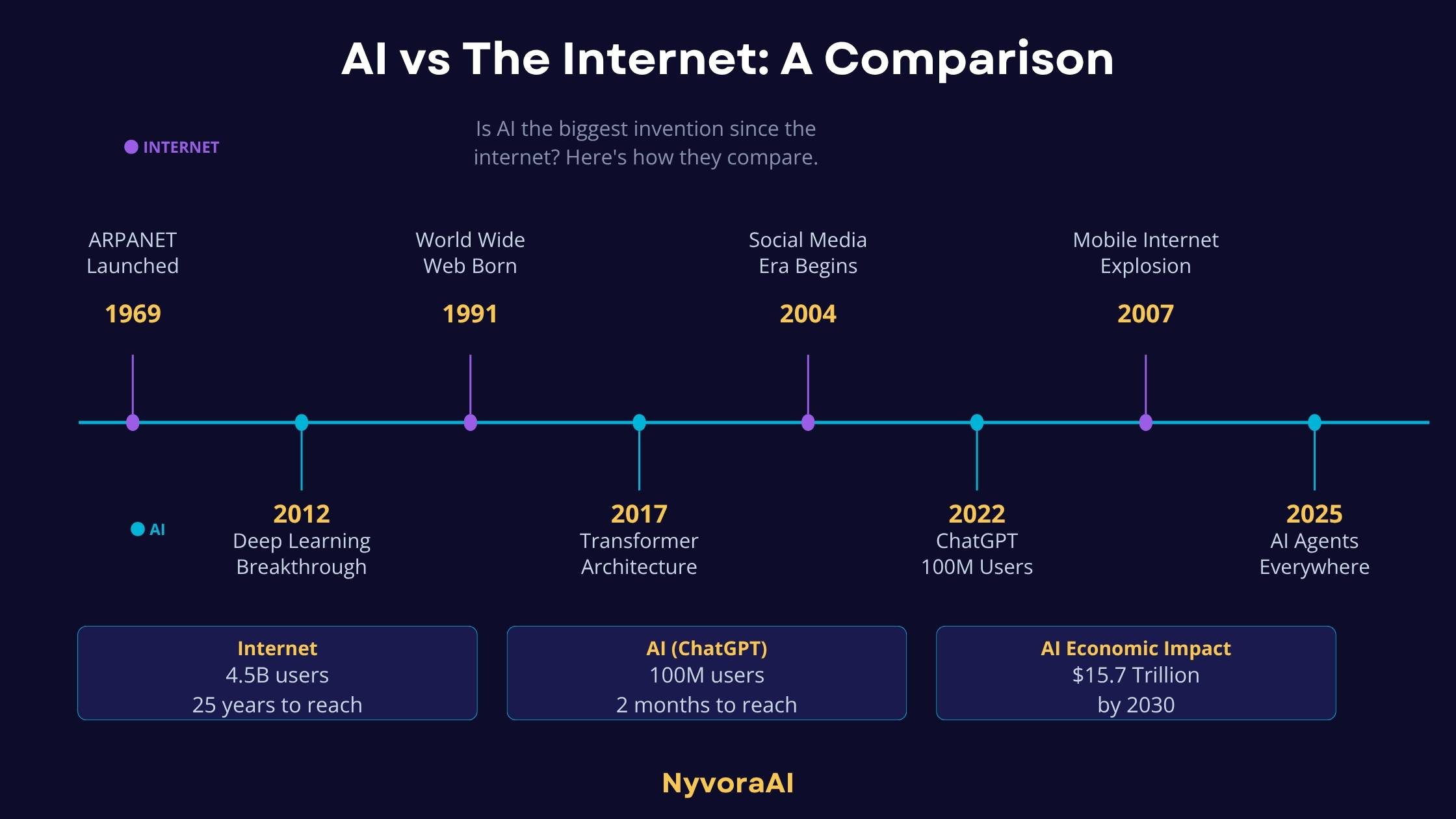
只看速度就够了。ChatGPT 在两个月内就达到 1 亿月活用户,而这种渗透程度,互联网用十多年才慢慢逼近。AI 被接纳的速度,让人既惊恐又兴奋,程度不相上下。
04为什么 AI 有可能真的更大
为什么这么多研究者会说 AI 超越了互联网?答案在于两者各自能触到的天花板。
1. 攻下那些「无解」的问题
互联网加快的是科研成果的流通速度,AI 则是亲自做研究。预测出几乎所有已知蛋白质的三维结构——AlphaFold 的成就——若交给人类生物学家,需要数百万年。如今 AI 在为气候问题建模、设计新的电池化学体系、发现过去未知的抗生素。互联网给了我们一座图书馆;AI 则是读完这座图书馆、并做出发现的科学家。
2. 专业能力人人可用
互联网让所有人接触到同样的信息,却没能让所有人拥有同样的技能。2005 年想做个网站,你得学 HTML 和 CSS;想分析一份庞大的数据集,你得学 Python 和 SQL。
AI 把这条学习曲线几乎抹平了。用日常英语说出你想要什么,活儿就干完了。劳动力市场正被从根子上搅动。任何琢磨过自己职业去向的从业者,大概都问过自己:2026 年 AI 会取代内容写作者吗?程序员、分析师和设计师面对的是同一道题。AI 交到你手上的不只是信息,而是达到专业水准的执行能力。
3. 进入物理世界
互联网基本停留在屏幕里。AI 正在跨进物理空间:自动驾驶汽车、机器人手术、智能电网和人形机器人,背后都是它。互联网连接了我们的头脑;AI 将延伸我们双手能触及的范围。
05反方观点:为什么互联网仍戴着王冠
别急。在把奖杯递出去之前,先把反方立场认真听一遍。有一种相当有力的论证认为:在技术革命这件事上,互联网依然是毫无争议的冠军。
一个事实就能说清:抽掉互联网,AI 根本不存在。
每一个现代 AI 模型都是从互联网上学的。大语言模型里的每一个参数,都是用过去三十年人们上传的文本、图片和代码调出来的。互联网是底座,AI 不过是叠在上面最复杂的那层应用。说 AI 比互联网更大,就像说汽车的发动机比车轮更重要。它是动力源没错——但没有轮子,哪儿也去不了。
还有一层。互联网对人类社会的重塑,AI 目前还没做到。它建起了跨越大陆的社群,点燃了政治起义(阿拉伯之春),改写了恋爱的规则,也重新定义了「名人」。社交媒体甚至重塑了我们的多巴胺回路。AI 正在改变我们的经济;互联网改变的是我们的灵魂。
06阴影那一面:AI 热潮押上了什么风险
任何一次巨大的技术跃迁都带着阴影。互联网带来了网络霸凌、身份盗用、信息茧房和地方媒体的衰落。AI 带来的也许更棘手,因为它同时冲击两样东西:我们对「真相」的概念,以及我们对自己能动性的感受。
在旧互联网上传播的谎言,通常始于一个人对另一些人的欺骗。AI 生成的虚假信息打破了这个模式:几秒钟内,它就能产出数百万条各不相同、极具说服力、几可乱真的深度伪造,并且专门针对你的心理特征定制。我们正面临的那场认知危机——再也无法相信自己的眼睛和耳朵——正是 AI 直接造成的。
哲学层面的危险也一并存在。把写作、思考、解决问题统统交给算法,人的认知会变成什么样?批评者已经开始敲警钟,追问AI 是不是正在削弱我们的创造力。如果永远不必面对空白页,创新的能力会不会一起枯萎?这类问题,互联网从未逼我们问过。
- 1
认知层面的风险
1 AI 可以无止境地生产有说服力的假话。我们正在进入一个「零信任」的数字环境:要确认何为真实,得靠密码学证明。
- 2
经济层面的冲击
2 互联网长期来看创造的岗位多于它消灭的岗位。AI 的威胁性质不同:它可能整体取代脑力劳动,而过渡期足以撕扯社会结构。
- 3
对齐问题
3 AI 系统越自主,就越难让它的目标与人类价值保持一致——这就是「对齐问题」,也是这个时代最核心的技术挑战。
07结论:两项技术一起生长
那么 AI 配得上这个称号吗?这个问题本身有点歪,因为它预设两者在同一场竞赛里争夺同一个名次。
历史上最伟大的沟通发明是互联网,最伟大的思考发明是 AI。
接下来不是 AI 时代取代互联网时代,而是「智能互联网」时代。不久的将来,没人会把 AI 当成一件单独的软件去「使用」。它会成为互联网之下那层看不见的底座,AI 智能体会住进你的浏览器、住进你的操作系统。互联网不再是你去访问的一个地方,而是一套替你行动的系统。
互联网把世界的知识连了起来,AI 则终于让我们能读懂它、用上它。从这个角度看,答案是肯定的:自人类第一次学会围在火堆边互相讲故事以来,AI 也许就是发生在我们这个物种身上最重要的一件事。
08我们常被问到的问题
人们真的把 AI 视为互联网以来最大的发明吗?
AI 与互联网革命的区别在哪?
将来 AI 有可能取代互联网吗?
和互联网相比,AI 革命最严重的风险是什么?
Spend five minutes on tech Twitter, or on any podcast with a venture capitalist as guest, and the same line comes round again like a chant: "AI is the biggest thing to happen since the internet."
It is an easy line to remember, and it lands because the internet is the one technological upheaval most of us experienced first-hand. It rebuilt, from the ground up, the way we talk to each other, earn a living and pass the time. Calling AI "the next internet" is therefore shorthand of the bluntest kind for: everything is about to be different.
Having spent far too many hours parsing technology trends, I keep coming back to a nagging thought: bundling these two together may not be fair to either. Is this merely one more platform transition, or does AI rank as the biggest invention since the internet — or perhaps since the printing press itself?
Answering it means ignoring the noise and examining the mechanics: how each of these two upheavals actually altered what people do. Pour yourself a coffee — this goes deep.
01What the Internet Actually Achieved
Before handing the crown to AI, give the internet its due. Familiarity makes it easy to overlook, yet the internet may be the single most important invention of the 20th century.
Before the 1990s, finding something out meant a trip to the library, a question put to a specialist, or waiting for the evening bulletin. Geography, money and institutional membership determined who could learn what. Digitising encyclopedias was the least of it: the internet drove the cost of moving information down to almost nothing.
It brought the digital economy into being, and with it e-commerce, working from home, social platforms and cloud computing. 5 billion people ended up connected. The essential point, though, is that the internet is a pipe. Bits travel from one point to another through it, and it has no grasp of what those bits signify. Meaning has to be supplied by a person at the far end, who reads, interprets and then acts.
02The Shift AI Brings: From Plumbing to Thinking
Here the comparison starts to bite. Suppose the internet is the finest plumbing ever laid; AI is the water running through it — except this water thinks.
Today's AI — the generative and reasoning systems in particular — does more than fetch information. It combines and produces it, and it reads context. Writing code, spotting disease in X-rays, translating between languages as speech happens, generating artwork indistinguishable from a photograph: all of it is within reach.
Put a question to a search engine and back come ten links; the clicking, the reading and the assembling of an answer remain your job. Put the same question to an AI and it does the reading, absorbs the ideas and returns an answer already assembled to suit you. The mental labour migrates from person to machine.
03Internet Against AI, Side by Side
Set the two next to each other and compare them on a handful of measures.
🌐 The Internet Era
- Speed of adoption: roughly 20 years to reach the mass market
- Main impact: how we communicate and trade
- Entry barrier: physical infrastructure was needed (cables, cell towers)
- Human role: making content and consuming it
🤖 The AI Era
- Speed of adoption: about 2 years to pass 100M+ users
- Main impact: thinking, automation and creation
- Entry barrier: huge compute and data required (and already in place)
- Human role: directing and editing what the AI produces
Consider the pace alone. ChatGPT reached 100 million monthly active users within two months, a level of penetration the internet needed more than a decade to approach. How quickly AI is being taken up is both alarming and thrilling, in equal doses.
04Why AI Might Genuinely Outweigh It
What leads so many researchers to say AI outranks the internet? The answer lies in the ceiling each one can reach.
1. Cracking Problems That Defied Solution
Where the internet sped up how scientific findings circulated, AI carries out the research itself. Predicting the 3D structures of virtually every known protein — AlphaFold's achievement — would have occupied biologists for millions of years. Today AI models climate solutions, designs new battery chemistries and uncovers antibiotics that were previously unknown. The internet handed us a library; AI is the researcher who reads it and produces the discoveries.
2. Expertise Available to Anyone
Equal access to information, which the internet provided, is not equal access to skill. Building a website in 2005 meant learning HTML and CSS. Making sense of a very large dataset meant learning Python and SQL.
AI flattens that curve until it is nearly gone. Say what you want in ordinary English and the work gets done. The labour market is being disrupted at a fundamental level. Any professional who has wondered where their career is heading has probably already put the question to themselves: is AI going to replace content writers in 2026? Coders, analysts and designers face the same reckoning. AI hands over not just information but the capacity to perform at a professional standard.
3. Moving Into the Physical World
Screens contained most of what the internet did. AI is crossing into physical space: self-driving vehicles, robot-assisted surgery, intelligent power grids and humanoid robots all run on it. The internet linked our minds; AI will extend what our bodies can touch.
05The Other Side: Why the Internet Keeps the Crown
Not so fast. Before the trophy changes hands, take the contrary position seriously. A formidable case can be made that the internet is still the undisputed champion among technological revolutions.
A single fact cuts through it: take the internet away and AI does not exist.
Every modern AI model learns from the internet. Each parameter inside a large language model was set using the accumulated text, pictures and code that people uploaded over the past three decades. The internet is the base layer; AI is simply the most intricate application layered on top. Claiming AI outranks the internet is like arguing a car's engine matters more than its wheels. Power source it may be — but strip away the wheels and nothing moves.
There is more. Human social life was reshaped by the internet in ways AI has not managed. It built communities that span continents, ignited political uprisings (the Arab Spring), rewrote the rules of courtship and changed what fame means. Social media even retuned our dopamine systems. AI is reshaping our economy; the internet reshaped our soul.
06The Shadow Side: What the AI Boom Puts at Risk
No great technological jump has ever arrived without a shadow. The internet delivered online harassment, stolen identities, filter bubbles and the decline of local newspapers. What AI brings may prove thornier still, since it goes after two things at once: our notion of truth and our sense of our own agency.
Lies travelling across the old internet generally started with a person lying to other people. AI-generated misinformation breaks that pattern: in seconds it can turn out millions of distinct, highly convincing, near-photographic deepfakes, tuned to your particular psychology. The crisis of knowing what to believe — living in a world where your own eyes and ears can no longer be trusted — is something AI has produced directly.
A philosophical danger sits alongside it. Hand every act of writing, thinking and problem-solving to an algorithm and what becomes of human cognition? Critics have begun sounding the alarm, asking whether AI is eroding our creativity. If the blank page never has to be faced again, does the capacity to invent wither? The internet never posed us questions like these.
- 1
The Risk to What We Can Know
1 AI can manufacture persuasive falsehoods without limit. A "zero-trust" digital environment is arriving, one in which reality has to be verified with cryptographic proof.
- 2
The Economic Fallout
2 The internet, over time, generated more work than it eliminated. AI poses a different threat: the wholesale replacement of mental labour, with a transition period that could tear at the social fabric.
- 3
The Alignment Problem
3 The more autonomous AI systems become, the harder it is to keep their objectives matched to human values — the "alignment problem," and the defining technical challenge of this era.
07The Verdict: Two Technologies Growing Together
So does AI deserve the title? The question is a little crooked, since it presumes the two are rivals in a single contest.
History's greatest invention in communication was the internet. Its greatest invention in thinking is AI.
The next era is not the AI era replacing the internet era — it is the era of the Intelligent Internet. Soon nobody will "use AI" as a distinct piece of software. It will be the unseen layer beneath the internet, and an AI agent will sit inside your browser and inside your operating system. Rather than a place you go to, the internet becomes a nervous system that acts for you.
The internet wired the world's knowledge together. AI is what finally lets us make sense of it and put it to use. Seen that way, the answer is yes: AI may be the most significant thing to befall our species since the first humans discovered they could trade stories around a fire.