Leitarkkk/dsh-research-nudge
DeepSeek Harness 插件:当本地试错成本升高时,自动注入检索提示,引导 Agent 查阅文档或联网搜索。
Project Overview项目介绍
dsh-research-nudge is a research-debt guard for DeepSeek Harness. It accumulates a weighted score from reads, edits, executions, and failures, then injects a short advisory reminder when the score crosses a threshold, prompting the agent to consult official docs, error messages, or existing issues instead of repeating local trial-and-error. Use it when an agent loops through read-edit-run-fail cycles on unfamiliar APIs; self-contained tasks continue normally. The reminder is advisory: no LLM call, no tool blocking, no result mutation, and agents may snooze via research_nudge_snooze. Git installs run a local build script, so review the source and pin a tag or commit first.
dsh-research-nudge 是 DeepSeek Harness 的研究债守望插件。它按权重累计读取、编辑、执行、失败等操作的"研究债"分数,到达阈值时向模型注入简短提示,促使其查阅官方文档、错误信息或已有议题,而非继续盲目试错。可在代理陷入读-改-跑-失败循环时使用,自包含任务不受影响。提醒属建议性质,不调用模型、不阻断工具,可通过 research_nudge_snooze 主动暂停。Git 安装会执行本地构建脚本,请审阅源码并固定标签或提交哈希后再允许构建。
请帮我了解并安装插件:【dsh-research-nudge】【https://github.com/Leitarkkk/dsh-research-nudge】Send this message to DSH in your current session. CLI install commands may not be accurate across systems — DSH will figure it out for you.把上面这条消息直接发给当前会话里的 DSH,让它帮你了解并安装。安装命令不一定准确,发给 DSH 更稳。
Or use CLI install (for developers)或使用命令行安装(适合开发者)
CLI Install命令行安装
dsh plugin --profile web add dsh-research-nudge把 Leitarkkk/dsh-research-nudge 加入你的 DSH 配置(web profile)即可启用。
READMEREADME
dsh-research-nudge



English | 简体中文
An advisory research-debt guard for DeepSeek Harness. It notices when an agent spends a long stretch reading, editing, executing, and repeating failures without consulting external evidence, then adds a short reminder to the next model step.
It does not call an LLM, perform a search, block a tool, or force the agent to browse. The reminder explicitly allows self-contained work to continue normally.
The problem
Agents sometimes fall into a local trial-and-error loop:
read → guess an unfamiliar API → edit → run → fail → edit → run → same failure
A search of the official docs, an exact error message, or an existing GitHub issue may resolve that uncertainty faster. dsh-research-nudge turns the growing cost of the local loop into a deterministic score called Research Debt.
Research Debt: a calculated example
This is a hypothetical sequence calculated from the documented default weights, not production telemetry. It shows exactly how the score would cross the threshold:
| Step | Signal | Added debt | Total |
|---|---|---|---|
| Read local code | ordinary tool | +1 | 1 |
| Edit a file | mutation | +2 | 3 |
| Run and fail | execution + failure | +1 +4 | 8 |
| Edit again | mutation | +2 | 10 |
| Run and hit the equivalent failure again | execution + failure + repeated failure | +1 +4 +6 | 21 |
The default threshold is 20, so the last result carries an additional model-visible context:
[Research Nudge]

Pause and reflect before continuing:

1. What problem am I trying to solve right now? Restate it precisely.
2. What approach am I currently taking, and how many attempts has it taken without success?
3. Am I fully confident this approach will work? If I am guessing at an API, an error message, a library's behavior, or platform details I have not verified, I am not fully confident.
4. If I am not fully confident: external research is cheaper than more local trial-and-error. Search the official documentation, GitHub issues, existing libraries, or the exact error message before trying again.

Do not search merely to satisfy this reminder. If the task is self-contained and external research would not help, continue normally. If you are deliberately making progress from local evidence and do not want another reminder for a while, use the research_nudge_snooze tool.

Current signals: debt=21/20, tool_calls_since_research=5,
failures=2, repeated_failures=1.
Equivalent failures are fingerprinted after normalizing changing numbers and addresses, so TypeError at line 123 and TypeError at line 456 count as a repeat. A recognized research tool resets the accumulated state for that agent.
Install
Prerequisites:
- DeepSeek Harness
0.1.0-rc.7(the currentnextrelease line) - Node.js
^22.19.0or>=24.0.0, matching the current DSH baseline
From GitHub:
dsh plugin --profile web add github:Leitarkkk/dsh-research-nudge
Git installs run this package's prepare build. pnpm may reject that build until you explicitly trust it. Follow the exact allowBuilds entry printed by DSH/pnpm, review the source first, and pin a tag or commit for reproducible installs:
dsh plugin --profile web add github:Leitarkkk/dsh-research-nudge#<tag-or-commit>
After the package is published to npm, the prebuilt install is:
dsh plugin --profile web add dsh-research-nudge
Verify the composed layer, then restart the profile:
dsh --profile web --dump-config
dsh web
Local development install
git clone https://github.com/Leitarkkk/dsh-research-nudge.git
cd dsh-research-nudge
npm install
npm run check
dsh plugin --profile web add .
Relative paths are resolved from the directory where dsh plugin is invoked.
Default policy
| Signal | Debt |
|---|---|
| Ordinary tool call | +1 |
| File mutation | +2 |
| Shell/build/test execution | +1 |
| Failed tool result | +4 |
| Repeated equivalent failure | +6 |
| Recognized external research tool | reset to 0 |
A reminder is eligible when any condition is met:
- Research Debt reaches 20;
- 15 tool calls occur without recognized research; or
- 15 minutes pass without recognized research.
After a reminder, the per-agent state continues accumulating but further reminders are suppressed for 10 minutes. Names are normalized before classification and research matching, so WebSearch, web_search, and web-search are treated consistently.
Agent snooze
An agent that is deliberately making progress from local evidence can call the model-visible research_nudge_snooze tool to suppress reminders for a while (defaults to 30 minutes, capped by maxAgentSnoozeMinutes):
- Snoozing is per agent — other agents keep their own schedules.
- Research Debt keeps accumulating while snoozed: snoozing neither counts as research nor erases debt or failure counters. Once the snooze expires, an already-eligible state nudges on the next tool call.
- A failed snooze call (for example, invalid arguments rejected by schema validation) arms nothing and is recorded as an ordinary failed call. Snooze executions bypass research recognition entirely, so a custom
researchToolspattern such assearch(which substring-matches the snooze tool's own name) can never turn a failed snooze into a debt reset.
Configuration
The bundle inserts a row with the id research-nudge. Override that row in the profile's cordis.patch.yml:
- id: research-nudge
  config:
    enabled: true
    debtThreshold: 20
    maxToolCallsWithoutResearch: 15
    maxMinutesWithoutResearch: 15
    cooldownMinutes: 10
    ordinaryToolDebt: 1
    mutationDebt: 2
    executionDebt: 1
    failureDebt: 4
    repeatedFailureDebt: 6
    maxAgentSnoozeMinutes: 60
    researchTools:
      - web_search
      - web_fetch
      - github_search
      - docs_search
      - fetch_url
    debug: false
DSH patch layers replace a row's entire config value rather than deep-merging it. Any omitted fields above fall back to this plugin's schema defaults. reminder may also be set to a custom string.
| Field | Default | Meaning |
|---|---|---|
enabled |
true |
Register the lifecycle listener |
debtThreshold |
20 |
Debt score that makes a reminder eligible |
maxToolCallsWithoutResearch |
15 |
Call-count fallback threshold |
maxMinutesWithoutResearch |
15 |
Elapsed-time fallback threshold |
cooldownMinutes |
10 |
Minimum time between reminders |
ordinaryToolDebt |
1 |
Weight for other local tools |
mutationDebt |
2 |
Weight for write/edit/delete-style tools |
executionDebt |
1 |
Weight for shell/build/test-style tools |
failureDebt |
4 |
Extra weight for a failed result |
repeatedFailureDebt |
6 |
Extra weight for an equivalent consecutive failure |
maxAgentSnoozeMinutes |
60 |
Upper bound for one agent-requested snooze of reminders |
researchTools |
common web/docs/GitHub names | Substring patterns that reset state after normalization |
reminder |
built-in advisory text | Model-visible reminder body |
debug |
false |
Log resets and queued reminders to stderr |
How it integrates with DSH
The plugin listens to the current tools/post-execute waterfall. It observes the typed ToolExecution and ToolExecutionResult, delegates to later listeners with next(), then prepends one official createUserMessage(...) notice through PostToolDecision.additionalContexts. Accept/block decisions and existing contexts are preserved.
The plugin declares inject: ['tools'] and registers its research_nudge_snooze tool through ctx.tools.register(...); no other service is read from ctx. State is held in a WeakMap keyed by the calling agent and disappears with the agent/runtime.
Compatibility
The adapter is compiled and tested against the official @deepseek-ai/dsh-tools and @deepseek-ai/dsh-llm 0.1.0-rc.7 contracts. DSH is still a Developer Preview and explicitly allows compatibility-breaking changes. If a later DSH release changes the tool waterfall or message contract, update the small adapter in src/index.ts; the deterministic policy in src/policy.ts is independent.
Privacy and safety
- No telemetry, network requests, API keys, or extra model calls.
- No tool arguments are stored or copied.
- The in-memory fingerprint uses only failed-result text; it is not persisted.
- The reminder is advisory and never changes a tool result or permission decision.
- Git installs execute a local build script; review and pin third-party code before allowing it.
Development
npm ci
npm run check
npm pack --dry-run
See CONTRIBUTING.md for contribution guidelines.
License
Related相关推荐
-
 imsai-sh/awesome-deepseek-harness-plugins
DeepSeek Harness plugin store, marketplace and hub — 11,000+ dsh plugins with search, rankings, install commands and a f…
imsai-sh/awesome-deepseek-harness-plugins
DeepSeek Harness plugin store, marketplace and hub — 11,000+ dsh plugins with search, rankings, install commands and a f…
-
 2BingLing/dsh-market
DeepSeek Harness 插件市场 · 持续收录 6000+ DSH 插件:中文搜索 + 实用五维评分 + 一键安装。Web 版与 DSH 侧边栏插件双形态。Plugin marketplace for DeepSeek Harne…
2BingLing/dsh-market
DeepSeek Harness 插件市场 · 持续收录 6000+ DSH 插件:中文搜索 + 实用五维评分 + 一键安装。Web 版与 DSH 侧边栏插件双形态。Plugin marketplace for DeepSeek Harne…
-
 feibi-mochi/deepseek-harness-control-center
DeepSeek Harness control center for balance, usage, peak/off-peak pricing, encrypted multi-account switching, health che…
feibi-mochi/deepseek-harness-control-center
DeepSeek Harness control center for balance, usage, peak/off-peak pricing, encrypted multi-account switching, health che…
-
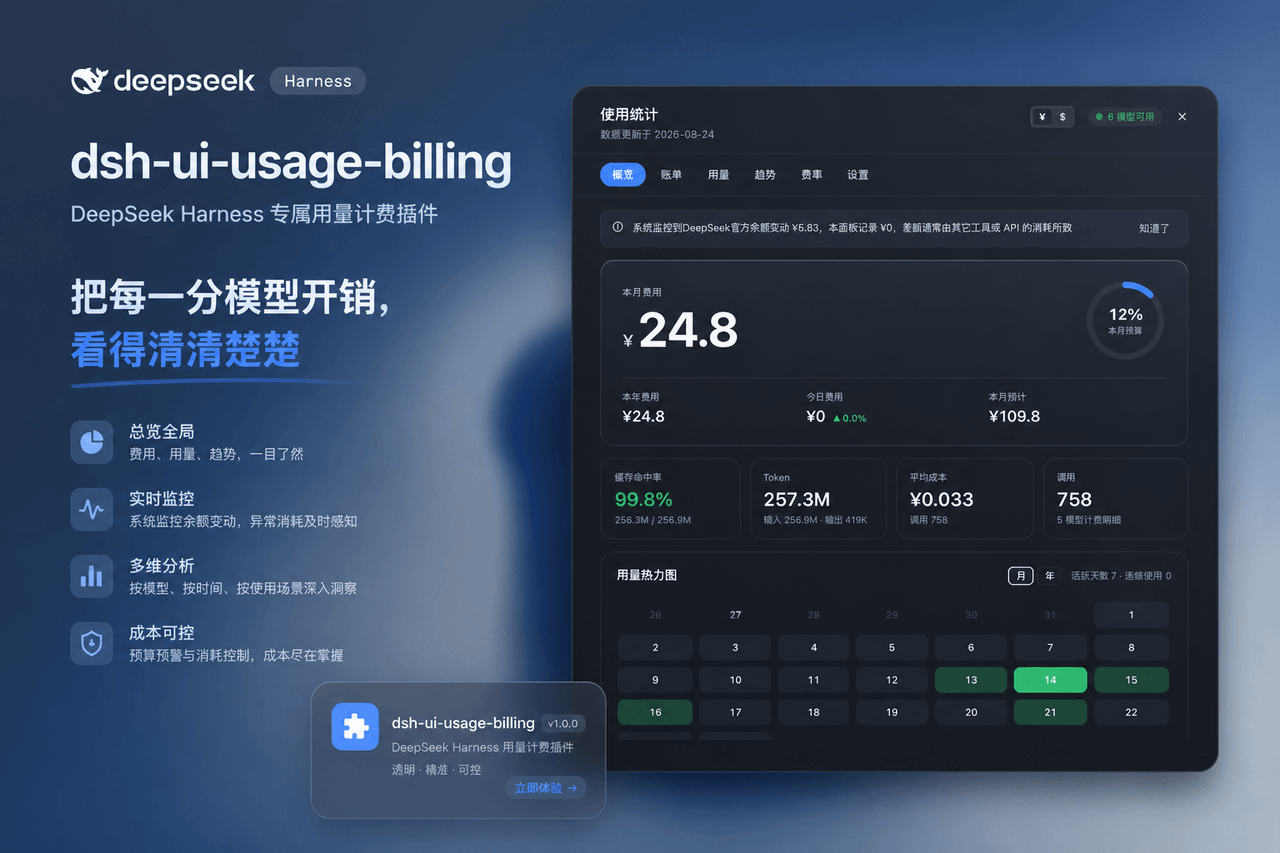 kenz1117/dsh-ui-usage-billing
Usage billing dashboard plugin for DeepSeek Harness: sidebar cost metrics, real usage aggregation from session logs, cur…
kenz1117/dsh-ui-usage-billing
Usage billing dashboard plugin for DeepSeek Harness: sidebar cost metrics, real usage aggregation from session logs, cur…
-
 Zhenyu98/dsh-context-doctor
DSH 上下文注入审计插件:统计 AGENTS.md 指令链/技能目录/工具 schema 的 token 成本,检测重复与冲突;Web UI 圆环面板 + context_audit 工具。Context Doctor for DeepS…
Zhenyu98/dsh-context-doctor
DSH 上下文注入审计插件:统计 AGENTS.md 指令链/技能目录/工具 schema 的 token 成本,检测重复与冲突;Web UI 圆环面板 + context_audit 工具。Context Doctor for DeepS…
-
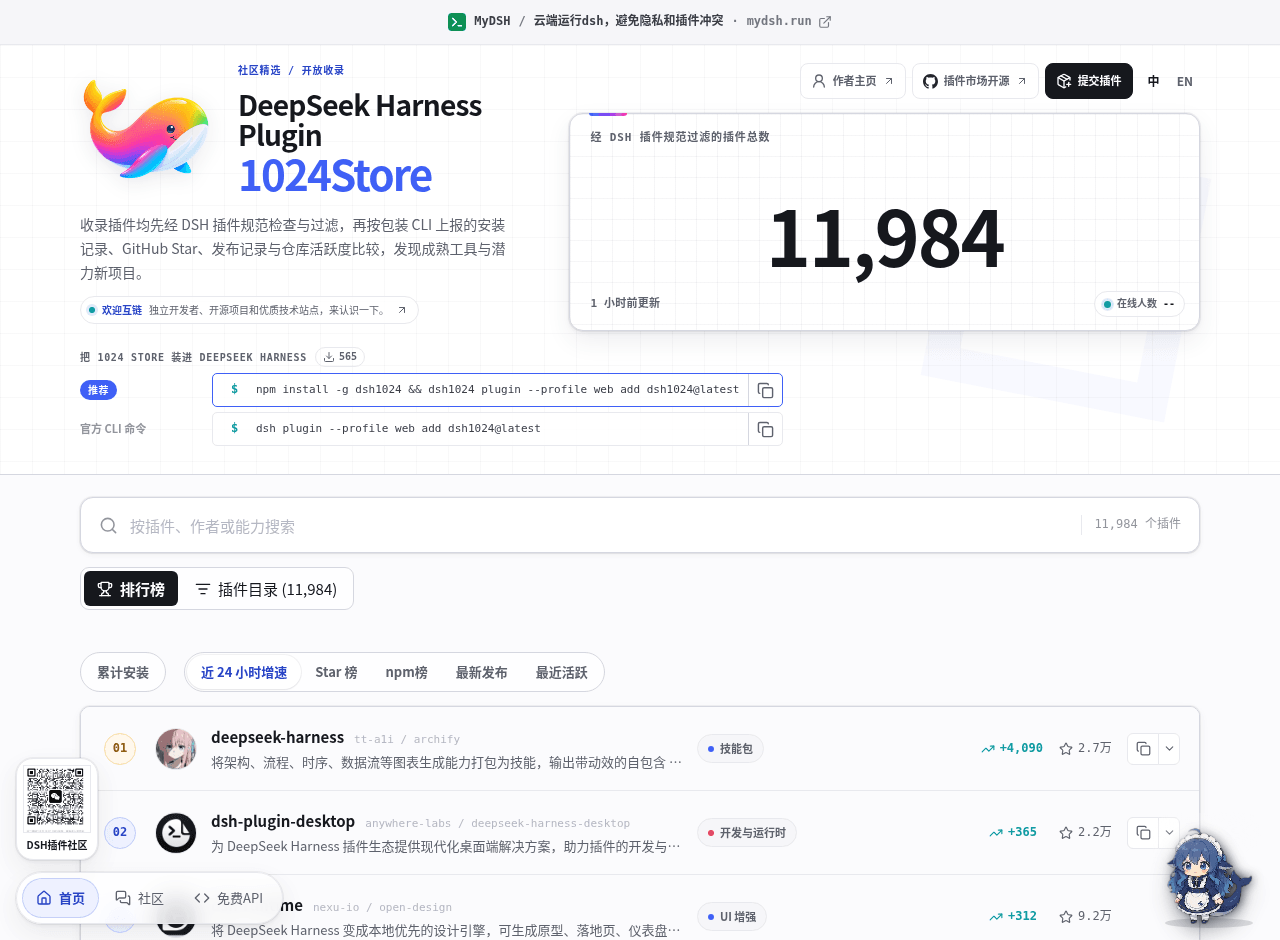 imsai-sh/dsh-1024store
DeepSeek Harness plugin store, marketplace and hub — 11,000+ dsh plugins with search, rankings, install commands and a f…
imsai-sh/dsh-1024store
DeepSeek Harness plugin store, marketplace and hub — 11,000+ dsh plugins with search, rankings, install commands and a f…
-
 Thanksgiver233/comm-protocol-hub
将分散在 3GPP Release 15~18 的 70+ 条通信协议规范,按 TN/NTN/全息/近远场/混合/安全等 8 个维度结构化整理,为通信工程师和 AI 助手提供一键式协议查询能力。通过三个 DSH 工具(关键词搜索、分类浏览、…
Thanksgiver233/comm-protocol-hub
将分散在 3GPP Release 15~18 的 70+ 条通信协议规范,按 TN/NTN/全息/近远场/混合/安全等 8 个维度结构化整理,为通信工程师和 AI 助手提供一键式协议查询能力。通过三个 DSH 工具(关键词搜索、分类浏览、…
-
 titanwings/dsh-better-browser
DSH 真实浏览器插件:通过 Kimi WebBridge 让 Agent 操作用户已登录的浏览器,并提供 13 个 webbridge_* 工具。 / Let DSH Agents use your signed-in browser t…
titanwings/dsh-better-browser
DSH 真实浏览器插件:通过 Kimi WebBridge 让 Agent 操作用户已登录的浏览器,并提供 13 个 webbridge_* 工具。 / Let DSH Agents use your signed-in browser t…