wings1848/dsh-mcp-lazy
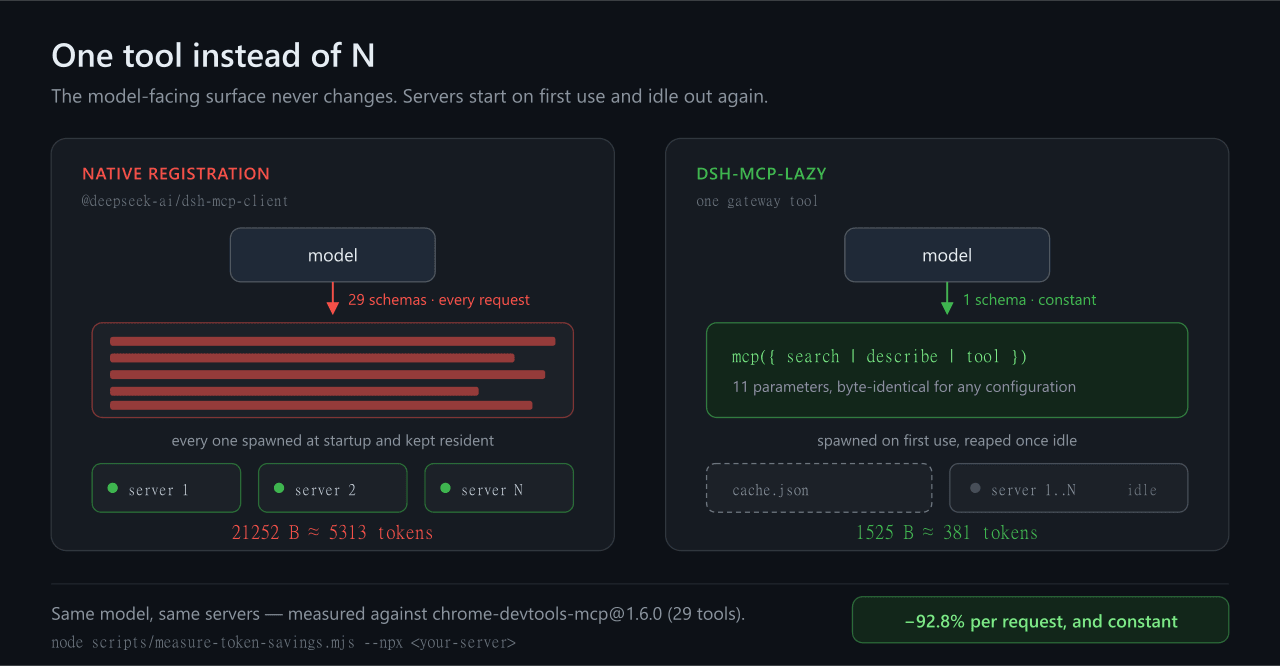
A lazy MCP gateway for DeepSeek Harness. It puts one tool in front of the model instead of N MCP tool schemas: servers start on first use, idle out again, and their tool metadata is cached on disk so search and describe never spawn anything.
catalog descriptioncatalog 简介 / catalog description:Lazy MCP gateway for DeepSeek Harness: one stable proxy tool instead of N tool schemas, servers connect on first use and idle out, metadata cached to disk.
Project Overview项目介绍
This is a lazy Model Context Protocol (MCP) gateway plugin for DeepSeek Harness. It exposes one unified tool to the model, caches tool metadata, spawns servers on demand, and drastically cuts per-request token usage. It works best for setups with multiple MCP servers. It will increase token use for just a few small tools, so measure first.
这是面向DeepSeek Harness的懒加载MCP网关插件。它仅向模型暴露一个统一工具,缓存MCP工具元数据、按需启动服务,可大幅减少每次请求的Token消耗,适合配置多个MCP服务的场景。注意:若仅少量小工具,该插件反而会增加Token开销,需提前测量。
请帮我了解并安装插件:【dsh-mcp-lazy】【https://github.com/wings1848/dsh-mcp-lazy】Send this message to DSH in your current session. CLI install commands may not be accurate across systems — DSH will figure it out for you.把上面这条消息直接发给当前会话里的 DSH,让它帮你了解并安装。安装命令不一定准确,发给 DSH 更稳。
Or use CLI install (for developers)或使用命令行安装(适合开发者)
CLI Install命令行安装
dsh plugin --profile web add dsh-mcp-lazy把 wings1848/dsh-mcp-lazy 加入你的 DSH 配置(web profile)即可启用。
READMEREADME
dsh-mcp-lazy


A lazy MCP gateway for DeepSeek Harness. It puts one
tool in front of the model instead of N MCP tool schemas: servers start on first use, idle
out again, and their tool metadata is cached on disk so search and describe never spawn
anything.

Why
@deepseek-ai/dsh-mcp-client connects every configured server at startup and registers every
one of its tools as a native tool. As its own README puts it, tool descriptions and input
schemas "enter every request while the tools are registered". A handful of servers therefore
costs thousands of tokens on every request and one resident child process each — whether or
not the model ever calls them.
This plugin keeps the model-facing surface at exactly one tool whose schema never changes, discovers tools on demand from a disk cache, and only spawns a server when a call needs it.
The numbers
Measured against chrome-devtools-mcp@1.6.0 (29 tools), both sides rendered the same way —
JSON bytes of the tool definitions, then four bytes per token:
| per request | |
|---|---|
| native registration | 21252 bytes ≈ 5313 tokens |
| this gateway | 1525 bytes ≈ 381 tokens |
| saved | 92.8% |
The gateway figure is constant: configuring ten more servers does not move it, because their schemas are read on demand rather than sent every request.
The honest counterweight. The gateway costs a fixed 1525 bytes, so it wins only when a server's rendered tool definitions exceed that. The bundled fixture offers 7 small tools and the saving drops to 1.7%. A server with a couple of tiny tools would make the gateway a net loss. Measure your own before assuming:
pnpm run measure:savings                                          # local fixture
node scripts/measure-token-savings.mjs --npx <your-server>
Install
dsh plugin --profile <your-profile> add dsh-mcp-lazy
That installs the package into the profile and registers its bundle patch, which inserts the
mcp-lazy row. Then give it your servers in the profile's cordis.patch.yml:
- id: mcp-lazy
  config:
    servers:
      - serverName: chrome
        transport: stdio
        command: npx
        args: ['-y', 'chrome-devtools-mcp@1.6.0']
        lifecycle: lazy
      - serverName: docs
        transport: streamable-http
        url: http://127.0.0.1:3000/mcp
Restart the profile. Every field is documented in docs/configuration.md.
Moving servers off @deepseek-ai/dsh-mcp-client
Every writer of MCP configuration in this ecosystem emits a @deepseek-ai/dsh-mcp-client row:
the config-manager panel hardcodes that package name, @hyzyn/dsh-codegraph writes a managed
row, and a hand-written config follows the same convention. Such a row registers each MCP tool
as a real tool, so its schemas enter every request — and a server listed in both places
cancels the saving this plugin exists for, with no error and nothing to notice. (The mcp({})
status output does warn you — for any server the other plugin serves natively, whether or not
this one has it too — which is how you usually find out.)
adopt does the move for you:
dsh-mcp-lazy-adopt                 # dry run: prints the plan, writes nothing
dsh-mcp-lazy-adopt --write         # applies it, with a timestamped backup of each file
Or, without leaving the session, as a slash command:
/mcp-adopt                         # dry run
/mcp-adopt apply                   # writes
The command drives the same CLI, so the plan, the backups and the write are one code path; a
successful apply is followed by a re-plan whose result is shown to you, so the answer to "did
it work?" is evidence rather than an assurance. It still requires the human to type it: nothing
runs at plugin startup.
It reads what is actually mounted (dsh --profile <p> --dump-config, so all four patch layers
are composed), marks each original row disabled: true in place, and appends the server to
this plugin's servers list. Nothing else in the file is touched — comments, blank lines and
!!js expressions are preserved byte for byte — and a row it cannot move safely is reported
with a reason instead of being guessed at. Run it while the host is stopped: the web profile
reloads its patch layer live, and dsh-config-manager rewrites the same file from its own
state.
Check the blast radius before you apply. The native row usually lives in the home patch, which every profile reads, while this plugin's row lives in one profile's patch. Disabling the former therefore takes that server away from every other profile as well — and those profiles have no gateway to receive it, so they simply lose the capability. The plan names them:
  ⚠ the row being disabled lives in the home layer ~/.dsh/cordis.patch.yml, which every profile reads.
    3 other profile(s) do not mount dsh-mcp-lazy, so they would lose codegraph with no replacement:
    default, dsh-tui, headless.
    Mount dsh-mcp-lazy in those profiles, or move the row into web's own layer, if they need it.
If any of them need the server, mount this plugin there too (or move the row) before applying.
A server that does move arrives with only the fields this plugin implements. Two of the other
plugin's fields are not implemented here — reconnect and failOnStartupError — and
carrying them over is an error rather than a no-op, so a row that sets either one is reported as
unsupported-field and left exactly where it is: no half-move, and no load failure from a
setting that would look configured and do nothing. A misspelled field name is reported the same
way. The per-row id is dropped, because it names the loader row rather than the server.
What the model sees
One tool, always the same 11 parameters:
mcp({ search: "screenshot" })          # find a tool — reads the cache, starts nothing
mcp({ describe: "take_screenshot" })   # full argument schema
mcp({ tool: "take_screenshot" })       # call it — this is what spawns the server
mcp({ tool: "echo", server: "docs" })  # disambiguate a name two servers share
mcp({ connect: "chrome" })             # connect and refresh the cache, without calling
mcp({ instructions: "chrome" })        # the server's own usage notes
mcp({})                                # status: tool count, connection state, cache age
Seven of the 11 are the actions above. The other four shape a search and are
never needed for anything else:
| Parameter | Meaning | Default | Limit |
|---|---|---|---|
regex |
Treat search as a regular expression rather than literal text. |
false |
— |
includeSchemas |
Include each match's parameter summary in the result. | true |
— |
limit |
How many matches to return. | 12 |
40; clamped into 1–40, never an error |
offset |
Skip this many matches, for paging through a long result. | 0 |
— |
That one tool is the whole model-facing surface by default. directTools is
the opt-in that promotes chosen server tools into real native tools instead —
see docs/configuration.md
for what it accepts, and why the default is the cheap choice.
Documentation
| docs/configuration.md | every field, the four lifecycle modes, output ceiling |
| docs/troubleshooting.md | failed servers, cold cache, name resolution |
| docs/development.md | build, test, why link-dsh is mandatory |
| docs/design/plan.md | implementation plan and acceptance criteria |
| docs/design/adopt-native-rows.md | the adopt command: design, invariants, acceptance criteria, and what implementing it turned up |
| docs/design/mcp-adopt-command.md | the /mcp-adopt slash command, and the adversarial review that changed it |
| docs/design/parity-pi-mcp-adapter.md | module-by-module audit against pi-mcp-adapter v2.33.0 |
Known limitations
The v1 boundary, stated plainly:
- Tools only. No MCP resources, prompts, sampling, or elicitation. Only
tools/list_changedis subscribed. - No OAuth. Authentication is a plaintext
headersentry or an environment variable. - Image and audio results are not forwarded. They are projected to a one-line metadata entry (type and byte count). Forwarding pixels needs attachment storage this plugin does not implement.
- No approval gate. MCP calls follow your DSH permission preset.
- No config interop. It reads DSH-native config only; it will not import
.mcp.json, Cursor, Claude Code, Codex, or VS Code server lists. - The regex guard is deliberately narrow. A 256-character cap plus a nested-quantifier
check, which does not catch overlapping alternation like
(a|aa)+or polynomial backtracking likea*a*a*b. A full analyser would mean a second runtime dependency. - No SSE or unix-socket transports.
stdioandstreamable-httponly. npxis not resolved to the underlying binary, so annpx-launched server costs one extra Node parent process.
Development
pnpm install
pnpm test          # builds, relinks the peer packages, runs 354 tests
pnpm run check     # typecheck, lint, build, then type-check the test sources
See CONTRIBUTING.md.
Star history

License
MIT — see LICENSE. The connection supervisor, transport factory, and
environment-scrubbing rules derive from @deepseek-ai/dsh-mcp-client; the single-proxy-tool
gateway, metadata cache, and weighted search ranking derive from pi-mcp-adapter. Both are
MIT; their notices are reproduced in THIRD_PARTY_NOTICES.md.
Related相关推荐
-
 HuanLinOTO/dsh-plugin-aigc-canvas
provider-agnostic AIGC HTTP 桥 + 无限画布 + ffmpeg 后处理,13 个工具含画布连边/reroll/媒体编辑 | Provider-agnostic AIGC HTTP bridge + infinit…
HuanLinOTO/dsh-plugin-aigc-canvas
provider-agnostic AIGC HTTP 桥 + 无限画布 + ffmpeg 后处理,13 个工具含画布连边/reroll/媒体编辑 | Provider-agnostic AIGC HTTP bridge + infinit…
-
 cloveric/tarocub
Feishu/Lark-first local AI agent gateway and native DeepSeek Harness plugin for Codex, Claude Code, Kimi Code, DeepSeek …
cloveric/tarocub
Feishu/Lark-first local AI agent gateway and native DeepSeek Harness plugin for Codex, Claude Code, Kimi Code, DeepSeek …
- huermi/dsh-deepseek-web-adapter 免费的 DeepSeek 网页版(chat.deepseek.com)LLM 服务提供方,用于 DeepSeek Harness——无需 API 密钥。自动启动网关,支持工具调用和连续对话。Free DeepSeek Web (chat.d…
- Victor-770/dsh-commandcode-provider A Command Code LLM provider plugin for DeepSeek Harness (dsh) — supporting all subscription plans (incl. Go & Pro) via S…
-
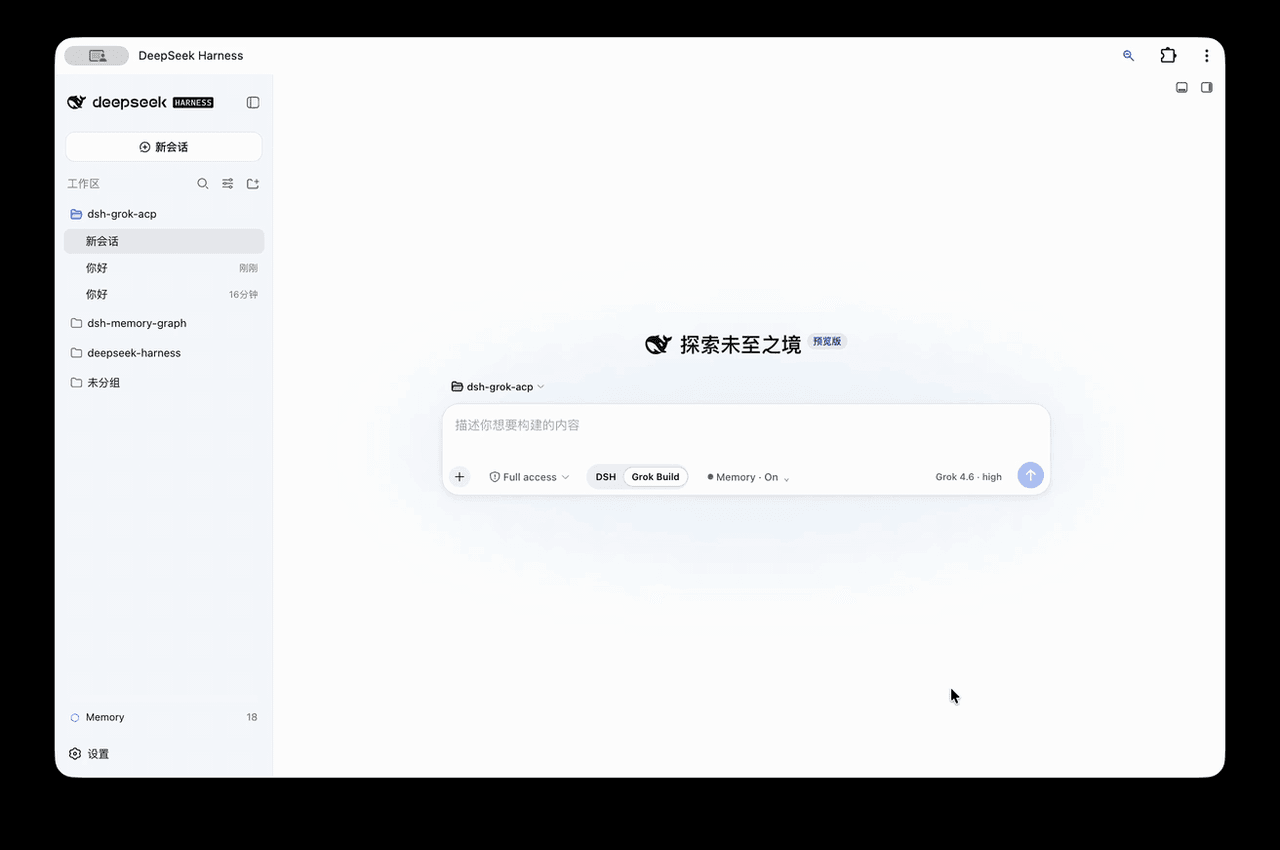 zmh2000829/DSH-agent-bridge
Use Grok Build inside DeepSeek Harness Web through ACP
zmh2000829/DSH-agent-bridge
Use Grok Build inside DeepSeek Harness Web through ACP
-
 wenzetan/dsh-llm-newapi
NewAPI (OpenAI-compatible gateway) LLM provider plugin for DeepSeek Harness (dsh): chat-only model discovery + Web setti…
wenzetan/dsh-llm-newapi
NewAPI (OpenAI-compatible gateway) LLM provider plugin for DeepSeek Harness (dsh): chat-only model discovery + Web setti…
- clarknu/dsh-gateway Self-contained HTTPS remote-access gateway for the DeepSeek Harness web surface — the Caddy layer as a dsh plugin.
- xiaowei2025cqu23phy/dsh-desktop DeepSeek Harness 桌面端:内嵌 Web UI、AI 屏保(替换系统屏保)、全模型切换、手机 PWA 远程控制、QQ 机器人通道