MonshinYu/dsh-desktop
DeepSeek Harness 的桌面客户端。为 @deepseek-ai/dsh 提供原生桌面外壳:内置 Bun 打包的 dsh 运行时、系统托盘、开机启动 dsh 本地服务,并以 iframe 承载其 Web 界面。
catalog descriptioncatalog 简介 / catalog description:DeepSeek Harness的Desktop版本
Project Overview项目介绍
dsh-desktop is a native desktop client for the DeepSeek Harness (dsh), built on Tauri with a Bun-compiled dsh runtime bundled as a single executable. It provides a system tray, automatic port allocation, an embedded splash screen, and an iframe host for the dsh web UI, eliminating the need for users to install Node.js. Suitable for running local dsh services in a desktop environment. Note: the runtime is roughly 110 MB and building requires Bun, Rust, and Tauri 2 platform dependencies.
dsh-desktop 是 DeepSeek Harness 的桌面客户端,基于 Tauri 壳集成 Bun 编译的 dsh 运行时,提供系统托盘、自动端口分配与 iframe Web 承载,无需用户预装 Node.js。适合需要原生桌面体验运行本地 dsh 服务的用户。需注意:runtime 资源约 110 MB,且构建依赖 Bun、Rust 及 Tauri 2 系统依赖。
请帮我了解并安装插件:【dsh-desktop】【https://github.com/MonshinYu/dsh-desktop】Send this message to DSH in your current session. CLI install commands may not be accurate across systems — DSH will figure it out for you.把上面这条消息直接发给当前会话里的 DSH,让它帮你了解并安装。安装命令不一定准确,发给 DSH 更稳。
Or use CLI install (for developers)或使用命令行安装(适合开发者)
CLI Install命令行安装
dsh plugin --profile web add github:MonshinYu/dsh-desktop把 MonshinYu/dsh-desktop 加入你的 DSH 配置(web profile)即可启用。
READMEREADME
DeepSeek Harness Desktop (dsh-desktop)
DeepSeek Harness 的桌面客户端。为 @deepseek-ai/dsh 提供原生桌面外壳:内置 Bun 打包的 dsh 运行时、系统托盘、开机启动 dsh 本地服务,并以 iframe 承载其 Web 界面。
特性
- 零依赖运行时 — dsh 运行时由 Bun 编译为单个可执行文件 (
runtime/dsh),随应用一起分发,无需用户安装 Node.js - 兼容层 — 通过影子化
node_modules与 Node 子进程重定向,让 dsh 在 Bun 下以与 Node 完全一致的方式启动 - 嵌入式 zstd archive —
node_modules与兼容层以自定义DSHA格式(zstd 单 frame)内嵌进二进制,首次启动解压到~/.cache/dsh/<hash>/,内容不变缓存永久有效 - 系统托盘 — 显示/隐藏窗口、使用默认浏览器打开、开发者控制台、退出;关闭窗口最小化到托盘
- 自动端口管理 — 启动时自动选择可用端口,运行中若端口变化(dsh 重启)前端自动跟随跳转
- 启动动画 — 加载态 splash(品牌 logo 绘制动画),dsh 服务就绪后淡出并载入 iframe
架构
┌─────────────────────────── dsh-desktop ───────────────────────────┐
│                                                                   │
│  ┌─────────────────────────────┐        ┌──────────────────────┐  │
│  │  Tauri shell (Rust)         │        │  Frontend (TS/Vite)  │  │
│  │  · 启动/守护 runtime/dsh     │  IPC   │  · splash 加载动画     │  │
│  │  · 系统托盘                  │◄─────►│  · 轮询 check_page     │  │
│  │  · 端口分配与监控             │  port  │  · iframe 承载 Web UI  │  │
│  └──────────────┬──────────────┘        └──────────┬───────────┘  │
│                 │ spawn                             │ http://     │
│                 ▼                                   ▼             │
│  ┌─────────────────────────────────────────────────────────────┐  │
│  │  runtime/dsh  (Bun 编译的独立可执行文件)                      │  │
│  │  ┌───────────────────────────────────────────────────────┐  │  │
│  │  │  main.ts 启动器                                        │  │  │
│  │  │   · dev: 直接用源码树,不碰 archive                     │  │  │
│  │  │   · bin: 解压 .dsh-archive.bin → ~/.cache/dsh/<hash>/ │  │  │
│  │  │   · spawn bun --preload lib/.dsh-preload.js dsh/bin  │  │  │
│  │  └───────────────────────────────────────────────────────┘  │  │
│  │  lib/preload.js  影子 node_modules + Node API 重定向        │  │
│  │  node_modules    @deepseek-ai/dsh 及其依赖                   │  │
│  └─────────────────────────────────────────────────────────────┘  │
└───────────────────────────────────────────────────────────────────┘
运行时启动流程
- Tauri shell 在 setup 阶段获取可用端口,spawn
runtime/dsh - dsh 启动器对内嵌 archive 做 sha256,定位
~/.cache/dsh/<hash>/- 命中 marker → 直接复用缓存,热启动 ≈ 400ms
- 未命中 → 单次 zstd 解压(33k 个文件),冷启动 ≈ 5–6s
- 前端轮询
check_page(每 1s),dsh 的 HTTP 服务就绪后把 iframe 指向http://127.0.0.1:<port> - 运行期间每 3s 检测端口 generation,端口变化(进程重启)时自动重新加载 iframe
目录结构
dsh-desktop/
├── src/                        # 前端:启动 splash + iframe 宿主
│   ├── main.ts                 #   轮询/加载/端口变更跟随
│   └── assets/                 #   logo 与图标
├── src-tauri/                  # Tauri 壳 (Rust)
│   ├── src/main.rs             #   启动 runtime、托盘、窗口事件
│   └── src/core/               #   端口分配、状态存储、托盘
├── plugins/dsh-bun-pkg/        # Bun 打包插件(独立仓库 clone 而来)
│   ├── main.ts                 #   启动器
│   ├── lib/                    #   Node 兼容垫片
│   ├── scripts/embed.ts        #   DSHA archive 构建
│   └── target/dsh              #   `bun build --compile` 产物
├── runtime/                    # 构建产物,被 src-tauri bundle 为资源
│   └── dsh                     #   最终随应用分发的可执行文件
├── scripts/
│   ├── clone_runtime_build_lib.ts   # git clone dsh-bun-pkg
│   └── build_runtime.ts             # bun install → build → runtime/
└── index.html                  # 宿主页面(splash + iframe)
环境要求
- Bun ≥ 1.x(构建与运行脚本依赖)
- Rust stable + Tauri 2 的系统依赖(macOS: Xcode CLT;Windows: WebView2 + MSVC;Linux: webkit2gtk 等)
- Node.js(仅运行时兼容层重定向 worker_threads 时使用,不是用户要求)
开发
bun install            # 安装前端依赖

# 方式一:先构建运行时再跑 Tauri dev
bun run clone:runtime:lib
bun run build:runtime
bun run tauri dev
构建与打包
bun run tauri:build
# = bun run clone:runtime:lib   # clone 最新 dsh-bun-pkg
# + bun run build:runtime       # bun install + build → runtime/dsh
# + bun tauri build             # 产出安装包(dmg/msi/AppImage 等)
runtime/ 与 src/assets/ 作为资源打包进应用(runtime/dsh 约 110 MB)。
常见问题
想强制重新解压运行时缓存?
删除 ~/.cache/dsh/ 即可,下次启动会重新解压。
自定义 dsh-bun-pkg?
scripts/clone_runtime_build_lib.ts 中的 REPO_URL 指向你的 fork 后重新执行 bun run tauri:build。
开发控制台/浏览器打开? 通过托盘菜单:右键托盘图标 → 「链接」→「打开开发者控制台」或「使用默认浏览器打开」。
License
MIT © MonshinYu
Related相关推荐
-
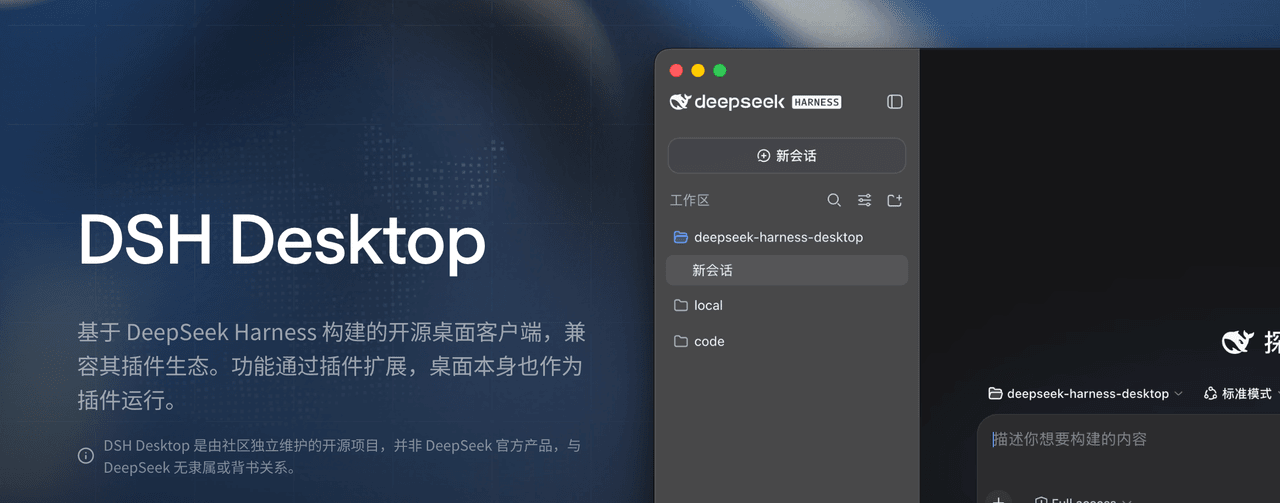 anywhere-labs/dsh-desktop
为 DeepSeek Harness (DSH) 插件生态打造的现代化桌面端解决方案。万物皆「插件」,桌面本身也是「插件」。
anywhere-labs/dsh-desktop
为 DeepSeek Harness (DSH) 插件生态打造的现代化桌面端解决方案。万物皆「插件」,桌面本身也是「插件」。
-
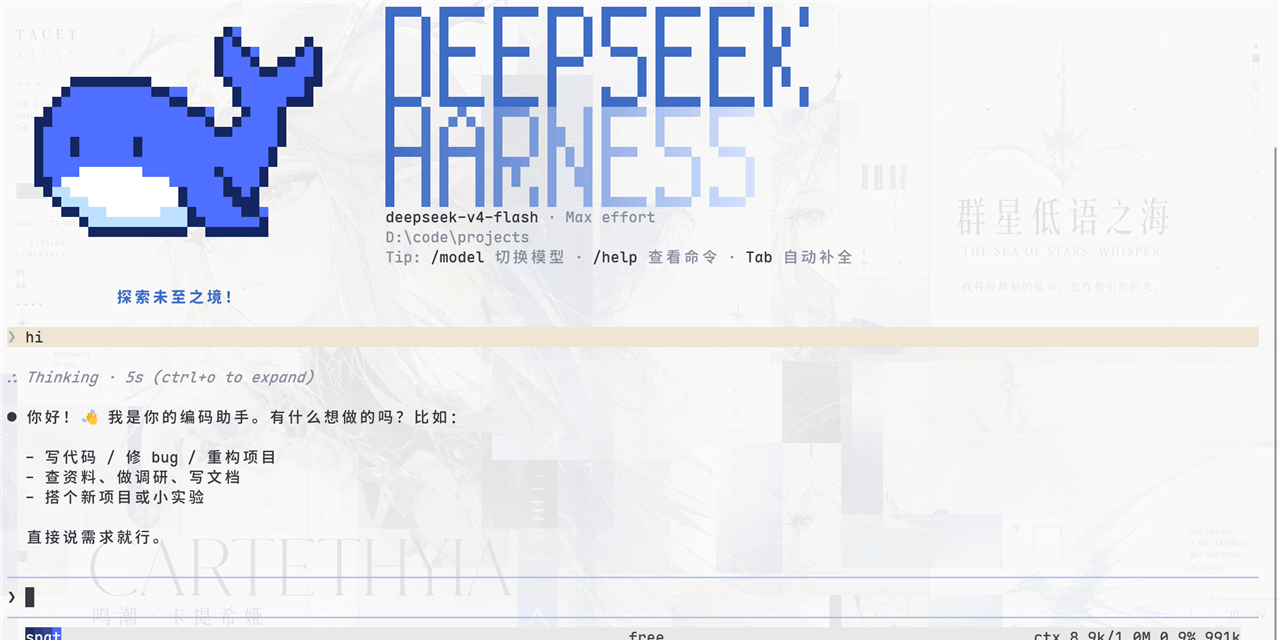 ccch1mneyyy/dsh-TUI
DSH 官方公众号收录的 TUI 补位插件:Claude Code 风,鲸鱼顶栏/实时状态/流式思考/双击 Esc 回滚/上下文进度+TPS。npm 一键装。 DSH official WeChat featured TUI plugin…
ccch1mneyyy/dsh-TUI
DSH 官方公众号收录的 TUI 补位插件:Claude Code 风,鲸鱼顶栏/实时状态/流式思考/双击 Esc 回滚/上下文进度+TPS。npm 一键装。 DSH official WeChat featured TUI plugin…
- dsh-tauri-desk/deepseek-harness-desktop DeepSeek Harness Tauri 桌面版 | Only 5mb installer, zero environment setup, preset plugins, Windows / macOS / Linux.
-
 shaobeichen/dsh-pocket
把 DeepSeek Harness 装进你的口袋:电脑上跑 dsh web,手机扫码即同步访问(局域网 + 公网,实时同屏)Put DeepSeek Harness in your pocket: run dsh web on your …
shaobeichen/dsh-pocket
把 DeepSeek Harness 装进你的口袋:电脑上跑 dsh web,手机扫码即同步访问(局域网 + 公网,实时同屏)Put DeepSeek Harness in your pocket: run dsh web on your …
-
 whitelonng/dshcode
Community desktop companion for DeepSeek Harness — one-click Electron app for macOS and Windows
whitelonng/dshcode
Community desktop companion for DeepSeek Harness — one-click Electron app for macOS and Windows
-
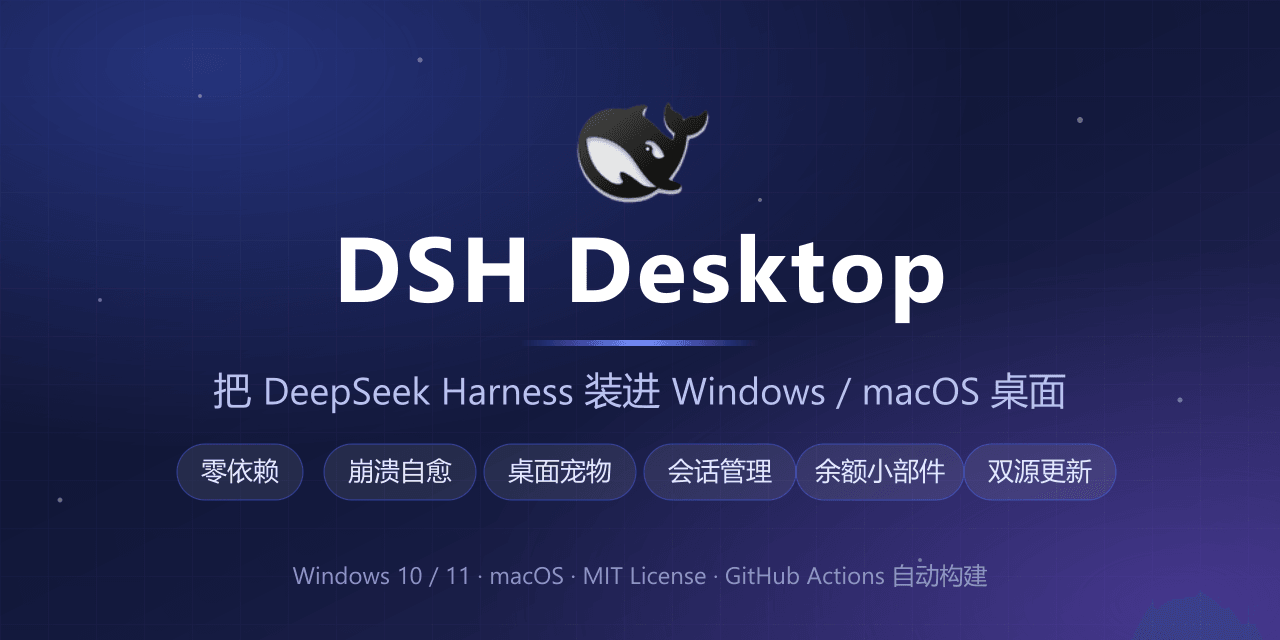 myYangyunfan/dsh_desktop
DeepSeek Harness (dsh) Windows desktop client - bundled Node.js + dsh CLI, one-click launch
myYangyunfan/dsh_desktop
DeepSeek Harness (dsh) Windows desktop client - bundled Node.js + dsh CLI, one-click launch
-
 lencx/Minke
🐳 DeepSeek Harness Desktop
lencx/Minke
🐳 DeepSeek Harness Desktop
-
 Nagi-ovo/dsh-ads
把 DSH 变成 2005 年门户网站|Parody ads, fake games, and popups for the DSH Web UI
Nagi-ovo/dsh-ads
把 DSH 变成 2005 年门户网站|Parody ads, fake games, and popups for the DSH Web UI