xiaoheizi1212/dsh-computer-use
DeepSeek Harness 的模型无关计算机使用:隔离浏览器、Windows 原生辅助程序、第三方视觉感知,以及 Chrome Cookie 桥接器。
Project Overview项目介绍
This is a native computer use capability plugin built exclusively for DeepSeek Harness. It can be installed directly via the DSH CLI with the command dsh plugin --profile web add dsh-computer-use, and after installation you will need to run npx playwright install chromium once to set up the Chromium browser required for the Playwright backend. It exposes a core capability seam ctx.computerUse and six model-facing tools that let agents interact with browsers and desktop interfaces, and includes three built-in providers for different use cases.
This plugin is designed for DSH users and developers who want to enable their agents to complete automated tasks that require interacting with web content and desktop interfaces. A typical first run workflow starts with installing the plugin and its dependencies, then selecting your preferred provider via either the DSH GUI settings panel or editing the YAML configuration file in your user profile. You can also configure options like domain allowlists, risk-based action confirmation, vision model settings, and cookie importing to match your specific automation needs.
The plugin is released under the open-source MIT license, so it is free to use, modify, and redistribute for any purpose. The Windows native desktop provider is currently only available on 64-bit Windows systems, while the Playwright browser provider and all other core functionality work cross-platform. macOS support for the native provider is not currently available, as the maintainer does not have access to a macOS development environment, and community contributions for a macOS port are welcome. The plugin requires several official DSH core plugins as dependencies to work properly.
这是专为DeepSeek Harness(DSH)开发的原生计算机操作能力插件,提供 ctx.computerUse 能力接口和六个面向大模型的工具接口,内置三种后端:fake 用于测试,playwright 用于启动隔离的Chromium浏览器,windows 用于原生桌面自动化。它支持导入本地Chrome已登录的Cookie、密码和浏览历史,可通过DSH图形界面设置或YAML配置文件调整参数。
该插件面向需要让DSH代理执行浏览器操作、原生桌面自动化任务的开发者和用户。典型工作流是先通过DSH的CLI命令安装插件,再安装Playwright的Chromium依赖,随后在配置中选择后端提供商,设置允许访问的域名、视觉模型参数等,代理就可以调用工具完成网页交互、桌面点击输入等各类任务。
插件采用MIT许可证开源免费使用,目前Windows原生后端仅支持Windows系统,Playwright后端和其他功能跨平台可用,macOS原生支持尚未开发。需要依赖DSH核心的多个官方插件才能运行,使用前需要配置支持图像输入的第三方视觉大模型,并验证模型的图像输入能力避免出错。
请帮我安装这个 DSH 插件。安装前先完成【兼容性检查 + 安全性检查】,检查通过再动手。

插件:dsh-computer-use(xiaoheizi1212/dsh-computer-use)
仓库:https://github.com/xiaoheizi1212/dsh-computer-use
本站详情页:https://www.yhbd.top/plugins/xiaoheizi1212-dsh-computer-use/
本站登记:类型 plugin · 归类 原生 DSH 插件 · 许可证 MIT · ⭐ 6 · 最近提交 2026-08-14 · 主语言 TypeScript

按下面顺序执行,每步先把结论告诉我,再进入下一步:

【1 兼容性检查】
① 我这边:DSH 版本、Node 版本、操作系统、当前 profile(web / desktop)。
② 读它的 README、package.json、插件 manifest,列出它要求的 DSH 版本 / Node 版本 / 操作系统 / 外部依赖 / 需要另外先装的运行时。
③ 逐条比对,结论只写「满足 / 不满足 / 未知」三种;不满足的给出可行替代方案。
④ 检查是否和我已装的插件冲突:命令名重复、skill / tool 重名、端口占用、重复注册的 MCP server。

【2 安全性检查】
① 仓库可信度:和上面「本站登记」是否一致;star / fork 数、创建时间、最近提交,是否归档或长期停更。
② 安装脚本:逐行看 package.json 的 preinstall / install / postinstall,以及 install.sh、setup.ps1 之类脚本。出现 curl|bash、下载后直接执行、混淆代码、访问与插件功能无关的域名,立刻停下来告诉我,不要继续装。
③ 依赖:列出新增依赖,标出无人维护、或与知名包拼写近似的可疑包(typosquatting)。
④ 权限与副作用:它会读写哪些目录、访问哪些域名、需要哪些 DSH 权限(filesystem / network / shell / clipboard 等),以及怎么卸载和回滚。
⑤ 如果它要求 sudo / 管理员权限,或权限明显超出功能所需,先停下来问我。

【3 安装】
上面两步没有「不满足」和「高危项」时才执行;用官方推荐方式安装,不要自行提权。

【4 汇报】
用表格输出:检查项 / 结论 / 依据 / 是否需要我决策。拿不准的一律写「未知」并说明要我怎么确认——不要猜,也不要替我决定。
Send this message to DSH in your current session: it verifies compatibility and security first (answering met / not met / unknown item by item) and only installs once everything checks out — it will stop and ask you if it finds a high-risk item. The box scrolls; the copy is the full prompt. CLI install commands may not be accurate across systems, so DSH is the safer route.把上面这条消息直接发给当前会话里的 DSH:它会先核对兼容性与安全性(逐条给「满足 / 不满足 / 未知」),确认没问题再安装,有高危项会停下来问你。框内可滚动,复制到的是完整提示词;安装命令不一定准确,发给 DSH 更稳。
- Only 6 stars - very few users, little community feedback星标只有 6,几乎没人在用,遇到问题缺少社区反馈
DSH walks through these 9 checksDSH 会逐条核对这 9 项
Compatibility兼容性
- DSH, Node, OS and profile requirementsDSH 版本 / Node 版本 / 操作系统 / profile 是否满足要求
- External dependencies and runtimes (Electron / Python / Docker, ...)外部依赖与运行时(Electron / Python / Docker 等)是否齐备
- Conflicts with installed plugins: command names, skill / tool names, ports, duplicate MCP registration与已装插件是否冲突:命令名、skill / tool 重名、端口占用、重复 MCP 注册
Security安全性
- Repo matches the facts registered here; archived or abandoned?仓库是否与页面登记一致,是否归档或长期停更
- Safety of preinstall / install / postinstall and install.sh / setup.ps1preinstall / install / postinstall 与 install.sh、setup.ps1 是否安全
- curl|bash, download-then-execute, obfuscation, unrelated domains → stop immediatelycurl|bash、下载即执行、混淆代码、无关域名 → 立刻停止
- Typosquatting or unmaintained packages among the new dependencies新增依赖里有没有 typosquatting 或无人维护的包
- Requested permissions vs. what the feature actually needs申请了哪些权限、是否超出功能所需(filesystem / network / shell / clipboard)
- Any sudo / admin requirement, plus uninstall and rollback是否要求 sudo / 管理员权限,以及卸载与回滚方式
Anything uncertain must be marked unknown with a note on how to confirm it. This site's signal screen is a static snapshot, not a security audit.拿不准的必须标「未知」并说明要我怎么确认。本站的信号筛查是静态快照,不能替代安全审计。
Or use CLI install (for developers)或使用命令行安装(适合开发者)
CLI Install命令行安装
dsh plugin --profile web add dsh-computer-use把 xiaoheizi1212/dsh-computer-use 加入你的 DSH 配置(web profile)即可启用。
READMEREADME
dsh-computer-use
Model-agnostic Computer Use capability for DeepSeek Harness: an isolated browser, a Windows native helper, provider-neutral observation, a Chrome Cookie Bridge for importing your logged-in sessions, and a text planner (DeepSeek) plus a third-party vision model for perception.
Platform & License
- License: MIT — open source, free to use, modify, and redistribute.
- Platform: the
windowsprovider's native helper is Windows-only; theplaywrightbrowser provider and everything else are cross-platform. - macOS: not currently developed — the author has no macOS environment. Developers are welcome to contribute a macOS version.
Credits
1st version — created using DeepSeek-V4-Pro-0813 with DeepSeek Harness.
Token usage: 223,443,625 tokens · 99% cache hit rate.
What it provides
- A capability seam
ctx.computerUse(start/listTargets/observe/act/stop). - Six model-facing tools:
computer_observe,computer_act,computer_stop,computer_take_over,computer_resume,computer_perceive. - Three providers behind one seam:
fake(deterministic tests),playwright(isolated Chromium),windows(native helper). - A perception layer:
accessibilitymode (no image) andanalyzemode (screenshot → third-party vision model → structured result). - Risk-classified, fail-closed approval + domain allowlist + a full
computer/*replayable session log.
Required plugins (harness dependencies)
| Package | Why |
|---|---|
@deepseek-ai/dsh-llm-pi-ai |
Hosts the third-party vision route (declares input:['text','image']) |
@deepseek-ai/dsh-llm |
The image content block and createUserMessage |
@deepseek-ai/dsh-attachment (+ -local) |
Persists screenshots as content-addressed refs |
@deepseek-ai/dsh-credentials (+ -local) |
Resolves the vision API key per request |
@deepseek-ai/dsh-user-approval |
One-shot fail-closed action approval |
@deepseek-ai/dsh-tools / -session / -system-prompt |
Tool registry, session log, guidance |
@deepseek-ai/dsh-llm-deepseek is text-only and cannot be the vision model — it is the planner.
Showing the opening section of the README — the full document lives in the repository以上为 README 开头摘要,完整文档在仓库内 · View the full README on GitHub →在 GitHub 查看完整 README →
Related相关推荐
- MicroHEROX/dsh-Kimi-WebBridge Kimi WebBridge for DeepSeek Harness — a third-party dsh plugin bundle that turns the local Kimi WebBridge daemon into 15…
- egnmosk/dsh-browser-bridge DeepSeek Harness plugin + browser extension bridge: browser_* agent tools (navigate, click, type, screenshot, eval) over…
-
 liustack/modlens
The first vision plugin for DeepSeek Harness, and the vision bridge for every text-only coding agent. Paste an image, ge…
liustack/modlens
The first vision plugin for DeepSeek Harness, and the vision bridge for every text-only coding agent. Paste an image, ge…
-
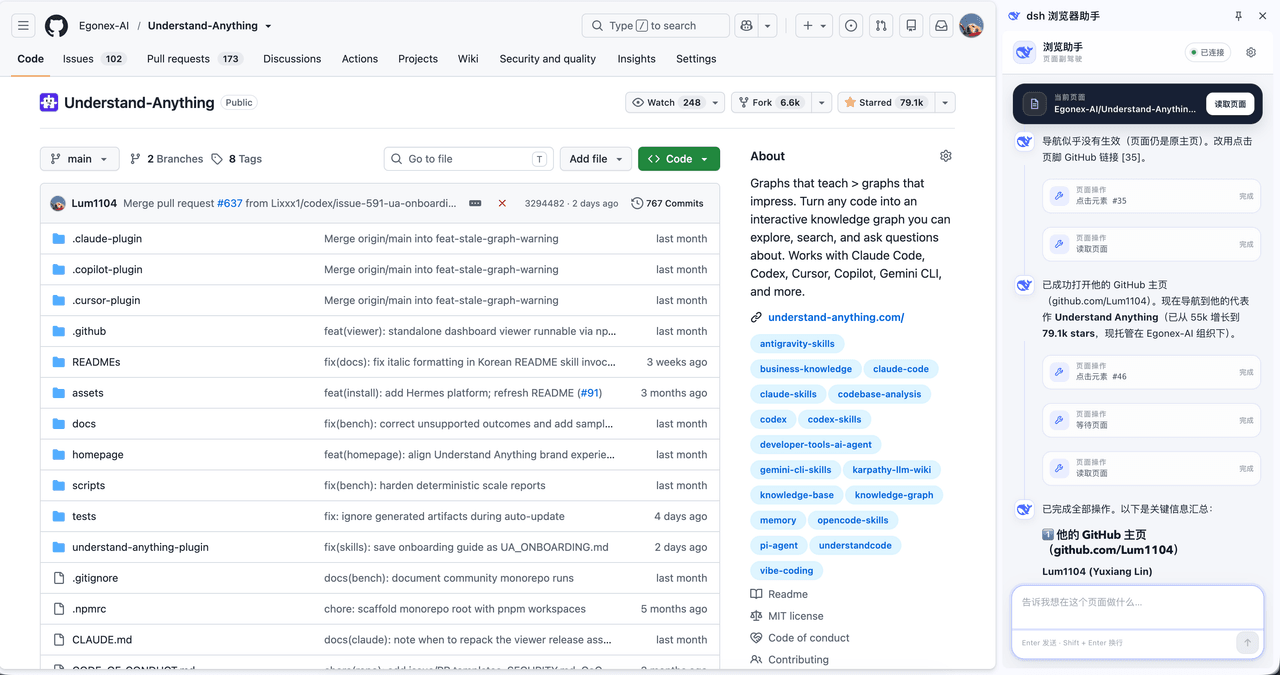 omdsh-dev/dsh-browser
Chrome sidebar extension that lets DeepSeek Harness operate your browser directly, no vision capabilities required. 一款 C…
omdsh-dev/dsh-browser
Chrome sidebar extension that lets DeepSeek Harness operate your browser directly, no vision capabilities required. 一款 C…
-
 Clarklevis1995/dsh-mobile
DeepSeek Harness Mobile 是一个面向 DeepSeek Harness 的原生 iOS 客户端。它通过 dsh-plugin-mobile-gateway 与 Harness 建立 WebSocket 连接,将工作区、…
Clarklevis1995/dsh-mobile
DeepSeek Harness Mobile 是一个面向 DeepSeek Harness 的原生 iOS 客户端。它通过 dsh-plugin-mobile-gateway 与 Harness 建立 WebSocket 连接,将工作区、…
- Fisfzy/dsh-ego-browser DSH(DeepSeek Harness)插件:把 ego-lite 浏览器(给 AI Agent 用的 Chromium)接入 HARNESS——13 个结构化 ego_* 工具(文本语义快照、语义定位点击、表单填充、截图、CDP 控制、…
-
 ZSeven-W/dsh-crew
DeepSeek Harness (DSH) plugin: dispatch work to DSH agents from Claude Code / Codex — native subagent progress, in-host …
ZSeven-W/dsh-crew
DeepSeek Harness (DSH) plugin: dispatch work to DSH agents from Claude Code / Codex — native subagent progress, in-host …
-
 yinnho/aginxbrowser
The browser built for AI agents — fetch live pages as markdown, render JS/SPAs with built-in V8, take screenshots withou…
yinnho/aginxbrowser
The browser built for AI agents — fetch live pages as markdown, render JS/SPAs with built-in V8, take screenshots withou…