AI 究竟靠什么创作音乐?By What Mechanism Does AI Create Music?
打开 Suno、Udio,哪怕只是最简单的循环生成器,输入一种情绪加一种曲风,半分钟后一首完整的歌就到手——人声、打击乐、抓耳的钩子俱全,听上去简直像某个真的被伤透了心的人写的。是什么让 AI 把歌写到能骗过普通听众的耳朵?下文从原始声波讲到成品音轨,把幕后全过程全部摊开。
Fire up Suno, Udio, or even the simplest loop maker, enter a feeling plus a style, and half a minute on, a complete song lands in your lap — singing, percussion, and a hook that could pass for the work of someone genuinely nursing a broken heart. What lets AI fake songwriting convincingly enough to slip past an ordinary ear? Below, the whole process is laid bare, starting with raw waveforms and ending in a finished track.
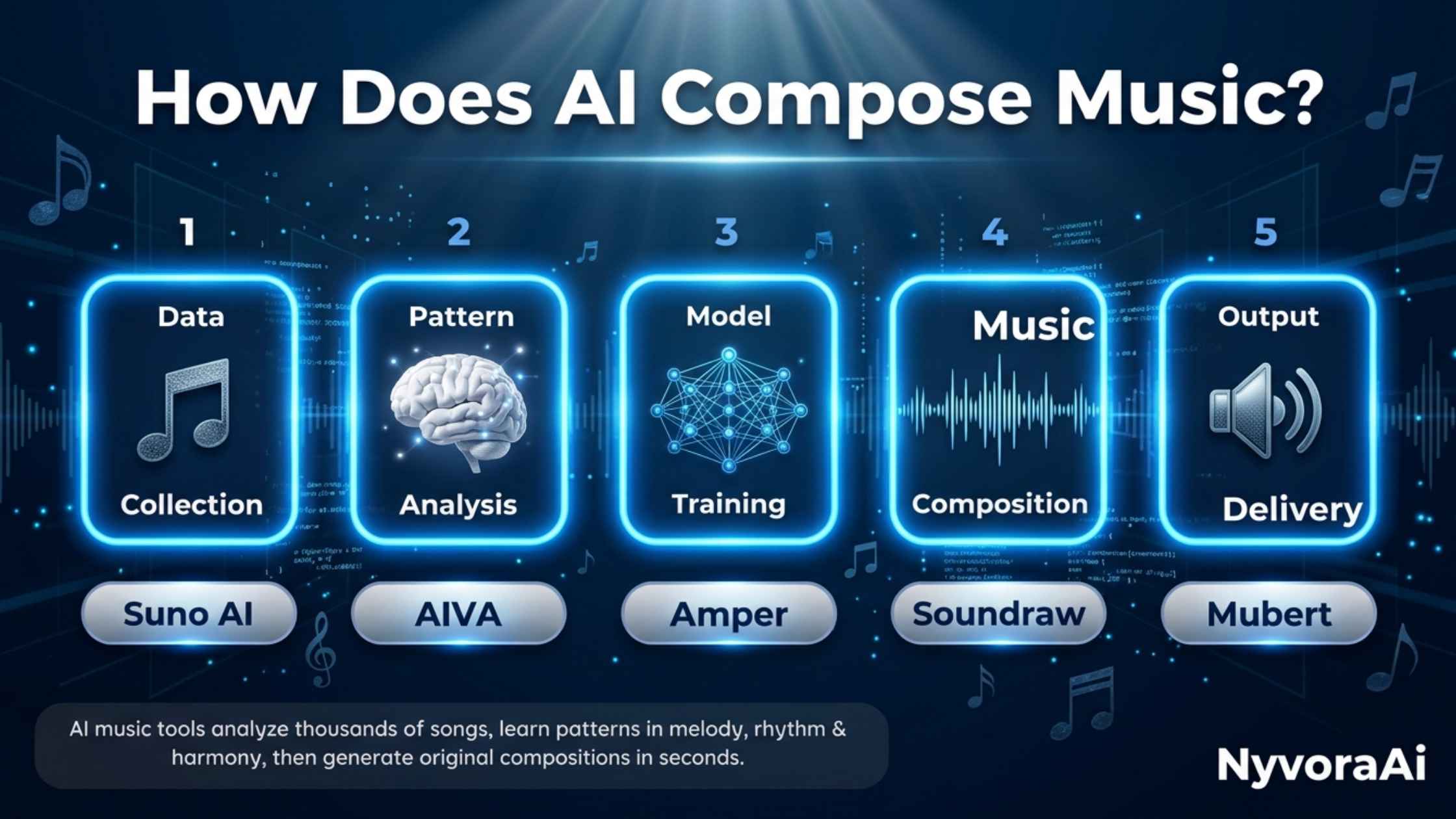
就在几年前,提起“AI 音乐”,人们想到的还是一段僵硬的 MIDI 循环,谁也不会把它错认成真正的歌曲。这一印象过时得飞快。给工具一句简短提示——比如“轻快的独立流行乐,一首关于夏日公路旅行的小曲”——如今就能换回整整三分钟:主唱、和声、节拍,甚至像模像样的副歌。效果近乎魔法,只是每一步都刻意、且可以学会。弄懂这些步骤,所谓魔法就让位于更有意思的东西:亲眼看见机器如何习得创造力。
真正的机制是什么?拆开来看,机器作曲靠的正是当今大多数 AI 背后的同一个套路。声音和旋律——这些模拟的、属人的东西——先被翻译成数字;数百万首已录制的歌曲再让模型学会藏在这些数字里的统计规律;训练好的系统便据此猜测下一个该出现的音符、和弦或音色。不妨称之为穿着作曲家外衣的预测,成效却相当惊人。
如果“把人造之物变成数字”听起来耳熟,那是因为人工智能几乎每个分支都在用它。我们那篇讲AI 怎样在照片中识别人脸的文章,把同一套打法用在脸上而非曲调上:杂乱的人类信号变成模型能测量、比对的整齐数字集合。而任何音乐系统都要先训练才能产出内容,这就是为什么值得先读我们那篇机器学习是什么、模型如何训练的入门篇——它是本文一切内容的地基。
01简短回答:教机器如何“听”出规律
电脑并不以音乐家的方式把握旋律、律动或情绪。算术它天生擅长;可小三和弦为何听来悲伤、落在反拍上的底鼓为何让人兴奋,它却毫无头绪。AI 作曲的存在,正是为了弥合这道鸿沟,把声音重塑成模型能够检视、吸收、并最终独立产出的有序数字材料。
进入系统的每样东西——单个音符、和弦序列、波形——都会变成承载音高、时机与音色规律的数字编码。以这种形式灌进数百万首歌曲后,模型开始察觉到种种习惯:某些和弦链倾向于跟在另一些后面,特定律动配属特定曲风,上扬的旋律通常意味着张力即将释放。这些它一样都“感受”不到,全部是在庞大训练语料上做统计测量。
这里与语言生成的重叠极深。说到底,曲调就是一个序列,正如句子是词的序列。我们那篇讲AI 用什么机制选择下一句话的文章拆解了聊天机器人的下一词机制,而正是这同一个原理——预测序列的下一个成员——让模型选定接下来的音符。
02从数据集到成品歌曲,逐阶段看
跟着下面这些阶段,可以看到原始音乐素材如何一路从训练语料变成一首真能按下播放键的作品。
请记住,开头三个阶段——收集素材与训练——只发生一次,远在你输入提示之前。你那首特定的歌只调用已经训练好的模型。如果这道分界对你还陌生,我们那篇讲训练与推理之别的文章会说明为何前者缓慢昂贵、而后者几乎瞬间返回。
03互动演示:看 AI 如何“解读”一段旋律
下面是一段简短的旋律。点击按钮,可以看到同样的音符如何根据模型执行的不同任务而被以不同方式解读。
04从手写规则到今天的神经网络
神经网络并不是起点。1950 年代到 1990 年代,算法作曲靠的是手工编写的乐理规则:固定音阶、固定和弦进行、概率表,全由研究人员费力录入。产出的作品技术上可能无懈可击,却往往很机械,因为规则无法编码那种练出来的直觉——正是这种直觉让真正作曲家的选择显得顺理成章,而非随机任意。
深度学习改写了局面。循环神经网络在整个 2010 年代广为使用,它能根据后面一小段音符窗口来预测下一个音,写出的短句旋律步态更自然。决定性的飞跃来自 transformer 架构、以及随后的扩散模型——原本用于图像生成的工具,被重新指向原始音频。与早期系统不同,这些模型能同时考量整首歌的结构,这正是今天的音轨终于拥有令人信服的主副歌形态、层层推进、以及从头到尾风格统一的原因。
领域在这里分叉成两条相邻的路线。符号生成处理 MIDI 这类有序音符数据;原始音频生成直接操作波形,返回混音完整、带人声的歌曲。Suno 和 Udio 重度依赖后者,这也部分解释了为何它们交回的东西像一首成品歌曲,而不是简陋的器乐草稿。
| 时代 | 手法 | 现实类比 |
|---|---|---|
| 算法作曲(1950 年代–1990 年代) | 手工编写的乐理规则与概率表 | 像一位不苟言笑、绝不即兴的乐理教授 |
| 统计与马尔可夫模型(1990 年代–2010 年代) | 根据最近的短模式预测下一个音符 | 像凭习惯而非完整上下文去猜下一个音 |
| 循环神经网络(2010 年代) | 在更长的序列里学习旋律模式 | 像写下一段时还记得上一段歌词 |
| Transformer 与扩散模型(2020 年代至今) | 一次性生成整首歌的结构与音频 | 像在弹出第一个音之前就已写完全曲 |
05机器造音乐已经在用的地方
“小众实验”这个标签已经不再合适;这项技术正悄悄支撑着你很可能已经接触过的产品:
免版税背景乐
电子游戏配乐
完整歌曲生成
歌曲创作辅助
影视与广告配乐
个性化歌单
这里有必要划清一条线:很多“个性化”音乐体验根本不涉及生成。大多数流媒体推荐分析的是收听行为,而不是创作新曲——这与我们那篇讲YouTube 的推荐如何运作的文章机制非常相似,在那里,是观看时长这类信号、而非语言或作曲,决定下一个被推到眼前的内容。
06机器造音乐到底有多强,又在哪里仍然露怯?
模仿类型惯例、唱腔风格和歌曲结构,是当今工具做得极为出色的事。而写出“有意为之”、而不只是技术正确的音乐,仍是另一量级的难题,当前的种种短板往往就出在这里。
当今短板:
- ✗
情绪的具体性
✗ 一首泛泛“悲伤”或“快乐”的曲子不难;但精准锁定一个具体而私人的情感瞬间——那种真正的词曲作者从亲身经历中开掘的东西——仍然很困难。
- ✗
长篇的连贯性
✗ 做出可信的 30 秒片段是一回事;在整首 3 到 4 分钟里维持连贯且不断发展的结构,兼具主歌、桥段和令人满足的结尾,则是另一回事。
- ✗
歌词的深度
✗ 机器写的歌词可以押韵、节奏也对,却依旧显得空泛,因为模型在追逐看似合理的词序列,而不是从真实的个人叙事出发。
- ✗
代表性不足的曲风
✗ 正如语言模型在数据丰富的语言上表现最好,音乐模型在流行、嘻哈这类被大量呈现的曲风上最强,对小众或地域性音乐传统的结果则较弱。
- ✗
从训练数据继承的偏见
✗ 如果模型主要基于西方流行乐的惯例训练,其产出自然会朝那个方向倾斜,哪怕提示要求的是另一种文化风格。
07版权、归属与 AI 音乐的伦理
当完整歌曲能够被批量生产时,讨论自然会越过音质,进入更棘手的领域:
对听众或创作者而言,最实际的一条是:在把 AI 生成音乐用于商业用途前,先查看该平台的具体条款,因为授权规则、版税义务与版权资格在不同工具和司法辖区之间仍差异显著。
08常见问题
AI 是通过什么过程创作音乐的?
生成音乐用的是哪类模型?
机器造歌曲能获得版权吗?
生成音乐能与人类创作的作品媲美吗?
有哪些被广泛使用的音乐生成工具?
作曲软件需要音乐训练数据吗?
机器会取代人类乐手吗?
操作这些工具必须懂乐理吗?
09结语
那么机器造音乐从何而来?来自驱动几乎所有近期 AI 突破的同一个原理:把属人的东西数字化,吸收数百万个案例中的规律,再预测接下来会出现什么——一个音一个音地推进,再一个和弦一个和弦、一拍接一拍。它既不是魔法,也算不上人类意义上的“创造力”,却已是一件强大的工具,正在改变背景乐、游戏配乐乃至完整歌曲的制作方式。
生成音乐最终会作为又一件乐器与人类创作并肩而立,还是有朝一日彻底弥合情感差距,仍是未解之问。可以确定的是其底层机制——序列预测,这同一招在 AI 其他领域反复出现。我们那篇讲自然语言处理(NLP)的入门文展示了它在另一情境下的样子:在那里,被变成机器预测对象的是词而非音符,一个 token 接一个 token 地给出。
Not long ago, the phrase "AI music" called up a stiff MIDI loop no listener would confuse with an actual track. That picture has dated very quickly. Give a tool a short prompt — say, "upbeat indie pop, a number about a summer road trip" — and it now returns a full three minutes: lead vocal, harmonies, beat, even a plausible refrain. The effect borders on sorcery, except that every step is deliberate and understandable. Grasp those steps and the apparent magic gives way to something richer: a front-row view of machines picking up creativity.
What is the actual mechanism? Stripped down, computer-made songs rely on the same trick behind most present-day AI. Sound and melody — things analog and human — get translated into numbers. Millions of recorded tracks then teach the model the statistical regularities living inside those numbers, and the trained system uses them to guess which note, chord, or timbre ought to follow. Call it prediction wearing a composer's clothes; the results speak for themselves.
If translating the human-made into digits rings a bell, that's because nearly every corner of artificial intelligence leans on it. Our piece about the way AI spots faces inside photographs runs the identical playbook on a face rather than a tune: a messy human signal becomes an orderly numeric set the model can measure against others. And no music system can output anything until it has been trained, which is why it pays to first read our primer on machine learning itself and the training process — the bedrock under everything discussed here.
01The Short Version: Showing Machines How to "Listen" for Regularities
A computer has no grasp of melody, groove, or feeling in any musician's sense. Arithmetic comes naturally; the reason a minor triad reads as mournful, or an off-beat kick as thrilling, does not. Composition software exists to close exactly that divide, recasting sound as orderly numeric material the model can examine, absorb, and in time produce unassisted.
Whatever enters the system — a single note, a chord sequence, a waveform — becomes a numeric encoding carrying pitch, timing, and timbre patterns. After drinking in millions of tracks in that form, the model begins registering habits: some chord chains tend to trail others, particular grooves belong with particular styles, and an upward-leaning line usually means tension heading toward release. None of it is felt; all of it is measured, statistically, across a vast training corpus.
That overlap with language generation runs deep. A tune is, at bottom, a sequence — just as prose is a sequence of words. Our article on the mechanism AI uses to pick its next utterance walks through chatbots' next-word machinery, and that very principle — forecasting the next member of a sequence — is what lets a model choose the upcoming note.
02From Dataset to Final Track, One Stage at a Time
Trace the stages below to watch raw musical material travel all the way from a training corpus into something you can actually press play on.
Bear in mind that the opening three stages — collecting material and training — happen just once, well before your prompt exists. Your particular song only ever calls on the finished, trained model. If that divide is unfamiliar, our explainer on training versus inference spells out why the one is slow and costly while the other comes back almost at once.
03Hands-On Demo: Watching AI "Parse" a Tune
Below sits a short melodic line. Use the buttons to observe the same notes being read several ways, according to the job the model is handed.
04From Hand-Written Rules to Today's Neural Nets
Neural networks were not the starting point. Between the 1950s and 1990s, algorithmic composition ran on rules of theory coded by hand: fixed scales, set progressions, probability tables, all laboriously entered by researchers. The output could be technically flawless yet mechanical, because rules cannot encode the practiced intuition that makes a living composer's decisions feel inevitable instead of arbitrary.
Deep learning rewrote the bargain. Recurrent neural networks, widespread over the 2010s, learned to forecast a note from a short trailing window, yielding short lines with a more natural gait. The decisive leap arrived with transformer designs and, later, diffusion models — the image-generation toolkit, repointed at raw audio. Unlike earlier systems, these weigh the architecture of a whole song simultaneously, which is exactly why today's tracks at last carry convincing verse–chorus shapes, convincing builds, and a style that holds from the first bar to the last.
Here the field forks into two neighboring branches. Symbolic generation manipulates orderly note data such as MIDI; raw-audio generation works straight from waveforms and returns fully mixed songs complete with voices. Suno and Udio sit heavily on the latter, which helps explain why they hand back something resembling a finished track rather than a bare instrumental sketch.
| Period | Technique | Everyday Comparison |
|---|---|---|
| Algorithmic Composition (1950s–1990s) | Theory rules and probability tables encoded by hand | A stern theory teacher who will not deviate from the page |
| Statistical & Markov Models (1990s–2010s) | Forecasting notes from a short trailing pattern | Choosing the next note out of habit rather than full context |
| Recurrent Neural Networks (2010s) | Picking up melodic habits across lengthier stretches | Keeping the previous verse in mind while drafting the next |
| Transformers & Diffusion Models (2020s+) | Producing a song's full shape and audio in one pass | Writing the entire piece before sounding a single note |
05Where Machine-Made Music Already Shows Up
The experimental-niche label no longer fits; the technology quietly backs products you have very likely encountered:
Royalty-Free Backing Tracks
Video Game Scores
Complete Song Creation
Songwriting Support
Film and Advertising Music
Individually Tailored Playlists
A distinction is worth drawing: plenty of "personalized" music features involve no generating whatsoever. Most streaming suggestions study listening habits, not composition — closely mirroring the mechanism in our piece on the way YouTube recommendations function, where signals such as watch time, rather than language or songwriting, decide what surfaces next.
06How Strong Is Machine-Made Music — and Where Does It Still Stumble?
Copying genre habits, vocal character, and song architecture is something current tools do strikingly well. Writing music that reads as intentional — rather than merely correct — remains a different order of problem, and that is where today's weak spots tend to surface.
Present-Day Weak Points:
- ✗
Specificity of Feeling
✗ A broadly "sad" or "happy" piece is easy; pinning down one precise, personal feeling — the kind writers mine from lived life — stays genuinely hard.
- ✗
Coherence Over Long Spans
✗ A plausible half-minute is one thing; sustaining a developing architecture across a full 3 to 4 minutes, with verses, bridges, and an earned ending, is another.
- ✗
Lyrical Substance
✗ Machine-written words can rhyme and scan and still feel hollow, because the model chases plausible word chains rather than a true personal story.
- ✗
Under-Represented Styles
✗ As language models favor tongues with ample data, music models favor data-rich styles such as pop and hip hop; niche or regional traditions come off far weaker.
- ✗
Bias Carried Over From Training
✗ Train chiefly on Western pop habits and the results drift that way by default, even when the prompt requests another cultural sound.
07Copyright, Ownership, and the Moral Questions
Once complete songs can be produced in bulk, the conversation inevitably moves past audio quality into harder territory:
For any listener or creator, the practical rule is simple — read the platform's terms before putting generated music to commercial use, since licensing, royalty duties, and copyright eligibility still differ sharply across tools and legal systems.
08Common Questions
By what process does AI write music?
Which kinds of models generate music?
Can machine-made songs receive copyright?
Does generated music rival work written by people?
Which music-generation tools are widely used?
Does composition software require musical training data?
Will machines take the place of human musicians?
Must I know theory to operate these tools?
09Closing Thoughts
So where does machine-made music begin? With the same principle driving nearly every recent AI advance: render a human thing numerically, absorb the regularities inside millions of cases, and forecast what follows, stepping forward note by note, then chord by chord, beat after beat. It is neither magic nor human-style "creativity," yet it is already a formidable instrument changing the production of backing music, game scores, and even full songs.
Whether generated music settles in beside human writing as merely another instrument, or one day closes the emotional distance outright, remains unresolved. What is certain is the machinery underneath — sequence forecasting, the same move repeated across the rest of AI. Our primer on natural language processing (NLP) shows the trick in another setting: there, words rather than notes become a machine's prediction, issued token by token.