自然语言处理(NLP)究竟是什么What Natural Language Processing (NLP) Actually Means
手机悄悄补全你打了一半的句子、Alexa 听懂你嘟囔的“设个闹钟”、垃圾邮件还没进收件箱就被拦下——这一切背后都是同一门人工智能在运作。下文拆解它如何把人类松散随意的读写方式,变成计算机能用的数据。
Whether your phone quietly finishes a half-typed sentence, Alexa catches a mumbled request to start a timer, or a junk message never reaches your inbox, one branch of artificial intelligence makes all of it possible. Below, we unpack how that field takes the loose, sloppy way humans write and speak and reshapes it into data a computer can work with.
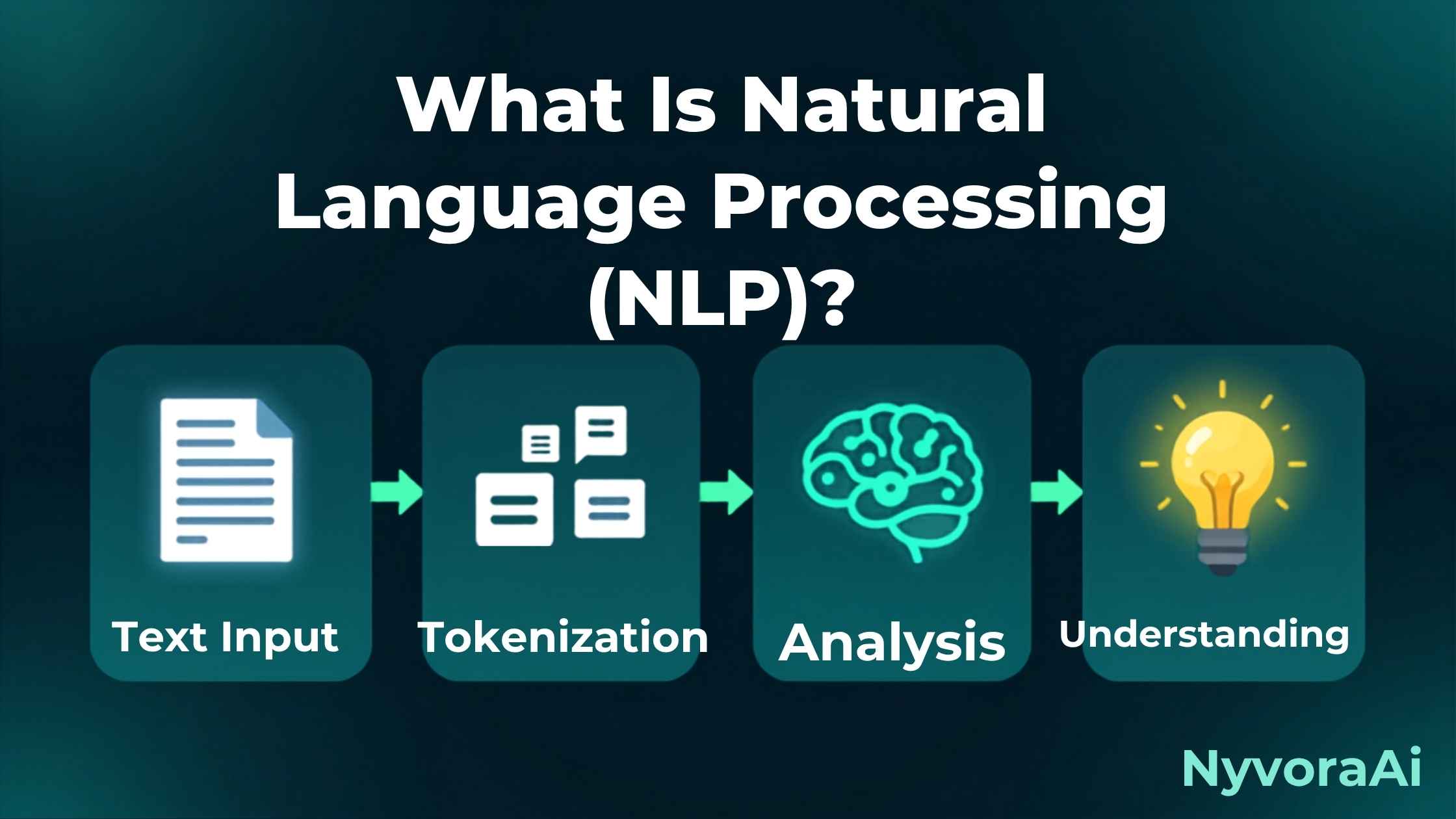
在搜索框敲入“how do i”,引擎会在你想好整句话之前替你补完;对手机说一句“明天提醒我给妈妈打电话”,它就能听懂并照办;用印地语写的邮件发出去,对方收到时可以是流利的英语。抽掉人工智能的某一个分支,这些瞬间全都无法成立。
那么自然语言处理(NLP)到底是什么?简单讲,它是人工智能中专门教机器读懂、理解并产出人类语言的领域——那种混乱、含糊、满是俚语的真实语言,而不是计算机通常偏爱的整齐数字行。它就像一座桥,连接“人类怎么说话”和“机器能算什么”。
NLP 不是单个程序,而是一整套技术;和当代大多数 AI 一样,它归属于更宽泛的机器学习。如果你还分不清真正“学到东西”的 AI 和只按固定规则走的 AI,在深入 NLP 之前,可以先看我们的AI 与自动化有何区别。
01简单回答:教计算机听懂语言
计算机天生擅长数字,也天生不擅长语言。它不知道“bank”在“河岸”和“储蓄银行”里意思不同,对语法、语气或讽刺也毫无内置概念。NLP 正是为了弥合这道鸿沟,把非结构化文本转成模型真正能处理的结构化数据。
当代大多数 AI 系统用的都是同一个基本招数。如果你读过我们关于AI 如何识别照片中的人脸的文章,就已经见过这个模式:系统把某样混乱而属于人的东西——那次是一张脸——变成一组干净、可衡量、可比较的数字。NLP 对词做的事一模一样。每个词、每句话或每份文档都会被转成一个“嵌入”,即一长串捕捉其含义的数字,于是用法相近的词最终会在那个数学空间里紧挨在一起。
语言一旦变成数字,训练好的模型几乎可以对它做任何事:分类、翻译、摘要,或生成一句全新的回复。如果你刚接触“用数据训练模型”这个概念,在继续往下读之前,我们那篇机器学习是什么、如何训练用大白话讲清了基础。
02逐步解析:NLP 怎样把文本变成意义
下面是一句话从原始文本走到可用结果所经历的路线:
03互动演示:看 NLP 标注真实句子
下面是一条示例产品评论。点击下方按钮,看不同的 NLP 任务如何以各自方式“解读”同一句话。
04从基于规则的系统到 Transformer
NLP 并非始于深度学习。1960 年代到 1990 年代的早期系统依赖手写的语法规则和词典,语言学家要为语言抛出的每一个例外费力编码。它们很脆弱:句子结构稍有不同,系统就直接崩溃。
统计式 NLP 在 1990 年代末到 2010 年代占据主导,用从真实文本学到的概率取代硬编码规则,是一大进步;但这些模型处理上下文的窗口仍相当窄,通常只看附近几个词。真正的转折来自深度学习,尤其是 Transformer 架构:它能同时权衡一句话(甚至整篇文档)里每个词之间的关系,而不是一次只看一个相邻词。
也是在这里,NLP 分成两个相关但不同的方向:自然语言理解(NLU)关乎解读一句话的含义,自然语言生成(NLG)关乎产出连贯的新文本。聊天机器人两者都需要。我们关于AI 如何决定下一句说什么的文章专门聚焦生成一侧,即预测序列中的下一个词,这正是当代聊天机器人撰写回复的方式。
还值得知道的是,“学习语言”的重活早在你输入任何消息之前就已完成。在庞大语料库上训练大型 NLP 模型需要极长的计算时间,但用训练好的模型读懂你的句子几乎瞬间发生。我们那篇 AI 推理与训练的文章详细讲了二者的区别。
| 时期 | 采用的方法 | 现实类比 |
|---|---|---|
| 规则时代(1960s–1990s) | 手工编写的语法规则与词典 | 像一位严厉的语法老师,完全应付不了俚语 |
| 统计式 NLP(1990s–2010s) | 从词频中学到的概率 | 像凭习惯猜下一个词,而不是真的理解 |
| 深度学习 / 嵌入(2013+) | 词被表示为意义空间中的向量 | 像按“谁和谁挨得近”把每个词钉在一张地图上 |
| Transformer(2017+) | 注意力同时覆盖整句话或整篇文档 | 像先读完一整段,再形成看法 |
05NLP 早已在你每天使用的地方
NLP 不是未来概念,它早已悄悄运行在你今天早上可能就用过的工具里:
搜索引擎
聊天机器人和虚拟助手
机器翻译
垃圾邮件与内容审核
情感分析
自动补全与拼写检查
值得注意的是:并非每个在线个性化系统都靠语言运转。比如 YouTube 的信息流更多依赖观看时长这类行为信号,而不是你输入或说过的任何话;想了解语言类 AI 与行为类 AI 的对比,可看我们关于YouTube 上的 AI 推荐如何运作的分析。
06它有多准确?(又在哪些地方仍然吃力?)
当代 NLP,尤其是基于 Transformer 的系统,在理解上下文、语气乃至言外之意方面已相当出色。但语言确实是最难建模的事物之一,因为它大量依赖共享的文化、处境和没有明说的前提。
NLP 仍然不足的地方:
- ✗
讽刺与冷幽默
✗ “Oh great, another Monday”表面读起来正面,语气却是负面的;缺少额外线索时,连强大的模型也仍会在这道坎上绊倒。
- ✗
低资源语言
✗ NLP 在可用文本海量的语言(如英语)上表现最好;数字足迹较小的语言,得到的支持往往明显更弱。
- ✗
歧义表达
✗ “I saw her duck”可能指动物,也可能指一个动作。模型靠上下文来消解,但真正歧义的句子仍可能把它们搞糊涂。
- ✗
从训练数据继承的偏见
✗ 由于模型从真实文本中学习,它们可能吸收并重复那些数据中存在的刻板印象、俚语偏见或扭曲联想。
- ✗
上下文窗口有限
✗ 即便是强大的模型,一次也只能“看见”一定数量的周围文本,因此极长的文档或对话可能丢失较早的上下文。
07隐私与伦理之争
一项能够大规模阅读和解读人类语言的技术,自然会引出远超准确度本身的问题:
作为用户,最实际的防护就是保持清醒:你输入聊天机器人、评论框或评论区的任何内容,都可能被处理、分析,并在某些情况下被用于改进未来的模型——具体取决于该平台的隐私政策。
08常见问题解答
什么是自然语言处理(NLP)?
NLP 是怎样一步步工作的?
NLP 和机器学习有什么区别?
NLP 有哪些日常例子?
NLP 能理解讽刺和语气吗?
ChatGPT 是 NLP 的例子吗?
NLP 和 Transformer 模型有什么不同?
理解 NLP 需要会编程吗?
Key those same two words — "how do i" — into a search box, and the engine completes the question before you've decided how it ends. Tell your phone, "remind me to call mom tomorrow," and it figures out the instruction well enough to set it. Fire off an email written in Hindi, and it can arrive in fluent English at the other end. Strip away one particular arm of AI, and every one of these moments collapses.
Put directly, natural language processing is the AI discipline devoted to helping machines read, make sense of, and produce the language people use — slang, ambiguity, and all — instead of the neat number grids they were designed to handle. Think of it as the span connecting human-style communication with machine-style computation.
NLP isn't one program but a whole collection of techniques, and as with much of today's artificial intelligence, it lives under the wider umbrella of machine learning. Anyone fuzzy on where genuinely learning-based AI ends and rigid, scripted software begins should read our AI versus automation explainer first, then come back for the NLP detail.
01The Short Version: Machines Learn to Handle Language
Numbers come naturally to computers; words don't. Nothing tells them out of the box that "bank" shifts meaning between a riverside and a place to keep savings, and grammar, tone, and sarcasm arrive with no built-in instructions. NLP bridges that divide by reshaping loose text into organized data a model can chew on.
Most of modern AI runs on essentially the same move. Our piece on how AI identifies faces inside photos shows it clearly: something messy and human — there, a face — gets converted into a tidy numeric signature that can be measured against others. NLP applies that identical move to vocabulary. Individual words, full sentences, even entire documents become embeddings: long numeric strings encoding meaning, arranged so words used in similar ways land near each other in the math.
Once speech and writing exist as numbers, a trained model can sort them, render them in another language, compress them, or spin off a fresh sentence in response. Anyone unfamiliar with how models get trained on data should start with our plain-language machine learning fundamentals guide before reading on.
02Following a Sentence Through the Pipeline
Trace one ordinary line and you can watch it move stage by stage, leaving raw text behind and arriving at a result you can actually use:
03Play With a Demo: Watch NLP Label a Live Sentence
Take this genuine product review as a guinea pig. Hit the buttons and several separate NLP tasks will each pull a distinct reading out of the one identical line.
04How the Field Evolved: Hand-Built Rules to Transformers
Deep learning wasn't the opening act. Between the 1960s and 1990s, systems leaned on grammars and dictionaries that linguists coded by hand, encoding each irregularity the language threw up. The result was fragile: build a sentence even a little outside expectations and the program simply gave out.
Statistical NLP then took over from the late 1990s into the 2010s, swapping rigid rules for probabilities estimated from genuine text — a genuine leap, though these models still only saw a narrow slice of context, typically a few adjacent words. Deep learning moved the goalposts, and transformer designs most of all: rather than checking neighbors one by one, they weigh how every word in a sentence — or a whole document — relates to all the others at the same time.
Here the field also branches into two related but separate pursuits: natural language understanding (NLU) handles working out what a line means, while natural language generation (NLG) handles writing fresh, coherent text. Chatbots draw on both. Our look at how AI chooses its next word zooms in on the generation half of this — sequence-by-sequence prediction, precisely the mechanism behind modern chatbot answers.
One timing detail helps: the costly work of "learning language" finishes long before your first keystroke. Training a sizeable NLP model on massive text collections devours compute, but once that's done, reading your single sentence takes barely a moment. Our training-versus-inference piece traces the two phases in depth.
| Period | Method Used | Everyday Comparison |
|---|---|---|
| Rule-Driven Era (1960s–1990s) | Grammars and dictionaries coded by hand | A rigid schoolteacher with zero patience for slang |
| Statistical NLP (1990s–2010s) | Probabilities estimated from how often words occur | Predicting the next word out of habit rather than comprehension |
| Deep Learning / Embeddings (2013+) | Words encoded as vectors inside a space of meaning | Pinning each word on a map according to its neighbors |
| Transformers (2017+) | Attention spanning a full sentence or document in one pass | Reading the whole paragraph before reaching a judgment |
05NLP in the Tools You Already Touch Daily
Far from science fiction, NLP is already humming inside products you likely opened before breakfast:
Search
Bots and Voice Assistants
Automated Translation
Junk Mail and Content Review
Reading Sentiment
Predictive Text and Spelling
One caveat: not every online personalization system runs on words. YouTube's recommendations, for instance, draw far more from behavior — minutes watched above all — than from anything typed or spoken; our YouTube recommendation breakdown draws a useful contrast between language-driven and behavior-driven AI.
06How Good Is NLP Today — and Where Does It Still Fail?
Transformer-based NLP in particular now handles context, tone, and even the unsaid with surprising skill. Even so, language ranks among the hardest phenomena to model: so much rides on shared culture, setting, and assumptions nobody states aloud.
Persistent Weak Spots:
- ✗
Sarcasm and Deadpan Jokes
✗ On paper, "Oh great, another Monday" looks upbeat; in the mouth of a groaning employee it is anything but, and without extra cues even strong models still trip.
- ✗
Languages With Little Data
✗ Results are strongest where training text is abundant, English above all; languages with a thin digital footprint receive visibly shakier support.
- ✗
Sentences With Two Readings
✗ "I saw her duck" might describe spotting waterfowl or watching someone dodge — context usually disambiguates, but genuinely slippery lines still confuse models.
- ✗
Prejudice Carried Over From Training Text
✗ Training on real-world writing means models can pick up and parrot the stereotypes, slang-linked prejudices, and lopsided associations baked into that text.
- ✗
Short Memory for Surrounding Text
✗ Even leading models hold only so much surrounding text in view at once, so book-length documents or sprawling chats can shed earlier details.
07Privacy and Ethics: The Bigger Argument
Give a system the power to parse and make sense of human words across millions of users, and the conversation quickly stretches past whether its answers are correct:
For everyday users, the simplest protection is awareness: whatever you feed a chatbot, a review form, or a comment thread may be parsed, analyzed, and sometimes reused to train later models — depending on that platform's stated privacy policy.