AI 是怎样识别垃圾邮件的?How Does AI Identify Spam Messages?
每年,你的收件箱都悄悄挡下数以千计的诈骗企图、伪造发票和钓鱼链接,其中绝大多数你根本看不见。下文精确讲解垃圾邮件的检测方式:被读取的线索、产出分数的模型,以及为什么仍有少数可疑邮件漏网。
Every year your inbox quietly turns back thousands of fraud attempts, forged invoices, and phishing links, the vast majority hidden from view. Below is precisely the way junk mail gets detected: the cues that get read, the model producing the score, and the reason a handful of shady notes still get through.
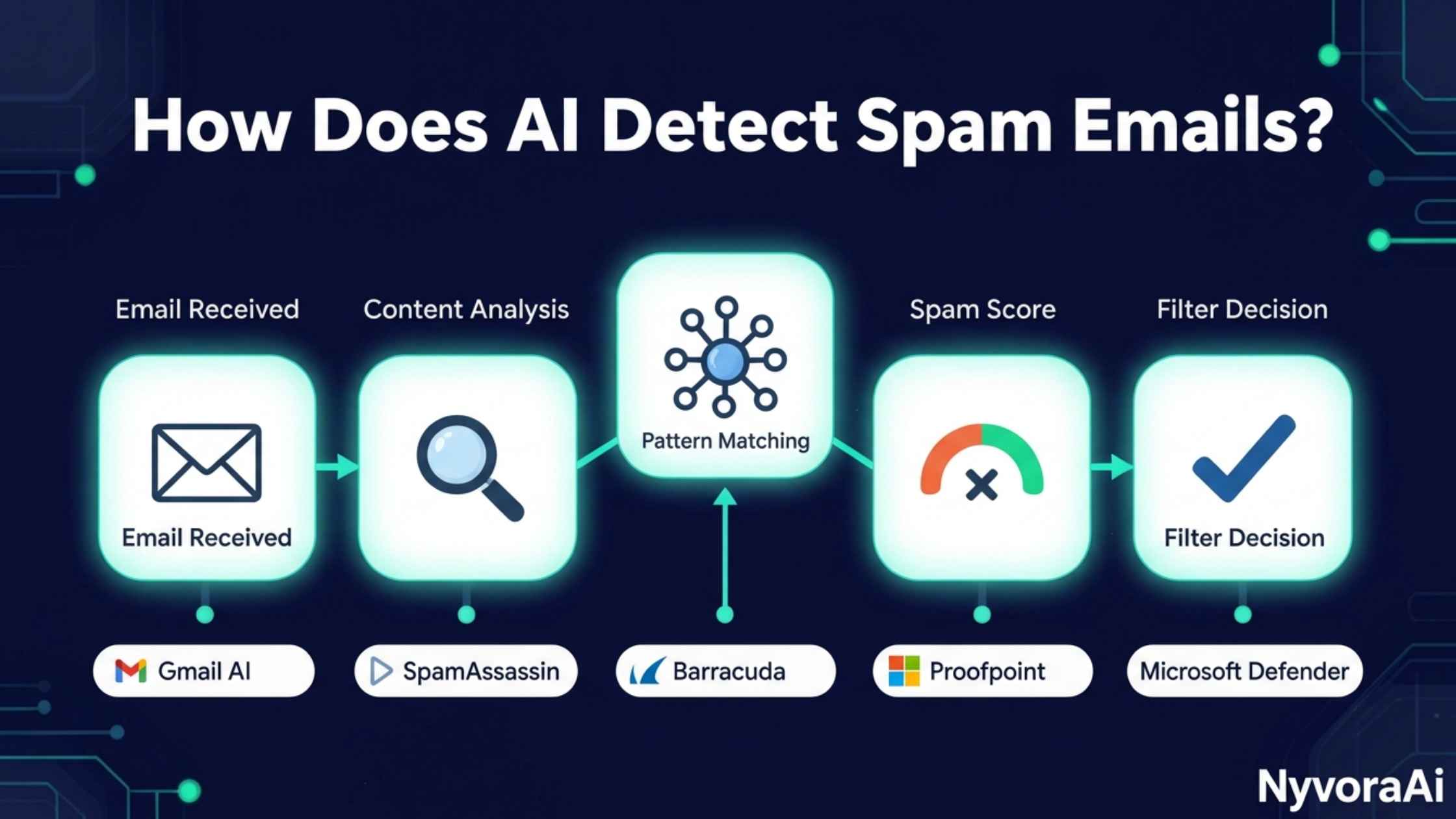
现在打开垃圾邮件文件夹,会看到一座小小的墓地:虚假的快递通知、好得令人难以置信的工作邀约、还有声称“你的账户已被暂停”的恐吓信。你从没点过举报按钮,也没亲手调校过任何过滤器,可收件箱就是知道。这种安静而不停的分拣,是日常生活中运行最久、也最成功的人工智能应用之一,却几乎没人想过它是怎么运作的。
那么 AI 凭什么识别垃圾邮件?用一个多疑侦探的框架就很好理解:邮件来自何处、措辞如何、带着哪些链接和附件、以及相似邮件过去的表现。每条线索都变成一个数字,一旦合计分数越过某条线,邮件就被锁起来,根本到不了你面前。
这与你日常接触的许多 AI 背后是同一套模式匹配。如果你好奇这套技术里更高级的“亲戚”如何读懂整句、而不只是标记,我们那篇讲自然语言处理(NLP)的指南会深入展开语言这一面——垃圾检测本质上就是被派去做一件明确而实际工作的 NLP。
01简短回答:每封邮件一个风险分数
本质上,垃圾邮件过滤器是一个分类器。每封到达的邮件都经过一个训练好的模型,返回一个概率——这封消息有多大可能是垃圾、钓鱼,还是用户想看的正常邮件?概率变成分数,落点决定结局:正常投递、挂上警示横幅,或直奔垃圾文件夹。
它之所以配得上“AI”之名,而非简单的 if-this-then-that 脚本,是因为它不遵循人手编写的规则列表。系统从海量真实邮件数据中,统计学地学会了垃圾邮件往往长什么样,哪怕发件人改词躲避检测。如果“模型从数据中学习”而非被显式编程还是个新概念,我们那篇讲机器学习及其训练的文章讲的正是这块地基。
别把它想成拿着固定名单核对身份的门卫,而要想成一个已经看过一百万人进门、对谁会惹麻烦养出了直觉的门卫——哪怕这个具体的陌生人从没出现过。
02逐阶段看:一封邮件如何被打分
拿一封邮件从抵达至裁决来看:在零点几秒内,它得离开服务器、出现在你收件箱里或被拒之门外,下面几个阶段追踪的正是这条路。
03互动演示:看着一封可疑邮件被标记
下面是一封伪装成骗局的邮件。逐个点开按钮,留意哪一处会引来标记,以及标记的依据。
04藏在过滤器背后的模型
1990 年代和 2000 年代初的旧过滤器靠的是贝叶斯过滤:本质上是计算特定词出现在垃圾邮件与正常邮件中的统计概率。它一度相当管用,直到发件人学会把触发词拼错、或把文字藏进图片,以躲过关键词扫描。
当今的垃圾检测分层要多得多。通常有几类模型协同工作:梯度提升决策树处理发件人信誉、元数据这类结构化线索,transformer 语言模型则读出文本背后真正的含义与意图,而不是孤立的单词。这套架构与现代聊天机器人里的大体相同,只是瞄准一个更窄的任务。我们那篇讲AI 如何挑选下一个词的深潜文章解释了这些语言模型如何处理和预测文本,与过滤器“阅读”可疑邮件高度重叠。
训练要投入巨量带标签的数据和算力,可一旦完成,给一封到达邮件打分几乎是瞬时的。训练阶段的缓慢昂贵,与使用模型时的近乎即时之间的鸿沟,本身就值得弄懂,我们那篇讲AI 推理与训练的文章把这道分界讲得很清楚。
| 时代 | 技术 | 现实类比 |
|---|---|---|
| 关键词过滤器(1990 年代) | 拦截包含特定被标记词的邮件 | 像拿着禁用名单的门卫,一张假证件就能骗过 |
| 贝叶斯方法(2000 年代初) | 根据词频得出的统计概率 | 像凭某些短语在过去骗局中出现的频率去猜测 |
| 机器学习分类器(2010 年代) | 基于机器学习的分类器(2010 年代) | 像侦探交叉核对多条线索,而不是只看一条 |
| Transformer 驱动的 NLP(2018 年至今) | 对意图与语气的深度语境化解读 | 像读完整封邮件并察觉到其中的操纵,而非只抓到一个词 |
05垃圾过滤器真正会读取的每条线索
没有任何一条孤立线索能封掉一封邮件。是数十条小线索层层叠加,才把它推过垃圾邮件分界线:
发件人认证
域名与 IP 信誉
内嵌链接的构造方式
语言与语气
附件
随附文件
值得注意:与网上其他地方运行的更大型个性化引擎相比,垃圾检测是一种相当窄的“规则遇上学习”型 AI。想要对比一种完全不同、仅凭行为而非内容决定给你看什么的模型,请看我们对 YouTube 上 AI 推荐的拆解。
06过滤器到底有多可靠,又有什么会漏过去?
在垃圾或钓鱼邮件能够靠近收件箱之前,大型邮件服务商已经化解了其中近乎全部。关键词是“近乎”——因为剩下那一小撮听着虽少,却恰恰是用户真正吃亏的地方。
垃圾检测仍然吃力之处:
- ✗
误报
✗ 来自年轻公司、陌生外联、或格式怪异的正常邮件,有时会被误判为垃圾,埋在你够不到的地方。
- ✗
图片型垃圾邮件
✗ 发件人有时把推销内容做成图片而非文字,以躲过基于语言的检测,迫使过滤器改用更慢的图像分析手段。
- ✗
高度定向的钓鱼
✗ 为某个人或某家公司量身定制、没有明显群发指纹的鱼叉式钓鱼,会给基于模式的模型添上多得多的麻烦。
- ✗
被盗用的正常账户
✗ 一旦骗子从一个已受信任、被黑掉的邮箱发信,发件人信誉线索就会大幅失效,因为域名本身看起来是干净的。
- ✗
全新的诈骗模式
✗ 一种真正新颖的骗局,到攒够可供可靠识别的带标签样本之间,总会隔着一段短暂的滞后。
07在过滤器之外保护自己
单靠过滤器会留下缺口;最基本的谨慎承担着工具做不到的部分。真正漏过来的邮件,大多能靠短短几个习惯兜住。
把整件事浓缩成一句:检测软件与个人判断各自单打独斗都表现平平,配成一对却好得多;你提交的每一次举报,都在进一步调校系统的嗅觉。
08常见问题
AI 凭什么识别垃圾邮件?
AI 垃圾过滤器权衡哪些线索?
AI 垃圾过滤器会出错吗?
AI 垃圾检测与旧的关键词过滤器有何不同?
AI 垃圾过滤器会随时间变聪明吗?
垃圾邮件发送者能骗过 AI 检测吗?
垃圾检测和钓鱼检测是一回事吗?
下次当一封诈骗邮件悄无声息落进垃圾文件夹,不妨想想这不起眼的一瞬间里装了多少东西:认证检查、信誉评分、语言审查、链接检视、众包行为线索,在比眨眼还短的时间里融成一个决定。骗子适应得如此之快,无懈可击并不可能;但今天这种分层、基于学习的设计,早已远离早期互联网的关键词黑名单,也是最清晰的日常提醒之一——无形的 AI 基础设施正在悄悄护着你。
Open the junk folder now and a small graveyard greets you: fake delivery slips, job pitches too good to be true, panic notes claiming "your account has been suspended." No report button was ever clicked, and no filter was tuned by your hand. Yet the inbox somehow knew. That quiet, nonstop triage ranks among the oldest and most winning uses of artificial intelligence running in ordinary life, and almost nobody stops to ask how it functions.
So by what means does AI catch junk mail? A suspicious detective frame works well: where the note came from, the way it is phrased, which links and files it carries, and how comparable messages have acted before. Each of those cues turns into a number, and once the combined figure passes a line, the message is locked away before it can reach you.
This is the same pattern-matching behind much of the AI you brush against daily. If you have ever wondered how a far more advanced relative reads whole sentences for meaning rather than mere markers, our guide to natural language processing (NLP) treats the language side in depth — junk detection is essentially NLP handed one sharply defined, practical job.
01The Short Version: One Risk Figure for Every Note
At heart, a junk-mail filter is a classifier. Each arriving note passes through a trained model that returns a probability — what chance does this message have of being spam, phishing, or wanted mail? That probability becomes a score, and its landing spot decides the outcome: normal delivery, a warning banner, or a one-way trip to the junk folder.
What earns it the label "AI," instead of a plain if-this-then-that script, is that no human-written rule list is followed. Out of huge volumes of genuine mail data, the system has learned statistically what junk tends to resemble, even when senders reword to dodge detection. If a model "learning" from data rather than being explicitly programmed is a new idea, our explainer on machine learning and its training covers exactly that groundwork.
Picture not a bouncer checking names against a fixed sheet, but one who has watched a million visitors pass the door and grown an instinct for trouble, even when this exact stranger has never appeared before.
02Stage by Stage: How a Note Gets Scored
Consider a single note from arrival to verdict: within a sliver of a second it must travel off the server and either appear in your inbox or be turned away, and the stages below trace that path.
03Interactive Demo: Watching a Suspicious Note Get Tagged
What follows is a message dressed up as a scam. Work through the buttons one by one and note which fragment would draw a flag, together with the grounds for it.
04The Models Hiding Behind the Filter
Older junk filters of the 1990s and early 2000s leant on Bayesian filtering: essentially the statistical chance that chosen words show up in spam versus wanted mail. It held up reasonably, until senders learned to misspell trigger words or bury text inside images to slip past keyword scans.
Present-day junk detection runs in far more layers. Several model types usually work in concert: gradient-boosted decision trees for structured cues such as sender standing and metadata, plus transformer language models that read the true meaning and intent behind the text instead of isolated words. The architecture is much the one inside modern chatbots, just aimed at a narrower job. Our deep dive on how AI picks its next words explains how those language models handle and forecast text, which overlaps heavily with a filter "reading" a shady message.
Enormous piles of labelled data and computing power go into training, yet scoring one arriving note is near-instant once that is done. The gulf between the slow, costly training stage and the near-instant act of using a model is worth grasping for itself, and our piece on AI inference versus training covers that divide clearly.
| Period | Technique | Everyday Comparison |
|---|---|---|
| Keyword Filters (1990s) | Bar mail that contained chosen flagged words | A doorman holding a banned-names sheet, easily beaten by a fake ID |
| Bayesian Methods (Early 2000s) | Statistical odds built from word frequency | Guessing from how often certain phrases recurred in past cons |
| Machine Learning Classifiers (2010s) | ML-Based Classifiers (2010s) | A detective cross-checking several clues rather than just one |
| Transformer-Driven NLP (2018+) | Deep contextual reading of intent and tone | Reading the full note and sensing manipulation, not catching one word |
05Every Cue a Junk Filter Actually Reads
No lone clue blocks a message. Dozens of small cues pile together to push it past the spam line:
Sender Authentication
Domain & IP Standing
How Embedded Links Are Built
Language & Tone
Attachments
Attached Files
Worth noting: junk detection is a fairly narrow rules-meet-learning AI beside the broader personalization engines running elsewhere online. For a contrast with a wholly different model that chooses what to show you from behavior alone rather than content, see our breakdown of AI recommendations on YouTube.
06How Reliable Are the Filters — and What Slips Past Them?
By the time junk or phishing can come near an inbox, the big mail services have already neutralized nearly all of it. The operative word is nearly — because the residual sliver, small though it sounds, is exactly where users get hurt.
Where Junk Detection Still Struggles:
- ✗
False Positives
✗ Wanted notes from young firms, unfamiliar outreach, or oddly formatted legitimate mail will at times be misread as junk and buried beyond reach.
- ✗
Image-Based Spam
✗ Senders sometimes encode their pitch inside an image rather than text to dodge language-based detection, forcing slower image-analysis methods.
- ✗
Highly Targeted Phishing
✗ Spear phishing tailored to a single person or firm, with no obvious mass-spam fingerprint, gives pattern-based models far more trouble.
- ✗
Hijacked Legitimate Accounts
✗ Once a scammer posts from a trusted, hacked mailbox, sender-standing cues weaken sharply, since the domain itself reads clean.
- ✗
Brand-New Scam Patterns
✗ A brief lag always separates a genuinely new con from the point where enough labelled examples exist for reliable recognition.
07Guarding Yourself Past the Filter
Relying on the filter alone leaves a gap; elementary caution does work the tool cannot. Most of the messages that do get past tend to be caught by a short list of habits.
Reduce the whole picture to one line: detection software and personal judgment each perform poorly in isolation and far better as a pair, every report you file further tuning the system's nose.
08Common Questions
By what means does AI catch junk mail?
Which cues do AI junk filters weigh?
Can AI junk filters be wrong?
How does AI junk detection differ from older keyword filters?
Do AI junk filters grow smarter over time?
Can spammers fool AI detection?
Is junk detection the same as phishing detection?
Next time a scam note silently drops into your junk folder, consider everything packed into that one unremarkable instant: authentication checks, standing scores, language review, link inspection, crowd-sourced conduct cues, fused into one decision faster than a blink. Flawlessness is impossible while scammers adapt this quickly, yet today's layered, learning-based design sits a long way from early-internet keyword blocklists, and it offers one of the clearest daily reminders of the invisible AI infrastructure quietly shielding you.