生成式 AI 与判别式 AI:差别究竟在哪?Generative Against Discriminative AI: How Do They Differ?
面对同一张猫咪照片,两个 AI 模型干的可能是完全不同的活。一个干巴巴地报告:「对,是猫。」另一个却可能凭空「梦」出一只从未在任何照片里出现过的新猫。这一道分野,正是生成式与判别式 AI 的全部含义;一旦看清,你就会在手头已有的工具里到处发现它的身影。
Shown the very same cat photograph, two AI models can set about entirely separate jobs. One flatly reports, "yes, a cat." From the other might come a wholly new cat, one no photograph anywhere has ever captured. That single division is the whole notion behind generative versus discriminative AI, and recognizing it once means spotting it all through the tools already in your hands.
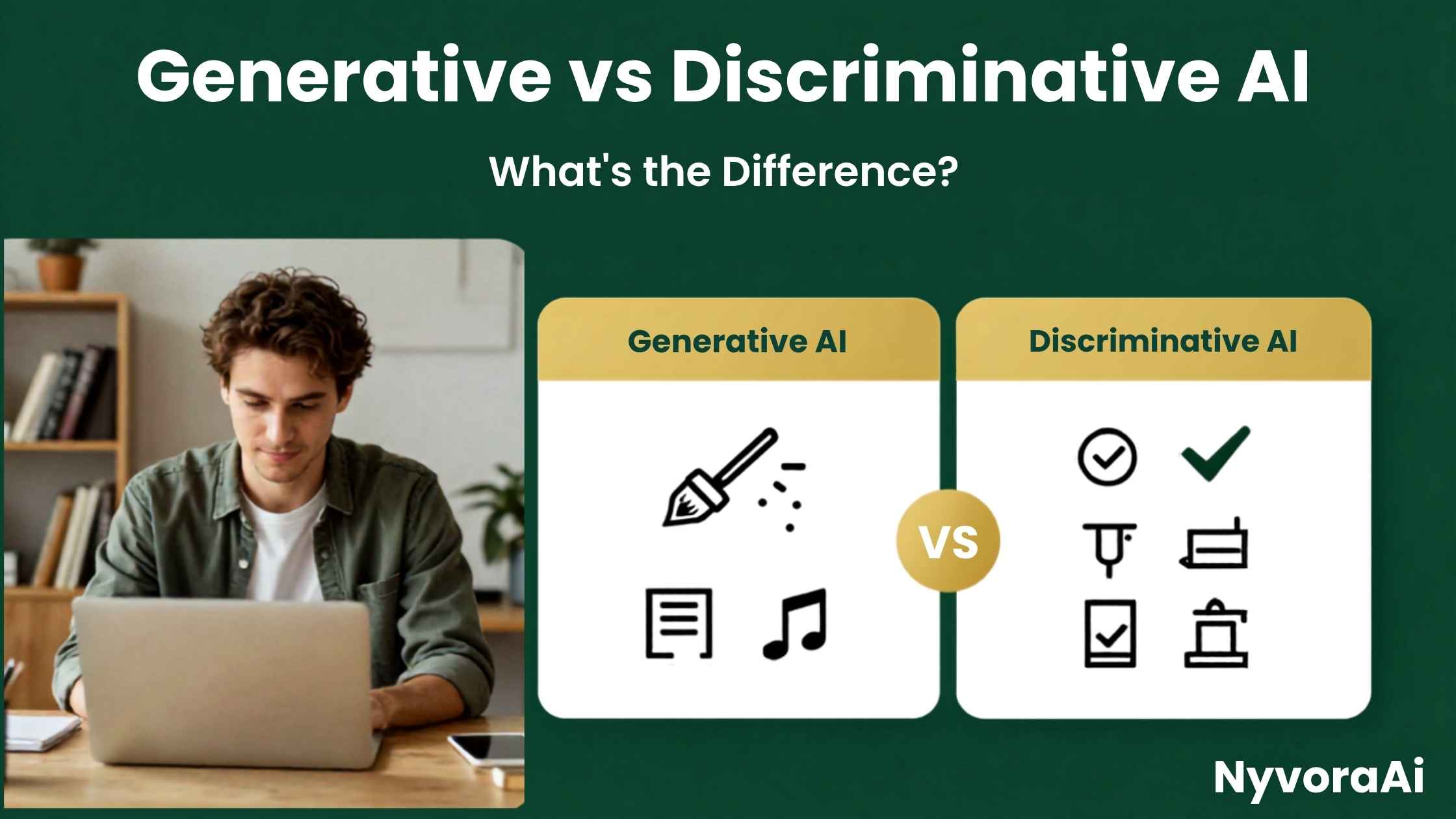
问垃圾邮件过滤器「这封是垃圾邮件吗?」,得到的是干脆的是或否;让图像生成器「画一幅山间日落」,递回来的却是一张从没人见过的图。两者背后都是 AI,底层面对的数据甚至可能十分相似,但围绕的是两个根本不同的目标,而这道差别有个名字:生成式 AI 对判别式 AI。
这道区分也不只是书斋里的冷知识。它解释了 ChatGPT 能为你写一首诗、而银行的欺诈检测系统却不能;解释了为何有些 AI 显得「有创造力」,另一些则像不苟言笑的裁判;也解释了为什么有些问题天生更适合其中一条路线。如果你对机器究竟如何从数据中学习还很陌生,在读本文之前,可先看我们的什么是机器学习、它如何被训练。
读到最后,几乎任何一款 AI 工具——聊天机器人也好,手机的人脸解锁也好——你都能立刻判断它是以生成式模型还是判别式模型在工作,以及这一选择为何重要。
01直白答案:分辨已有之物,与创造未有之物
用大白话说,判别式模型学会的是把一类数据与另一类分开的那条线(边界)。给它一样没见过的东西,它会告诉你落在界线哪一侧——是猫还是狗、是垃圾邮件还是正常邮件、是欺诈还是合法交易。
生成式模型则把一整个类别的底层规律摸得足够透,以至于能从零产出一个全新的样本。它不问「这个落在哪边?」,而是问「既然我懂得猫真正长什么样,能不能画出一只从没人见过的猫?」
一个方便记忆的办法:把判别式 AI 想成评论家,把生成式 AI 想成艺术家。评论家对眼前已有的东西下判断,艺术家则把上一刻还不存在的东西带来人间。两者都依靠从海量训练数据里学到的规律;如果你仍觉得「为什么需要这么多数据」很模糊,我们的AI 推理与训练之别会讲清数据究竟在何时、何处被用上。
02两类模型实际如何运转
追根究底,差别在于每类模型在数学上试图估计什么。你不必是统计学家,只需抓住其中的直觉。
03互动演示:同一张照片,两份不同的工作
拿一张狗的照片,先后送进两个不同的 AI 系统。点击下面的按钮,就能看到两类模型各自如何作答。
04生成式与判别式 AI:并排对照
把对比集中在一处,让每条路线的强项一目了然。
| 维度 | 判别式 AI | 生成式 AI |
|---|---|---|
| 核心问题 | 「这属于哪一类?」 | 「这类东西大概长什么样?」 |
| 目标 | 对眼前的输入做分类或贴标签 | 带来全新、原创的产出 |
| 学到什么 | 类别之间的界线 | 数据的完整分布 |
| 典型产出 | 类别、标签或评分 | 音频、文字、图像或其他新内容 |
| 训练需求 | 通常更轻、更高效 | 更重,往往需要多得多的数据与算力 |
| 代表性工具 | 人脸比对系统、欺诈检测、垃圾邮件过滤 | 音乐作曲、图像生成器、聊天机器人 |
05两类 AI 早已填满你的每一天
今天你很可能已经与两类 AI 都打过交道,却从没想过背后运行的是哪一种。
垃圾邮件过滤(判别式)
聊天机器人与助手(生成式)
欺诈检测(判别式)
图像生成器(生成式)
人脸解锁(判别式)
AI 音乐与语音工具(生成式)
个性化体验并不总能干净地归进某一类。某些推荐系统既不靠纯粹的分类,也不靠直接的生成,它们读取的反而是行为信号。YouTube 的 AI 推荐是怎么运作的就很好地说明了这一点——它本质上更像一道排序题,而不是一个整齐的「生成还是判别」二选一。
06该用哪一种?一个实用的判断法
在打造或评估一款 AI 工具时,要问自己的问题很简单:你需要的是一个判断,还是新的内容?
而且两者也未必是对手。生成对抗网络(Generative Adversarial Network,简称 GAN)会让二者同步运转:生成器负责伪造看似真实的图像,判别器则负责识破这些假货。每一轮较量都让双方变得更强——网上那些以假乱真的合成图,靠的正是这个把戏。若想更具体地看清当下生成式一侧的动力来源,AI 中的 transformer 模型是什么讲清了驱动当今大多数语言与图像模型的那套机制。
07两类路线各自的强项与边界
没有哪一类能「通吃」;各自舍弃的东西不同,看清边界才能把期待放得实在。
判别式 AI 的短板
- ✗
没有创造能力
✗ 判别式模型只能对你交给它的东西做分拣,无法自己生成新样本,也补不上缺失信息。
- ✗
拿陌生类别没辙
✗ 训练中从未见过的类别,会让判别式模型没有体面的应对方式,只能在已学会的边界之间做选择。
- ✗
对「为什么」所知有限
✗ 许多判别式模型能给出标签,却对数据更深层的结构或意义提供不了多少洞察。
生成式 AI 的短板
- ✗
资源需求更重
✗ 要合成出新的、可信的样本,模型就得吃透整个数据集的形态;与规模相近的判别式任务相比,这个过程通常要消耗多得多的数据和算力。
- ✗
可能出现自信却错误的产出
✗ 生成式模型能产出流畅、可信却事实上错误的内容,因为它追求的是统计上的合理,而非保证为真。
- ✗
评估更困难
✗ 生成式任务很少有唯一「正确」的产出,因此衡量质量与准确度,远不如看一个分类评分那样直截了当。
08常见问题
生成式与判别式 AI 有何不同?
ChatGPT 属于生成式还是判别式 AI?
哪类模型更准确,生成式还是判别式?
同一个模型能既生成式又判别式吗?
日常生活里判别式 AI 有哪些例子?
日常生活里生成式 AI 有哪些例子?
理解这道差别需要技术背景吗?
09结语
把已经存在的东西分拣清楚,还是把尚不存在的东西造出来——生成式与判别式的分野,归根到底就浓缩成这一个选择。判别式模型是安静而高效的裁判,藏在拦截垃圾邮件的过滤器、银行对可疑扣款发出的警报、以及帮你解锁手机的人脸核验背后。生成式系统则是更张扬、更抢头条的那一方:它们起草聊天回复、依据一段提示渲染图像,还能凭空谱出乐曲。
两派都没有天生的高下之分——它们只是为不同的任务而设计,最聪明的产品往往同时借助二者。所以下次当一件 AI 工具摆在面前,不妨停下来问一句,它真正在回答的是哪个问题:「这是什么?」还是「这可能变成什么?」一旦学会抓住这一个区别,整片现代 AI 的版图一下子就清晰多了。
Put "is this email spam?" to a spam filter and back comes a plain yes or no. Ask an image generator to "draw me a sunset over mountains" and a picture no one has laid eyes on arrives in return. AI is at work in both. The data underneath might even look much alike. Yet two fundamentally unlike goals sit at their centers, and that split carries a name: generative AI against discriminative AI.
Nor is the distinction mere academic trivia. It accounts for why a poem can come from ChatGPT but never from the fraud-detection system run by your bank, why some AI carries an air of "creativity" while the rest feels like stern judging, and why particular problems suit one approach over the other outright. If the very question of how machines learn from data is new to you, our piece on what machine learning is and how training works is a useful first stop ahead of this one.
By the closing section, nearly any AI tool — a chatbot, the face-unlock on your phone — should read clearly to you as either a generative model at work or a discriminative one, along with why that call matters.
01The Straight Answer: Telling Things Apart Versus Making Them
In plain language: the line, or boundary, dividing one data category from another is what a discriminative model picks up. Hand it something unfamiliar and it reports where relative to that line the item falls — cat against dog, spam against legitimate, fraud against honest transaction.
A generative model instead masters the patterns underneath a whole category to the point of producing a fresh example from nothing. The question is not "which side does this land on?" but "now that I grasp what a cat truly looks like, can I paint one nobody has seen?"
A handy way to keep the two straight: think of discriminative AI as a critic and generative AI as an artist. The critic passes judgment on what is already there; the artist brings into being what did not exist a moment ago. Each leans on patterns drawn from vast training data, and if the need for that much data still feels hazy, our piece on AI inference against training spells out exactly when and where the data gets put to work.
02How the Two Kinds Actually Operate
Underneath it all, the division is a matter of what each model type aims to estimate in mathematical terms. A statistician's background is not required — only the underlying intuition.
03Hands-On Demo: One Photograph, Two Separate Jobs
Take one photograph of a dog and route it into two separate AI systems in turn. Use the buttons underneath to watch each kind of model reply in its own way.
04Generative Against Discriminative AI: A Side-by-Side View
The comparison gathered in one spot, so each approach's strong suit is plain to see.
| Dimension | Discriminative AI | Generative AI |
|---|---|---|
| Central Question | "Which category does this belong to?" | "What would a thing like this look like?" |
| Aim | To classify or label the input at hand | To bring forth fresh, original output |
| What Gets Learned | The line separating categories | The data's complete distribution |
| Usual Output | A category, label, or score | Audio, text, an image, or other new content |
| Training Demands | Usually lighter and more efficient | Heavier, often with far more data and compute |
| Sample Tools | Face-match systems, fraud detection, spam filters | Music composers, image generators, chatbots |
05Where Both Kinds Already Fill Your Day
Chances are you have used both AI types already today, with never a thought for which one was running underneath.
Spam Filtering (Discriminative)
Chatbots & Assistants (Generative)
Fraud Detection (Discriminative)
Image Generators (Generative)
Face Unlock (Discriminative)
AI Music & Voice Tools (Generative)
Personalisation does not always slot cleanly into one bucket. Certain recommendation systems are built on neither straight classification nor outright generation; what they read instead is behavioral signals. YouTube 的 AI 推荐是怎么运作的 illustrates the point nicely — at heart it behaves more like a ranking exercise than a tidy generative-or-discriminative choice.
06Which Kind Should You Reach For? A Practical Test
When building or judging an AI tool, the question to put to yourself is plain: is a judgment what you need, or new content?
And the two need not be opponents either. A Generative Adversarial Network — GAN for short — runs one of each in lockstep: the generator's job is to forge images that look real, and the discriminator's job is to see through the fakes. Each round of that duel sharpens both sides, which is the very trick behind some of the most believable synthetic images circulating online. For a closer look at what powers today's generative side specifically, AI 中的 transformer 模型是什么 walks through the mechanism driving the bulk of contemporary language and image models.
07The Strengths and Limits of Each Kind
Neither kind is "better" across the board; different things get traded away by each, and knowing the limits keeps expectations realistic.
Where Discriminative AI Falls Short
- ✗
No Power to Create
✗ Sorting what you give it is all a discriminative model does; generating fresh examples or filling gaps on its own lies beyond it.
- ✗
Unfamiliar Categories Pose Trouble
✗ A category never seen in training leaves a discriminative model with no graceful response, only the boundaries already learned.
- ✗
Little Insight Into the "Why"
✗ The label may come through while the data's deeper structure or meaning stays largely out of reach for many discriminative models.
Where Generative AI Falls Short
- ✗
Heavier Resource Needs
✗ To synthesize fresh, believable examples, a model has to internalise the full shape of a dataset, and that process generally soaks up substantially more data and compute than a discriminative job of similar scope.
- ✗
Confident Yet Wrong Output Can Appear
✗ Fluent, convincing content that is factually wrong can come from generative models, since statistical plausibility rather than guaranteed truth is their aim.
- ✗
Evaluation Is Harder
✗ Rarely does a single "correct" answer exist for a generative task, so judging quality and accuracy is far less direct than reading a classification score.
08Frequently Asked Questions
How do generative and discriminative AI differ?
Is ChatGPT generative or discriminative AI?
Which kind is more accurate, generative or discriminative models?
Can one model be both generative and discriminative?
What are everyday examples of discriminative AI?
What are everyday examples of generative AI?
Is a technical background required to grasp the difference?
09Conclusion
Sorting through what already exists, or producing what does not yet exist — that single choice is all the generative-versus-discriminative divide really boils down to. Discriminative models are the quiet, efficient judges behind the filter that catches junk email, the alert your bank raises on a suspicious charge and the facial check that opens your phone. Generative systems are the louder, headline-grabbing counterparts: they draft chatbot replies, render an image from a prompt and compose music out of thin air.
Neither camp holds the upper hand by nature — the two were simply engineered for unlike tasks, and the sharpest products routinely tap both together. So next time a piece of AI is in front of you, pause and ask which of two questions it is really after: "what is this?" or "what might this turn into?" Learn to catch that one distinction, and the entire terrain of modern AI suddenly reads much more clearly.