An afternoon used to disappear into it: pull one seed term, stare at a spreadsheet, guess the intent behind each phrase, repeat. AI can compress all of that into something quicker and considerably less dull, provided you steer it correctly. What follows is exactly how to do that.
所以,当有人问「怎么用 AI 做 SEO 关键词研究」,准确答案是:把它当成关键词工具旁边的思考伙伴,而不是替代品。想清楚这个定位,能省下大量徒劳的折腾。如果你对提示词还不熟,建议先看我们这篇 如何为 AI 工具写出更好的提示词——研究产出的质量,和输入的质量高度相关。
01AI 在关键词研究里究竟能做什么
在进入流程之前,先弄清你究竟把什么任务交了出去。语言模型手里没有实时搜索数据,也不会去爬 Google 看当前排名。它真正拥有的是对话题之间关联的深层模式化理解——这种理解来自对海量文本的处理,内容覆盖语言、搜索行为、营销,以及几乎每一个行业。
正是这种训练,让它在几类明确的任务上表现出色。给它一个种子概念,它能展开你根本没想到的相关子话题;给它一份杂乱词表,它能归并成有逻辑的组群;给它一个短句,它能判断打字的人是还在了解、在比较,还是已经准备掏钱。它还能推想:一个受挫的用户会往 Google 里敲什么问题,而那些预算充足的竞品却始终懒得回答。
基本适合,因为它解决了「面对空白页不知从何下手」的问题。新手不必纠结起点,可以让模型先产出一张话题地图,再用 Google Search Console 或 Ubersuggest 这类免费工具检验哪些想法确实有需求。
怎么判断 AI 建议的关键词值不值得做?
把 AI 建议的词逐个过一遍专业 SEO 工具,看月搜索量和难度。优先选那些确实有需求、且难度分在你的域名可承受范围内的词。然后自己打开 SERP,看看现在排在那儿的是什么类型的内容。
用免费的 AI 工具能做吗?
可以。对话工具的免费版足以胜任出点子、话题聚类和意图分析。再配上 Google Trends、Google Search Console 或 Ubersuggest 免费版这类零成本工具来验证搜索量,整套研究流程不花钱也能跑通。
为什么搜索意图这么重要?
意图指的是用户敲下这行字背后的动机:他是想了解信息、比较选项,还是已经准备付钱?内容与这个动机是否对齐,是最大的排名因素之一。而在长词表上快速完成意图分类,正是 AI 特别擅长的事。
AI 不会替你把内容策略写完,你大概也不希望如此。它真正省下的是那些枯燥环节上的时间:把种子词铺开、给意图分类、搭出话题簇、找出同领域里还没人写过的角度。数字交给真正的关键词工具,思考交给 AI,一份更有意思的规划会用原来一小部分时间成型。真正的突破口在于这种搭配——不是二选一,而是让各自干它真正擅长的事。
◆
知微
Varun 写的是如何把 AI 落地到日常内容与 SEO 流程里的实用指南——那种真的会改变你每天工作方式的建议。有问题?点这里联系我。
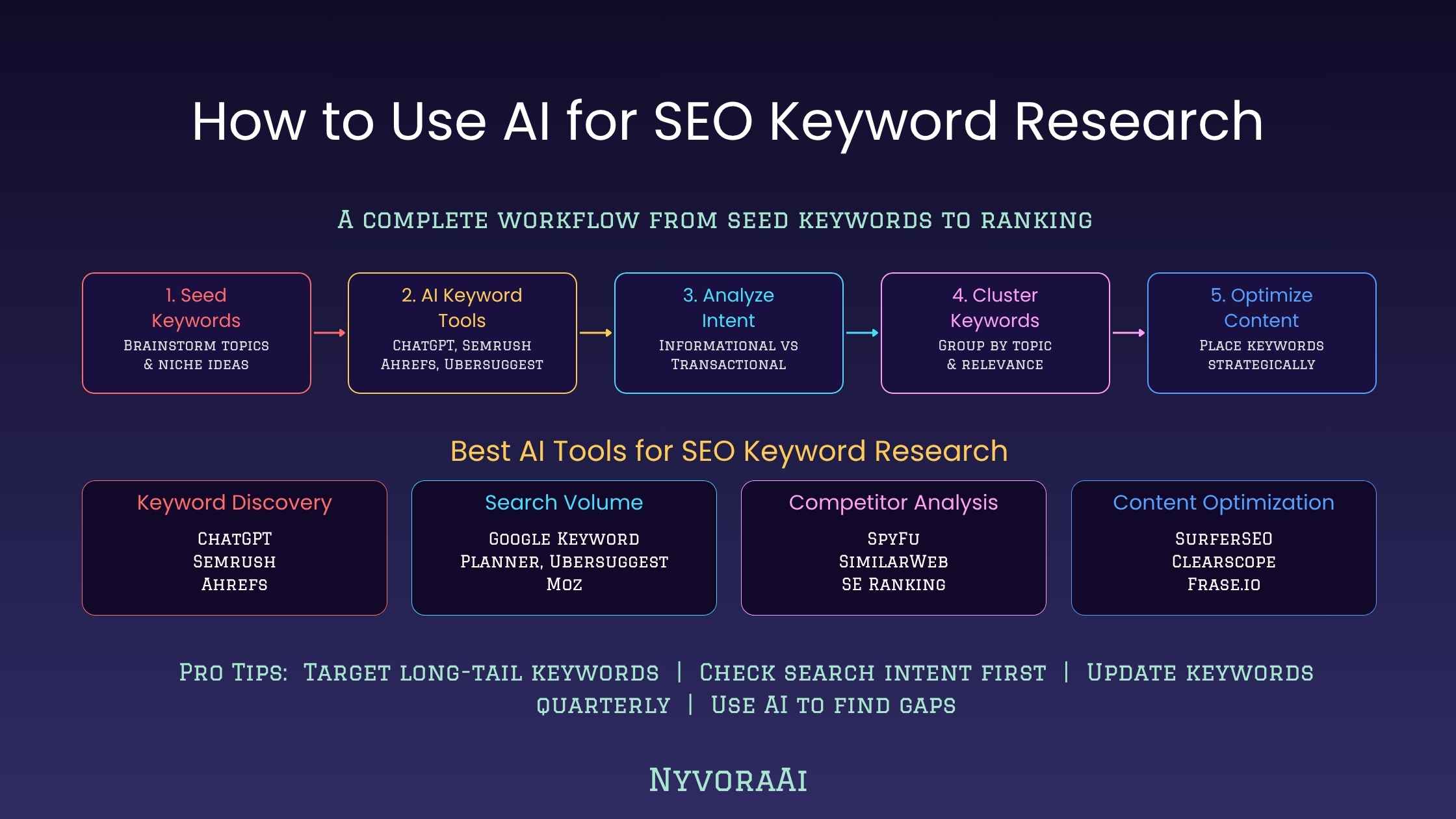
One thing needs saying before we go any further: AI is not a substitute for a proper keyword tool. Volume figures, difficulty scores and genuine SERP information come from Google Search Console, Ahrefs, Semrush or comparable platforms, and nowhere else. Where AI earns its keep is on everything happening before and around those tools: idea generation, topic clustering, intent interpretation, finding angles rivals ignored, and growing a skinny seed term into a content plan that holds together.
So when someone asks how AI fits into SEO keyword research, the accurate answer is this: treat it as the thinking partner next to your keyword tool, never as the thing replacing it. Getting that framing right spares you a great deal of frustration. If the prompting side of this is new to you, read our guide on writing better prompts for AI tools first, because the quality coming out of your research tracks the quality you put in.
01Where AI Genuinely Helps in Keyword Work
Before the workflow itself, it is worth being precise about the job you are handing over. A language model holds no live search data and does not crawl Google to check current rankings. What it does hold is an unusually deep, pattern-based grasp of how subjects connect to one another, accumulated from processing vast quantities of text about language, search behaviour, marketing and practically every trade there is.
That training makes it strong on a defined set of jobs. Feed it a seed concept and it will unfold related sub-topics you never considered. Hand it a disorganised list and it will sort the terms into coherent groups. Show it a phrase and it will judge whether the person typing it is researching, comparing or already reaching for a card. And it can reason about the questions a fed-up user might put into Google that a well-funded rival brand has never bothered to answer.
Live data is not required for any of that. Pattern recognition and reasoning are, and those are precisely what these models were built to do. Picture a research assistant who reads at absurd speed and never tires of reorganising spreadsheets. The catch is that they cannot pull today's traffic figures for you; that part stays on your desk.
02A Repeatable Workflow
The process below is one you can run again on whatever content project comes next:
If the writing itself already runs through AI once research is done, the next stage is covered in our guide on writing blog posts faster with AI, which treats research and drafting as one connected AI-assisted flow.
03Prompt Patterns Worth Copying
Most guides glide past this bit: they tell you to use AI for keyword research and never show what to type. Below are concrete prompt patterns, each pairing a weak attempt with a stronger one.
Look at what changed. The stronger version tells the model who will read the piece, how far along in the journey they are, and which content format the keywords must serve. That context is the only thing standing between you and a list of blindingly obvious terms that every fitness site online is already chasing.
Of all the techniques available in AI keyword research, instructing the model to reason as a frustrated searcher is among the most productive. It pushes the model toward what people want and cannot locate, and that gap between wanting and finding is precisely what a content opportunity is.
04Try It: Sorting Intent the Way AI Does
Intent may well be the single largest ranking factor there is, and no manual method classifies it as quickly as a model does. Tap any keyword below to watch the reasoning unfold, and to see why the intent behind a query dictates the kind of page you should build.
05What AI and Keyword Tools Each Do Best
Online discussion keeps framing this as AI against keyword tools, and the framing is false. The two do entirely separate jobs. Grasp the split properly and you avoid both errors: writing AI off altogether, or leaning on it for something it fundamentally cannot deliver.
What you're doing
AI chat model
Dedicated keyword tool
Turning a seed into keyword ideas
✅ Excellent: quick, inventive, tuned to your niche
✅ Good: grounded in data, though often obvious
Search volume per month
❌ Not something it can supply
✅ What it exists for
Difficulty and competition scores
❌ Not something it can supply
✅ What it exists for
Labelling search intent
✅ Handles it well at volume
⚠️ Rudimentary; usually a single label
Grouping topics together
✅ Excellent: grasps semantic meaning
⚠️ Limited, typically just alphabetical buckets
Finding content gaps
✅ Strong, given the right prompt
⚠️ Lists rivals' keywords, not the angles nobody covered
Reading the SERP
❌ No live SERP data
✅ Complete SERP data on tap
Drafting the content brief
✅ Strong, provided keyword context
❌ Never built for it
What this means in practice: hand AI the creative, structural and intent-related work, leave the numbers to your keyword tool, and merge both into a brief before a single sentence gets written.
06Spotting Gaps Your Rivals Left Open
In an SEO workflow this is arguably the most under-exploited use of AI. A conventional keyword tool reports what your rivals currently rank for. That is worth knowing, but the same list is visible to everyone, so the whole market ends up chasing identical terms. AI lets you reframe the question entirely: not what already ranks, but what ought to exist and does not.
One framing helps a lot here. Ask the model to imagine a real person who searched your topic, waded through a dozen mediocre articles, and came away still annoyed because none of them addressed their actual question. What did that person type? What never turned up? The answer is your content gap.
🔍
The annoyed-searcher angle
Have the model play a person who ran your topic through search again and again without ever landing on a decent answer. Which questions stayed open? What would their complaint sound like?
📌
The forum-thread angle
Get the model to picture the questions real people drop into Reddit, Quora and niche forums on your subject. Those conversational phrasings regularly turn up long-tail ideas that keyword tools never show.
🧩
The before-and-after angle
Ask the model what a reader must grasp before your main target keyword becomes useful to them, and what they should know once they have it. That sketches the supporting articles which give your cluster its strength.
Build a topic cluster this way and you are, in effect, assembling a small hub around one subject, something Google rewards with growing topical authority over time. To stretch it into a full publishing routine, our breakdown of building a daily workflow with AI tools shows where these research steps slot in. And once pieces go live, accuracy still has to be checked, so keeping fact-checking AI-generated content handy pays off at that point.
07Mistakes Beginners Make
The same handful of errors show up again and again the first time someone puts AI to work on keyword research:
⚠️
Believing the volume numbers
When a model claims some keyword "has high search volume," you are looking at an inference from its training data, not a live figure. Confirm it in a real tool before you build anything around that term.
⚠️
Prompts that say nothing
"Give me SEO keywords for my blog" yields precisely the predictable list every other newcomer receives. How specific you are in the prompt is the biggest single lever on what comes back.
⚠️
Skipping verification
Models will happily invent keyword phrases that sound entirely plausible and that nobody has ever searched. Filter the whole batch through a keyword tool before the ideas turn into a content calendar.
⚠️
Overlooking local and niche context
Prompt vaguely and you get vague, globally-flavoured keywords back. Whenever the target is a particular city, language or niche audience, spell it out in the prompt, every single time.
⚠️
Treating research as one-off
Research is not something you finish. Trends move, unfamiliar questions surface, and rivals keep shipping new pages. Put a quarterly cluster review on the calendar, with AI doing the heavy lifting.
⚠️
Leaving the list disconnected from a plan
Keywords without a plan behind them are only a list. Have AI convert the validated terms into a ranked content calendar, complete with suggested formats and the intent each piece targets.
If the workflow carries on into social after the blog is live, the same keyword habits pay off there. Our step-by-step guide to applying AI to social media demonstrates how the clusters you build for SEO can feed a social calendar at the same time. And for anyone freelancing, these skills convert straight into income, which is what using AI for freelance writing jobs covers on the commercial side.
08Questions People Ask
What's the right way to use AI for keyword research?
Ask a language model to draw out topic clusters, propose long-tail variants, work out the intent sitting behind each phrase, and flag the gaps your rivals have probably left open, and you have the core of an AI-assisted research method. The brainstorming phase moves dramatically faster, yet search volume and difficulty still have to be confirmed with a dedicated SEO tool.
Does AI make keyword tools redundant?
No, and it is not meant to. Idea generation, intent analysis, clustering and gap-hunting are all areas where a model outperforms manual work, but live volume, difficulty scores and real-time SERP data are beyond it. The strongest setup pairs AI brainstorming with a keyword platform such as Semrush, Google Search Console or Ahrefs for verification.
Which prompt works best for keyword research?
A strong prompt names your niche, who the content is for, the competitors or topics in play, and the kind of keyword you are after. Take this example: "Produce 20 informational long-tail keywords for a personal finance blog aimed at beginners, with readers aged 25 to 35 in India and a focus on saving and budgeting."
Is this approach beginner-friendly?
They are, largely because the blank page stops being intimidating. Rather than wondering where to begin, a newcomer can have a model produce a whole topic map, then run those ideas through something free like Google Search Console or Ubersuggest to see which ones carry real demand.
How can I tell whether AI's keyword suggestions are worth chasing?
Put every AI-suggested term through a proper SEO tool and look at monthly volume plus difficulty. Give priority to terms that show real demand and a difficulty score your domain can realistically fight for. Then open the SERP yourself and see what kind of pages already sit there.
Can this be done with free AI tools?
You can. Chatbot free tiers handle idea generation, topic clustering and intent analysis competently enough. Combine them with zero-cost options such as Google Trends, Google Search Console or Ubersuggest's free tier to check volume, and the resulting workflow costs nothing.
Why does search intent matter so much?
Intent is the reason behind the keystrokes: does this person want to learn something, weigh up alternatives, or hand over money? Aligning a page with that motive counts among the largest ranking factors there are, and sorting intent at speed over long keyword lists is something AI does particularly well.
AI will not hand you a finished content strategy, and you would not want it to. The payoff lies in the hours it returns on the tedious parts: expanding a seed, sorting intent, sketching clusters, and surfacing the angles that no competing site has covered. Let a genuine keyword tool supply the figures, let AI do the reasoning, and a stronger plan takes shape far faster than it once did. That pairing is the actual unlock, not one instrument or the other, but each doing the job it is genuinely good at.
◆
知微
Varun's guides cover putting AI to work inside everyday content and SEO workflows, the sort of advice that genuinely alters how you spend your working day. Got a question? Get in touch here.