研究工具对比:Perplexity AI 还是 Google 怎么选Research Tools Compared: Picking Perplexity AI or Google
Perplexity AI 和 Google 都想回答你的问题,走的路子却几乎完全相反;选错了工具,确实是在白白浪费时间。下面拆解两者实际的运作方式、一方明显领先的领域,以及一条决定先开哪个的简单规则。
Both Perplexity AI and Google exist to answer you, yet the routes they take could hardly differ more, and opening the wrong one for a given job is a genuine time drain. Read on for how each actually operates, the areas where one clearly leads, and a quick rule for choosing which to launch.
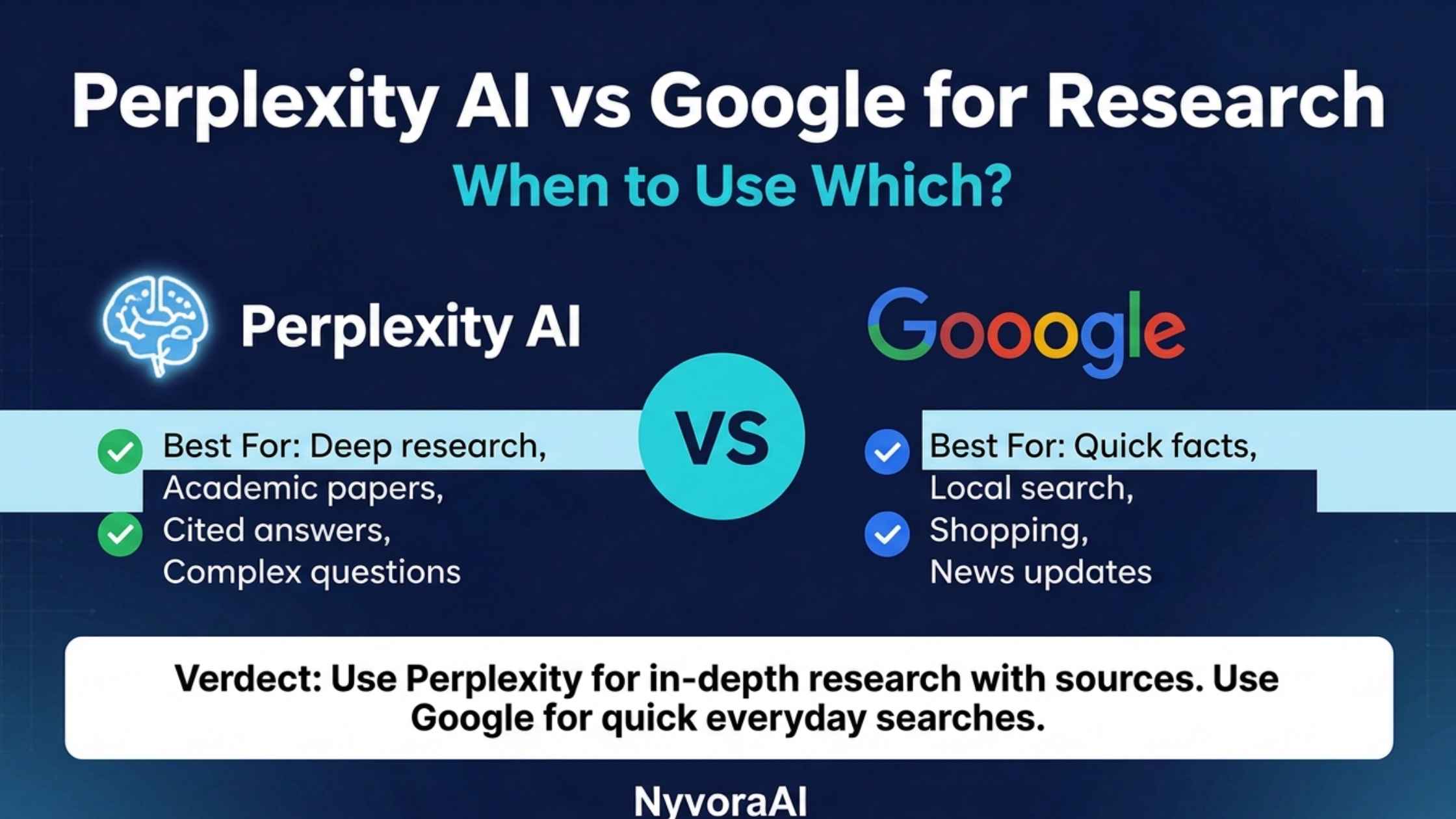
说件我最近亲身经历的事:为一篇文章查资料,我并排开了两个标签页——左边 Perplexity,右边 Google。大约三分钟后,差别就藏不住了。Google 给我列了十二个也许包含答案的页面;Perplexity 则已经读完其中几个,直接把答案递给我,旁边还挂着可核实的引用。
这一幕基本就是整场对比的缩影。不过,想真正掌握研究时该用 Perplexity AI 还是 Google,光知道「一个替你读、一个不替你读」还不够。两者各有真正更强的任务;像多数人那样随意混用,等于把一大块研究质量丢在桌上。
01两款工具内部到底怎么运作
天天用也不必深究这一点,但一旦理解差别,你伸手选工具时会自然得多。内容并不难懂,却真的有用。
本质上,Google 是一个链接检索系统。它抓取并索引网页,搜索时返回一组按相关性排序的文档。拿到清单的是你,逐页阅读的也是你。叠加在搜索之上的 AI 功能——AI Overviews 和那些快速摘要——是较晚才加在这套底层结构上的新东西,目前仍在完善。
Perplexity 从一开始就走另一条路。你的问题会先在实时网页上检索,再由一个大型语言模型读回结果,把它们熔成一段通顺的答案,并附上可以直接点开的编号引用。你不必评估一串页面,而是拿到一份熔合好、来源就在旁边的回答。研究发生在工具内部,而不是你这边。
客观讲,两条路没有高下之分:一个把综合工作交给 AI,另一个给你原材料、综合由你完成。关键是此刻哪条路贴合你要做的事。而等你用 Perplexity 建立起整体认识后,把这些内容带进写作会顺得多——我们这篇用 AI 更快写出博客文章就讲了如何从调研无缝过渡到起草,质量还不掉。
02两款工具真正领先的地方
03真实研究场景:该伸手拿哪个
说点实际的。理论上谁更好,不如对「此刻该用哪个」有清晰的直觉来得有用。
04互动测试:哪个工具适合你的任务?
拿不准下一个研究任务该开哪个?回答几个小问题,就能得到推荐。
05逐项正面对照表
| 研究任务 | Perplexity AI | 胜出方 | |
|---|---|---|---|
| 主题概览与综合 | 表现出色:通读多个来源再加以浓缩 | 阅读工作得自己完成 | Perplexity |
| 答案内附带引用来源 | 内置功能:每条回答都带编号出处 | AI Overviews 偶尔会标注,普通搜索则没有 | Perplexity |
| 地图结果与本地商家 | 覆盖极为有限 | 业界标杆 | |
| 购物与实时价格 | 当前价格不能指望它 | 专门的 Shopping 标签页 | |
| 最近几小时的突发新闻 | 在改善,但表现时好时坏 | Google News 覆盖更广、速度更快 | |
| 复杂的多部分问题 | 一条回答内就能顺畅处理 | 需要多次搜索加一堆标签页 | Perplexity |
| 图片与视频搜索 | 没有对应的专用功能 | 现有选择里最强 | |
| 对话式研究与追问 | 结合上下文的追问很好用 | 每次搜索都从零开始 | Perplexity |
| 冷门与技术类主题 | 来源丰富的话题处理得不错 | 索引更宽,能挖到更深的冷门页面 | 看情况 |
| 费用 | 免费版足够结实;Pro 需付费 | 免费 | 平局 |
06在一套研究流程中同时使用两者
说真的,最有效率的研究者不会认准一个、冷落另一个。他们先用 Perplexity 快速进入状态,再用 Google 沿特定方向往下深挖。实际操作时,顺序大致是下面这样。
从 Perplexity 开始。把完整问题写进去——要的是真正的问句,不是关键词——让它把整片领域梳理成一份扎实的概览。读完后,标出看起来最权威的引用,记下它引出的子问题或角度。
深度工作再交给 Google。打开最值得通读的引用,搜出你想独立核实的数据或论断,在更窄的线索上寻找最可信的一手来源。也正是在这里,更宽的索引体现价值——把综合答案漏掉的那一篇论文或那个冷门论坛帖子翻出来。
这套模式放大后依然顺畅。为文章做研究时,Perplexity 给概览和有潜力的线索,Google 给来源深度与核实,总研究时间明显下降。我们这篇用 AI 工具搭建日常工作流讲了如何把这种双工具模式变成固定习惯,而不是每次都重新权衡。如果研究是为内容或自由职业服务,自由撰稿人的 AI 工作流说明了怎样把研究工具接入专业流程。
社媒内容仍沿用熟悉的节奏——Perplexity 快速搭概览,核实工作和寻找新角度则交给 Google。我们的社媒 AI 分步拆解讲了如何高效地把研究成果变成帖子。
07准确性、核实与该复查的时刻
那些热情吹捧 Perplexity 的文章往往略过这一段。引用帮了大忙,每个论点大约只需点十秒就能核实。但做综合的终究是 AI,而综合过程可能注入错误、压平细微差别,或者偶尔误读来源。
一条好用的经验:赌注很小时——满足个人好奇、自己想搞懂一件事——Perplexity 带引用的摘要通常够用。赌注一高就不同:要发表的文字、涉及金钱的决定、专业文档里引用的统计,每个关键论点都要直接对照原文核实。
我们这篇如何核查 AI 生成内容通篇都在讲如何让核实成为习惯。简而言之,把 AI 综合当成聪明同事的摘要:有用、通常可靠,但真相要紧时绝不能替代原文。提问的质量也与此相连——这篇给 AI 工具写更强的提示词适合搭配着读,因为措辞直接决定 Perplexity 综合的成色。
08常见问题
研究工作该让 Perplexity AI 和 Google 怎么分工?
做研究时 Perplexity AI 比 Google 更强吗?
Perplexity AI 的回答可信吗?
Perplexity AI 可以免费用吗?
Perplexity 和 ChatGPT 的主要区别是什么?
什么时候仍然该用 Google 而不是 Perplexity?
Perplexity AI 能帮着做博客或内容研究吗?
Perplexity 和 Google 其实从来不是在抢同一份工作:一个把信息过载的网页熔成好读、带引用、可以立刻照做的答案;另一个把网页以原始形态敞开,提供只有 Google 索引才有的组织方式、新鲜度和广度。看清这个区别、按当下所需选工具,正是两种研究者的分野——一种觉得 AI 真的改变了工作方式,另一种试过、偶尔觉得好用,又悄悄退回老习惯。两个都用,而且有意识地用,秘密其实就这一条。
A small scene from my own week: researching background for an article, I kept two tabs side by side — Perplexity left, Google right. Roughly three minutes in, the contrast was impossible to miss. Google presented twelve pages that maybe held what I needed; Perplexity had already worked through several and handed me the answer itself, citations attached for checking.
That moment basically captures the whole debate. Still, mastering when to turn to Perplexity AI versus Google runs deeper than "one does the reading, one doesn't." Each genuinely outperforms on particular jobs, and treating them as interchangeable — the way most users do — throws away a meaningful slice of research quality.
01What's Actually Happening Inside Each Tool
Daily use never requires thinking about this, yet grasping the contrast changes how naturally you reach for each. It isn't technical; it simply pays off.
At its core, Google retrieves links. Crawling and indexing the web, a search returns a ranked set of documents judged relevant to your words. You receive the list; the reading stays on your side. The newer AI layer — AI Overviews, the quick summaries — was added fairly recently on top of that base structure and continues maturing.
Perplexity takes another route entirely. Your question triggers searches across the live web, after which a large language model reads what came back and fuses it into one smooth answer, complete with numbered citations you can open directly. No page list awaits judgment; instead, a fused response arrives with sources attached. The tool does the research, so you don't have to.
Objectively, neither route wins. One hands the synthesis to AI; the other supplies raw material and leaves synthesis to you. What matters is which fits the job in front of you at that instant. And once Perplexity has given you that overview, moving it into writing gets easier — our guide on using AI to draft blog posts in less time explains how to cross from research into drafting without dropping quality.
02Where Each Tool Holds a Clear Edge
03Real Research Moments: What to Reach For
Time for the practical view. A theoretical winner helps less than a reliable instinct about which tool fits the moment.
04Interactive: Which One Fits Your Task?
Unsure what to open for your next research job? A few quick questions produce a recommendation.
05Direct Side-by-Side Breakdown
| The research job | Perplexity AI | Who takes it | |
|---|---|---|---|
| Topic overviews and fused summaries | Outstanding: works through several sources and condenses them | You handle the reading on your own | Perplexity |
| Sources cited inside the answer | Built right in: every response carries numbered references | AI Overviews cite occasionally; ordinary search doesn't | Perplexity |
| Map results and local businesses | Barely any coverage | Sets the standard | |
| Shopping and live prices | Can't be trusted for current pricing | A purpose-built Shopping tab | |
| Breaking news within the last few hours | Getting better, though results vary | Google News reaches further and faster | |
| Tangled, multi-part questions | Dealt with smoothly inside a single response | Means several searches and a stack of tabs | Perplexity |
| Image and video searching | No dedicated feature available | The strongest option on offer | |
| Conversational research and follow-ups | Context-aware follow-ups perform strongly | Every search begins from scratch | Perplexity |
| Niche and technical subjects | Solid when the topic has rich sourcing | A wider index reaches deeper into obscure pages | Depends |
| Pricing | Free tier holds up well; Pro costs money | No charge | Tie |
06Pairing the Two Inside One Research Workflow
Truth is, the sharpest researchers don't commit to one and drop the other. Perplexity gets them up to speed quickly; Google then carries them deeper along particular threads. In practice, the sequence looks roughly like this.
Begin with Perplexity. Put the full question in — a genuine question, not keywords — and let it map the territory into a grounded overview. After reading, mark the citations that look most authoritative and note the sub-questions or angles it surfaces.
Google then takes over for depth. Open the citations worth reading in full, hunt down figures or claims you want checked independently, and seek the strongest primary sources on the narrower threads. This is also where the wider index pays off — surfacing that lone paper or niche forum post the fused answer missed.
The pattern scales cleanly. For article research, Perplexity supplies the overview and promising threads, Google supplies source depth and verification, and the combined research time drops sharply. Our walkthrough on building a daily workflow around AI tools explains how to turn this two-tool pattern into a standing habit rather than a daily decision. If the research feeds content or freelance work, AI workflows for freelance writers shows how to connect research tools into a professional pipeline.
Social posts keep to a familiar rhythm — Perplexity builds a quick overview, while Google handles the checking and any new angles. Our step-by-step social-media AI breakdown explains how to convert that research into posts efficiently.
07Accuracy, Verification, and the Moments to Recheck
Here's what glowing Perplexity write-ups tend to skip. The citations help enormously, putting each claim roughly ten seconds of clicking away from verification. Still, an AI is doing the fusing, and that fusing can inject errors, flatten nuance, or now and then misread a source.
A handy rule: with low stakes — personal curiosity, understanding for its own sake — a cited Perplexity summary usually suffices. Higher stakes change things. Published writing, money decisions, statistics in a professional document all call for direct verification of every key claim against the original.
Our full guide on fact-checking AI-generated content is built around making verification habitual. In brief, treat AI fusing like a bright colleague's summary: helpful and mostly dependable, never a substitute for the original when truth matters. Question quality is linked too — our guide on crafting stronger prompts for AI tools pairs naturally, since phrasing shapes how good Perplexity's fusion turns out.
08Frequently Asked Questions
How should Perplexity AI and Google divide research work?
Does Perplexity AI outperform Google for research?
Are Perplexity AI's answers trustworthy?
Is Perplexity AI free to use?
What chiefly separates Perplexity from ChatGPT?
When does Google still deserve the call over Perplexity?
Can Perplexity AI support blog or content research?
Perplexity and Google were never really contesting one job. One fuses an information-rich web into a readable, cited answer ready for action; the other opens that web in the raw, with the organization, freshness, and range only Google's index supplies. Grasp that distinction and choose by what the moment demands — this is what divides researchers who feel AI genuinely reshapes their work from those who tried it, found it handy sometimes, and slipped back into old routines. Put both to deliberate use; that is genuinely the whole secret.