开源 AI 真的危险吗?Is Open-Source AI Actually Dangerous?
如今科技圈吵得最凶的,已经不是谁的聊天机器人更聪明,而是底层代码该锁进公司的保险库,还是交到所有人手里。先把噪音拨开,看看真实风险到底是什么。
Nobody in tech is arguing about which chatbot is cleverest anymore — the fight is over whether the code underneath it belongs in a corporate vault or in everyone's hands. Time to strip away the shouting and examine what the actual risks are.
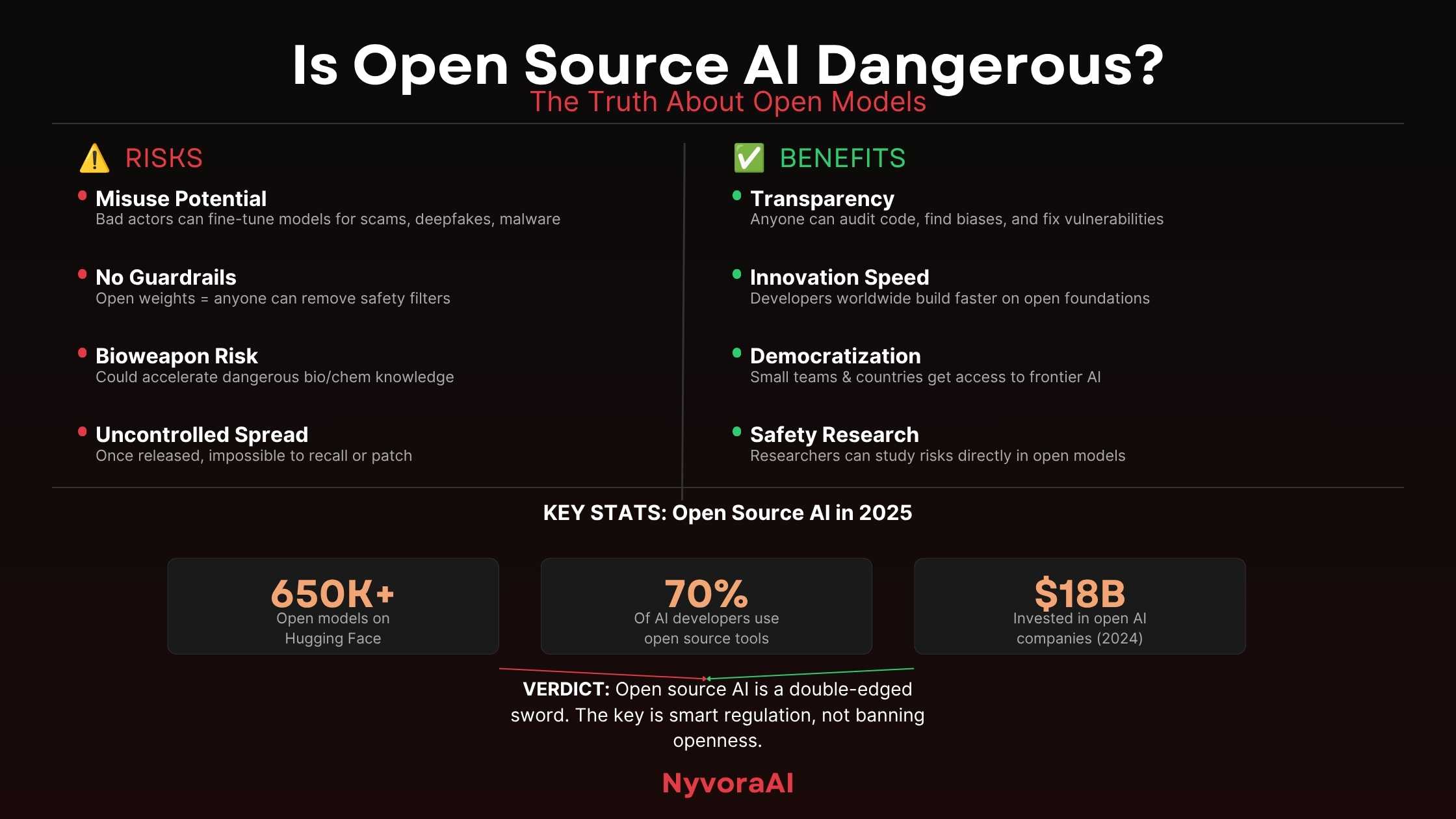
我有个做网络安全的朋友,上周我们因为一个刚发布的大型开放权重语言模型吵了起来。他急得直抓头发:把这种级别的智能交给公众,在他看来等于在玩具店门口零售铀矿。我坐在对面替开源阵营辩护,更多是想把论点试到底。
这件事早就不是大学实验室里的学术争论,而是一场涉及数十亿美元的势力争夺,结果将决定未来十年技术进步的走向。一边是开源纯粹派和"e/acc"(有效加速主义)阵营,他们认为把 AI 锁起来本身就是对人类自由的威胁;另一边是"末日派"和不少企业高管,他们坚称开源 AI 危险到足以让社会崩塌。
那到底谁说得对?开放模型是已经开始倒计时的炸弹,还是唯一能阻止少数科技垄断者主宰一切的力量?倒杯咖啡,我们要一头扎进人工智能领域争议最大的话题。
01巨大的分裂:一边是自由,一边是安全
这场争论之所以火药味十足,原因很简单:两派面对的是同一项技术,却得出了截然相反的走向判断。
在开源阵营看来,AI 是最彻底的平权工具,是 21 世纪的印刷机。他们说,如果发展中国家的天才少年能接触到和硅谷资深工程师一样的顶尖推理模型,气候变化、疾病、贫困都会以前所未有的速度被攻克。从这个角度看,限制 AI 不过是科技巨头守住护城河的手段。
在安全阵营看来,AI 是一把没上保险的枪。他们的主张是:软件漏洞或社交媒体算法完全是另一种性质的问题——足够先进的模型可以自行设计出前所未见的病原体,或协调一场让电网瘫痪的网络攻击。把这种能力的图纸交到所有人手上,你就无从控制谁会把它造出来。
这也正是"AI 是互联网以来最伟大的发明"这一说法的由来——它是一次根本性转变,把人类的才华与残酷同时放大。
02等等,AI 语境下的"开源"到底指什么?
问题就出在这里——媒体和行业吹捧者十次里有九次会讲错。Meta 一发布 Llama,Mistral 一发布新模型,标题就开始大喊"开源 AI!"
纯粹派会说这说法站不住脚。真正的开源软件(Linux 是典型例子)会把源代码、构建工具和训练数据一并交给你,你能从零把整套东西重建出来。
实际放出来的只是开放权重:训练好的神经网络连同数十亿参数交到你手上,而数据集和确切的训练配方仍锁在门后。动机是钱——这些数据可能价值数十亿美元,而且大量是从受版权保护或私密来源抓取来的。
03真正的危险在哪里——末日派为何如此紧张
不必粉饰:把能力强大的 AI 模型放到 Hugging Face 上供人随意下载,带来的风险真实且令人不安。安全领域给这件事起了个名字——两用困境。
1. 护栏被拆掉
透过 ChatGPT 或 Claude 这类封闭 API 使用时,公司已经投入数百万美元做"RLHF"(基于人类反馈的强化学习),让模型拒绝有害请求——它不会教你造炸弹,也不会替你写种族主义檄文。
下载一个开放权重模型,几分钟内就能把这些护栏全部拆掉——这相当于在架构层面直接"越狱"。心怀不轨的人可以专门微调一个模型,让它始终有帮助、无害、诚实……只在被要求生成钓鱼工具、自动化勒索软件或合成非法内容时例外。
2. 深度伪造泛滥
AI 垃圾内容和深度伪造早已泛滥成灾,源头就是开源的图像与视频模型——Stable Diffusion 及其后继者。它们在消费级显卡上本地运行,没有任何中心机构能审核这些输出。这直接加剧了围绕AI 是否正在削弱我们的创造力的文化焦虑:合成、缺乏原创、往往带有欺骗性的媒体正涌向互联网。
3. 独狼难题
过去,发动大规模网络攻击或设计生物武器,需要国家力量或庞大的恐怖组织,还要后勤、人手和专门的实验室。如今令人担忧的是,开源 AI 会成倍放大单个人的能力。理论上,一个人只要有一台笔记本和一个下载来的模型,就能实施过去需要一支队伍才能完成的行动。
04为什么仍应让 AI 保持开放
成千上万能力出众的研究者拼命维护 AI 的开放——如果它真那么危险,这是为什么?因为取代开放的东西可能更糟。
1. 用透明度换取安全
安全领域有一条铁律:把系统怎么运作藏起来,并不等于它安全。假设世界上最先进的模型只掌握在三家公司手里,代码从不示人——我们凭什么判断它们行为正常?又怎么知道里面没有潜藏的偏见、被人埋下的后门,或某种会以糟糕方式收场的失效模式?
开放让全球研究者都能审查模型。开放模型里的缺陷,会有成千上万独立开发者一起修补;闭源模型里的缺陷,则要一直埋着,直到有人爆料或出了大事。
2. 不让 AI 落入垄断之手
设想全球经济的基础智能只掌握在两三家公司手里:你看到什么信息、写出什么代码、哪些科研优先获得资源,全由它们决定;甚至只要它们不认同某国的政治立场,就能直接对该国断供 AI。
开源是唯一能制衡这种权力的东西。它让 AI 更接近公共设施,而不是私人领地,也让初创公司、高校和独立创作者能在最前沿动手,而不必向科技巨头缴纳"税"。
3. 让科学研究提速
闭源模型是为消费者聊天和企业 SaaS 调优的,开源模型则是为科学研究调优的。开源 AI 已经在帮研究者预测蛋白质折叠、寻找新型电池材料、模拟气候变化。把这项技术锁在付费墙后,科学进步几乎会停滞。
05闭源带来的安全幻觉
有一个让"安全派"游说者不愿你细想的事实:闭源并不等于安全。
闭源系统会泄露,我们已经反复见证:黑客窃取源码,员工把 U 盘带回家,模型通过抓取 API 被逆向还原。以为前沿模型能永远待在保险库里,只是一厢情愿。
更进一步说,"安全"常常只是监管俘获的木马。只要让立法者相信开源风险太大,闭源公司就能推动通过法律,让任何竞争者都变成违法存在。他们的目的不是拯救世界,而是戴着"公共安全"的面具消灭对手。
06这对普通用户意味着什么
你也许在想:"这不就是亿万富翁和学者之间的哲学之争吗?跟我有什么关系?"答案是:关系相当大。
如果开源 AI 被监管挤出市场,使用 AI 的成本会飞涨,每一次查询都变成向垄断者缴纳的通行费。自由职业者、小企业主和创作者,利润会被 API 账单啃掉。这正是人们如此担心2026 年 AI 会不会取代内容写手的原因——当只有超大型企业用得起最好的 AI,小玩家就被碾碎了。
反过来看也一样:因为开源存在,一个能力不俗的模型可以跑在你自己的笔记本上,你喂给它的东西一步都不离开设备,隐私完全由你掌握。整理生活、写代码、管理财务,都不必担心有企业"监工"盯着你的每个动作。
同样的道理也解释了孩子是否该在学校学习 AI 技能为何分量这么重。如果想让下一代成为 AI 的设计者而不只是消费者,他们就得能接触开放模型,去折腾、拆坏、动手摸索——这是理解这项技术底层原理的唯一途径。
07中间路线:负责任地发布
那么,开源 AI 危险吗?危险——火、电、互联网也都危险。危险从来不是真问题。真问题是:收益是否大于代价,代价又该如何被压低。
业界正在慢慢形成一套"负责任发布"框架,主要由四块构成:
- 1
分阶段发布
1 与其在第一天就放出全球最强的模型,公司会先发布一个规模略小、更安全的版本,观察生态中的使用情况,确认没有被滥用后,才推出满血版本。
- 2
算力上限
2 监管者的着力点在硬件。想训练超大模型,就得向政府登记 GPU 集群,这样模型的"出生"在它公开之前就被记录在案。
- 3
面向开源发布的独立安全测试
3 模型发布前必须通过由独立第三方执行的标准化"红队"测试,确认它无法轻易制造 CBRN(化学、生物、放射及核)威胁。
- 4
由社区推动的水印
4 为 AI 生成的文本、代码和媒体制定通用的不可见水印标准,让开放模型的输出来源更容易追溯。
08最终结论:精灵早已出瓶
危险吗?毫无疑问。它拉低了网络犯罪的门槛,加速了深度伪造危机,也拆掉了让普通用户免于被自己最坏冲动伤害的企业护栏。
但现实摆在这里:精灵早就离开瓶子了。
Transformer 架构无法被"取消发明",Llama、Mistral、Stable Diffusion 的权重也无法被"取消发布"。它们存在于成千上万块硬盘上,被镜像到区块链,散布在全球各地。今天下禁令并不会让我们更安全,只会确保技术和黑市成为唯一的持有者,而讲伦理的研究者和守法公民被关在门外。
往前走的唯一路径是彻底的透明、扎实的社区审计,以及国际间的协作。互联网的免疫系统必须实时搭建——而病毒已经在血液里流动。这很混乱,很危险,也令人恐惧。
不过从历史看,长期而言开放协作总是胜过闭门保密。互联网熬过了蠕虫、病毒和网络喷子;开源 AI 也会度过自己的成长期。关键在于我们怎么聪明地应对。
A friend of mine works in cybersecurity, and last week the two of us got into it over a newly shipped, very large open-weight language model. He was close to tearing his hair out: putting that much intelligence in the public's hands, he said, was like selling enriched uranium at a hobby shop. I took the other chair and argued the open-source side, mostly to test it.
What used to be a seminar-room dispute has turned into a multi-billion-dollar land grab, and its outcome will shape the coming decade of technological progress. Arrayed on one side are open-source purists alongside the "e/acc" (effective acceleration) contingent, who see any attempt to lock AI away as a threat to human freedom itself. Facing them are the "doomers" and a good number of corporate executives, who insist open source AI is dangerous enough to bring society down.
So which camp has it right? Is an open model a bomb with the timer already running, or the one force stopping a handful of tech monopolies from running everything? Pour yourself something warm — this is the most contested subject in all of artificial intelligence.
01The Great Split: Freedom on One Side, Safety on the Other
The reason this argument turns so vicious is simple: the two camps stare at an identical piece of technology and walk away with opposite pictures of where it leads.
To the open camp, AI is the great leveller — the printing press of the 21st century. Give a gifted teenager in a developing nation the same state-of-the-art reasoning model a senior Silicon Valley engineer can reach, they say, and climate change, disease, and poverty all start falling at a pace never seen before. From this vantage point, restrictions on AI are simply how Big Tech keeps its moats intact.
To the safety camp, AI is a weapon with the safety off. Their claim is that a software bug or a social media algorithm is a different order of problem — an advanced enough model could, on its own, engineer a never-before-seen pathogen or coordinate a cyberattack that takes down a power grid. Hand the blueprints for that capability to everyone and there is no way to control who assembles it.
This is the same reasoning behind the claim that AI ranks as the biggest invention since the internet — it is a foundational shift that magnifies human brilliance and human cruelty in equal measure.
02Hold On — What Does "Open Source" Mean When It Comes to AI?
This is the point where journalists and industry boosters mislead you nine times out of ten. Meta ships Llama, Mistral ships its newest model, and the headlines bellow "open source AI!"
Purists will call that claim false. Genuinely open-source software, Linux being the classic case, hands over the source code, the build toolchain, and the dataset behind it — everything needed to rebuild it from zero.
What actually ships is open weights: the finished, trained network with its billions of parameters arrives in your hands, while the dataset and the precise recipe used to train it stay behind closed doors. The motive is money — that data can be worth billions, and much of it was scraped from copyrighted or private material.
03Where the Genuine Dangers Lie — and Why the Doomers Are Alarmed
No point dressing it up: putting capable AI models on Hugging Face for the world to download carries risks that are real and genuinely frightening. Security professionals have a name for it — the dual-use dilemma.
1. Guardrails Come Off
Behind a closed API such as ChatGPT or Claude, millions have gone into "RLHF" (Reinforcement Learning from Human Feedback) so the model declines harmful requests — it will not walk you through bomb construction, and it will not draft racist screeds.
Download an open-weight model and those guardrails can be gone within minutes — jailbreaking performed at the level of the architecture itself. A malicious operator can fine-tune a model to be helpful, harmless, and honest in every case... except when the request is to build phishing kits, automate ransomware, or synthesise illegal material.
2. Deepfakes Multiply
AI sludge and deepfakes already swamp us, and open-source image and video models — Stable Diffusion and everything that followed — are the cause. They execute locally on consumer GPUs, which leaves nobody in a position to moderate the output. That feeds straight into the cultural unease around whether AI is making us less creative, as synthetic, derivative, frequently deceptive media pours onto the internet.
3. The Lone Wolf Problem
Mounting a large-scale cyberattack or engineering a biological weapon used to demand a state or a sizeable terrorist network — logistics, people, dedicated laboratories. The worry now is that open-source AI multiplies the power of a single individual. In theory, one person armed with a laptop plus a downloaded model could carry out operations that previously took an army.
04The Case for Keeping AI Open
Thousands of highly capable researchers fight relentlessly to keep AI open — why, if it is that dangerous? Because what replaces openness may be worse.
1. Transparency as a Security Strategy
Security work has one iron rule: hiding how a system works does not make it safe. Suppose the world's most advanced models sit inside three companies and the code is never shown — what evidence would we have that they behave? How would anyone know about latent bias, a planted backdoor, or a failure mode that ends badly?
Openness lets researchers worldwide inspect a model. A flaw discovered in an open model gets fixed by thousands of independent developers. A flaw discovered in a closed one stays buried until somebody leaks it or something goes badly wrong.
2. Keeping AI Out of a Monopoly
Picture the foundational intelligence of the world economy resting with two or three firms. They would decide which information reaches you, which code gets written, which research gets funded first — and could cut a whole country off from the AI if they disliked its politics.
Open source is the sole counterweight. It keeps AI closer to a public utility than a private estate, and it lets startups, universities, and solo creators work at the frontier without handing a "tax" to the tech giants.
3. Speeding Up Science
Consumer chat and enterprise SaaS are what closed models are tuned for; science is what open models are tuned for. Open-source AI already helps researchers predict protein folding, hunt for new battery materials, and simulate climate change. Put that technology behind a paywall and scientific progress would stall almost completely.
05The Illusion of Safety in Closed Systems
There is an awkward fact the "safety" lobby would rather you skipped past: closed does not mean safe.
Closed systems leak, and we keep watching it happen. Hackers steal source code. Staff walk out with USB drives. Models are reverse-engineered by scraping the API. Believing a frontier model can live in a vault indefinitely is wishful thinking.
What is more, "safety" frequently functions as a Trojan horse for regulatory capture. Convince lawmakers that open source is too risky, and a closed-source company can get statutes passed that make competing with it illegal. The goal is not saving the world — it is eliminating rivals while wearing the mask of public safety.
06What This Means for Ordinary People
"This is a philosophical spat for billionaires and academics," you may be thinking. "What has it got to do with me?" Quite a lot, as it turns out.
Regulate open source AI out of existence and the price of using AI climbs through the roof; every query becomes a toll paid to a monopoly. Freelancers, small business owners, and creators would see API bills eat their margins alive. That is precisely the fear behind whether AI will replace content writers in 2026 — when only giant corporations can afford the best AI, everyone smaller gets flattened.
The reverse also holds: open source means a genuinely capable model can run on your own laptop. Nothing you feed it leaves the device, so privacy is total. Organise your life, write code, manage your money — with no corporate overseer tracking each step.
The same logic explains why the argument over whether children should learn AI skills in school carries so much weight. A generation that designs AI rather than merely consuming it needs open models to poke at, break, and learn from — that is the only route to understanding how the technology works underneath.
07A Middle Path: Releasing Responsibly
Is open source AI dangerous, then? Yes — as are fire, electricity, and the internet. Danger was never the real question. The real questions are whether the upside exceeds the downside and how the downside gets reduced.
A "Responsible Release" framework is slowly taking shape across the industry. It rests on four pieces:
- 1
Staged Rollout
1 Rather than shipping the strongest model on earth on launch day, a company starts with a slightly reduced, safer variant, watches how the ecosystem uses it, and only then puts out the full-strength version.
- 2
Compute Caps
2 Hardware is where regulators are aiming. Anyone training a huge model must register their GPU clusters with the government, which means a model's "birth" is logged long before it appears in the open.
- 3
Independent Safety Testing for Open Releases
3 No model goes out before clearing standardised "red-teaming" tests run by outside parties, whose job is to confirm it cannot readily produce CBRN (Chemical, Biological, Radiological, and Nuclear) threats.
- 4
Watermarking by the Community
4 Common standards get written for invisible watermarks inside AI-generated text, code, and media, so outputs from an open model can be traced back to their origin.
08The Verdict: The Genie Left the Bottle Already
Dangerous? Without question. It drops the entry barrier for cybercriminals, speeds the deepfake crisis along, and strips away the corporate guardrails that shield ordinary users from their own worst instincts.
And yet, reality intervenes: the genie has already left the bottle.
The transformer architecture cannot be uninvented. The weights of Llama, Mistral, and Stable Diffusion cannot be unpublished. They sit on thousands of hard drives, are mirrored on blockchains, and are scattered worldwide. A ban today would not buy us safety — it would simply guarantee that only governments and the black market hold the technology, while ethical researchers and law-abiding citizens are locked out.
Forward means radical transparency, serious community auditing, and cooperation between nations. The internet's immune system has to be assembled live, in real time, with the virus already circulating in the blood. It will be messy, risky, and frightening.
History, though, suggests that over the long run open collaboration outperforms closed secrecy every time. The internet absorbed the worms, the viruses, and the trolls without collapsing. Open source AI will weather its growing pains as well. The trick is handling it intelligently.