理解 AI 中的零样本学习Understanding Zero-Shot Learning in AI
让今天的 AI 模型把客户投诉归进它从未见过的类别,或翻译一对从未专门匹配过的语言,它往往说做就做。不用重新训练、不用标注样本、不用微调。下文我们会确切拆解什么是零样本学习、模型如何做到,以及它仍会失手的地方。
Ask a present-day AI model to bucket customer complaints into labels it has never met, or to translate a language pair it was never expressly matched on, and it frequently just goes ahead. No fresh training, no labelled cases, no fine-tuning. Below we unpack precisely what zero-shot learning is, how a model carries it off, and the points at which it still falters.
设想你递给某人一张他这辈子从未见过的动物照片——一只穿山甲——却听到一句靠谱的回答:“某种带鳞片的哺乳动物”,而这纯粹来自他对鳞片、哺乳动物和动物的一般认识。穿山甲从未出现在他的受训经验里,他是靠脑子里已有的其他知识推断出答案的。这个画面正好抓住了现代 AI 一项真正令人惊叹之能力背后的直觉。
那么零样本学习究竟指什么?它是指一个训练好的模型,在该情形没有任何标注样本的情况下,仍能处理自己训练时从未遇到过的任务、类别或案例。模型并不需要一份专为新任务搭建的数据集,而是从已掌握的广博知识出发进行推断,把它用到真正陌生的事物上。
这个概念正是当今大型语言模型让人感觉如此灵活的核心所在。每当聊天机器人处理了它的构建者从未专门训练它做的事、却仍给出合理回答,你就亲眼看到了零样本学习。我们关于自然语言处理(NLP)的指南,铺陈了这项能力所依赖的语言基础。
01简短回答:不靠重新训练也能推断
传统机器学习像一个只会复习提纲上那些确切题目的学生。把一张标注好的猫照片给模型看一千遍,它认猫认得出神入化,可一旦指向从未见过标注的东西,它就一脸茫然。零样本学习解除了这一限制:它在训练阶段赋予模型一种丰富得多、也普遍得多的“意义感”,宽广到足以当场对全新类别进行推理。
只有当模型在庞大而多样、而非狭窄单一的数据集上训练之后,这种能力才真正具备规模化的可行性。巨大的规模正是它在那个时点浮现的原因;我们关于AI 推理与训练的文章提供了有用背景:零样本能力是在昂贵的训练阶段铸就的,之后每次你查询模型时又几乎瞬间被调用。
用日常的话说,零样本模型并不是在背诵答复,而是在识别意义与关联的模式,再把这种理解带到它从未正式“学过”的事情上。
02逐步拆解:零样本学习如何运作
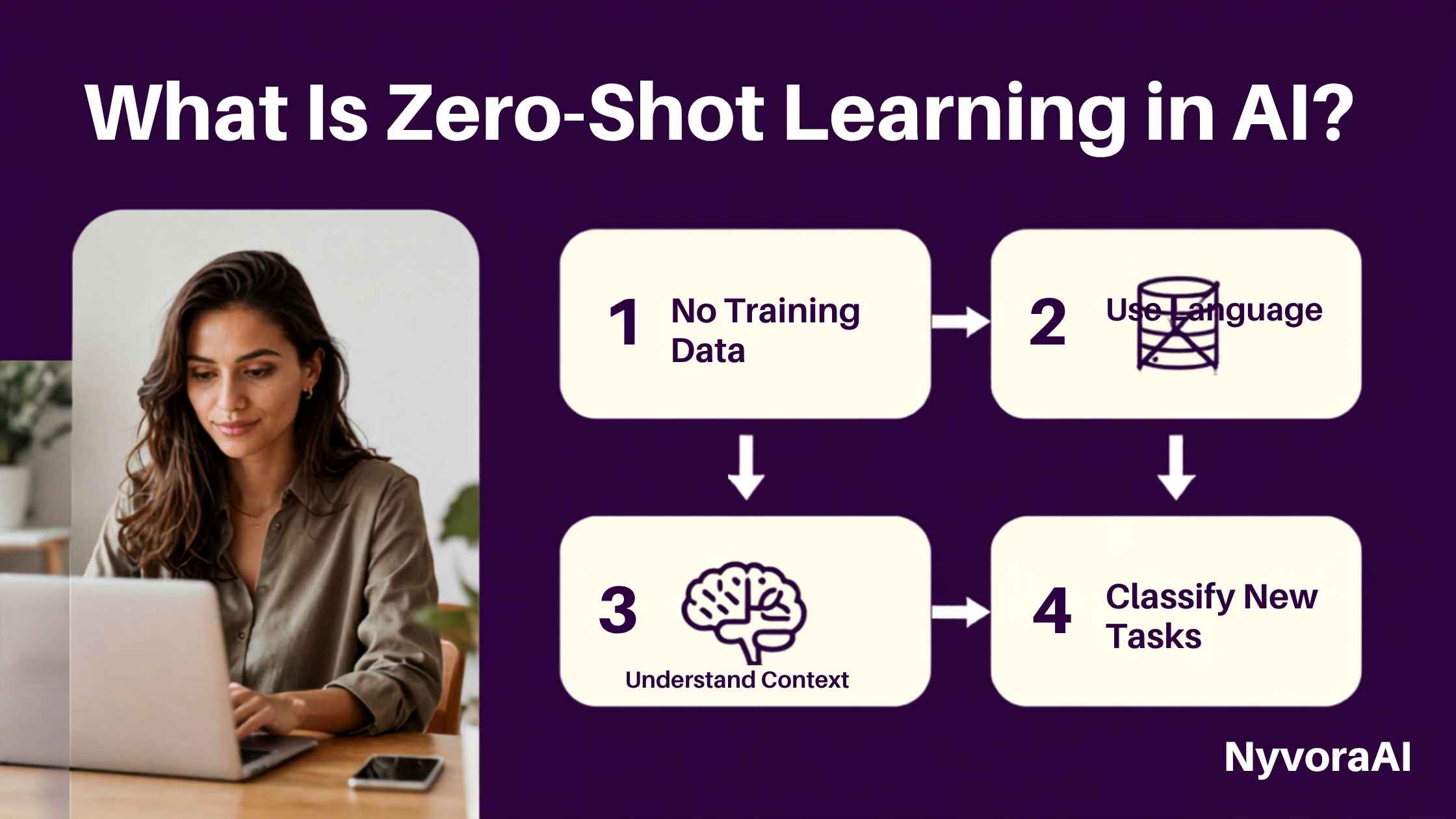
当模型处理一项从未被专门训练过的工作时,表面之下会发生这些:
03互动演示:亲眼看看零样本分类
下面放着一句模型从未以标注形式见过的示例句。点击控件,看它如何在没有针对此任务之训练样本的情况下选定正确类别。
04零样本、少样本与微调:它在光谱上的位置
零样本学习标记的是一条光谱的一端,而非孤立的技术。一端是完全微调的模型,靠数千个标注样本为单一任务打磨;另一端是零样本,完全没有任务专属样本,只能依靠已有知识。夹在中间的是少样本学习:任务开始前先给模型看寥寥几个例子,往往能把准确率明显抬到零样本之上。
不妨把它框成两种风格迥异的 AI 行为。垃圾邮件过滤器这类系统高度依赖随时间打磨、经过训练的标注模式,我们关于AI 如何检测垃圾邮件的指南有详细说明。另一些则依赖纯粹推断、几乎没有任务专属训练,那就是光谱的零样本一端。如今大多数生产环境中的 AI 其实会根据任务、以及现实中能拿到多少标注数据,把两者混合使用。
这一点也值得与“模型最初如何构建”的更大分歧放在一起理解。我们关于生成式 AI 与判别式 AI 的讲解,剖析了一种相关却不同的划分——创造新内容的系统,与只对既有输入分类或打分的系统——而这会影响一种架构究竟能在多大程度上支持零样本行为。
| 方法 | 所需标注样本 | 典型准确率 |
|---|---|---|
| 零样本学习 | 新任务一个都不需要 | 不错,但通常低于经过训练的方案 |
| 少样本学习 | 寥寥几个,通常 1-10 个 | 明显强于零样本 |
| 微调模型 | 数百到数千个样本 | 最高,但成本高、准备慢 |
| 从零完整训练 | 庞大的任务专属数据集 | 所能达到的最高水平,但对小众任务通常不现实 |
05零样本学习已经出现在哪里
这并非实验室里的稀罕物。零样本能力早已悄悄运行在你很可能用过的产品中:
灵活的聊天机器人
开放词表分类
跨语言翻译
开放集图像搜索
可适应的内容审核
推荐冷启动
把它与那些几乎完全建立在累积行为数据、而非推断之上的系统做个对比。我们对 YouTube 上的 AI 推荐如何运作的拆解,展示了一个高度依赖观看历史的系统,作为有用的反例,帮你看清推断在哪里帮助最大。
06它到底有多准,又在哪些地方仍然吃力?
零样本学习确实有用,却远非魔法,很少能匹敌专门为眼前任务训练或微调过的模型。新任务离任何类似原始训练数据的东西漂得越远,它的表现往往越不稳。
零样本学习仍然不足的地方:
- ✗
高度专门的领域
自带行话的小众技术、法律或科学工作,常常让零样本模型犯糊涂,因为相关模式在训练中只得到稀疏体现。
- ✗
自信却错误的回答
当一个新类别离此前见过的任何东西都太远时,模型仍可能给出听起来很有把握、实则完全错误的回答,且几乎看不出它在猜。
- ✗
模糊的类别定义
如果标签本身措辞含糊、或在意义上相互重叠,模型在把输入与每个选项比对时能抓住的东西就更少。
- ✗
规模化后可靠性较弱
对于每秒处理数千请求的高风险生产系统,这一准确率差距可能转化为数量可观的真实错误。
- ✗
随模型大小而表现不一
较小模型的零样本能力往往明显弱于大模型,因为宽广的推断在规模之下才最有力地显现。
07零样本学习在未来为何重要
它实际的吸引力很朴素:收集和标注数据既慢又贵,对小众或快速变化的任务有时干脆不可能。零样本学习为现实中相当一部分问题移除了这个瓶颈,让一个经过广泛训练的模型,能处理它的构建者从未明确预见到的任务。
简言之,正因为有零样本学习,AI 工具才不那么像僵硬、单一用途的计算器,而更像能在你实际问题所在之处附近与你会合的灵活协作者。
08常见问题
AI 中的零样本学习是什么意思?
零样本学习实际上如何运作?
零样本学习和少样本学习有何区别?
零样本学习在现实中的例子有哪些?
零样本学习对 AI 为何重要?
ChatGPT 算零样本学习的一个例子吗?
零样本学习有哪些局限?
零样本学习静静提醒我们:最有用的 AI 飞跃未必总是耀眼的新产品,有时它只是模型训练方式上的微妙转变,却让建立在其上的一切都灵活得多。下次当 AI 在你没有任何特别准备的情况下、处理了一件你没料到它能搞定的任务,背后很可能就是零样本推断。它并不完美,在准确率真正要紧时也替代不了专门训练,但它跻身于最清晰的迹象之列,表明现代 AI 开始更像我们一点地推理:把陌生的东西,与它已经知道的东西联系起来。
Imagine handing someone a picture of an animal they have never once encountered, a pangolin, and hearing the sound reply some form of scaled mammal, drawn purely from general knowledge of scales, mammals, and animals. Pangolins were never part of their training; they reasoned to the answer using everything else already in mind. That image captures the intuition behind one of modern AI's more genuinely striking abilities.
So what does zero-shot learning actually denote? It is the capacity of a trained model to handle a task, category, or case it never encountered while training, supplied with zero labelled examples for that situation. Rather than demanding a dataset assembled solely for the new job, the model extrapolates from the broad knowledge already inside it and applies it to something genuinely novel.
This notion lies at the heart of why today's large language models feel so adaptable. Whenever a chatbot has handled a job its builders never expressly trained it for and still returned a sensible answer, you have watched zero-shot learning at first hand. Our guide on natural language processing (NLP) lays out the language foundations this ability rests upon.
01The Short Answer: Extrapolating Without Fresh Training
Classical machine learning behaves like a student who knows only the precise questions on the study sheet. Show the model a labelled cat photo a thousand times and it recognises cats superbly, yet point it at something never seen labelled and it draws a blank. Zero-shot learning lifts that limit by furnishing, during training, a far richer and more general sense of meaning, broad enough to reason about wholly new categories on the spot.
This grew practical at scale only once models trained on vast, varied datasets rather than narrow, single-task ones. Massive scale is precisely why the ability surfaced when it did, and our piece on AI inference versus training offers useful background: zero-shot capacity is forged during the costly training stage and then invoked almost instantly each time you query the model.
In everyday words, a zero-shot model is not memorising replies; it is recognising patterns of meaning and connection and then carrying that understanding onto something it has never formally studied.
02Step by Step: How Zero-Shot Learning Works
What unfolds beneath the surface when a model handles a job it was never expressly trained for:
03Interactive Demo: See Zero-Shot Classification at Work
Underneath sits a sample sentence the model has never met in labelled form. Move through the controls to watch how it settles on the correct category with no training examples for this precise job.
04Zero-Shot vs Few-Shot vs Fine-Tuned: Its Place on the Line
Zero-shot learning marks one end of a spectrum rather than standing alone. At one extreme sit fully fine-tuned models, schooled on thousands of labelled examples for a single job; at the other sits zero-shot, with no task-specific examples at all and nothing but prior knowledge to lean on. Between lies few-shot learning, where a small handful of examples is shown immediately before the task, often lifting accuracy visibly above the zero-shot case.
It helps to frame this as two contrasting styles of AI behaviour. Systems such as spam filters lean heavily on trained, labelled patterns honed over time, which our guide on how AI detects spam emails details. Others lean on pure extrapolation with little or no task-specific training, the zero-shot end. Most production AI today in fact blends the two according to the task and how much labelled data is realistically within reach.
This is also worth grasping beside the larger split in how models are first constructed. Our explainer on generative versus discriminative AI digs into a related yet distinct division, systems that create new content versus those that merely classify or score what already exists, and this shapes how readily an architecture can support zero-shot behaviour at all.
| Approach | Labelled examples required | Typical accuracy |
|---|---|---|
| Zero-shot learning | None for the new task | Good, yet usually beneath trained alternatives |
| Few-shot learning | A small handful, often 1-10 examples | Visibly stronger than zero-shot |
| Model after fine-tuning | Somewhere between hundreds and thousands of examples | The top tier of accuracy, though preparation is slow and costly |
| Fully trained from scratch | Vast task-specific datasets | The highest attainable, yet rarely practical for niche jobs |
05Where Zero-Shot Learning Already Appears
This is no laboratory curiosity. Zero-shot capacity is already quietly at work inside products you have likely used:
Adaptable Chatbots
Open-Vocabulary Classification
Cross-Language Translation
Open-Set Image Search
Flexible Content Moderation
Recommendation Cold-Starts
Contrast this with systems built almost wholly on accumulated behavioural data rather than extrapolation. Our breakdown of how AI recommendations work on YouTube examines a setup built chiefly around watch history, a helpful contrast when judging where generalization offers the most.
06How Accurate Is It, and Where Does It Still Falter?
Zero-shot learning is genuinely useful yet far from magic, rarely matching a model trained or fine-tuned expressly for the job in front of you. The farther a new task drifts from anything resembling the original training data, the shakier its performance tends to become.
Points at Which Zero-Shot Learning Remains Weak:
- ✗
Highly Specialised Fields
Niche technical, legal, or scientific work carrying its own jargon frequently confuses zero-shot models, since the relevant patterns were sparsely represented during training.
- ✗
Confidently Wrong Replies
When a new category sits too far from anything previously met, the model may still return a confident-sounding reply that is simply wrong, with little sign that it is guessing.
- ✗
Vague Category Definitions
If the labels themselves are worded vaguely or overlap in meaning, the model has less to grasp while measuring the input against each choice.
- ✗
Weaker Reliability at Scale
For high-stakes production systems fielding thousands of requests, the accuracy gap can translate into a meaningful tally of real-world errors.
- ✗
Inconsistent Across Model Sizes
Smaller models tend to show visibly weaker zero-shot capacity than large ones, since broad extrapolation emerges most strongly at scale.
07Why Zero-Shot Learning Matters Ahead
The practical allure is plain: gathering and labelling data is slow, costly, and at times outright impossible for niche or fast-moving jobs. Zero-shot learning removes that bottleneck for a meaningful share of real problems, letting one broadly trained model handle tasks its builders never expressly foresaw.
Put briefly, this capacity helps explain why AI no longer behaves like an inflexible device built for one fixed job; instead it comes across as a versatile partner, ready to meet you somewhere near the actual problem in front of you.
08Frequently Asked Questions
What does zero-shot learning mean in AI?
How does zero-shot learning actually function?
How do zero-shot and few-shot learning differ?
What are real-world zero-shot learning examples?
Why does zero-shot learning matter for AI?
Is ChatGPT an instance of zero-shot learning?
What limits does zero-shot learning carry?
Zero-shot learning is a quiet reminder that the most useful AI leaps are not always flashy new products; sometimes they are a subtle shift in how a model is trained that makes everything built above it far more adaptable. So when an AI next pulls off something you assumed lay beyond it, and you supplied no preparation of your own, the likely explanation is zero-shot generalization. The effect is imperfect, and wherever accuracy genuinely matters it cannot take the place of dedicated training. Even so, it stands among the clearest hints that present-day AI is edging toward a more human style of reasoning: tying whatever seems novel back to knowledge it already holds.