Grivn/mnemon-memory-agent
Long-term memory for AI agents on Jev. Keep raw records, judge them with a fast System 1 model and answer from under 4k tokens of context.
Project Overview项目介绍
Mnemon is a research snapshot of a long-term memory agent for LLM assistants that splits question answering into two systems modeled on dual-process cognition. A fast decision model called Jev performs many small independent yes/no judgments over retrieved records, while an LLM acting as System 2 writes a few search queries, names what the reply needs, and composes the final answer. The system runs as a second instance of DeepSeek Harness (DSH) alongside the main agent, which it leaves unchanged, and publishes one View per turn; its code will be migrated step by step into the official mnemon and dsh-mnemon product repositories.
The intended workflow begins when a user asks a question: System 2 produces search queries against raw, dated conversation records, System 1 screens and judges each candidate in roughly a third of a second per judgment, and the loop continues until enough evidence satisfies the named needs, after which System 2 composes the answer. A background consolidation pass indexes each record once so that questions about an entire conversation can reach evidence their own searches would otherwise miss. The project targets researchers and engineers studying agent memory, context engineering, and dual-process architectures who want to reproduce the published numbers on LoCoMo, LongMemEval-S, and BEAM.
Installation relies on the frozen lockfile, followed by kernel and plugin builds and the full plugin test suite of 223 tests, after which the documented smoke run answers both benchmark questions. Dependencies include the DeepSeek Harness kernel, the Jev decision model, and gpt-4.1-mini or DeepSeek-V4.1-Flash as the answering LLM. The source code is MIT-licensed under dsh-mnemon, but benchmark texts retain their own licenses (LoCoMo CC BY-NC 4.0, BEAM CC BY-SA 4.0, LongMemEval MIT), and HaluMem run records are excluded because CC BY-NC-ND 4.0 forbids redistribution; the manuscript itself is all rights reserved. The repository is explicitly not the mnemon CLI and not a release of the dsh-mnemon package, and integrity is checked via tools/audit.py over the working tree and full history.
Mnemon 是一个面向 LLM 助手的长期记忆智能体研究快照,以双过程视角拆分问答阶段:System 1 由 Jev 决策模型对检索结果批量独立做小型判断,System 2 由 LLM 生成查询、命名需求并合成最终回复。它以 DeepSeek Harness(DSH)的第二个实例并行运行于主智能体旁,发布每次回合的视图,不修改主智能体本身;系统代码将逐步迁入官方 mnemon 与 dsh-mnemon 仓库。
典型流程是:用户提问时由 System 2 写出若干查询、检索原始带时间戳的对话记录,System 1 在毫秒级逐条判断"是否采用""是否仍有效""是否满足某一证据需求",不满足则再次检索,直到凑齐依据再合成答案;后台合并过程将每条记录单次写入索引,使整段对话的提问能命中自身搜索遗漏的证据。目标用户是研究 LLM 代理长期记忆、上下文工程与双过程架构的开发者与评测者。
依赖方面需使用冻结 lockfile 安装、构建内核与插件,并通过 223 项插件测试;运行示例为对 BEAM-100K 到 BEAM-10M 等数据集的复现脚本,使用 gpt-4.1-mini 回答。代码采用 MIT 许可,但 LoCoMo(CC BY-NC 4.0)、BEAM(CC BY-SA 4.0)、LongMemEval(MIT)等基准文本各自独立许可,HaluMem(CC BY-NC-ND 4.0)运行记录未随仓库分发;论文稿件版权保留,使用 tools/audit.py 验证来源一致。本仓库不是 mnemon CLI,也不是 dsh-mnemon 的发布版本。
请帮我安装这个 DSH 插件。安装前先完成【兼容性检查 + 安全性检查】,检查通过再动手。

插件:mnemon-memory-agent(Grivn/mnemon-memory-agent)
仓库:https://github.com/Grivn/mnemon-memory-agent
本站详情页:https://www.yhbd.top/plugins/grivn-mnemon-memory-agent/
本站登记:类型 plugin · 归类 原生 DSH 插件 · 许可证 MIT · ⭐ 4 · 最近提交 2026-09-30 · 主语言 TypeScript

按下面顺序执行,每步先把结论告诉我,再进入下一步:

【1 兼容性检查】
① 我这边:DSH 版本、Node 版本、操作系统、当前 profile(web / desktop)。
② 读它的 README、package.json、插件 manifest,列出它要求的 DSH 版本 / Node 版本 / 操作系统 / 外部依赖 / 需要另外先装的运行时。
③ 逐条比对,结论只写「满足 / 不满足 / 未知」三种;不满足的给出可行替代方案。
④ 检查是否和我已装的插件冲突:命令名重复、skill / tool 重名、端口占用、重复注册的 MCP server。

【2 安全性检查】
① 仓库可信度:和上面「本站登记」是否一致;star / fork 数、创建时间、最近提交,是否归档或长期停更。
② 安装脚本:逐行看 package.json 的 preinstall / install / postinstall,以及 install.sh、setup.ps1 之类脚本。出现 curl|bash、下载后直接执行、混淆代码、访问与插件功能无关的域名,立刻停下来告诉我,不要继续装。
③ 依赖:列出新增依赖,标出无人维护、或与知名包拼写近似的可疑包(typosquatting)。
④ 权限与副作用:它会读写哪些目录、访问哪些域名、需要哪些 DSH 权限(filesystem / network / shell / clipboard 等),以及怎么卸载和回滚。
⑤ 如果它要求 sudo / 管理员权限,或权限明显超出功能所需,先停下来问我。

【3 安装】
上面两步没有「不满足」和「高危项」时才执行;用官方推荐方式安装,不要自行提权。

【4 汇报】
用表格输出:检查项 / 结论 / 依据 / 是否需要我决策。拿不准的一律写「未知」并说明要我怎么确认——不要猜,也不要替我决定。
Send this message to DSH in your current session: it verifies compatibility and security first (answering met / not met / unknown item by item) and only installs once everything checks out — it will stop and ask you if it finds a high-risk item. The box scrolls; the copy is the full prompt. CLI install commands may not be accurate across systems, so DSH is the safer route.把上面这条消息直接发给当前会话里的 DSH:它会先核对兼容性与安全性(逐条给「满足 / 不满足 / 未知」),确认没问题再安装,有高危项会停下来问你。框内可滚动,复制到的是完整提示词;安装命令不一定准确,发给 DSH 更稳。
- Only 4 stars - very few users, little community feedback星标只有 4,几乎没人在用,遇到问题缺少社区反馈
DSH walks through these 9 checksDSH 会逐条核对这 9 项
Compatibility兼容性
- DSH, Node, OS and profile requirementsDSH 版本 / Node 版本 / 操作系统 / profile 是否满足要求
- External dependencies and runtimes (Electron / Python / Docker, ...)外部依赖与运行时(Electron / Python / Docker 等)是否齐备
- Conflicts with installed plugins: command names, skill / tool names, ports, duplicate MCP registration与已装插件是否冲突:命令名、skill / tool 重名、端口占用、重复 MCP 注册
Security安全性
- Repo matches the facts registered here; archived or abandoned?仓库是否与页面登记一致,是否归档或长期停更
- Safety of preinstall / install / postinstall and install.sh / setup.ps1preinstall / install / postinstall 与 install.sh、setup.ps1 是否安全
- curl|bash, download-then-execute, obfuscation, unrelated domains → stop immediatelycurl|bash、下载即执行、混淆代码、无关域名 → 立刻停止
- Typosquatting or unmaintained packages among the new dependencies新增依赖里有没有 typosquatting 或无人维护的包
- Requested permissions vs. what the feature actually needs申请了哪些权限、是否超出功能所需(filesystem / network / shell / clipboard)
- Any sudo / admin requirement, plus uninstall and rollback是否要求 sudo / 管理员权限,以及卸载与回滚方式
Anything uncertain must be marked unknown with a note on how to confirm it. This site's signal screen is a static snapshot, not a security audit.拿不准的必须标「未知」并说明要我怎么确认。本站的信号筛查是静态快照,不能替代安全审计。
Or use CLI install (for developers)或使用命令行安装(适合开发者)
CLI Install命令行安装
dsh plugin --profile web add github:Grivn/mnemon-memory-agent把 Grivn/mnemon-memory-agent 加入你的 DSH 配置(web profile)即可启用。
READMEREADME
Mnemon
Raw Records, Fast Judgments, Slow Thoughts


Paper · Results · Reproduce · Run · 中文
Mnemon is a long-term memory agent for LLM assistants. It keeps conversations as raw, dated records and does its work when a question arrives, dividing that work the way dual-process accounts divide thinking. A fast decision model (System 1) makes many small yes/no judgments about the records the searches return. An LLM (System 2) writes a few search queries, names what the reply needs and composes the answer. A background pass consolidates each record once into an index that points back to the records, so that questions about a whole conversation reach evidence their own searches miss. The results of this research will be brought step by step into the official projects mnemon and dsh-mnemon (see From research to product).
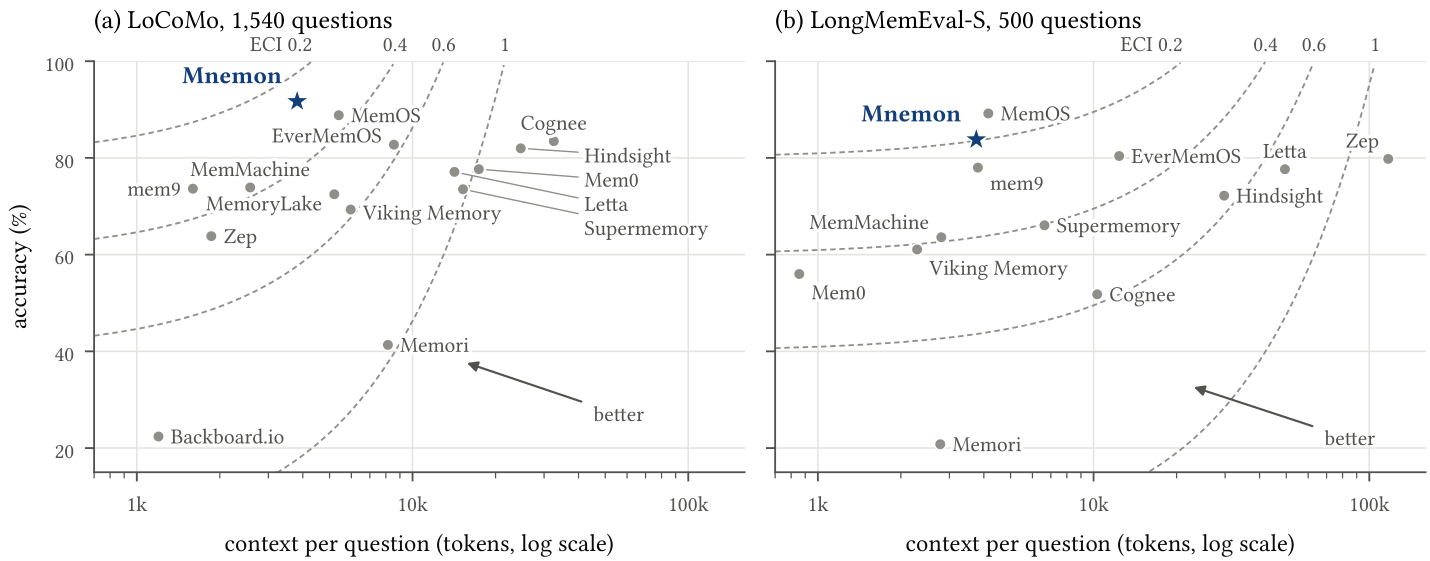
Accuracy against the context sent to the answering model per question. Mnemon (star) and the 14 systems re-evaluated by OmniMemEval all use gpt-4.1-mini to answer. Dashed lines join points of equal effective cost index; up and to the left is better.
Highlights
- Most accurate on LoCoMo, from under 4k tokens of context. Compared with the 14 systems OmniMemEval re-evaluated, all with gpt-4.1-mini answering, Mnemon scores 91.7% on LoCoMo (first of 15 systems) and 83.8% on LongMemEval-S (second of 13). It sends the answering model about 3.8k tokens per question. It is the only system above 80% on both benchmarks below 4k tokens.
- Lowest effective cost index on LoCoMo: 0.259, against 0.337 for the next system.
- On par with the best published results on LongMemEval-S. With DeepSeek-V4.1-Flash as System 2, Mnemon reaches 94.4% on LongMemEval-S and 92.2% on LoCoMo (95.3% on revised labels).
- Bounded cost at 10M tokens. From BEAM-100K to BEAM-10M, with 80 times as many records, the cost per question grows by a factor of 1.11, and the work on a question's critical path stays about the same.
- System 1 judges better. On the same 14,359 records, Jev separates gold evidence with an AUC of 0.942. DeepSeek reaches 0.900 and gpt-4.1-mini 0.853, at 3–11 times Jev's latency.
- Raw records beat a write-time graph built by the same model. Under one protocol, Jev-Mem, which uses Jev to organize memory into a graph as turns are written, scores 84.4% on LoCoMo against Mnemon's 91.7% (7.3 points, 95% CI 5.5–9.2).
Showing the opening section of the README — the full document lives in the repository以上为 README 开头摘要,完整文档在仓库内 · View the full README on GitHub →在 GitHub 查看完整 README →
Related相关推荐
-
 vshulcz/deja-vu
The most accurate, cheapest and fastest memory for coding agents: searchable session history from Claude Code, Codex, Cu…
vshulcz/deja-vu
The most accurate, cheapest and fastest memory for coding agents: searchable session history from Claude Code, Codex, Cu…
-
 adoresever/graph-memory
Deepseek Harness、Openclaw知识图谱记忆插件。2026年4月受邀发布在清华大学讨论会。Knowledge Graph + Memory;Knowledge Graph Context Engine for OpenCl…
adoresever/graph-memory
Deepseek Harness、Openclaw知识图谱记忆插件。2026年4月受邀发布在清华大学讨论会。Knowledge Graph + Memory;Knowledge Graph Context Engine for OpenCl…
-
 mnemon-dev/mnemon
LLM-supervised persistent memory for AI agents — graph-based recall, cross-session knowledge, single binary. Works with …
mnemon-dev/mnemon
LLM-supervised persistent memory for AI agents — graph-based recall, cross-session knowledge, single binary. Works with …
-
 Phant0Meow/dsh-meow-memory
Cross-session memory plugin for DeepSeek Harness: seven-layer SQLite store (soul/user/project/fact/lesson/topic/rules), …
Phant0Meow/dsh-meow-memory
Cross-session memory plugin for DeepSeek Harness: seven-layer SQLite store (soul/user/project/fact/lesson/topic/rules), …
-
 slow-stack/mneme
🧠 The memory that dreams — cross-session memory for DeepSeek Harness. Offline & private, auto-consolidates in its sleep…
slow-stack/mneme
🧠 The memory that dreams — cross-session memory for DeepSeek Harness. Offline & private, auto-consolidates in its sleep…
- hg1048596-pixel/dsh-recall-unread DeepSeek Harness (DSH) 插件:在模型读取前撤回已发送的文字消息,支持单条与全部撤回。A DeepSeek Harness plugin that recalls sent-but-unread text message…
- Tasihi89/dsh-talk-map Visual conversation map for DeepSeek Harness — sessions as cards on a whiteboard: drag to arrange, double-click to chat,…
-
 Aik358/dsh-auto-memory
Proactive associative memory for DSH: system-prompt recall before the model speaks, three-layer auto-consolidation, skil…
Aik358/dsh-auto-memory
Proactive associative memory for DSH: system-prompt recall before the model speaks, three-layer auto-consolidation, skil…