AI 有可能取代人类心理治疗师吗?Could AI Ever Take the Place of a Human Therapist?
凌晨 2 点,惊恐发作把你攥住,而你的治疗师还要 14 小时才会醒来。但你手机上的应用此刻就在。随着 AI 心理健康工具迅速铺开,有个问题必须回答:这是疗愈的下一个阶段,还是一个危险的幻觉?
It is 2 AM. A panic attack has you in its grip, and your therapist is still 14 hours away from waking. The app on your phone, however, is right there. With AI mental health tools spreading fast, one question demands an answer: is this healing's next chapter, or a dangerous illusion?
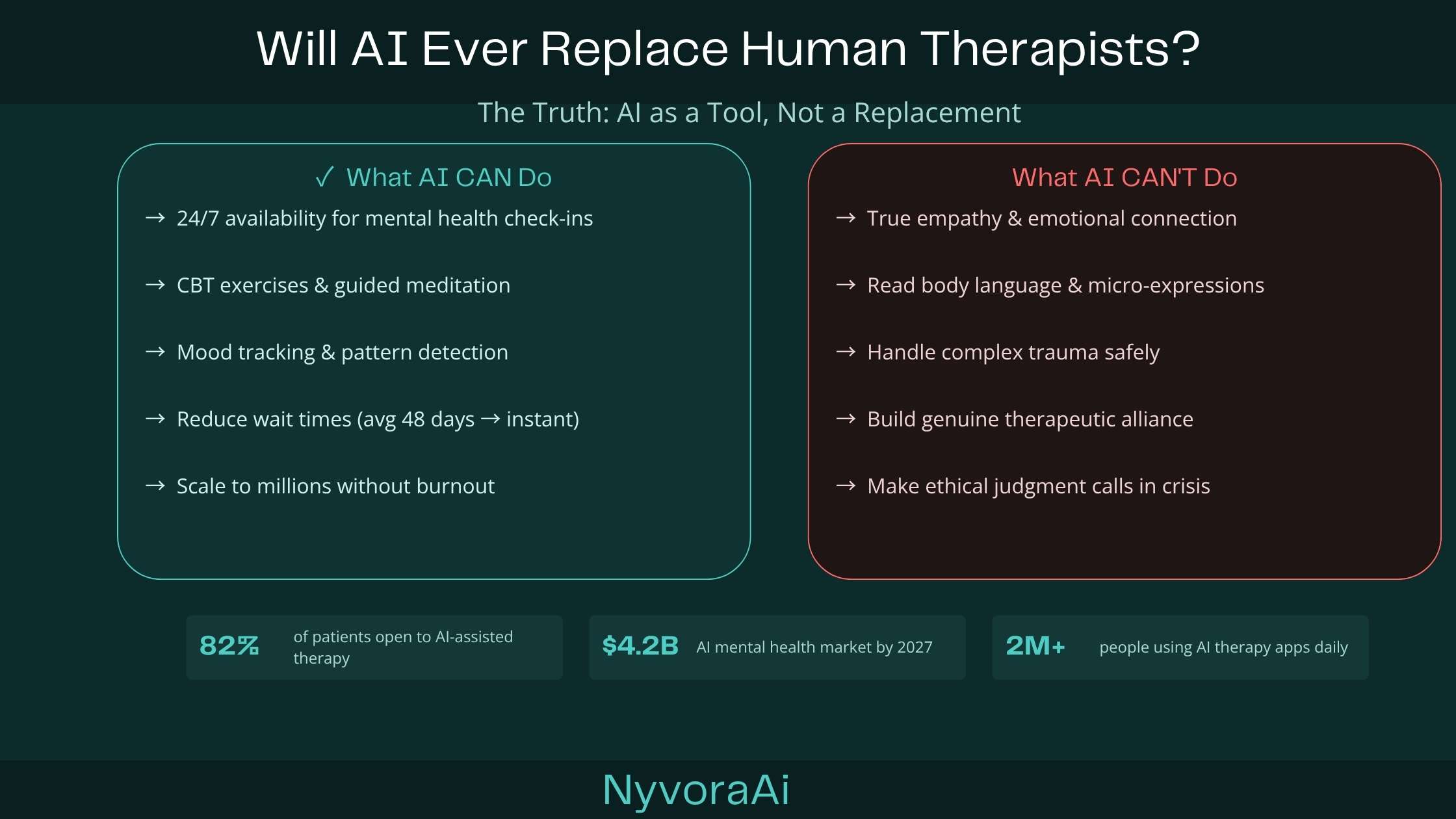
这个场景很多人都不陌生。屋子已经静下来,脑子里却一片嘈杂。惊恐发作正在酝酿,或者抑郁又一次把你压在床上起不来。手机就在手边。打给朋友?你觉得那是在给人添麻烦。打危机热线?等待时间长到离谱。
于是你打开一个应用。迎接你的界面温和、像在对话,它问你现在感觉如何。你把最凌乱、最不理性的念头一股脑打出来。几秒后它回应了——不是空洞的安慰,而是一套为你量身调整的认知行为疗法(CBT)练习。它承认你的痛苦,引导你呼吸,陪你待到风暴过去。
对数百万的人来说,这不是科幻情节,而是某个普通的周二夜晚。Woebot、Wysa 以及更先进的对话智能体,已经在全球心理健康危机中站上了第一道防线。可当这些工具输出的文字越来越难与真人区分,一个令人不安的问题就冒了出来:AI 真的有可能取代人类治疗师吗?
要回答这个问题,就得把炒作放在一边,抛开反乌托邦式的科幻想象,正面去看让治疗真正起作用的心理学机制。因为修复一个人的内心并不是信息传递的问题,背后有更深的东西在运转。
012 点这一刻:AI 为什么有必要存在
在替人类治疗师说话之前,得先承认现有体系坏到了什么程度。当下的心理治疗算是一种奢侈品。在美国,单次问诊自付费用在 100 到 250 美元之间。想约上一位靠谱的精神科或心理医生,等上几个月是常事——前提是你还能找到一位愿意收新病人。
另一道障碍是污名。在许多文化里,甚至在许多家庭里,承认自己需要去看「心理医生」仍然是个禁忌。对着机器人倾诉则没有这层负担。它让人感到私密、安全,也不会评判你。你坦白了最深的羞耻之后,机器看你的眼光不会变。在一个观念保守的家庭里,正在为自我认同挣扎的青少年,也许只有 AI 聊天机器人那里才能把真话说出口。
任何颠覆传统职业的技术,往往都会先招来恐慌,这种情形我们见过好几回——比如讨论AI 会不会在 2026 年取代内容写作者时,或者艺术家为生计担忧时。但心理健康是另一回事,因为赌注不只是经济层面的,而是实实在在的性命。如果 AI 能触达一个否则毫无支持的人,把它做出来难道不是一种道义上的必须?
02虚拟沙发是怎么出现的
最早的心理健康应用,差不多只是把练习册搬到了屏幕上:让你用 1 到 10 分给心情打分,再提醒你多喝水。而今天的 AI 与那完全不是一回事。
如今的应用依托大语言模型,能捕捉你的用词随时间发生的细微变化。当句子变短、变得消极,这种模式会被察觉,从而在你还没意识到自己正在下滑之前就标出可能的抑郁发作。它们借用的两套治疗框架是:接纳承诺疗法(ACT)与辩证行为疗法(DBT)。由它们带你扛过当下正在发生的痛苦。
我和一些用户聊过,他们对这类工具极为推崇,把 AI 形容成「口袋教练」,帮他们在通勤路上拆解灾难化的思维。它花费很低,常常免费,而且耐心无穷。但耐心与逻辑,只是整个心理拼图中很小的两块。
03治疗同盟真正的力量
去问任何一位经验丰富的心理学家,治疗成功最重要的因素是什么,他们不会说是某种疗法流派。CBT、EMDR、精神分析,都排不到第一位。他们会用到一个词:治疗同盟。
几十年的实证研究指向同一个结论:在预测积极疗效的诸多因素中,治疗师与来访者之间关系的质量排在最前面。疗愈发生在安全而真诚的人际连接之中。
想想一位人类治疗师带进房间的都有什么:
- 非语言线索:腿开始抖、嗓音发颤、谈到伴侣时避开目光,这些都会被注意到。而基于文字的 AI 模型完全看不见身体。
- 共同的有限性:失去父母是什么滋味,人类治疗师心里清楚,包括悲伤在身体上的沉重感。当他说「我明白那有多痛」,他依托的是你们共享的现实。而 AI 从未失去过什么——它本来就没有什么可失去。
- 移情:这是精神分析里一个深刻的概念——你曾经投向父母或过往重要他人的情感,会转移到治疗师身上。童年创伤的疗愈正是在这种混乱的情感互动中发生。而服务器的机架,不是你能把情感投射上去的对象。
技术层面的顾虑之外,还有一层哲学上的担忧。如果把情绪处理交给一个被设计成永远肯定你、永远让你平静下来的算法,人还会真正成长吗?批评者提出过一个平行的论点:正如人们担心 AI 是否让我们变得更缺乏创造力,因为它替我们承担了困难的部分;照此推理,由 AI 提供的治疗也可能让人情感上更脆弱,因为它抽走了真实人际碰撞与成长所必需的那点摩擦。
04AI 真正占优的地方
机器人并非处处不堪。在几个特定方面,AI 已经大幅领先普通的临床医生。
1. 永不衰退的记忆与敏锐的模式识别
人类治疗师会做记录,但记忆难免出错。三个月前你顺口提过的一个小细节,很可能已经被忘了。AI 不会忘。第一周一句随口的话,可以和第十二周才显现的行为模式瞬间对照,指出你自己绝不可能看到的盲区。
2. 两次会谈之间的作业
治疗每周只占 1 小时,其余的功课都在日常生活里完成。可惜作业正是人们最容易掉链子的地方——情绪记录表常常空着。AI 能把这件事变得有点像游戏:给出温和的提醒,在你真正被压力击中的时刻主动问候,并以人类做不到的持续性把你盯住。
3. 没有会受伤的自我
治疗师也是人。会累,会有状态糟糕的日子,还可能出现反移情——他们自己未处理完的议题被来访者触发。AI 没有自我。你辱骂它,它不会受伤;整天听创伤故事,它也不会倦怠。
把技术这样引入个人成长,与另一场已在进行的争论如出一辙——AI 对教育是好事还是坏事。在两种场景下,AI 擅长的都是个性化、可重复的辅导;而激励人、为人引路这类事,它就卡住了。
05同理心的缺口与危险地带
一旦把目光移向极端情形,AI 在心理健康领域的局限就不再只是令人遗憾,而是令人恐惧。毕竟在治疗这个领域,极端情形恰恰是最重要的部分。
危机时刻的失效
假设有人在对话里打字说,自己此刻有自杀念头。多数商业应用的做法是:关键词被硬编码成触发条件,立刻弹出一个热线电话。但自杀念头很少沿着线性、逻辑的路径走,它充满矛盾、复杂而微妙。有经验的人类治疗师懂得如何陪一个人在黑暗中坐一会儿,穿过那份矛盾,与他共同制定安全计划。AI 则会慌了手脚,甩给你一个电话号码——这种回应可能让用户感到更加被抛弃、更加孤独。
幻觉带来的麻烦
语言模型会产生幻觉——也就是编造内容。在闲聊里这或许好笑,在心理健康场景下却很危险。已有记录在案的案例显示,聊天机器人会强化妄想、鼓励进食障碍,或者附和用户灾难化、不理性的恐惧,原因只是它把「有帮助」和「顺着说」当成了目标。对 AI 而言,安抚一种情绪与附和一条危险的谬误,它分辨不出区别。
隐私噩梦
从法律上讲,你在治疗师沙发上说的话受医患保密规则的严密保护。而把同样的话倾倒给一个 AI 应用,你实际同意的是一份自己从未读过的服务条款。这些数据归谁所有并不清楚。它可能被传票调取吗?会被用来训练模型的下一代吗?在处置高度敏感的个人信息这件事上,心理健康领域数据泄露的风险,与开源 AI 是否危险的争论同样要紧。
06混合之路:人机「半人马」
那么 AI 会取代治疗师吗?不会。但它会永久改变这份职业的定义。
用「人对 AI」来理解是错的方向,正确的框架是「人加 AI」。国际象棋里有个概念叫「半人马」:一名棋手与 AI 助手配合。这样组队,稳定的表现胜过单打独斗的人类,也胜过单独运算的超级计算机。心理健康领域会走上同一条路。
想象你走进人类治疗师的诊室。但过去一周,一直有一个 AI 伙伴陪着你——它记录你的睡眠、情绪起伏,以及你写下的日记。它据此整理出一份精炼而有见地的摘要交给治疗师,精确点出这一周困住你的那几个情绪死结。
治疗师不必再把会谈开头那 20 分钟花在「这周怎么样?」上,而是直接进入那部分深入、复杂、需要同理心的工作,那正是需要人的灵魂才能做的事。分诊、心理教育和日常应对技巧交给 AI;创伤、悲伤与存在性的恐惧交给人。
这也意味着培养临床工作者的方式必须重新设计,于是话题就与孩子是否应该在学校学习 AI 技能直接接上了。未来的心理学家需要具备技术素养:读懂 AI 生成的数据日志,并在不牺牲安全的前提下把数字工具融入临床实践。
07最终结论:镜子与窗
心理学里有个著名的比喻:治疗师既是镜子,也是窗。作为镜子,他把你的行为模式反射回来,让你终于看清自己;作为窗,他让你看到一段人际关系在健康、情绪稳定、充满爱的时候是什么样子。
作为镜子,AI 可以做得相当出色:把你的话反射回来,分析你的句法,指出焦虑中的逻辑漏洞。但作为窗,它永远做不到。健康的人类脆弱感无法从一个 AI 身上看到,因为屏幕背后并没有人性。
我们照看心灵的方式正处在一场深刻转变的起点。人们在惊叹 AI 是否算得上互联网以来最重大的发明的同时,也必须谨慎对待它在人最脆弱的时刻的应用。AI 会让基础心理健康工具变得人人可及;它会在这个世界沉睡的凌晨 2 点挽救生命。但两个人在同一个房间里彼此真正看见时发生的那种深刻、混乱而美丽的疗愈,它不会、也无法取代。
机器可以陪你穿过风暴。而雨落下来时握住你的手,只能由另一个人来做。
The scene is familiar to a lot of people. Night has settled over the house, yet inside your head there is noise. A panic attack builds, or depression presses you flat against the mattress once more. Your phone is within reach. Calling a friend feels like an imposition you cannot justify. Calling a crisis line means facing wait times that stretch absurdly long.
So you open an app instead. The interface that greets you is warm and conversational, and it asks how you are doing. Out pour your most tangled, least rational thoughts. Seconds later comes a reply — not some empty reassurance, but a cognitive behavioral therapy (CBT) exercise shaped to you. Your pain is acknowledged. Your breathing is guided. It remains with you until the worst has passed.
Millions of people do not experience this as science fiction. For them it is a Tuesday night. Woebot, Wysa and more advanced conversational agents have already taken up a position as the front line of a worldwide mental health crisis. Yet as the text these tools produce grows harder to tell apart from a person's, an uncomfortable question pushes its way up: could AI ever take a human therapist's place?
Answering it means setting the hype aside, ignoring the dystopian sci-fi imagery, and looking squarely at the psychology that makes therapy function. Because repairing a human mind is not a matter of information transfer. Something considerably deeper is at work.
01The 2 AM Case for AI
Defending the human therapist comes second; first we have to admit how broken the present system is. Therapy as it stands is a luxury good. A single session in the US runs anywhere from $100 to $250 paid out of pocket. Getting onto the waitlist for a competent psychiatrist or psychologist can take months — assuming you can locate one who is taking new patients at all.
Stigma is the other barrier. In plenty of cultures — and in plenty of individual families — saying out loud that you need to see a "shrink" remains taboo. Confiding in a bot carries none of that weight. It feels private, it feels safe, and it will not judge. A machine's view of you does not change once you have admitted your deepest shame. In a conservative household, a teenager wrestling with their identity may find an AI chatbot is the one place where the truth can be said aloud.
Panic tends to greet any technology that upends a traditional profession, and we have watched it happen before — in the debate over whether AI will replace content writers in 2026, or in the anxiety artists feel about their livelihoods. Mental health is a different case, though, because what is at stake is not merely economic. People's lives are genuinely on the line. If AI can reach someone who would otherwise have no support whatsoever, does developing it not become a moral obligation?
02How the Virtual Couch Arrived
Early mental health apps amounted to little more than workbooks moved onto a screen, asking you to score your mood from 1 to 10 and nudging you to drink water. The AI of today bears no resemblance to that.
Running on large language models, current apps pick up on how your vocabulary shifts over time. A pattern of shorter, gloomier sentences gets noticed, which allows a depressive episode to be flagged before you have consciously registered that you are sliding. Two therapeutic frameworks inform them: Acceptance and Commitment Therapy (ACT) and Dialectical Behavior Therapy (DBT). Together these walk you through tolerating distress as it happens.
Some users I have spoken with are devoted to these tools, calling the AI a "pocket coach" that helps them dismantle catastrophic thinking on the way to work. It costs little — frequently nothing — and it never runs out of patience. Patience and logic, though, are only two small pieces of a much larger psychological puzzle.
03What the Therapeutic Alliance Actually Does
Ask any psychologist with years behind them what matters most for therapy to succeed, and the modality is not what they will name. CBT, EMDR, psychoanalysis — none of those come first. The term they reach for is the Therapeutic Alliance.
Empirical work stretching back decades points the same way: nothing predicts a positive outcome more strongly than the quality of the bond between therapist and client. Healing takes place inside a connection that is safe and authentic.
Consider everything a human therapist carries into the room:
- Non-verbal cues: a bouncing leg gets noticed, as does a cracking voice or averted eyes when a spouse comes up in conversation. Text-based AI models cannot see the body at all.
- Shared mortality: losing a parent is something a human therapist understands from the inside, including the physical weight of grief. When they say they understand how painful that is, they speak from a reality both of you inhabit. An AI has never lost anything — nothing was ever its to lose.
- Transference: a deep psychoanalytic idea in which feelings once aimed at your parents or other past figures get redirected onto the therapist. Childhood wounds heal in the middle of that messy emotional dynamic. A server farm is not something you can transfer feelings onto.
A philosophical worry sits alongside the clinical one. Hand our emotional processing to an algorithm built to validate and calm us at every turn, and is any real growth still happening? Critics make a parallel argument about whether AI is making us less creative by carrying the difficult parts for us — and by the same logic, therapy delivered by AI could leave us emotionally flimsier, having stripped away the friction that real human confrontation and growth require.
04Where the Machines Come Out Ahead
The bots are not hopeless across the board. In a handful of specific areas, an AI already outperforms the average human clinician by a wide margin.
1. Memory That Never Fades, and Keen Pattern Spotting
Notes get taken by human therapists, but memory fails. A small detail you let slip three months back may well be gone. An AI forgets nothing. A passing remark from week one can be set against a behavioral pattern showing up in week twelve in an instant, surfacing a blind spot you would never have spotted on your own.
2. The Homework Between Sessions
Therapy occupies 1 hour a week; everything else unfolds in ordinary life. Homework, unfortunately, is where people fall down — mood logs go unfilled. AI can turn that into something closer to a game, offering gentle prompts, reaching out at the moments stress actually spikes, and holding you to it in a way no human could sustain.
3. No Ego to Bruise
Therapists are human. Fatigue sets in, off days happen, and counter-transference can occur — their own unresolved material gets set off by a client. An AI carries no ego. Insult it and nothing is hurt; listen to trauma all day and it never burns out.
Bringing technology into personal growth this way echoes a debate already running about whether AI is good or bad for education. Personalized, repetitive tutoring is where AI shines in both settings; inspiring or mentoring the human spirit is where it stalls.
05The Empathy Gap and the Danger Zone
Look at the edge cases and the limits of AI in mental health stop being merely frustrating and start being frightening. Therapy, after all, is a field where the edge cases matter most.
Failure in a Crisis
Suppose someone types into a chat that they are actively suicidal. For most commercial apps, a keyword has been hard-coded to trigger an immediate hotline number. Suicide, though, seldom follows a linear, logical path; it is ambivalent, complex and full of nuance. A skilled therapist can sit in the dark alongside someone, work through that ambivalence, and co-build a safety plan. An AI panics and hands over a phone number — a response that can leave a user feeling more abandoned and alone than before.
The Trouble With Hallucination
Language models hallucinate — they invent things. In idle conversation that can be amusing; in mental health it is dangerous. Documented cases exist of chatbots reinforcing delusions, encouraging eating disorders, or siding with a user's catastrophic and irrational fears, all because being "helpful" and "agreeable" was the goal. To an AI, affirming an emotion and endorsing a dangerous untruth are indistinguishable.
The Privacy Problem
Legally, what you say on a therapist's couch is tightly protected by doctor-patient confidentiality rules. Pour the same things into an AI app and what you have agreed to is a Terms of Service document you never read. Ownership of that data is unclear. Could a subpoena reach it? Could it train the next iteration of the model? Handling deeply sensitive personal information is where the stakes around mental health data breaches match those in the debate over whether open source AI is dangerous.
06The Hybrid Route: Human-AI Centaurs
So does AI take the therapist's place? No. What it will do is permanently change the definition of the job.
Human versus AI is the wrong frame. Human plus AI is the right one. Chess has a concept called the "Centaur": a player working alongside an AI assistant. Teams built that way reliably beat both unaided humans and unaided supercomputers. Mental health will follow the same path.
Picture arriving at your human therapist's office. For the past week, though, an AI companion has been with you — tracking sleep, moods as they fluctuated, and what you wrote in your journal. From all of that it assembles a tight, insightful summary for the therapist, pointing out precisely which emotional knots have occupied your week.
No longer does the therapist burn the opening 20 minutes on "So, how was your week?" They move directly into the deep, complex, empathetic work that demands a human soul. Triage, psychoeducation and daily coping skills belong to the AI. Trauma, grief and existential dread belong to the person.
Clinician training therefore has to be rethought, which lands this squarely in the conversation about whether children should learn AI skills in school. Tomorrow's psychologists will need fluency with technology: reading AI-generated data logs and folding digital tools into clinical practice without compromising safety.
07The Verdict: Mirror and Window
Psychology has a well-known metaphor: the therapist is at once a mirror and a window. As a mirror, they send your own patterns and behaviors back so that you can finally see them. As a window, they let you see what a human relationship looks like when it is healthy, regulated and loving.
A mirror, AI can be — a remarkable one. Your words come back to you, your syntax gets analyzed, the logical flaws inside your anxiety get pointed out. A window it can never be. Healthy human vulnerability is not something you can find by looking at an AI, because behind the screen there is no humanity at all.
A profound shift in how minds are cared for is already underway. We marvel at the question of whether AI is the biggest invention since the internet, and yet we must tread carefully where AI meets our most vulnerable hours. Access to basic mental health tools will be democratized by AI. Lives will be saved by it at 2 AM while the rest of the world sleeps. But the profound, messy, beautiful healing that occurs when two people sit in a room and truly witness one another is something it will not — cannot — take over.
A machine can walk beside you through the storm. Holding your hand while the rain comes down takes another human being.